In the first half of 2025, investments in the Chinese semiconductor industry overall decreased by 9.8 percent compared to the previous year. However, spending on production equipment in chip manufacturing simultaneously increased by over 53 percent despite the general decline.
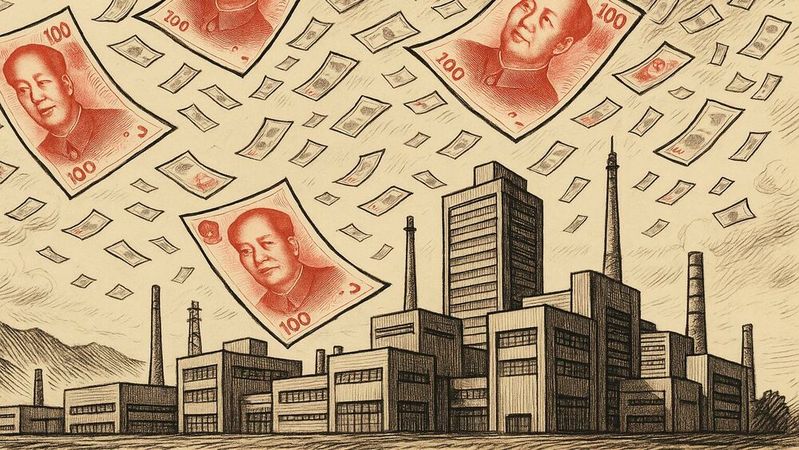
The long-term impact of state-led initiatives to promote high-tech industries is continually demonstrated in China. (Symbolic image)
(Image: Dall-E / AI-generated)
Equipment is currently the only sub-sector of the Chinese semiconductor industry that continues to grow despite the global downturn. The reason is China's efforts to counter semiconductor and technology embargoes from Washington and to produce its own chips in higher performance classes as quickly as possible.
Although China began systematically modernizing its domestic industries about a decade ago, the push toward high-tech is now accelerating significantly. Most analysts attribute the current equipment boom to increasing external pressure from the United States, which countries like the Netherlands (ASML) and Japan have reluctantly joined at Washington's urging.
Export control – the double-edged sword
The export controls imposed by the USA and its Western allies on semiconductors, lithography machines, and EDA software act like a double-edged sword. On the one hand, they temporarily restrict China's access to cutting-edge technologies, but at the same time, they have triggered a new investment boom in China, which in the long term favors the catch-up efforts of Chinese chip and equipment manufacturers compared to their Western competitors.
Large state investment funds in the People's Republic, led by the national "Big Fund," as well as local special funds, are specifically channeling capital into research and development of chip manufacturing equipment along the entire supply chain. New in the current round of "Big Fund III" is a stronger focus on particularly high-performance chips.
A wave of new chip factories in China is driving up demand for equipment. This combination of strategically well-directed financial injections and very strong demand is currently giving many Chinese manufacturers a better chance to catch up technologically with foreign competitors.
Clearing bottlenecks out of the way
After previously distributing its investments generously across various sectors, the Beijing government is now focusing more on targeted efforts to eliminate existing "bottlenecks" in domestic industries. At the same time, technological breakthroughs are to be enabled, the Chinese market research agency Huashang Guangdian Keji (CINNO) writes in an analysis of the semiconductor market.
"This development model based on the principle of 'sanction – pressure – breakthrough' is fundamentally changing the global landscape for semiconductor equipment. China is transforming from a passive recipient to an active innovator. While there are still bottlenecks in key technologies such as lithography systems, sustained investments in research and development, as well as coordinated innovations along the entire supply chain, are strengthening the foundations for future technological breakthroughs," writes CINNO.
This pattern becomes very clear when looking more closely at the individual segments where investments have flowed this time. For instance, strong growth was recorded in the "third-generation semiconductor materials" segment. These received 16.2 billion yuan (around €1.9 Billion/$2.1 Billion), accounting for 27.3 percent of total investments in materials equipment.
It is evident from such details that China is no longer content with manufacturing relatively simple "legacy chips" as before, but is increasingly aiming to produce new SiC and GaN chips. These will be needed for RF devices for 5G and 6G base stations, control units for electric drives, and other future technologies. Additionally, compared to previous years, investments in the "electronic specialty gases" segment have noticeably increased, accounting for 19.3 percent of all investments in the "materials" category this time. This also indicates a strategic shift in China's production toward higher-quality, more powerful chips.
The beneficiaries of the subsidies
Even the regional distribution of investments within the country reveals China's strong push toward modernization to insiders. For example, the inland province of Hubei was able to advance to fifth place among the leading investment recipients for the first time, as the regional government there is promoting a world-class "Science and Technology" cluster in the semiconductor sector. Among other developments, new capacities for modern memory chips are currently being established there.
In terms of regions, Jiangsu, Shanghai, Zhejiang, and the capital Beijing occupied the top four spots. Semiconductor clusters are also rapidly expanding there, where Chinese state-owned enterprises and start-ups, together with research institutes and the regional government, are working on developing the "new, high-quality productive forces," the promotion of which Beijing has declared a matter of national security in response to the US sanctions.
Date: 08.12.2025
Naturally, we always handle your personal data responsibly. Any personal data we receive from you is processed in accordance with applicable data protection legislation. For detailed information please see our privacy policy.
Consent to the use of data for promotional purposes
I hereby consent to Vogel Communications Group GmbH & Co. KG, Max-Planck-Str. 7-9, 97082 Würzburg including any affiliated companies according to §§ 15 et seq. AktG (hereafter: Vogel Communications Group) using my e-mail address to send editorial newsletters. A list of all affiliated companies can be found here
Newsletter content may include all products and services of any companies mentioned above, including for example specialist journals and books, events and fairs as well as event-related products and services, print and digital media offers and services such as additional (editorial) newsletters, raffles, lead campaigns, market research both online and offline, specialist webportals and e-learning offers. In case my personal telephone number has also been collected, it may be used for offers of aforementioned products, for services of the companies mentioned above, and market research purposes.
Additionally, my consent also includes the processing of my email address and telephone number for data matching for marketing purposes with select advertising partners such as LinkedIn, Google, and Meta. For this, Vogel Communications Group may transmit said data in hashed form to the advertising partners who then use said data to determine whether I am also a member of the mentioned advertising partner portals. Vogel Communications Group uses this feature for the purposes of re-targeting (up-selling, cross-selling, and customer loyalty), generating so-called look-alike audiences for acquisition of new customers, and as basis for exclusion for on-going advertising campaigns. Further information can be found in section “data matching for marketing purposes”.
In case I access protected data on Internet portals of Vogel Communications Group including any affiliated companies according to §§ 15 et seq. AktG, I need to provide further data in order to register for the access to such content. In return for this free access to editorial content, my data may be used in accordance with this consent for the purposes stated here. This does not apply to data matching for marketing purposes.
Right of revocation
I understand that I can revoke my consent at will. My revocation does not change the lawfulness of data processing that was conducted based on my consent leading up to my revocation. One option to declare my revocation is to use the contact form found at https://contact.vogel.de. In case I no longer wish to receive certain newsletters, I have subscribed to, I can also click on the unsubscribe link included at the end of a newsletter. Further information regarding my right of revocation and the implementation of it as well as the consequences of my revocation can be found in the data protection declaration, section editorial newsletter.
It is this combination of continued substantial investments in the Chinese semiconductor industry, even amidst a cyclical weakness in the global chip industry on the one hand, and the emergence of a unique innovative ecosystem on the other, that is driving an increasing number of technological breakthroughs by domestic Chinese semiconductor manufacturers.
Competition for Western equipment manufacturers
Chinese equipment manufacturers are also making significant technological progress. Companies like NAURA Technology and AMEC (Advanced Micro-Fabrication Equipment) have, in the view of many observers, now reached international top standards in key areas such as etching systems and thin-film coating equipment. Both are state-owned enterprises and can therefore count on the particular favor of the central government in Beijing.
New players, such as Huawei's equipment subsidiary SiCarrier, are also making a strong push into the market. Due to the investment surge in China, these companies are currently growing faster than many Western competitors. In areas where significant gaps still exist in the Chinese semiconductor supply chains, targeted investments are now set to intensify following a realignment of the "Big Fund III." The Big Fund is China's centrally managed investment program aimed at expanding its semiconductor industry with capital from public and private investors.
The current gaps also include the production of their own lithography machines, with the aim of one day overcoming the dominance of the Dutch company ASML and Japanese providers. A third segment where even more investments are now expected compared to before is the field of software for chip design (EDA or Electronic Design Automation), where U.S. companies like Cadence and Synopsys are currently leading.
From Beijing's perspective, EDA is another Achilles' heel of the Chinese semiconductor industry that urgently needs strengthening. The third edition of the Big Fund is still preparing its first major investments, but initial speculations have already leaked into the Chinese trade press. If the targeted capital of 344 billion yuan (approximately 41 billion euros) can be fully allocated, "Big Fund III" would be the largest Chinese semiconductor fund ever. The mandate is clear: China aims to achieve technological self-sufficiency in an increasing number of critical areas of semiconductor manufacturing and reduce its dependency on U.S. imports as quickly as possible. (sb)



:quality(80)/p7i.vogel.de/wcms/51/80/5180c4de993e1b059628f21fcb09237d/0132213451v1.jpeg "On the granite plate (top) stands a machine or testing system that is to be decoupled from vibrations. The inductive distance sensor (middle) continuously measures the distance to the granite plate (the target is a fixed steel disc). Supplied with these values, the controller quickly and precisely adjusts the level of the air spring (right). (Image: Baumer)")
:quality(80)/p7i.vogel.de/wcms/1a/f8/1af8bd935c6b41c436b69fc31683d862/0132154064v1.jpeg "Berg Spanntechnik uses numerous different tool holders from Haimer. (Image:Haimer)")
:quality(80)/p7i.vogel.de/wcms/ea/cf/eacf6467a8caf735571b7fd3b7496167/0113143253v1.jpeg "In our China Market Insider, we regularly provide you with relevant information directly from China. (Image:© Eisenhans - stock.adobe.com)")
:quality(80)/p7i.vogel.de/wcms/1d/5b/1d5bcee2e6539e24af41fd1905186599/0132188566v1.jpeg "China builds by far the most trade ships in the world. However, the USA now plans to impose port fees on Chinese ships, aiming to harm the de facto monopoly. Germany, however, could emerge as the winner, as a study aims to show... (Image: Yangzijiang)")
:quality(80)/p7i.vogel.de/wcms/27/cc/27cc40f8aaa78f54c6b17b74633137c7/aveva-digitales-20ecosystemv1.jpeg "The AI assistant identifies the relevant data and provides a summarized response. If needed, it directly generates a visualization as a dashboard or trend view, which can be saved and shared. (Image: Aveva)")
:quality(80)/p7i.vogel.de/wcms/3f/76/3f76bc2ab37381d97ca277e8cbb23c45/org-blobs-user-response-file-output-ed4732bf-8a80-4c33-adc7-c77521aa836b-plugin-output-nzs2ykoo-1659x934v1.png "(Image:Neurawork AI / Leonardo.ai)")
:quality(80)/p7i.vogel.de/wcms/bb/98/bb989c595d1efacb607eed23def1907e/0131989936v1.jpeg "Agentic AI has great potential for industrial processes but must be carefully implemented. (Image: ©Budi - stock.adobe.com)")
:quality(80)/p7i.vogel.de/wcms/bd/4f/bd4fdab25ba14de84c78c8569a08ef0a/adobestock-774959291-ashrafulislamv1.jpeg "The question arises of how the rapidly growing demand for energy and new technologies can be aligned with the existing infrastructure. (Source: © AshrafulIslam – stock.adobe.com)")
:quality(80)/p7i.vogel.de/wcms/4e/5f/4e5f11d24ccfdfc571168d267b6cb05e/0132244250v1.jpeg "Microsoft reported its first Fairwater data center in Mount Pleasant as fully operational in June 2026. Residents are now complaining about noise pollution from the site. (Image: Microsoft)")
:quality(80)/p7i.vogel.de/wcms/e3/6b/e36be9908dccd076ce4f8ef396cc9286/0132257860v1.jpeg "Lithium-ion batteries, as used in electric vehicles, have a limited lifespan in terms of capacity. However, the Canadian company Battery X Metals has now developed something that restores capacity remarkably well ... (Image:Battery X Metals)")
:quality(80)/p7i.vogel.de/wcms/53/6b/536b0bb25290f40453cf286dddc11ef6/3840x2160v1.jpeg "The so-called \"flapping-wing aerial-aquatic vehicle\" (FAAV) weighs less than 300 grams and is designed to help researchers study the mechanics that allow diving birds to move both in the air and in the water. (Source: Raphael Zufferey)")
:quality(80)/p7i.vogel.de/wcms/6e/10/6e10dcc8df836c65e67c05fad15d1ca8/indexv1.jpeg "With the SIL-HIL co-simulation, D-Space introduces a solution that enables a seamless connection between software-in-the-loop (SIL) and hardware-in-the-loop (HIL) test environments. (Source: dSpace)")
:quality(80)/p7i.vogel.de/wcms/b0/2d/b02dbf6b843ed970952dd2257cef9a48/0132268400v1.jpeg "Largest Mercedes-Benz plant! The Stuttgart automaker has upgraded its plant in Kecskemét, Hungary, with the help of around one billion euros. Ola Källenius' strategy is expected to succeed because production costs in Hungary are drastically lower than in Germany. (Image: Mercedes-Benz)")
:quality(80)/p7i.vogel.de/wcms/22/33/2233791c631e7354a03ed3a1673bda6f/0132258941v1.jpeg "Stellantis has momentum again after the automotive mix company experienced severe slumps. However, its commitment in Europe will be reduced ... (Image:Stellantis)")
:quality(80)/p7i.vogel.de/wcms/4e/51/4e517a7c5e763ce96ee492c7b82da8ea/volvo-truck-s7a2300v1.jpeg "In China, hybrid cars and electric trucks will no longer be exempt from vehicle taxes starting in 2027. (Image:Volvo Trucks)")
:quality(80)/p7i.vogel.de/wcms/81/31/8131a00e0c3a3459c4a68d6427304ad3/0132163682v1.jpeg "The design of the VW drivetrain. The two electric motors are axially arranged, and a multi-plate clutch enables through-drive for parallel operation. (Image:VW)")
:quality(80)/p7i.vogel.de/wcms/bf/6f/bf6f9e5ed076475d15903669223daa4d/0132250184v1.jpeg "Infineon's CoolGaN 100 V transistor family offers high switching performance and power capacity in a compact package. (Image:Infineon)")
:quality(80)/p7i.vogel.de/wcms/1a/dd/1add8d33096e196d5d02a9dc270071d5/0132256041v1.jpeg "Two in one: Forgix is equipped with a microcontroller and an FPGA. (Image:Adiuvo Engineering)")
:quality(80)/p7i.vogel.de/wcms/ab/10/ab103bc3836c066c7dc31469c616f717/0132140113v1.jpeg "Rosenberger offers an entire family of EBM connectors. (Image: Rosenberger)")
:quality(80)/p7i.vogel.de/wcms/93/3a/933a08061632fed0a05e5516dcb08597/0132236352v1.jpeg "The new hybrid aluminum electrolytic capacitors of the HVX (-K) and HTX (-K) series from TAIYO YUDEN are designed for 48 V automotive applications and combine low ESR with high current capability and an operating temperature of up to 135 °C. (Image: TAIYO YUDEN)")
:fill(fff,0)/images.vogel.de/vogelonline/companyimg/76800/76895/65.jpg "FAULHABER_120mm.jpg ()")
:quality(80)/p7i.vogel.de/wcms/08/3b/083b21d1e0e3f391768620fe93047db8/0131690335v1.jpeg "CXMT aims to raise at least 29.5 billion yuan in the planned IPO. The IPO is more than a financial event: China's largest DRAM manufacturer is expected to strengthen the domestic supply of memory chips as the U.S. further restricts access to key technologies. (Image:CXMT)")
:quality(80)/p7i.vogel.de/wcms/a5/ed/a5ed6fda029d362732a293d6b19d74c4/0130444216v1.jpeg "Thirteen executives from the Chinese chip industry have drawn up a plan to achieve an 80% self-sufficiency rate for semiconductors by 2030. (Image:Maxim_Kazmin - stock.adobe.com)")