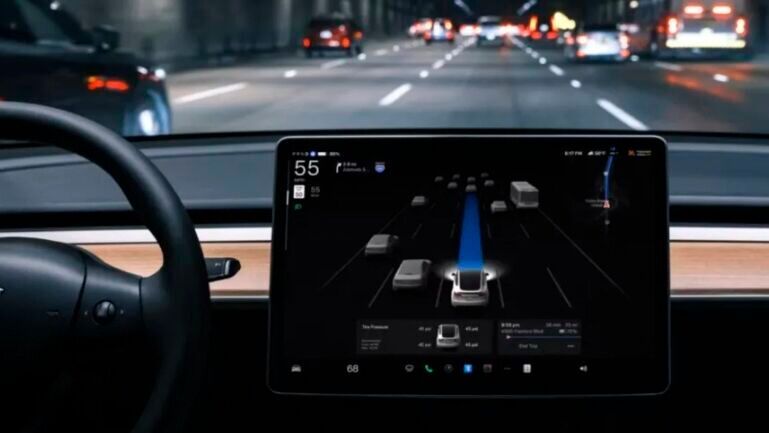
Tesla aims to bring its new version of the driver assistance system FSD to the streets in China later this year. Approval is now targeted for the third quarter of 2026, as Vaibhav Taneja, CFO of the U.S. automaker, told the Reuters news agency. However, this timeline is still not certain.
Tesla wants to bring its new version of the driver assistance system FSD to the streets in China later this year.
(Image: Tesla)
At the beginning of the year, CEO Elon Musk said he expected the green light from Beijing as early as February, reported the Chinese automotive portal CNEVPOST at the end of April. That did not happen. Now, Tesla is hoping for the third quarter of 2026.
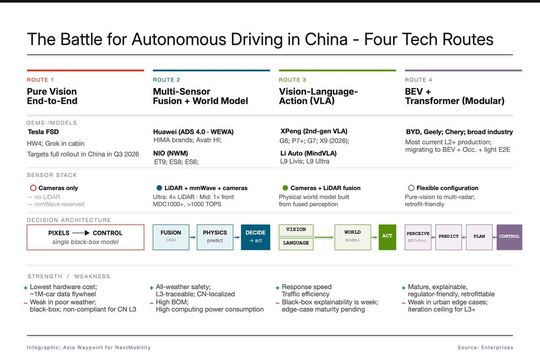
At the same time, driver assistance technology among Tesla's competitors in China is evolving in different directions. Four distinct technological approaches can currently be observed in the Chinese market, as recently described in a detailed analysis by the Chinese automotive newspaper Zhongguo Qichebao.
Without Lidar and Radar
The first approach is Tesla's own method, a so-called "pure vision end-to-end model." The system forgoes lidar and radar, relying solely on cameras and passing the data directly to a neural network without traditional intermediate steps, which makes the driving decisions. The advantages of this approach include comparatively low costs, rapid data iteration across Tesla's global fleet, and driving behavior that imitates human actions quite well. The weaknesses are also well-known. In poor visibility conditions such as fog or heavy rain, camera systems quickly reach their limits. Additionally, the decisions of the network are hardly comprehensible for national regulatory authorities.
Different paths lead to assisted and automated driving in China.
(Image: Asia Waypoint)
Multi-Sensor Fusion
The second approach, popular in China, is multi-sensor fusion combined with a "world model," a type of AI model that creates a digital representation of the external environment from sensor data. The most prominent Chinese representative of this approach is the technology corporation Huawei. Lidar, radar, and cameras simultaneously deliver signals, which the system then combines into a coherent image. Advantages include high safety even in poor visibility, strong predictive capabilities, and compatibility with the requirements of Chinese regulatory authorities, which value multiple independent sensor sources as additional redundancy. The downside of this solution is higher hardware costs and increased computational requirements.
Vision-Language-Action Architecture
The third approach is the Vision-Language-Action architecture, or VLA. A prominent proponent of this approach is the Chinese tech company XPeng. In VLA, language and perception are integrated into the decision-making process. Simply put, the system can verbally describe what it sees and make decisions based on this.
Advantages of this approach include relatively short response times and efficient traffic flow in complex situations. The central weakness is the typical black-box problem of modern AI systems. Those who need to certify the vehicle or reconstruct events in the event of damage face challenges.
Bird’s-Eye View
The fourth approach is the modular BEV method. BEV in this case stands for "Bird's Eye View," a bird's-eye perspective on traffic reconstructed from sensor data. Among experts, this approach is now considered "classic." Perception, planning, and control are clearly separated here. Each module can be individually tested, evaluated, and replaced if necessary. This ensures stability and traceability.
In complex urban traffic situations, such as during Shanghai rush hour with delivery scooters, pedestrians, and unpredictably parked delivery vans, the modular approach occasionally reaches its performance limits.
Parallel Existence of All Approaches
It is likely that several of these four approaches will coexist in the long term, according to Chinese market observers. However, end-to-end systems are expected to gain importance as the level of automation increases. At the same time, world models and VLA models are technologically converging more and more. Current regulations in the People's Republic clearly favor multi-sensor approaches. Whether a single manufacturer will dominate the mass market for autonomous driving will likely depend primarily on their ability to sufficiently reduce hardware costs.
Slow Recovery of Business
While the competition for the best architecture continues, Tesla's business in China and Europe is picking up again. Sales of the American-made electric cars produced in Shanghai rose by 36 percent in April 2026 compared to the previous year, according to data from the Chinese Passenger Car Association.
Deliveries from Tesla's factory in Shanghai, including exports to Europe and other markets, totaled 79,478 units. While this represents a 7.2 percent decline compared to the previous month of March, it is significantly above the level of the previous year. Tesla is thus stabilizing in its two most important markets outside the USA, after previously having to accept significant market share losses.
Date: 08.12.2025
Naturally, we always handle your personal data responsibly. Any personal data we receive from you is processed in accordance with applicable data protection legislation. For detailed information please see our privacy policy.
Consent to the use of data for promotional purposes
I hereby consent to Vogel Communications Group GmbH & Co. KG, Max-Planck-Str. 7-9, 97082 Würzburg including any affiliated companies according to §§ 15 et seq. AktG (hereafter: Vogel Communications Group) using my e-mail address to send editorial newsletters. A list of all affiliated companies can be found here
Newsletter content may include all products and services of any companies mentioned above, including for example specialist journals and books, events and fairs as well as event-related products and services, print and digital media offers and services such as additional (editorial) newsletters, raffles, lead campaigns, market research both online and offline, specialist webportals and e-learning offers. In case my personal telephone number has also been collected, it may be used for offers of aforementioned products, for services of the companies mentioned above, and market research purposes.
Additionally, my consent also includes the processing of my email address and telephone number for data matching for marketing purposes with select advertising partners such as LinkedIn, Google, and Meta. For this, Vogel Communications Group may transmit said data in hashed form to the advertising partners who then use said data to determine whether I am also a member of the mentioned advertising partner portals. Vogel Communications Group uses this feature for the purposes of re-targeting (up-selling, cross-selling, and customer loyalty), generating so-called look-alike audiences for acquisition of new customers, and as basis for exclusion for on-going advertising campaigns. Further information can be found in section “data matching for marketing purposes”.
In case I access protected data on Internet portals of Vogel Communications Group including any affiliated companies according to §§ 15 et seq. AktG, I need to provide further data in order to register for the access to such content. In return for this free access to editorial content, my data may be used in accordance with this consent for the purposes stated here. This does not apply to data matching for marketing purposes.
Right of revocation
I understand that I can revoke my consent at will. My revocation does not change the lawfulness of data processing that was conducted based on my consent leading up to my revocation. One option to declare my revocation is to use the contact form found at https://contact.vogel.de. In case I no longer wish to receive certain newsletters, I have subscribed to, I can also click on the unsubscribe link included at the end of a newsletter. Further information regarding my right of revocation and the implementation of it as well as the consequences of my revocation can be found in the data protection declaration, section editorial newsletter.
In Sweden, France, and Denmark, Tesla's sales continued to rise in April, according to various reports. Analysts write that the demand for battery electric vehicles has been noticeably boosted by higher oil prices resulting from the US-Iran conflict and the crisis in the Strait of Hormuz. Tesla is benefiting from this. The recovery follows a difficult period during which Tesla lost nearly half of its European market share by 2025.
Regulatory Issues
The approval of the next FSD version is facing challenges not only in China. In Europe, Tesla's system is also met with skepticism from regulatory authorities. Reuters cites unpublished emails from European regulatory insiders in the Netherlands, Sweden, Finland, Denmark, and Norway. According to these internal letters, authorities criticize that the Tesla system tends to exceed speed limits. Moreover, it is reportedly not reliable enough under winter road conditions, and safety features can be bypassed, according to Reuters.
Tesla is therefore still simultaneously grappling with regulatory issues in its two most important foreign markets, while Chinese competitors prepare their next steps with their own architectures, vast domestic data resources, and an overall supportive oversight in Beijing.
Tesla needs the newly requested update to its driver assistance system not only for market reasons. Ultimately, the sheer volume of data that can be collected on the road is the crucial competitive factor. The larger the vehicle fleet and the more extensive the data pool, the more powerful the system can become. Tesla currently still has advantages here. However, Chinese providers are catching up on their large domestic market month by month.



:quality(80)/p7i.vogel.de/wcms/51/1b/511b420dbcc296aec09e3bffb051b8a8/0133581587v1.jpeg "The cables connect numerous machine components—often in confined spaces. (Image:Helu)")
:quality(80)/p7i.vogel.de/wcms/b5/67/b5676f3bfb36251ed31f9a0cccf650b6/0133167827v1.jpeg "Thanks to JumboFlex Generation 2, employees can effortlessly move wheelchairs weighing as much as 40 kilograms. (Image:Lard)")
:quality(80)/p7i.vogel.de/wcms/5e/c6/5ec615b7a51440f668259f2af9158cb9/0132654694v1.jpeg "Strategic Partnerships in Industry: As buyers and restructuring partners, Chinese investors are increasingly helping to preserve jobs in Germany. (Image: ©Anatolii Rymarchuk - stock.adobe.com)")
:quality(80)/p7i.vogel.de/wcms/eb/2b/eb2bd1b8487afe577b37363cd02f16ff/0113143253v1.jpeg "In our China Market Insider, we regularly provide you with relevant information straight from China. (Image:© Eisenhans - stock.adobe.com)")
:quality(80)/p7i.vogel.de/wcms/aa/3e/aa3e2603a812f8e7d33c00ba8ae28c9f/0133507886v1.jpeg "With the Iggy Rob, igus is bringing a humanoid robot into factories for a price of 47,999 euros ($54,718). (Image: igus)")
:quality(80)/p7i.vogel.de/wcms/92/64/92645c64ffbb6980976d39102388d120/0113143253v1.jpeg "In our China Market Insider, we regularly provide you with relevant information straight from China. (Image:© Eisenhans - stock.adobe.com)")
:quality(80)/p7i.vogel.de/wcms/c7/05/c70542511e0824ee491f7b55e21fa429/0133598424v1.jpeg "In logistics, AI is often implemented only on a case-by-case basis; data is stored in separate systems, and inventory levels, status values, and priorities are not defined consistently. (Image: ©m-project - stock.adobe.com)")
:quality(80)/p7i.vogel.de/wcms/3a/9c/3a9c1fd546e1f041b86bb1d03cf39101/0133610524v1.jpeg "The Mason W-01 combines industrial-grade humanoid hardware, Physical AI-based perception, and autonomous task planning. (Image:Nova X Robotics)")
:quality(80)/p7i.vogel.de/wcms/e7/94/e794290f265afbd0ffc7a06c4fe9d425/adobestock-1887113836--hypnotics-14-stock-adobe-com-ki-generiertv1.jpeg "In both autonomous driving and industrial production, there is growing skepticism as to whether full autonomy is always desirable. (Source: © Hypnotics 14 – stock.adobe.com / AI-generated)")
:quality(80)/p7i.vogel.de/wcms/a8/71/a8712e5c6ef536228444ab5275cedfe2/adobestock-340905887--gorodenkoff-stock-adobe-comv1.jpeg "A new position paper outlines the conditions that the business community, academia, and policymakers must jointly establish in order to ensure the long-term viability of industry in Germany and Europe. (Source: © Gorodenkoff – stock.adobe.com)")
:quality(80)/p7i.vogel.de/wcms/7d/eb/7deb25ca674fa4c781a9d1fab083f7cf/parker-entwicklungszentrum-hresv1.jpeg "The centerpiece of the Parker Center for Drive and Control Technology in Offenbach is the exhibition area. (Source: Parker Hannifin)")
:quality(80)/p7i.vogel.de/wcms/3d/ff/3dff5e51c24b30c8dc37c1d024887157/0133602931v1.jpeg "Just a few years ago, SpaceX specialists were working on the world’s largest rocket—the Starship. Now, Elon Musk’s company has reached a milestone during a test flight: Earth’s orbit! But there was also a downside... (Image: SpaceX)")
:quality(80)/p7i.vogel.de/wcms/78/ab/78abbfbab0565fabb19efe637aea30e8/nio-power-swap-station-4-china-guangzhou-2024-1400x933-jpgv1.webp "Nio and Geely are collaborating on battery replacement for electric cars. (Source: Nio)")
:quality(80)/p7i.vogel.de/wcms/2e/58/2e58c664e733dd182666606f850c5da4/0133400664v1.jpeg "The IM6 is sort of the crossover version of the IM5. (Image:MG Motor)")
:quality(80)/p7i.vogel.de/wcms/40/5f/405f41f4075e8798878011f0932a8195/0133509065v1.jpeg "Caruso has integrated Hyundai into its platform. (Image:Hyundai)")
:quality(80)/p7i.vogel.de/wcms/06/98/06989beb3f95b8fb06d71190c86cffde/tabletv1.jpeg "The cockpit view during a test drive in the simulator. (Source: Uccello et al., IEEE OJITS 2026)")
:quality(80)/p7i.vogel.de/wcms/40/34/4034915f85470ad8264659267e4f02d0/0133655653v1.jpeg "Cariad, Volkswagen's software subsidiary, continues to struggle. Now, another round of layoffs has been announced, which will result in the loss of many jobs ... (Image:Cariad)")
:quality(80)/p7i.vogel.de/wcms/e4/2a/e42af12e2a0816bb3d25fac9932903e9/0133646920v1.jpeg "TSMC's U.S. headquarters in Arizona: According to various media reports, the world's largest contract semiconductor manufacturer may be planning to build up to six additional fabs in the state of Texas. (Image:TSMC)")
:quality(80)/p7i.vogel.de/wcms/de/8c/de8c694e560ce8e8d7d43fa5b91917b3/0133668420v1.jpeg "Open-source AI tools: DeepSeek and Huawei are making programming tools for Ascend processors available, with the aim of simplifying development, chip communication, and AI computations on Huawei's hardware—and thereby intensifying competition with Nvidia. (Image:Dall-E / AI-generated)")
:quality(80)/p7i.vogel.de/wcms/86/25/8625a62499a6e70e629a2ddde2f01dcb/0133671173v1.jpeg "\"OpenAI\" has repeatedly experienced problems in which AI models have accessed the internet without authorization in order to carry out their tasks. The company has now fired three people whom it no longer trusts ... (Image:AI-generated)")
:fill(fff,0)/images.vogel.de/vogelonline/companyimg/76800/76895/65.jpg "FAULHABER_120mm.jpg ()")
:fill(fff,0)/p7i.vogel.de/companies/69/de/69de1b7403b0d/simtos-logo.jpeg "simtos-logo (SIMTOS)")
:quality(80)/p7i.vogel.de/wcms/80/c6/80c6ed88edcd6debc35fcb4715bc25ab/0130871864v1.jpeg "Tech billionaire Elon Musk can be happy, as Tesla's turnover and profits rose significantly in the first quarter compared to the same period last year. And as far as car manufacturing is concerned, it's just a side show for Musk anyway ... (Image:Tesla)")
:quality(80)/p7i.vogel.de/wcms/29/a8/29a8ea15ab38e4404bc1c6a3e425e454/adobestock-1550141473--leopard-stock-adobe-com-ki-generiertv1.jpeg "When Machines Understand What They're Doing—The Five Technologies Behind Physical AI. (Source: © Leopard – stock.adobe.com_AI-generated)")
:quality(80)/p7i.vogel.de/wcms/ba/f7/baf7fa8cc2edc56040d1dde4d5a0d82e/567513617-8256x4642v1v1.jpeg "A look at Geely's booth at CES 2026 on January 6, 2026, at the Las Vegas Convention Center. (Image:picture alliance / Anadolu | Tayfun Coskun)")