China's Automakers "Do It Themselves"Chip War in the Cockpit: China Builds its Own, Xiaomi is Now on Board
From
Henrik Bork | Translated by AI
5 min Reading Time
China's car manufacturers say they have "no other choice." They have to build their car chips themselves. This is exactly what Lei Jun, the founder of the electronics manufacturer Xiaomi, which is now also building electric cars, recently stated.
In China, more and more car manufacturers are developing their own chips to bypass US embargos and supply chain uncertainties.
(Image: Dall-E / AI-generated)
"As for the battle for chips, we have no other choice," Lei wrote in a post for his millions of followers on China's social media last May. At the same time, he announced that the first car chip developed by Xiaomi itself would be unveiled "soon." He did not yet provide details about the architecture or intended use — whether for autonomous driving or infotainment. However, Xiaomi is joining a growing group of car manufacturers breaking away from Western chipmakers.
Nio, Xpeng, and Li Auto have been working on developing their own automotive semiconductors for years. "Going solo" is definitely the answer for some Chinese car manufacturers, writes the Chinese professional portal 36kr. The fact that this trend is now accelerating has two main reasons. In-house development is, on the one hand, the Chinese companies' response to the US chip export controls.
In Washington, elected representatives have been busy for several years denying China access to high-ranking semiconductors, particularly those capable of AI. Nvidia is already prohibited from delivering many of its best chips to China, losing more and more market share there. And just earlier this month, the latest tightening in a long list of export controls by the US towards China came into effect. New restrictions on the delivery of EDA software for chip design to China have come into force, reports the Financial Times.
Again Here: Embargos Don't Really Ignite
What the increasingly intense American attempt to cut China off from modern chip and AI technology has been causing for several years now is becoming very evident in the automotive industry. Jensen Huang, the CEO of the American chip manufacturer Nvidia, has illustrated it very vividly in the recent past.
Washington's export controls have failed, Huang said during a visit to Taiwan in May. They have given Chinese companies "the spirit, the energy, and the government support" they need "to accelerate their own development," according to the Nvidia CEO. It is a misconception to think that Chinese industrialists can be kept away from modern chips. "If they don't have enough Nvidia, they will use their own," the New York Times quotes Huang from Taipei.
On the other hand, and this is the second reason why China's car manufacturers believe they have "no other choice," supply difficulties from Nvidia have also contributed to the Chinese do-it-yourself efforts. Technical difficulties had repeatedly delayed the delivery of Nvidia's Thor chip. "Thor is now so delayed that competitor chips are already available," writes 36Kr. Nio and Xpeng have since removed Thor from their strategies; the risk is too great that planned models could be stalled by chip delivery problems.
The China Association of Automobile Manufacturers also recommended "caution when purchasing American chips" in a public statement, the Chinese auto portal Gasgoo reports.
Supply Chain Security for Market Dominance
The last thing Chinese car manufacturers can afford, given the very tough competition in the domestic and international car market, are uncertainties in supply chains, whether triggered by political activism or manufacturing delivery bottlenecks. In China, there is a forced reliance on expensive but promising self-development of car chips to ensure a certain autonomy over the product pipeline.
Nio has now installed its Shenji NX9031, based on a five-nanometer process, in several models like the ET9, ES6, and EC6. The chip replaces the function "of four conventional smart-driving chips," said William Li, chairman and CEO of Nio, to CNEVPOST. This not only saves costs but also achieves significantly better integration into its own SkyOS operating system. For the Nvidia founder, it must be painful to recall that Nio originally wanted to use Nvidia chips.
The same was true for Xpeng. The Chinese electric car startup had hoped for Nvidia, but then designed its own Turing chip, which is equipped with two specially developed neural cores. According to the company's own statements, the chip achieves a computing power of about 700 TOPS — comparable to the latest generation of Nvidia's Thor chips, which, after multiple delays, were finally able to be delivered in a slimmed-down version.
At the same time, Chinese car manufacturers are working on innovations concerning their car chips. They are striving to bypass the limitations of edge computing and bring the power of LLM into the car. This is meant to translate human-like "common sense" decisions into concrete driving instructions such as a lane change or brake application. "If we rely solely on vehicle computing, we reach limits," said Xpeng's autonomy chief Li Liyun at a technical briefing in April, reports 36Kr.
Date: 08.12.2025
Naturally, we always handle your personal data responsibly. Any personal data we receive from you is processed in accordance with applicable data protection legislation. For detailed information please see our privacy policy.
Consent to the use of data for promotional purposes
I hereby consent to Vogel Communications Group GmbH & Co. KG, Max-Planck-Str. 7-9, 97082 Würzburg including any affiliated companies according to §§ 15 et seq. AktG (hereafter: Vogel Communications Group) using my e-mail address to send editorial newsletters. A list of all affiliated companies can be found here
Newsletter content may include all products and services of any companies mentioned above, including for example specialist journals and books, events and fairs as well as event-related products and services, print and digital media offers and services such as additional (editorial) newsletters, raffles, lead campaigns, market research both online and offline, specialist webportals and e-learning offers. In case my personal telephone number has also been collected, it may be used for offers of aforementioned products, for services of the companies mentioned above, and market research purposes.
Additionally, my consent also includes the processing of my email address and telephone number for data matching for marketing purposes with select advertising partners such as LinkedIn, Google, and Meta. For this, Vogel Communications Group may transmit said data in hashed form to the advertising partners who then use said data to determine whether I am also a member of the mentioned advertising partner portals. Vogel Communications Group uses this feature for the purposes of re-targeting (up-selling, cross-selling, and customer loyalty), generating so-called look-alike audiences for acquisition of new customers, and as basis for exclusion for on-going advertising campaigns. Further information can be found in section “data matching for marketing purposes”.
In case I access protected data on Internet portals of Vogel Communications Group including any affiliated companies according to §§ 15 et seq. AktG, I need to provide further data in order to register for the access to such content. In return for this free access to editorial content, my data may be used in accordance with this consent for the purposes stated here. This does not apply to data matching for marketing purposes.
Right of revocation
I understand that I can revoke my consent at will. My revocation does not change the lawfulness of data processing that was conducted based on my consent leading up to my revocation. One option to declare my revocation is to use the contact form found at https://contact.vogel.de. In case I no longer wish to receive certain newsletters, I have subscribed to, I can also click on the unsubscribe link included at the end of a newsletter. Further information regarding my right of revocation and the implementation of it as well as the consequences of my revocation can be found in the data protection declaration, section editorial newsletter.
Distilled AI Models for the Car
Xpeng is now attempting a hybrid strategy: large AI models with up to 72 billion parameters are trained in the cloud and then distilled into smaller models for vehicle use. The Turing chip then processes these locally in the vehicle. Initial tests with this system architecture are reported to have been "surprisingly powerful," according to the company.
Meanwhile, newly joined in the ranks of "do-it-yourself" chip manufacturers in the Chinese automotive industry, Xiaomi, which has also just introduced its own new smartphone chip "Xring O1," relies on the Taiwanese contract manufacturer TSMC for chip production. Thus, it chooses the same path as Apple and Nvidia. However, according to a report by TrendForce, Xiaomi uses American EDA software for its internal design processes, which are now subject to export controls. Access to these tools is uncertain in the future, which could also affect Xiaomi's car chip plans, according to the trade medium.
Nevertheless, Lei Jun remains combative. Xiaomi intends to invest at least 50 billion yuan (around six billion euros) in chip development over the next ten years, he announced. This year alone, over six billion yuan, about 730 million euros, is to be invested. Xiaomi has a R&D team with 2,500 employees.
The Government Supports the Ambitions
The Chinese government supports these efforts. The state broadcaster CCTV referred to Xiaomi's announcement of its latest smartphone chip as a "breakthrough," showing that private companies in China are also capable of achieving technological sovereignty. Naturally, by using their own chips, Chinese car manufacturers not only increase their response speed but also their margin. Nio, for instance, was able to replace the use of four Nvidia Orin-X chips with two of its own, as its founder claims, and aims to achieve cost reductions that could be significant in the price competition in the domestic market.
The shift to Chinese chip autonomy in the automotive industry is happening rapidly. "Decoupling begins: Xpeng launches Turing AI chip in the second quarter and reduces dependence on Nvidia," was recently headlined by the CarNewsChina portal. Tesla had shown Chinese car manufacturers with its "Full Self Driving" architecture how far vertical integration can go. Now the Chinese are reluctantly following suit, with their own operating systems, data platforms, and AI models. As a result, they will need to order less from the Western abroad in the future. (sb)



:quality(80)/p7i.vogel.de/wcms/2c/d6/2cd65bff6624dbdc007f2315307612fe/0130800023v1.jpeg "An international consortium led by Tata Steel Nederland has made significant progress in the development of new zinc-coated ultra-strong steels. (Image:Tata Steel)")
:quality(80)/p7i.vogel.de/wcms/f0/e0/f0e05856a96a9afa991a8dd9f4aceb04/0131242862v1.jpeg "Humanoid robots are the focus of the \"TUM RoboGym (powered by Neura)\". (Image:Neura Robotics)")
:quality(80)/p7i.vogel.de/wcms/c3/be/c3be858b644b6f52c83ea025a6f596ad/0130477152v1.jpeg "With the \"DUO\" version of the \"POWER-Skate XL\", loads can be moved in all directions. (Image:HTS)")
:quality(80)/p7i.vogel.de/wcms/92/87/9287ce9327245bdcd01af627044b34c8/0131221372v1.jpeg "Here, Binder provides information on a standardized portfolio and, above all, on improvements for the assembly of M12 connectors, which are now easier to handle and even safer ... (Image:Binder)")
:quality(80)/p7i.vogel.de/wcms/fc/5c/fc5c314369136a0f2b4819ca4011ce80/0131048280v1.jpeg "It all depends on the overall IO-Link package. If the interaction between sensors, powerful masters and a manufacturer-independent configuration tool is right, a significant increase in machine performance is possible. (Image:Baumer)")
:quality(80)/p7i.vogel.de/wcms/69/a2/69a26de87302feccb0ad51bc5eefae4d/0131155056v1.jpeg "Quantum Mate with integrated cobot takes over manual, repetitive tasks in an automated, reliable and efficient process. (Image:Galdabini)")
:quality(80)/p7i.vogel.de/wcms/72/54/7254c0031573057a049e5879cba0de85/0130912407v1.jpeg "The serial interface still has its legitimacy in the age of Industry 4.0: it is still used, for example, to connect peripheral devices such as scanners. (Picture: ©Guy - stock.adobe.com)")
:quality(80)/p7i.vogel.de/wcms/c1/70/c170fd5c52c08ceb4bc2b58eb94ea95f/newsimage421365-2048x1151v1v1.jpeg "Diving robot from TU Bergakademie Freiberg before its first dive at the Malter dam (Image:Andreas Hiekel/TUBAF)")
:quality(80)/p7i.vogel.de/wcms/30/76/3076278d4a7b51a5c566581a20135afc/54963580015-cdcb4657c5-k-2047x1151v1v1.jpeg "The Nancy Grace Roman space telescope was completed in the largest clean room at NASA's Goddard Space Flight Center. It is due to be launched into space in September 2026. (Image:NASA/Jolearra Tshiteya / CC BY 4.0)")
:quality(80)/p7i.vogel.de/wcms/3a/08/3a08d5a0623b4d32294e8108d639f237/nivalon-20medical-20-1626x914v1v1.png "EvoFlex implant from Nivalon Medical consists of a bone-like ZTA ceramic that is precisely adapted to the anatomy of each patient. (Image:Nivalon)")
:quality(80)/p7i.vogel.de/wcms/55/93/55936485100842cd9e83fa3ec053e9c1/2-995x560v1v1.png "The research team at the Technical University of Munich measures and controls the tendon forces on the robot. The aim of the research project is to develop new control concepts. (Image:TU Munich)")
:quality(80)/p7i.vogel.de/wcms/c2/df/c2df275b52afda5130ec90662fc767af/adobestock-1858604981--c2-a9-20vladyslav-20andrukhiv-20-e2-80-93-20stock-adobe-com-ki-generiertv1.jpeg "Artificial sun on earth: Start-ups in China are working to accelerate the development of the virtually inexhaustible energy source of nuclear fusion with AI. (Source: © Vladyslav Andrukhiv - stock.adobe.com/AI-generated)")
:quality(80)/p7i.vogel.de/wcms/2c/1f/2c1fb590b96de7ca3ca029564b063865/0131218954v1.jpeg "Xpeng brings the X9 to Germany. (Picture:Xpeng)")
:quality(80)/p7i.vogel.de/wcms/94/6b/946b136b4478d8b80e3d9e62041e7274/0131259520v1.jpeg "The Craft test bench in Berlin is used to develop future propulsion systems for sustainable aviation. The aim is to minimize noise while maintaining the efficiency of aircraft engines. (Image:DLR)")
:quality(80)/p7i.vogel.de/wcms/5a/14/5a14b26a5d4495d3a192e90e5c216251/ai-catl-sodium-batteries-vs-lithium-revolution-1800x1012v1v1.jpeg "The supplier CATL is bringing its first sodium-ion batteries into series production. Although not in the automotive industry, this step is set to follow soon. (Image:CATL)")
:quality(80)/p7i.vogel.de/wcms/68/43/68433001d98374eb72f51b4a7db590fe/0131229290v1.jpeg "Charging infrastructure provider Evoltra will operate as Citywatt Development in the future. (Image:Citywatt)")
:quality(80)/p7i.vogel.de/wcms/98/11/981107e7d149b2ff970c574cdd73f158/0131183152v1.jpeg "An optical phased array (OPA) counteracts strong optical crosstalk. For this purpose, the antenna geometry is arranged asymmetrically. (Image:Amy Pan / MIT)")
:quality(80)/p7i.vogel.de/wcms/a3/2e/a32e8b8bb38bd5c1cfd27b043baf72b7/0131203375v1.jpeg "Alliance for the AI age: Sony and TSMC join forces to produce next-generation smart image sensors (Image:Brunox983/Pixabay)")
:quality(80)/p7i.vogel.de/wcms/f9/5d/f95d24afa8d7ffb2c27916d0f329c670/0131192604v1.jpeg "Symbolic image: Kontron has a positive outlook for 2026, but must restructure. (Image:AI-generated)")
:quality(80)/p7i.vogel.de/wcms/c7/6b/c76b7659a76e1dd6e9b007340a12c70b/0131171547v1.jpeg "Circular economy in practice: in future, automated systems will save intact battery cells for reuse. (Image:Rainer Betz/Fraunhofer IPA)")
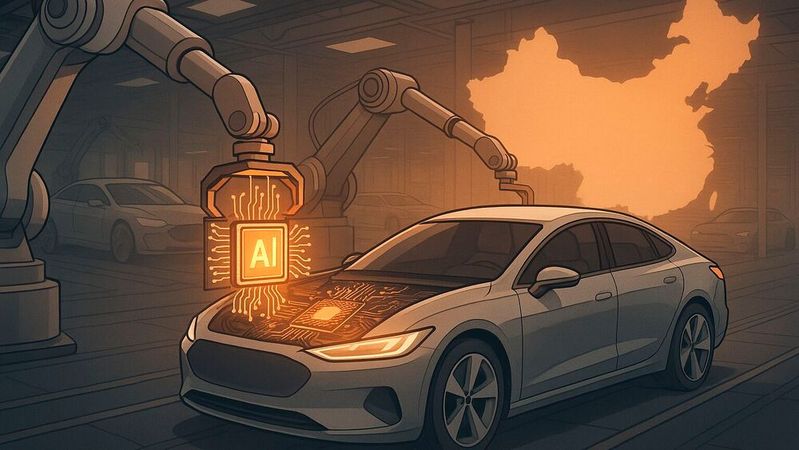
:quality(80)/p7i.vogel.de/wcms/8a/64/8a6427647249523e19356c89fd6c1453/0125087745v1.jpeg "In China, more and more car manufacturers are developing their own chips to circumvent US embargoes and supply chain uncertainties. (Image:Dall-E / AI-generated)")
:quality(80)/p7i.vogel.de/wcms/93/4d/934de334b47abaa526c78cba1417d7af/0130343495v1.jpeg "The new SU7 is available in three price categories, \"Standard\", \"Pro\" and \"Max\" (Image:Xiaomi)")