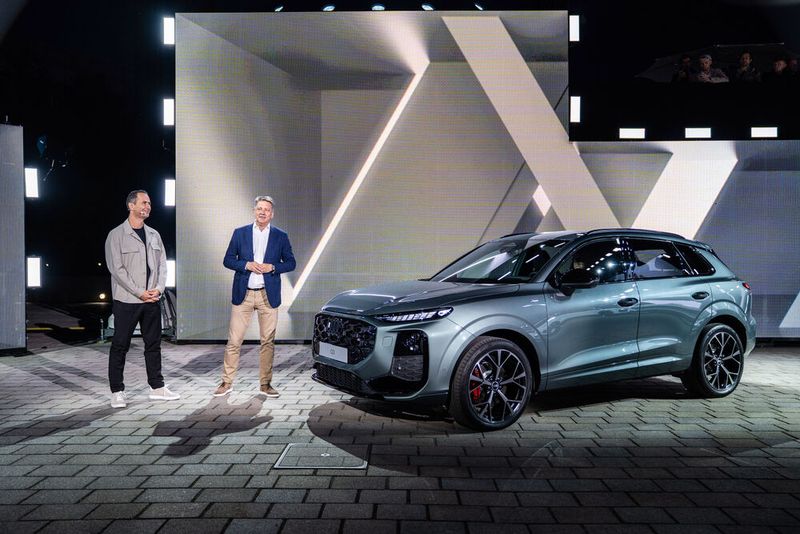
Audi has not forgotten how to party—as demonstrated by the world premiere of the new Q3. The market launch is planned for September. The SUV will be produced in Györ and Ingolstadt.
Audi CEO Gernot Döllner (right) and Head of Sales Marco Schubert at the presentation of the new Q3 in front of the Audi Forum in Ingolstadt.
(Image: Audi)
On Monday evening, Audi celebrated the world premiere of the new Q3 with international guests and employees on the piazza in front of the Audi Forum in Ingolstadt. The third generation of the compact SUV will be available to order from the summer, with the first models due to be delivered in October. "With a total of more than two million vehicles sold worldwide since the launch of the first generation, the Audi Q3 is one of our best-selling models and has a high status in our product portfolio. With the third generation, we are renewing an important model family as part of our product initiative and strengthening our range with a powerful plug-in hybrid and efficient combustion engines. The new model combines efficiency, driving dynamics and comfort," said Audi CEO Gernot Döllner, welcoming the guests.
The Q3 is now available to order at prices starting from 44,600 euros. The Sportback is set to follow soon. Technically, the compact SUV is based on the VW Group's MQB-evo platform. The body has been aerodynamically optimized to reduce fuel consumption. For example, a controllable cooling air intake is mounted under the Singleframe to direct the airstream to the rear with as little resistance as possible.
The 1.5-liter TFSI four-cylinder petrol engine with 110 kW, mild hybrid system and seven-speed S tronic as standard forms the entry-level model in the Q3 family at the start of sales—there is no longer a manual gearbox. To save fuel, the cylinder on demand system temporarily deactivates the second and third cylinders at low and medium loads.
Two 2.0-liter petrol engines with 150 kW and 195 kW respectively, each with Quattro drive, are also planned. There is also a 110 kW/150 hp TDI engine without all-wheel drive and a plug-in hybrid (e-hybrid) with 200 kW/272 hp system output and 400 Nm system torque.
The high-voltage battery in the floor is no bigger than the battery used in the current model until some time ago. But thanks to improved cell technology, the capacity has almost doubled to a usable 19.7 kWh. This should enable the PHEV to cover up to 120 kilometers (approx 75 miles) purely electrically in the WLTP cycle. The SUV can recharge its 50 kW battery to 80 percent in half an hour. Audi did not yet want to give a forecast for the drive distribution.
New Features from the Luxury Class
The small SUV also catches up with the larger models in terms of technology. One highlight is the adapted version of the digital Matrix LED light, which Audi previously only used in the luxury class. It has been adapted to the narrower front of the Q3 with a new micro-LED module. There are 25,600 micro-LEDs on the light element, which is just 13 millimetres wide. They are designed to illuminate the road better than the previous DMD module and provide more contrast in bad weather and fog.
The entire lighting technology has been more closely linked to the driving assistants. For example, warning messages from the blind spot and lane assistants are projected onto the road. The same applies to the threat of icy conditions: the lighting technology then "paints" an ice crystal onto the road from a speed of 70 km/h (approx. 43 mph). For the first time, individual functions of the matrix light can be switched on and off via the central MMI on-board system. In addition, Audi now offers various light scenarios with which the Q3 greets and bids farewell to its driver.
The interior, which is now also similar to that of the more expensive Audi models, is significantly more practical than before. Buyers can choose from seven interior packages, with many recycled materials or rapidly renewable wood being used in keeping with the spirit of the times. As in the larger Audis, a slightly curved panoramic display at the front combines a 12-inch instrument cluster and a slightly wider touchscreen for the on-board menus.
In addition, an optional head-up display shows important information on the windshield. This includes the white arrows that indicate the direction in which the driver can change lanes during assisted driving. Trained parking enables customers to teach the Q3 individual parking maneuvers and the new reversing assistant helps to reliably drive out of a dead end.
Audi is taking a new approach to operation in the Q3. The bulky gear lever has been removed and the gears are now selected via a narrow steering column lever. This creates space for two cup holders and the now 15-watt cell phone charger. In terms of space utilization, the SUV has also taken a big step forward. Thanks to the four centimeter longer body and the standard sliding and adjustable rear seat, the trunk volume varies from 488 to 575 liters. Owners of the current model have to make do with 350 liters.
Date: 08.12.2025
Naturally, we always handle your personal data responsibly. Any personal data we receive from you is processed in accordance with applicable data protection legislation. For detailed information please see our privacy policy.
Consent to the use of data for promotional purposes
I hereby consent to Vogel Communications Group GmbH & Co. KG, Max-Planck-Str. 7-9, 97082 Würzburg including any affiliated companies according to §§ 15 et seq. AktG (hereafter: Vogel Communications Group) using my e-mail address to send editorial newsletters. A list of all affiliated companies can be found here
Newsletter content may include all products and services of any companies mentioned above, including for example specialist journals and books, events and fairs as well as event-related products and services, print and digital media offers and services such as additional (editorial) newsletters, raffles, lead campaigns, market research both online and offline, specialist webportals and e-learning offers. In case my personal telephone number has also been collected, it may be used for offers of aforementioned products, for services of the companies mentioned above, and market research purposes.
Additionally, my consent also includes the processing of my email address and telephone number for data matching for marketing purposes with select advertising partners such as LinkedIn, Google, and Meta. For this, Vogel Communications Group may transmit said data in hashed form to the advertising partners who then use said data to determine whether I am also a member of the mentioned advertising partner portals. Vogel Communications Group uses this feature for the purposes of re-targeting (up-selling, cross-selling, and customer loyalty), generating so-called look-alike audiences for acquisition of new customers, and as basis for exclusion for on-going advertising campaigns. Further information can be found in section “data matching for marketing purposes”.
In case I access protected data on Internet portals of Vogel Communications Group including any affiliated companies according to §§ 15 et seq. AktG, I need to provide further data in order to register for the access to such content. In return for this free access to editorial content, my data may be used in accordance with this consent for the purposes stated here. This does not apply to data matching for marketing purposes.
Right of revocation
I understand that I can revoke my consent at will. My revocation does not change the lawfulness of data processing that was conducted based on my consent leading up to my revocation. One option to declare my revocation is to use the contact form found at https://contact.vogel.de. In case I no longer wish to receive certain newsletters, I have subscribed to, I can also click on the unsubscribe link included at the end of a newsletter. Further information regarding my right of revocation and the implementation of it as well as the consequences of my revocation can be found in the data protection declaration, section editorial newsletter.
The plug-in hybrid is expected to cost at least 49,300 euros (approx. 57.745 USD). A fully electric Q3 is not in the pipeline. Instead, there will be a separate, small electric SUV below the Q4 from the end of 2026 at the earliest.
Production Network Györ (Hungary) and Ingolstadt (Germany)
The compact SUV will continue to be manufactured at the Audi plant in Györ, Hungary, and will also be produced in Ingolstadt from 2026. "We are working at full capacity at our vehicle plant, even though the current Q3 is at the end of its life cycle. We are expecting even higher volumes for the new model, which is why we are also using integrated production," explains Michael Breme, Chairman of the Board of Management of Audi Hungaria. "We are proud that we can also build the third generation of the Q3 in Györ," adds Zoltán Les, Head of Production.
Joint production with Ingolstadt is scheduled to begin in 2026. The bodies will come from Györ, while painting and final assembly for the Ingolstadt models will take place at the main plant. The bottleneck in Györ is the paint shop. The plant's capacity limit is 185,000 vehicles per year, with three shifts over five working days—the Q3, Q3 Sportback and the Cupra Terramar are currently being built there.
The Q3 models are shipped all over the world from Hungary and Germany—with the exception of China. The Q3 successor is also to be localized there. There are currently no plans for Q3 production in the USA, for example due to the current customs discussions. Overall, Breme and Les emphasize that Györ remains a very attractive location—not only because of the wage level, but also because the general conditions are stable and resilient. The combination of vehicle plant and engine production also offers a great deal of breathing space.
Audi Hungaria
Audi Hungaria started in 1993 with the pure production of powertrains. In 1998, activities were expanded to include vehicle construction—and in 2001 the portfolio was extended to include technical development. Since 2005, Győr has also been home to one of the largest toolmaking facilities in Central Europe. In addition, vehicle production was expanded in 2013 to include a press shop, a body shop and a paint shop. Since then, the site has covered all areas of the automotive production value chain. In recent years, Audi has invested between 200 and 300 million euros (approx. 234 and 351 USD) per year in the site. With around 12,000 employees, Audi Hungaria is now one of the largest exporters and most profitable companies in the country.
With material from SP-X
Secure and Compliant Authentication in Laboratories



:quality(80)/p7i.vogel.de/wcms/36/2d/362dff6b0e2d837a564949f0564a7744/0131203282v1.jpeg "Porsche cannot rest, the losses are immense - and have been for some time. Now the management has decided to close down three subsidiaries ... (Image:Porsche)")
:quality(80)/p7i.vogel.de/wcms/a2/9c/a29cbb1970c72f5040c038feb1fd0647/0131196698v1.jpeg "Rheinmetall is realizing its plans to build cruise missiles with Destinus in the future, as can be seen here ... (Image:Destinus)")
:quality(80)/p7i.vogel.de/wcms/e7/2d/e72daf34b34495fbd4436b9bd29cc854/0131165612v1.jpeg "Donald keeps the world on tenterhooks! After all, the US President has suffered his second legal defeat over his tariff strategies. He has also extended the deadline for his latest announcements until the beginning of July. Meanwhile, the EU is negotiating how it should react ... (Image:AP)")
:quality(80)/p7i.vogel.de/wcms/b7/3e/b73e4abb821fbcef14bc24df426c0062/0131165798v1.jpeg "Better than using hydrofluoric acid! Here, a glass blank is processed with picosecond pulses using a USP laser to give it micro- or nanostructures. This works precisely and, above all, is more environmentally friendly than with conventional methods. But there's more ... (Image:Fraunhofer IPT)")
:quality(80)/p7i.vogel.de/wcms/fc/5c/fc5c314369136a0f2b4819ca4011ce80/0131048280v1.jpeg "It all depends on the overall IO-Link package. If the interaction between sensors, powerful masters and a manufacturer-independent configuration tool is right, a significant increase in machine performance is possible. (Image:Baumer)")
:quality(80)/p7i.vogel.de/wcms/69/a2/69a26de87302feccb0ad51bc5eefae4d/0131155056v1.jpeg "Quantum Mate with integrated cobot takes over manual, repetitive tasks in an automated, reliable and efficient process. (Image:Galdabini)")
:quality(80)/p7i.vogel.de/wcms/72/54/7254c0031573057a049e5879cba0de85/0130912407v1.jpeg "The serial interface still has its legitimacy in the age of Industry 4.0: it is still used, for example, to connect peripheral devices such as scanners. (Picture: ©Guy - stock.adobe.com)")
:quality(80)/p7i.vogel.de/wcms/c1/70/c170fd5c52c08ceb4bc2b58eb94ea95f/newsimage421365-2048x1151v1v1.jpeg "Diving robot from TU Bergakademie Freiberg before its first dive at the Malter dam (Image:Andreas Hiekel/TUBAF)")
:quality(80)/p7i.vogel.de/wcms/30/76/3076278d4a7b51a5c566581a20135afc/54963580015-cdcb4657c5-k-2047x1151v1v1.jpeg "The Nancy Grace Roman space telescope was completed in the largest clean room at NASA's Goddard Space Flight Center. It is due to be launched into space in September 2026. (Image:NASA/Jolearra Tshiteya / CC BY 4.0)")
:quality(80)/p7i.vogel.de/wcms/3a/08/3a08d5a0623b4d32294e8108d639f237/nivalon-20medical-20-1626x914v1v1.png "EvoFlex implant from Nivalon Medical consists of a bone-like ZTA ceramic that is precisely adapted to the anatomy of each patient. (Image:Nivalon)")
:quality(80)/p7i.vogel.de/wcms/55/93/55936485100842cd9e83fa3ec053e9c1/2-995x560v1v1.png "The research team at the Technical University of Munich measures and controls the tendon forces on the robot. The aim of the research project is to develop new control concepts. (Image:TU Munich)")
:quality(80)/p7i.vogel.de/wcms/c2/df/c2df275b52afda5130ec90662fc767af/adobestock-1858604981--c2-a9-20vladyslav-20andrukhiv-20-e2-80-93-20stock-adobe-com-ki-generiertv1.jpeg "Artificial sun on earth: Start-ups in China are working to accelerate the development of the virtually inexhaustible energy source of nuclear fusion with AI. (Source: © Vladyslav Andrukhiv - stock.adobe.com/AI-generated)")
:quality(80)/p7i.vogel.de/wcms/78/43/784356d3ccff7d4cbb096f6a4424f5fd/0131063056v1.jpeg "The \"Ufo-Brems\" project was funded by the Federal Ministry for Economic Affairs and Energy and coordinated by Project Management Jülich. (Image:TU Chemnitz)")
:quality(80)/p7i.vogel.de/wcms/d2/05/d2052e71ea2ccce237727f5e2f2333a2/0131108358v1.jpeg "Risk-based fire protection strategies offer manufacturers and users of lithium-ion batteries (LIB) the best possible protection. (Image:Siemens)")
:quality(80)/p7i.vogel.de/wcms/4f/7b/4f7bbe1f4e8d939d923e7cc4ae92e9df/0131157100v1.jpeg "Yanni von Roy-Jiang, pictured in her Webasto days, has taken over purchasing at Mercedes-Benz. She is now exerting massive pressure on the suppliers with a letter. (Image:Webasto)")
:quality(80)/p7i.vogel.de/wcms/cd/c4/cdc4f646f0c1e71e5788f4054dff870b/0131136593v1.jpeg "Highly integrated inverter with a power density of 500 kW/l, optimized for maximum power density (Image:Fraunhofer IZM / Volker Mai)")
:quality(80)/p7i.vogel.de/wcms/f9/5d/f95d24afa8d7ffb2c27916d0f329c670/0131192604v1.jpeg "Symbolic image: Kontron has a positive outlook for 2026, but must restructure. (Image:AI-generated)")
:quality(80)/p7i.vogel.de/wcms/c7/6b/c76b7659a76e1dd6e9b007340a12c70b/0131171547v1.jpeg "Circular economy in practice: in future, automated systems will save intact battery cells for reuse. (Image:Rainer Betz/Fraunhofer IPA)")
:quality(80)/p7i.vogel.de/wcms/ff/10/ff103cc3a0e70a865e433e48c7c89d92/0131202314v1.jpeg "Revival of the partnership: Apple is apparently planning to produce future processors in Intel's US plants. (Image:Intel Corp.)")
:quality(80)/p7i.vogel.de/wcms/22/35/2235aeefad964df8b6480beddec5b58c/0131086898v1.jpeg "The Eigenblue team with the eigenScan (from left to right): Ata Keşfeden, Shiyue Liu, Qiao Qiao, Johannes Zimmerer, Raphael Joppi and Tizian Unkauf. (Image:Eigenblue GmbH)")
:fill(fff,0)/images.vogel.de/vogelonline/companyimg/76800/76895/65.jpg "FAULHABER_120mm.jpg ()")
:fill(fff,0)/p7i.vogel.de/companies/69/de/69de1b7403b0d/simtos-logo.jpeg "simtos-logo (SIMTOS)")
:quality(80)/p7i.vogel.de/wcms/0d/b7/0db7e67ee0abc31b328e4bee28a997c0/0125245216v1.jpeg "On Monday evening (June 17), Audi celebrated the world premiere of the new Q3 on the piazza in front of the Audi Forum in Ingolstadt.(Picture: Audi)")
:quality(80)/p7i.vogel.de/wcms/70/91/70915dcae563dd85e835c33c13d31420/0125245252v1.jpeg "The Györ plant has a capacity limit of 185,000 vehicles per year.(Picture: Audi)")
:quality(80)/p7i.vogel.de/wcms/06/d2/06d2fad35d5c9e35e65687925ab3f841/0125245249v1.jpeg "The body shop in Györ.(Image: Audi)")
:quality(80)/p7i.vogel.de/wcms/3d/8b/3d8be787f533310816d5600b48c23c24/0125245235v1.jpeg "Zoltán Les, Board Member for Production at Audi Hungaria.(Image: Audi)")
:quality(80)/p7i.vogel.de/wcms/aa/f5/aaf555c197676ba08f976fcedf8b6ab5/0124336379v1.jpeg "At Auto Shanghai, Audi celebrates the new China brand AUDI with the premiere of the E5 E-tron. (Image:Audi)")
:quality(80):fill(efefef,0)/p7i.vogel.de/wcms/67/ac/67acb931a438c/elatec-wp-gmp.png "Elatec WP GMP")
:quality(80)/p7i.vogel.de/wcms/f7/46/f7463fce73cce957a98c976326b0a916/0126791869v1.jpeg "Generously spacious: The new BMW plant in Debrecen. 2,000 new jobs have been created there. (Image:BMW Group)")
:quality(80)/p7i.vogel.de/wcms/3b/e2/3be24fe161fce9153d3b83204c60d2bc/0124487702v1.jpeg "The Grandland has grown in the new generation. (Image:Opel)")