At the end of October, series production of the BMW iX3, the first model of the Neue Klasse, will begin at the "Greenfield" site in Debrecen, Hungary. The iFactory concept makes it possible – and manageable.
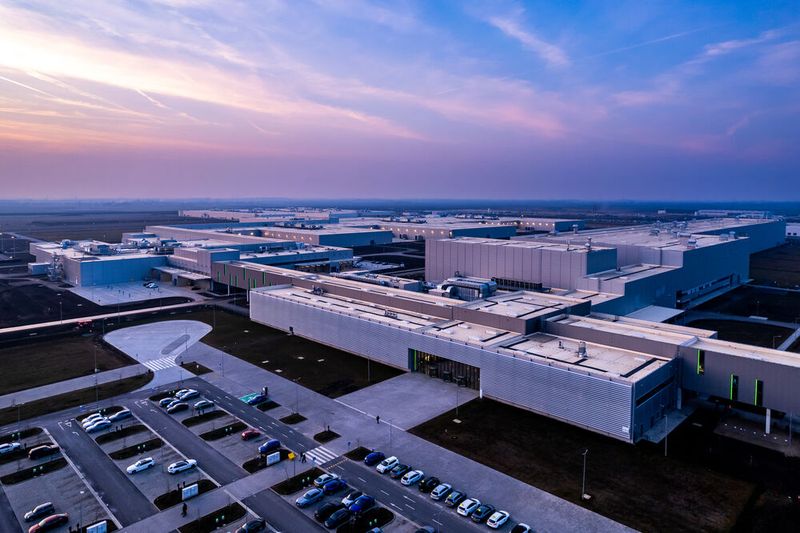
Generously spacious: The new BMW plant in Debrecen. 2,000 new jobs have been created there.
(Image: BMW Group)
While BMW has to economize on every square meter at the urban site in Munich in preparation for the Neue Klasse, the Bavarian automaker allows itself plenty of space in eastern Hungary, 30 kilometers from the Romanian border – both indoors and outdoors. 640,000 square meters of factory grounds with 22 uniformly gray buildings. Each is very generously sized and undoubtedly expandable.
The new BMW plant, first announced in 2018, on the outskirts of the 220,000-inhabitant city of Debrecen, is a full-scale facility with a press shop, body shop, paint shop, and vehicle assembly. Additionally, the site is the first BMW plant worldwide to feature its own "Gen6 (Generation 6)" battery assembly. EVE Energy, the supplier of round cells for the Gen6 battery of the Neue Klasse, is currently constructing a facility across the street. Planned start: 2027; capacity: 30 GWh per year.
In Debrecen, BMW has undertaken something that has so far been approached with great caution in the automotive industry: launching a completely new car in a completely new production facility. The iFactory concept makes it possible – and manageable.
In 2020, BMW announced the creation of a standardized production system to be rolled out across all BMW Group plants worldwide. Headline: Lean, green, digital. The objective: a fully digital and intelligently connected factory. The prerequisite: complete virtualization and simulation of production using digital twins, with every detail of the entire production process designed virtually. The assembly of BMW i7 models in Dingolfing was the company's first production designed according to the principles of the iFactory.
In Debrecen, a complete vehicle plant was digitally planned, virtually tested, and built according to iFactory principles. Virtually, the Debrecen plant was already launched in March 2023 in the "Virtual Factory" of the BMW Group. Subsequently, the production lines were installed exactly as in the digital twin.
Designed for 150,000 Vehicles per Year
Now it’s running "for real," albeit at a rather modest pace. In the final stretch before the official start of production of the iX3 SUV at the end of October, the focus is on employee training and fine-tuning the systems and processes. Currently, 2,000 employees are producing pre-series vehicles, around 30 units per day. The plant is designed for a capacity of 150,000 vehicles per year.
On September 9, just a few days after the official presentation of the new iX3 ahead of the IAA in Munich, BMW opened the doors of the new plant to visitors for the first time. Around 100 international journalists accepted the invitation to get to know the city of Debrecen, Hungary's second-largest city after Budapest, and the new plant, the 32nd in BMW's global production network.
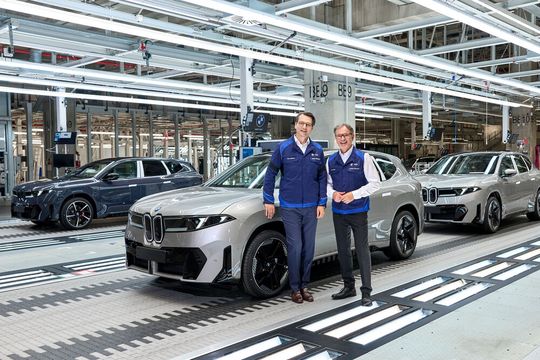
Proud of the achievements in Debrecen: BMW's Head of Production Milan Nedeljković (left) and Plant Manager Hans-Peter Kemser.
(Image: BMW Group/Daniel Kraus)
Milan Nedeljković: "New dimension of efficient production"
BMW production board member Milan Nedeljković emphasized during the opening how proud he was that the new plant was "completely planned and built according to our iFactory target vision." "Digital from the start," he explained, "the plant offers a new dimension of efficient production while completely eliminating fossil fuels." Debrecen is the first automobile factory in the world to be powered exclusively by electricity. Twenty-five percent of the required energy is supplied by the 50-hectare photovoltaic system on the factory grounds, with the rest being purchased. Not a cheap undertaking: according to BMW, industrial electricity costs in Hungary are roughly the same as in Germany.
One of the major challenges of an automobile factory powered exclusively by electricity is the paint shop, the largest energy consumer in any automotive production. In addition to various energy recovery systems, a thermal water energy storage system is being used as an additional energy-saving measure for the first time. This system holds 1.8 million liters, enough to fill 12,000 bathtubs. Excess energy from the photovoltaic system during low-load periods is stored there as heat to cover peak demands, such as restarting the paint shop after idle days. The storage system has a capacity of 130 MWh.
Date: 08.12.2025
Naturally, we always handle your personal data responsibly. Any personal data we receive from you is processed in accordance with applicable data protection legislation. For detailed information please see our privacy policy.
Consent to the use of data for promotional purposes
I hereby consent to Vogel Communications Group GmbH & Co. KG, Max-Planck-Str. 7-9, 97082 Würzburg including any affiliated companies according to §§ 15 et seq. AktG (hereafter: Vogel Communications Group) using my e-mail address to send editorial newsletters. A list of all affiliated companies can be found here
Newsletter content may include all products and services of any companies mentioned above, including for example specialist journals and books, events and fairs as well as event-related products and services, print and digital media offers and services such as additional (editorial) newsletters, raffles, lead campaigns, market research both online and offline, specialist webportals and e-learning offers. In case my personal telephone number has also been collected, it may be used for offers of aforementioned products, for services of the companies mentioned above, and market research purposes.
Additionally, my consent also includes the processing of my email address and telephone number for data matching for marketing purposes with select advertising partners such as LinkedIn, Google, and Meta. For this, Vogel Communications Group may transmit said data in hashed form to the advertising partners who then use said data to determine whether I am also a member of the mentioned advertising partner portals. Vogel Communications Group uses this feature for the purposes of re-targeting (up-selling, cross-selling, and customer loyalty), generating so-called look-alike audiences for acquisition of new customers, and as basis for exclusion for on-going advertising campaigns. Further information can be found in section “data matching for marketing purposes”.
In case I access protected data on Internet portals of Vogel Communications Group including any affiliated companies according to §§ 15 et seq. AktG, I need to provide further data in order to register for the access to such content. In return for this free access to editorial content, my data may be used in accordance with this consent for the purposes stated here. This does not apply to data matching for marketing purposes.
Right of revocation
I understand that I can revoke my consent at will. My revocation does not change the lawfulness of data processing that was conducted based on my consent leading up to my revocation. One option to declare my revocation is to use the contact form found at https://contact.vogel.de. In case I no longer wish to receive certain newsletters, I have subscribed to, I can also click on the unsubscribe link included at the end of a newsletter. Further information regarding my right of revocation and the implementation of it as well as the consequences of my revocation can be found in the data protection declaration, section editorial newsletter.
"Electric" Paint Shop: Two-Thirds Lower CO2 emissions
"The paint shop is the central factor for a significant reduction of the CO2e footprint of the BMW iX3," explains BMW. The production of the iX3 emits a total of around 80 kilograms of CO2e, combining emissions from the plant and in-house component production at other BMW locations. According to BMW, this represents a reduction of approximately two-thirds compared to the production of previous BMW models.
Vehicle assembly in Debrecen already began at the end of March 2025, "without any issues," as plant manager Hans-Peter Kemser confirmed. For him, the major achievements of the standardized production concept include "simplification of processes and reduction of complexity." For instance, the wiring harness was modularized, the variety of connectors was reduced, as well as the number of individual components, such as the frontend, which was reduced from 30 to 10-12.
600 Meters of Cable Saved: Modular Wiring Harness
The four wiring harness modules of the Neue Klasse—for the front section, body, rear, and roof—operate zone-based and can therefore be shorter, thinner, and lighter. They are connected via high-speed data links to smaller control units, the "zone controllers." This new "zonal wiring harness architecture" uses 600 meters less cable and 30 percent less weight compared to the previous generation. The modularization also enables a high degree of variant flexibility.
"Every single work step is digitally secured, and the processes are flexible for the integration of additional models," explains Kemser. Debrecen will produce more than just one model in the future. BMW CEO Oliver Zipse has announced a total of 40 new models and model updates "with the technology clusters of the Neue Klasse" worldwide by 2027.
Nucleus Debrecen: Global Technology Transfer
People from 50 nations, gathered from all corners of BMW's international production network, are currently working at the plant. A Babel of languages prevails. All signage is bilingual: Hungarian and English. During the launch in Debrecen, the four production sites of the Neue Klasse—besides Hungary, also Munich (launch of the Neue Klasse sedan in 2026), Shenyang (China), and San Luis Potosí in Mexico—are working hand in hand. This facilitates not only the exchange of employees for direct know-how transfer and qualification but also the sharing of best practices from one plant to another.
In addition, experienced planning and process experts from the global production network are supporting the Hungarian team on-site. For example, Jürgen Hartmann, previously head of planning at the BMW plant in Dingolfing, has been responsible for planning and setting up vehicle assembly in Debrecen since 2019. Another example is Alexander Eras, who, after four years as plant manager in Eisenach and starting in 2022 as head of Painted Body in Leipzig, took on the same role in Debrecen. He is now responsible for the press shop, body shop, and paint shop.
Less Complexity, More Efficiency
What Debrecen clearly demonstrates is a shift away from production-related extravagance. The motto is: what can be made simpler is made simpler—less complexity, more efficiency, lower costs. For instance, in both body construction and assembly, significantly fewer joining methods and connection techniques have been adopted. Laser welding for joining inner and outer door parts reduces adhesive usage, thereby facilitating recycling. In the body shop, only energy-saving servo-electric welding guns are in operation.
In the press shop, the five-stage system produces 34 components made of aluminum (including the front hood) and steel, covering about half of the total demand. BMW manufactures the tools in-house.
"We have consistently utilized the know-how from our global network," explains plant manager Kemser. The Leipzig plant, for example, served as the model for the finger structure of the assembly. Such a structure was first implemented there in 2005. In Debrecen, thanks to this concept, up to 80 percent of delivered parts can be directly—"one move, one touch"—made available from the truck to the production line. This is the highest rate in the BMW production network to date. Fully electric in-house logistics are handled, among other things, by autonomous route trains and Smart Transport Robots.
Assembly Line à la China
The BMW Brilliance plant Lydia in Shenyang, which opened in 2022 and currently produces the i3 and X3 models, served as the model for the assembly line. This was the first time all conveyor systems were fully planned and simulated virtually — and has now been implemented in exactly the same design in Debrecen.
Battery Instead of Floor Assembly: More Range
What sets the assembly of the Neue Klasse apart from all previous assemblies is that the installation of the drive unit—known as the "marriage" in traditional automotive manufacturing—takes place at Takt 1, right at the beginning of assembly. This is because the drive unit of the iX3, the Gen6 battery with 800-volt technology and integrated control unit, is designed as a compact component that functions as the vehicle's underbody, unlike the previous generation. The body leaves the body shop "open at the bottom" and is completed in the first assembly step.
"Pack-to-open-Body" is what BMW calls the innovative body concept of the Neue Klasse, which creates additional space for battery cells. Additional battery volume means more range: BMW announced over 800 kilometers according to WLTP for the BMW iX3 50xDrive.
The quality processes in assembly are automated using the AIQX ("Artificial Intelligence Quality Next") IT platform developed by BMW, with the help of camera systems and sensors integrated into the production line. Still a vision for the future but already firmly planned is the integration of vehicles into the IoT ecosystem. Among other things, they will perform self-analyses, interact with employees in real-time, and automatically share and document relevant messages. The "instruments" for this include the cameras and IT systems installed in the vehicle.



:quality(80)/p7i.vogel.de/wcms/a4/4c/a44ce96743685179c9e0fc31f35b1686/0132816576v1.jpeg "Laser Dicing: From the recoil force of the laser pulse upon impact on the semiconductor, a reproducible process signal can be derived in real time, enabling automated control of wafer dicing. (Image:Ciba University / CC BY-SA 4.0 / sciencedirect.com)")
:quality(80)/p7i.vogel.de/wcms/fe/c1/fec12ad4ec9ef66b02eb90f93c9b39f8/0113143253v1.jpeg "In our China Market Insider, we regularly provide you with relevant information directly from China. (Image:© Eisenhans - stock.adobe.com)")
:quality(80)/p7i.vogel.de/wcms/1f/59/1f5902056602846c4594d929d43a70a3/rose-tragarmsystem-gt-hd-print-20-28002-29v1.jpeg "The GT-HD support arm system from Rose was developed for use in particularly hygiene-critical areas (Source: Rose Systemtechnik)")
:quality(80)/p7i.vogel.de/wcms/25/51/2551b61097c77bc1001804d51b3b3adb/0132795572v1.jpeg "A five-axis milling machine no longer necessarily has to be located in a production hall. If it fits through a standard door and can be operated without specialized training, numerous possibilities open up. (Image:Gemini / LBR Manufacturing / AI-generated)")
:quality(80)/p7i.vogel.de/wcms/f8/f1/f8f1c458e77657803454f0a7c7b45ec9/0131615052v1.jpeg "The R-C2 automation from Gressel enables fully automatic complete machining of components with dimensions up to 217 millimeters x 217 millimeters x 217 millimeters. (Image:Spinner automation)")
:quality(80)/p7i.vogel.de/wcms/15/32/153251dffcb464d900d3cb0901ce9345/zimmer--cbps--sall--apr--v1v1.jpeg "Braking pneumatic cylinders: With safety certification according to DIN EN ISO 13849-1/-2, the clamping and braking elements of the CBPS series from Zimmer are suitable for safety-critical applications. (Source: Zimmer)")
:quality(80)/p7i.vogel.de/wcms/c7/8a/c78a9436a949192db665cbb6023ea27f/0132539338v1.jpeg "Many manufacturers meet all compliance requirements—yet remain vulnerable to cyberattacks. The problem does not lie in a lack of tools but in fragmented security strategies. (Image: ©solom - stock.adobe.com)")
:quality(80)/p7i.vogel.de/wcms/6b/70/6b70cd2fc515dee01219b578d82eb419/0132755946v1.jpeg "Artificial intelligence can help detect quality issues earlier and turn the 8D report into an efficiency booster. (Image:AI-generated)")
:quality(80)/p7i.vogel.de/wcms/b4/9a/b49aaad0500e06e253f7d75ecb77338a/adobestock-4840668--dani-kreienb-hl-stock-adobe-comv1.jpeg "Metal processing in 2026 will be more digital, automated, and data-driven – but not automatically easier. (Image:© Dani Kreienbühl - stock.adobe.com)")
:quality(80)/p7i.vogel.de/wcms/1a/59/1a59392a5924d433a9bf21e34ecad8ce/ed2456-ferry-boat-123059v1.jpeg "New project brings hydrogen to passenger ships. (Source: Meyer Werft)")
:quality(80)/p7i.vogel.de/wcms/dc/0b/dc0bb45fae3c250a7e75c1d9a1f5e041/thyssenkrupp-profile-aus-zm-beschichteten-bandstahlv1.jpeg "With ZM Ecoprotect Solar, thyssenkrupp Steel offers a variant developed for PV mounting systems. The coating is applied to the steel strip before forming, allowing profiles to be produced without the disadvantages of subsequent batch galvanizing. (Source: Thyssenkrupp Steel)")
:quality(80)/p7i.vogel.de/wcms/ca/90/ca90a13919cdade100d393bb3d2f4b3a/0132724138v1.jpeg "Improved cooling concept: Thanks to the cavity microstructure, known as vascular metamaterials, not only are volume and weight reduced, but the cooling capacity is also increased. (Image:Automoteam)")
:quality(80)/p7i.vogel.de/wcms/01/6a/016a20552c41084d80300e5eb073d192/0132817472v1.jpeg "The Chinese government plans to ban the so-called \"Automated Driving System Marker Lamps\" on new vehicles. They are distracting and can, among other things, dazzle other drivers. (Image:created with AI)")
:quality(80)/p7i.vogel.de/wcms/e4/ed/e4ed2843e0cfab50eb97a6d51601fc8f/org-blobs-user-response-file-output-a0911f41-dcc8-463c-a199-cab8094308fe-file-1786616125332-jpgv1.jpeg "In a survey by Capgemini, two-thirds of respondents from car manufacturers stated that they had already significantly accelerated their concept phases using AI. (Image:KI-generiert)")
:quality(80)/p7i.vogel.de/wcms/05/3a/053adcaaed4cfcb63fc47e6a484a7c22/porsche-911-reimagined-by-singer---classic--classic-turbo-02v1.jpeg "Louis Vuitton has given two Porsche 911 conversions by Singer a more luxurious touch. (Source: Singer)")
:quality(80)/p7i.vogel.de/wcms/18/26/18267dfa557eb442ee4450f505f82537/0132817699v1.jpeg "In Europe, Honda is significantly reducing its EV lineup in multiple ways: the Super-N is now the only electric vehicle, competing in the kei car class and, for the time being, only in the UK. (Image:Honda)")
:quality(80)/p7i.vogel.de/wcms/90/dc/90dc332e30a3e4bd3ff77646ed0633b7/0132833369v1.jpeg "Through a compromised repository of the widely used open-source tool LiteLLM, attackers were able to capture several terabytes of data and login credentials. Security company CloudSEK concludes, after analyzing the data, that the attack conducted in March of this year affected more than 2,000 companies, including major players like Microsoft, Nvidia, AWS, and Deutsche Bahn. (Image:freely licensed)")
:quality(80)/p7i.vogel.de/wcms/93/40/9340a3a1088dd79fce6bda5c73b7dd2f/0132818390v1.jpeg "Already in 1980, Intel exited the production of DRAM chips, and in 2022, the Optane series, manufactured using the 3D XPoint process, marked the company's last commercial venture in the field of memory technologies. However, in light of the memory crisis and the growing demand for fast memory chips, Intel CEO Lip-Bu Tan now appears to be considering a possible return to the memory business. (Image: Intel)")
:quality(80)/p7i.vogel.de/wcms/b5/2a/b52a740bb2b6e48b2e530a9bb03fcd3b/0132819357v1.jpeg "Industrial high-speed communication: The CAN XL transceiver TCAN6062 transfers more data at higher speeds, making it suitable for applications such as humanoid robots, industrial robots, and HMI systems. (Image:Texas Instruments)")
:quality(80)/p7i.vogel.de/wcms/e6/2b/e62bcec6fb21127dd59cb4d79c04381e/0132806622v1.jpeg "Next-generation packaging and testing solutions for high-density 3D power modules by JCET. (Image:JCET)")
:fill(fff,0)/p7i.vogel.de/companies/69/de/69de1b7403b0d/simtos-logo.jpeg "simtos-logo (SIMTOS)")
:quality(80)/p7i.vogel.de/wcms/20/6f/206f1634b94bd273488b915bb566d22d/0126791892v1.jpeg "The Debrecen plant is the first in BMW's global production network with Gen6 battery assembly. Woodruff in the USA, San Luis Potosí in Mexico, Shenyang in China, and Irlbach-Straßkirchen in Lower Bavaria will follow.(Image: BMW Group)")
:quality(80)/p7i.vogel.de/wcms/ca/29/ca29cbf792c031f51d00f183b5317fec/0126791874v1.jpeg "Almost complete: The BMW iX3 50 xDrive, the first model of the Neue Klasse, in Hungarian vehicle assembly.(Image: BMW Group)")
:quality(80)/p7i.vogel.de/wcms/3d/b7/3db70cfdb7cdf0bafd8116124ac5d3d3/0132517757v1.jpeg "Series production is ready to begin: Starting December 2026, high-voltage batteries for the iX5 will be manufactured at the BMW Plant Woodruff. (Image: BMW)")
:quality(80)/p7i.vogel.de/wcms/df/a0/dfa048434bb94f1b7d030e346b25b3ae/0130373541v1.jpeg "From August, BMW will be producing the i3 at its main plant in Munich - which the car manufacturer has extensively rebuilt for this purpose. (Image:Rainer Haeckl)")