According to the European Data Centre Association (EUDCA), investments in data centers are expected to reach over $108 billion by 2030. What does this mean for operators and how are they dealing with this sudden increase in demand?
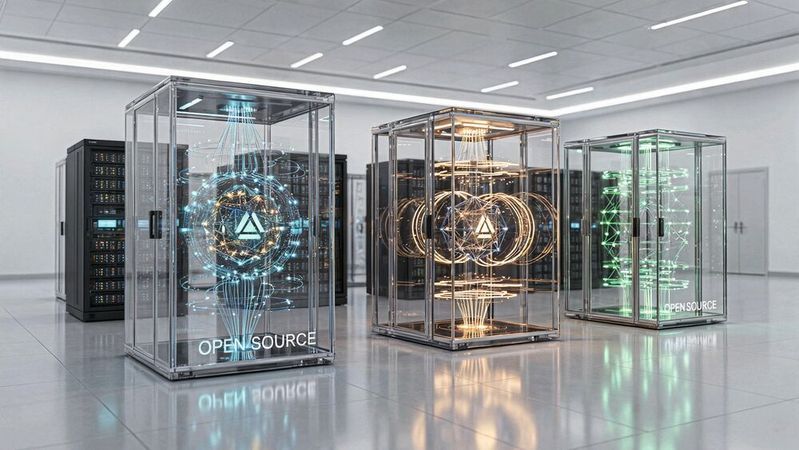
Converting for the future: In order to cope with the enormous workloads of generative AI, operators must fundamentally rethink the architecture of their data centers at all levels.
(Image: AI-generated)
Why is AI having such a profound impact on the data center industry and what is driving this change?
AI significantly increases the amount of data generated and processed. Machine learning (ML), neural networks, language processing, deep learning and generative AI are all based on the processing of enormous amounts of data. It is estimated that the global data volume will be 149 zettabytes (ZB) in 2024, up from just 59 ZB in 2020—a doubling in the last four years. This growth shows no sign of slowing down.
It's easy to see why investment in data centers is soaring. But it's not just about building more facilities. Traditional delivery models are becoming less important. To meet this demand, operators need to evolve their approaches in all areas—from hardware and infrastructure strategies to location and staffing models.
What Impact Does This Have on Hardware Decision-Making?
Although storage and computing capacities dominate the discussion, especially in view of the ongoing shortage, this is only part of the overall picture.
Consider, for example, data mobility within the data center. As more and more data is transferred at high speeds between nodes, system designers are faced with the task of evolving their approach to connecting infrastructure and increasingly using high-density fiber optic connections. We are seeing a growing demand for very small form factor connectors (VSFF) such as MMC and SN-MT. They offer three times the density of traditional fiber optic connectors, increase network capacity, reduce bottlenecks and improve overall system performance. They are therefore likely to become the preferred choice for faster deployment.
While solutions like these improve data throughput, they also present physical challenges. The sheer weight and bulk of these cables must also be considered. Many designers are therefore switching from high fiber count trunk cables to more manageable 144/288 fiber trunk cables. We anticipate that operators will be looking at similar options for vertical cable management within racks as the number of connections increases.
In addition to these challenges, bottlenecks in the supply chain are hampering the speed at which operators can deploy new equipment and upgrade existing sites. This in turn affects equipment purchasing decisions.
AI on this scale must place an unprecedented burden on the infrastructure of data centers. What impact will this have on energy consumption and power supply?
Power consumption remains a pressing issue. Data centers are energy-intensive, not only to process these enormous workloads, but also to ensure adequate cooling. The latest IEA (International Energy Agency) report found that data centers consumed around 460 TWh in 2022. It is predicted that this figure will exceed 1000 TWh by 2026.
This demand leads to regional capacity bottlenecks, which affect the distribution and transmission networks within the data centers. As a result, the model of expanding large clusters that has dominated the last decade is becoming increasingly unsustainable. Instead, we are seeing a trend towards more decentralized data centers that are closer to locations with high end-user density and sufficient power supply.
How does locating data centers close to end users affect local communities?
There were many justified objections from local residents, some of which led to lawsuits. One such case in France led to the withdrawal of a data center operator's operating license after the construction of the USD 150 million facility.
This forces operators to be very careful when deciding on the location of new data centers, especially in Europe.
One example is Frankfurt am Main, where energy consumption for municipal data centers has increased from 50 to 150 MW in just three years. This rapid development prompted the city council to introduce the "Frankfurt Data Center Master Plan", which aims to prevent the emergence of new data center clusters. To this end, urban planning regulations were amended to enable the strengthening of existing clusters and at the same time curb further expansion.
Date: 08.12.2025
Naturally, we always handle your personal data responsibly. Any personal data we receive from you is processed in accordance with applicable data protection legislation. For detailed information please see our privacy policy.
Consent to the use of data for promotional purposes
I hereby consent to Vogel Communications Group GmbH & Co. KG, Max-Planck-Str. 7-9, 97082 Würzburg including any affiliated companies according to §§ 15 et seq. AktG (hereafter: Vogel Communications Group) using my e-mail address to send editorial newsletters. A list of all affiliated companies can be found here
Newsletter content may include all products and services of any companies mentioned above, including for example specialist journals and books, events and fairs as well as event-related products and services, print and digital media offers and services such as additional (editorial) newsletters, raffles, lead campaigns, market research both online and offline, specialist webportals and e-learning offers. In case my personal telephone number has also been collected, it may be used for offers of aforementioned products, for services of the companies mentioned above, and market research purposes.
Additionally, my consent also includes the processing of my email address and telephone number for data matching for marketing purposes with select advertising partners such as LinkedIn, Google, and Meta. For this, Vogel Communications Group may transmit said data in hashed form to the advertising partners who then use said data to determine whether I am also a member of the mentioned advertising partner portals. Vogel Communications Group uses this feature for the purposes of re-targeting (up-selling, cross-selling, and customer loyalty), generating so-called look-alike audiences for acquisition of new customers, and as basis for exclusion for on-going advertising campaigns. Further information can be found in section “data matching for marketing purposes”.
In case I access protected data on Internet portals of Vogel Communications Group including any affiliated companies according to §§ 15 et seq. AktG, I need to provide further data in order to register for the access to such content. In return for this free access to editorial content, my data may be used in accordance with this consent for the purposes stated here. This does not apply to data matching for marketing purposes.
Right of revocation
I understand that I can revoke my consent at will. My revocation does not change the lawfulness of data processing that was conducted based on my consent leading up to my revocation. One option to declare my revocation is to use the contact form found at https://contact.vogel.de. In case I no longer wish to receive certain newsletters, I have subscribed to, I can also click on the unsubscribe link included at the end of a newsletter. Further information regarding my right of revocation and the implementation of it as well as the consequences of my revocation can be found in the data protection declaration, section editorial newsletter.
Ultimately, it comes down to communication and dialog with communities to explain the benefits, talk to decision-makers and support local initiatives to build trust.
In addition to location, what other geographical factors influence deployment strategies?
Data sovereignty is a key concern. Many regions are already enforcing strict data protection laws that impose regional controls, mobility standards and safeguards. These will continue to evolve alongside advances in AI, making flexibility and scalability essential when investing in physical infrastructure. This gives operators the confidence to easily support new topologies and data rates for upcoming servers and switches, even as regulations change.
How do all these new factors affect recruitment?
Recruitment remains a challenge and the skills shortage is significant. Around 10% of jobs in data centers are unfilled—more than double the national average for comparable industries. And that's before taking into account the expansion, which is further increasing the need for skilled workers.
These are highly technical positions. Only 15% of applicants meet the minimum requirements, leaving vacancies unfilled for months. This hinders plans for rapid scaling.
An effective approach here is to outsource complexity. Many companies now rely on external integrators who supply preconfigured, complete racks. This speeds up the expansion and relieves the burden on technical specialists at the new decentralized data centre locations.
Newly developed products also reduce deployment challenges: smaller multi-fibre connectors solve compaction issues, and multi-fibre connectors with over 100 fibres per connection speed up and optimize deployment. Another strategy is to consolidate connection points by using cables with a higher number of fibers. This significantly reduces the number of touch points and cabling density.
The challenge is that AI is forcing system developers and operators to rethink every level of design and deployment. These areas are just the beginning. Finding the right deployment strategies and system architectures, the right hardware and reliable integration partners as well as skilled staff is crucial. Scalability, resilience and efficiency are key to overcoming these challenges. How operators respond will shape the future of data centers for years to come.
* Trevor Smith is Business Development Manager at Molex.



:quality(80)/p7i.vogel.de/wcms/eb/2b/eb2bd1b8487afe577b37363cd02f16ff/0113143253v1.jpeg "In our China Market Insider, we regularly provide you with relevant information straight from China. (Image:© Eisenhans - stock.adobe.com)")
:quality(80)/p7i.vogel.de/wcms/d1/ef/d1ef6b6f7d4543f7999980bacccaf22b/0133499261v1.jpeg "As the growing imbalance in trade relations with China continues to widen, the EU Chamber of Commerce foresees a day when trade with China will have to be seriously reevaluated ... (Image: AI-generated)")
:quality(80)/p7i.vogel.de/wcms/fe/1f/fe1fa5ee713f94deaba963dc24c3abc5/0133299273v1.jpeg "The Flexistar enables highly flexible production of laser-welded tubes thanks to its tool-free clamping system. (Image:Because Technology, LLC)")
:quality(80)/p7i.vogel.de/wcms/1b/5a/1b5ac72f83db4dbee3ff91e51bc398f4/0133496095v1.jpeg "BASF announces that it will take the next step toward producing the polyurethane precursor MDI in India ... (Image:BASF)")
:quality(80)/p7i.vogel.de/wcms/60/ef/60ef4f07e4829b2c2929befc0f353c58/0133511729v1.jpeg "Humanoid robots can match human performance in certain tasks. (Image:Gemini / AI-generated)")
:quality(80)/p7i.vogel.de/wcms/2e/99/2e99726b522e4b35b690e25eb6a42643/0133463991v1.jpeg "Robotics: In AMR applications, connection technology must reliably transmit power, signals, and data despite vibration and shock loads—in very confined spaces and in a way that allows for regular maintenance. (Image:Hyperever)")
:quality(80)/p7i.vogel.de/wcms/d0/18/d01801e3d5dbd7bc9d0b4f60408b630c/0133468429v1.jpeg "Quality requirements for film packaging are on the rise. At the same time, many companies are turning to recyclable film materials, which, however, have their own challenges. Fraunhofer researchers have therefore developed a fast system that detects problems in real time. (Image:Fraunhofer IKTS)")
:quality(80)/p7i.vogel.de/wcms/b1/06/b106cf44923ce39565c3264982fd20eb/0133414574v1.jpeg "Robots Build Robots: At the new Ubtech factory, automated systems even handle parts of the material supply and logistics for the production of humanoid robots. (Image:Ubtech)")
:quality(80)/p7i.vogel.de/wcms/c0/52/c052f405eb55fc3d08c4837e77206fc0/adobestock-2021845957--aucartstudio-stock-adobe-com-ki-generiertv1.jpeg "An innovation from China to combat extreme summer heat: A novel coating lowers temperatures. (Source: © AucArtStudio – stock.adobe.com_AI-generated)")
:quality(80)/p7i.vogel.de/wcms/66/a7/66a7b78159caeacce57136529688799f/0133503398v1.jpeg "Sunlight Makes Stone! These stone blocks weren't made the traditional way. Instead, they were additively manufactured from sand using a laser. In the future, however, the laser is set to be replaced by concentrated sunlight—if the startup Addisol is successful... (Image:Addisol / F. Fiedler)")
:quality(80)/p7i.vogel.de/wcms/72/b9/72b995c2c8d812c5e2115cbef31e035a/0133462727v1.jpeg "Eggl manufactures center hoods that are precisely tailored to each cooking island—whether standard size or custom shape. They are made entirely of stainless steel and are individually customized in terms of size and filter arrangement. (Image:SPI)")
:quality(80)/p7i.vogel.de/wcms/13/5d/135dfae6229ceaf5c55467a43e8f7257/adobestock-1879961393--ardi-stock-adobe-com-ki-generiertv1.jpeg "Annoying chatterboxes or awkward silences in response to questions—a moderator should specifically prepare for difficult situations in order to navigate them effectively. (Image:ardi - stock.adobe.com_AI-generated)")
:quality(80)/p7i.vogel.de/wcms/aa/a2/aaa2c6dd2daa24b485cddbf9297590c0/0133467318v1.jpeg "Battery Monitoring: Battery monitoring using electrochemical impedance spectroscopy offers several advantages. (Image:TI)")
:quality(80)/p7i.vogel.de/wcms/39/b2/39b21bf03be1683831862239a369987c/0133469638v1.jpeg "Data from autonomous vehicles and robots operating autonomously is in high demand, and Ruqi wants to capitalize on this. (Image:Ruqi Mobility)")
:quality(80)/p7i.vogel.de/wcms/8a/bb/8abbb6217220595edc1549ac9b84f307/0133429906v1.jpeg "The IAA in Hanover showcased the ambitions of Chinese commercial vehicle manufacturers in Europe. (Image:Wehner - VCG)")
:quality(80)/p7i.vogel.de/wcms/0c/53/0c5313ef91c14b6df0d0996efc33c8ad/jpg03568-bearbeitetv1.jpeg "The category winners of the 2027 German Car of the Year award. (Source: GCOTY)")
:quality(80)/p7i.vogel.de/wcms/17/2b/172bd132f9febdfcbcedba292ad0504d/aufmacherv1.jpeg "Micro-Epsilon offers a wide range of IO-Link-compatible sensors. (Source: Micro-Epsilon Messtechnik GmbH & Co. KG)")
:quality(80)/p7i.vogel.de/wcms/ca/b4/cab46fd26d19d6a2febca032048200b6/0133471827v1.jpeg "Photonics SDK for C and Python: Computational operations are now abstracted as standard mathematical functions. (Image:Q.ANT)")
:quality(80)/p7i.vogel.de/wcms/92/b2/92b2ed5299cde450c0764f4f64468395/0133505895v1.jpeg "The \"Iris 100\" test system for high-precision volume production of microLEDs uses a spectrometer and a high-resolution camera. (Image:Teradyne)")
:quality(80)/p7i.vogel.de/wcms/f3/d8/f3d870d8f31a5a5110449c929ea3e641/0133470449v1.jpeg "The new Nexora sensor family from Teledyne e2v: These CMOS image sensors combine BSI technology with a global shutter and are available in 12- and 16-megapixel versions. (Image:Teledyne)")
:fill(fff,0)/p7i.vogel.de/companies/69/88/69882c428938e/tmts2026-ticec-banner-en-2000px.png "tmts2026-ticec-banner-en-2000px (https://www.tmts.tw/en)")
:quality(80):fill(efefef,0)/p7i.vogel.de/wcms/65/a6/65a678f1a2373/etmm-artificial-intelligence.png "ETMM Artificial Intelligence")
:quality(80)/p7i.vogel.de/wcms/ab/a0/aba00084ab468eac51ce70894a8e320f/mmc-ppb-5zu4-02-2026v1.jpeg "The push-pull mechanism allows for safe insertion and removal even at maximum port density. (Source: Rosenberger OSI)")
:quality(80)/p7i.vogel.de/wcms/18/5f/185f50b4a96889e23ff2215a24e14b61/0131645247v1.jpeg "The increasing use of AI applications is increasing the energy requirements of modern data centers and posing new challenges for power grids and energy infrastructures. (Image:Dall-E / AI-generated)")