Dirt, moisture, and vibrations pose challenges for fiber optic applications. Equipped with robust connectors, the fast and lightweight connection technology can now also leverage its advantages in harsh environments.
Fiber optic technology for harsh environments: Thanks to sophisticated methods for beam expansion and focusing, fiber optics can also be used in harsh environmental conditions.
(Image: Rosenberger)
Fast data transmission is becoming increasingly important in many areas today. Reasons include the increased use of image and video data, the growing deployment of AI applications and cloud services, as well as the ongoing digitalization.
A key metric is provided by the annual statistics of the German internet hub DE-CIX with its globally distributed data exchange points. In 2024, it recorded a global data traffic of 68 exabytes, an increase of 15 percent compared to 2023 (59 exabytes). The daily record saw a rise from 22.36 to 24.92 TBit/s, an increase of 11.4 percent.
This growth is only possible through the increasing use of fiber optic connections, which provide high bandwidths with low latency. Advances in transmission standards and connectors also enable more efficient use of individual fibers as well as easier bundling in limited space.
In data centers, fiber optics are already standard, and the connection of households and business locations is increasingly being switched from copper to fiber optics (FO). However, there are still areas where FO has not yet become established—as it is difficult to handle.
The transition from one fiber to the next is sensitive to contamination and moisture. Similarly, mechanical stresses and vibrations can impair or even interrupt data transmission. High temperatures and frequent mating cycles were also arguments against the use of optical fibers. In harsh environments, such as in manufacturing industries, users therefore often rely on copper cabling.
Beam Expansion for Less Sensitive Fiber Optics
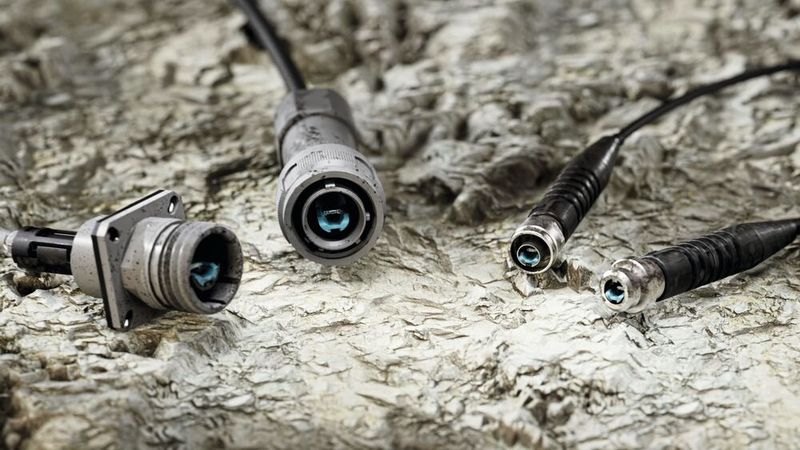
A first step towards more robust fiber optic connectors was achieved with the principle of beam expansion, which was further optimized with the EBO ferrule concept (Expanded Beam Optical). This was followed by robust connector systems from the EBM series (Expanded Beam Multifiber). The S-RMC and MIL13 connectors, developed in-house by Rosenberger Hochfrequenztechnik according to common industry standards, combine the robust EBO signal transmission with insensitive and stable housings.
The principle of beam expansion
Traditionally, signal transmission from one optical fiber to the next is achieved through physical contact (PC). The two fibers must be precisely aligned, i.e., centered and on a common axis. Additionally, the contact surface must be extremely clean, as dust and dirt would severely impair signal transmission. There is also the risk of fiber ends being scratched, which would affect the optical properties. Such connections are also sensitive to mechanical stresses and vibrations.
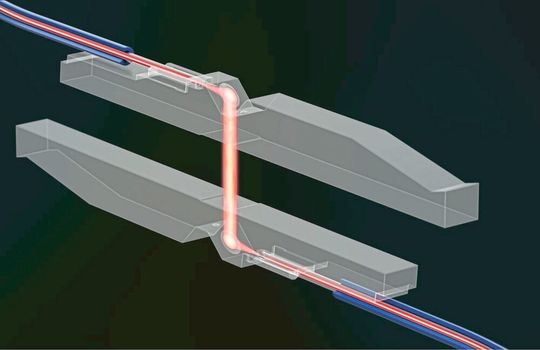
Using expanded beam technology, the connection becomes less sensitive to contamination. Shaped spherical lenses at the end of the optical fibers expand the focused light beam to a larger area and refocus it on the other side. Instead of a direct fiber-to-fiber contact, the light is transmitted through a free-space zone between the lenses—although still parallel to the alignment of the fiber, meaning there remains a risk of signal attenuation if the centering or alignment angle is not precisely maintained.
The EBO (Expanded Beam Optical) connector concept also expands and refocuses the light beam when transitioning from one fiber to another. However, it does so not along the fiber axis but using lenses with an elliptical cut that act like a collimator, thereby increasing the tolerance range. This ensures that the light beams are always correctly aligned, even if the fiber is not precisely positioned due to vibrations or mechanical stresses. At the same time, interference from particles is minimized, as pollen or intruding dirt only block a small part of the enlarged light area. The light beam is no longer fully or largely obstructed but only slightly attenuated. This preserves the full ability for data transmission.
Inside, there are ferrules that can hold between 2 and 16 single-mode or multi-mode fibers as needed. The robust connectors are designed for harsh conditions and up to 5,000 mating cycles. They ensure a reliable, low-loss connection with standardized formats (SC footprint) and allow for quick, intuitive installation without extensive training. The connectors are easy to clean without the need for special tools. The connector design is optimized for high performance with minimal space and weight requirements.
Challenges in the Manufacturing Industry
Image 1: The EBO connector concept expands the light beam during the transition from one fiber to another and then focuses it again.
(Image: Rosenberger)
In production, network components face various challenges: extreme or highly fluctuating temperatures, dust and dirt, liquids and chemicals, as well as vibrations and mechanical stresses. At the same time, there are high demands for reliability, as unplanned failures or plant downtime result in significant costs. The plug-and-play design of the EBM connectors in compact form factors (S-RMC, MIL13) simplifies installation and minimizes maintenance, reducing system downtime. The space-saving design, accommodating 2 to 16 single-mode or multi-mode fibers in a single connector, addresses the confined conditions in control cabinets and on control panels.
Another challenge is the increasing bandwidth requirements in factories. On one hand, growing digitalization means more sensors and actuators are being connected, while the use of image and video recordings in production processes is also rising sharply. Consequently, increasingly larger amounts of data, sometimes in real-time, must be transmitted and processed. This goes hand in hand with increasing automation, up to (partially) autonomous systems, which in turn require additional efforts to maintain safety and security. The resulting data volumes are best handled with fiber optics, which also offer an advantage in minimizing latency. (kr)
Harry Jacob is a freelance journalist in Augsburg, Germany.
Future-Proof Authentication with Universal RFID Readers
Naturally, we always handle your personal data responsibly. Any personal data we receive from you is processed in accordance with applicable data protection legislation. For detailed information please see our privacy policy.
Consent to the use of data for promotional purposes
I hereby consent to Vogel Communications Group GmbH & Co. KG, Max-Planck-Str. 7-9, 97082 Würzburg including any affiliated companies according to §§ 15 et seq. AktG (hereafter: Vogel Communications Group) using my e-mail address to send editorial newsletters. A list of all affiliated companies can be found here
Newsletter content may include all products and services of any companies mentioned above, including for example specialist journals and books, events and fairs as well as event-related products and services, print and digital media offers and services such as additional (editorial) newsletters, raffles, lead campaigns, market research both online and offline, specialist webportals and e-learning offers. In case my personal telephone number has also been collected, it may be used for offers of aforementioned products, for services of the companies mentioned above, and market research purposes.
Additionally, my consent also includes the processing of my email address and telephone number for data matching for marketing purposes with select advertising partners such as LinkedIn, Google, and Meta. For this, Vogel Communications Group may transmit said data in hashed form to the advertising partners who then use said data to determine whether I am also a member of the mentioned advertising partner portals. Vogel Communications Group uses this feature for the purposes of re-targeting (up-selling, cross-selling, and customer loyalty), generating so-called look-alike audiences for acquisition of new customers, and as basis for exclusion for on-going advertising campaigns. Further information can be found in section “data matching for marketing purposes”.
In case I access protected data on Internet portals of Vogel Communications Group including any affiliated companies according to §§ 15 et seq. AktG, I need to provide further data in order to register for the access to such content. In return for this free access to editorial content, my data may be used in accordance with this consent for the purposes stated here. This does not apply to data matching for marketing purposes.
Right of revocation
I understand that I can revoke my consent at will. My revocation does not change the lawfulness of data processing that was conducted based on my consent leading up to my revocation. One option to declare my revocation is to use the contact form found at https://contact.vogel.de. In case I no longer wish to receive certain newsletters, I have subscribed to, I can also click on the unsubscribe link included at the end of a newsletter. Further information regarding my right of revocation and the implementation of it as well as the consequences of my revocation can be found in the data protection declaration, section editorial newsletter.



:quality(80)/p7i.vogel.de/wcms/1d/09/1d0999956ef87709b72ab1d0402ba207/csf-minis-gruppe-final-01-outputv1.jpeg "Since mid-2026, Harmonic Drive has been offering its CSF Mini gearheads in size 7 as well, in six variants designed for different installation scenarios. (Source: Harmonic Drive)")
:quality(80)/p7i.vogel.de/wcms/ab/08/ab08675922c3a7edea45128248b45b00/0133857009v1.jpeg "In the aerospace industry—one of the most demanding sectors of all—the Shanghai-based company TOPNC has already made a name for itself. (Image:TOPNC)")
:quality(80)/p7i.vogel.de/wcms/ff/48/ff48b1154746e79128935f28bd73ba0e/0113143253v1.jpeg "In our China Market Insider, we regularly provide you with relevant information straight from China. (Image:© Eisenhans - stock.adobe.com)")
:quality(80)/p7i.vogel.de/wcms/b4/6e/b46ec48324b602f1a1b43836293d8968/0133970817v1.jpeg "New Weapons! Chancellor Friedrich Merz and French President Emmanuel Macron, in particular, are calling on the European Commission to take tougher action against unfair trade practices by certain countries. Read here to find out what that might look like... (Image: AI-generated)")
:quality(80)/p7i.vogel.de/wcms/ca/24/ca24d741a2fd714fa14d2a3e9db1c904/image1v1.jpeg "With 117,500 units sold, transportation and logistics will remain the leading application area for service robotics in 2025 as well. (Image:Innok Robotics)")
:quality(80)/p7i.vogel.de/wcms/b7/95/b795d5fb82459f8a526e880f0698dffa/1-maxon-mind-covershot-landscapev1.jpeg "Claude Jaquemet demonstrates the Maxon Mind demo system. (Source: Maxon)")
:quality(80)/p7i.vogel.de/wcms/be/66/be661616d5250d4c3814a25688f3904b/0133917202v1.jpeg "Neuron AI combines 3D vision, touch, hearing, proprioception, and language—along with memory—into a Perception-Language-Action (PLA) model. Robots can grasp objects they cannot see. (Image:Neura)")
:quality(80)/p7i.vogel.de/wcms/c7/12/c712b688dba2262fa3906e3a4c1d2f7d/humanoide-robotikv1.jpeg "“Find a job that the humanoid can actually do, and understand your processes”—that’s the advice robotics expert Sebastian Prinz gives companies so they can benefit from the technology in the long term. (Source: Fraunhofer IEM / Janosch Gruschczyk)")
:quality(80)/p7i.vogel.de/wcms/51/b8/51b8e08d2105fdd9952aff385f154192/graphic-2-adma1v1.png "The new surface hardening process enhances the performance of corrosion-resistant alloys by improving their tribological and mechanical surface properties, while preserving the properties of the base material. (Source: Bodycote)")
:quality(80)/p7i.vogel.de/wcms/96/ef/96effc239916cb7e0f396ab75627b8c0/image-space-testingv1.jpeg "Two scientists in front of a vacuum chamber used for testing: As technical instruments for spaceflight become more sensitive, the test facilities are becoming a critical system. (Source: Busch Group)")
:quality(80)/p7i.vogel.de/wcms/5a/12/5a1294a38a634f839f542c0055024d7a/jie-yin-feather-star-header-1500v1.jpeg "Underwater Acrobatics: The new soft robot mimics brittle stars—using minimal propulsion technology. (Source: North Carolina State University)")
:quality(80)/p7i.vogel.de/wcms/96/89/9689197f666e4aa9bc4a1f395c25d3ef/0133739635v1.jpeg "The 2026 Nobel Prize in Medicine laureates: Karl Deisseroth, Peter Hegemann, and Georg Nagel. (Image:Nobel Prize Outreach)")
:quality(80)/p7i.vogel.de/wcms/e3/0b/e30b87c9b7a6c41b7e7336f34f0a8214/0133970831v1.jpeg "Tesla's planned expansion of vehicle and battery production capacity in Grünheide, near Berlin, appears to be gaining momentum, according to a recent announcement by the U.S. electric car manufacturer ... (Image: AI-generated)")
:quality(80)/p7i.vogel.de/wcms/23/5f/235fa4afabc57699636224d17e106b4b/kraemer-p2p-display-technologyv1.png "The cockpit display system from Krämer Automotive Systems shows driving-related information, infotainment, and vehicle functions. (Source: Krämer Automotive)")
:quality(80)/p7i.vogel.de/wcms/74/c2/74c23330dd9ae0a52a04081387700910/0133983556v1.jpeg "(Image:Stadler Rail AG)")
:quality(80)/p7i.vogel.de/wcms/9d/2b/9d2bfaec0c4526db4dba63f74ae63872/screenshot-2026-10-19-113605v1.png "The brake pedal on the Maextro V800 luxury van is broken. This has implications for regulations in China. (Screenshot from the website) (Image:Maextro/HIMA)")
:quality(80)/p7i.vogel.de/wcms/b3/bf/b3bf55a31510b319bb473f73aa205477/0133987448v1.jpeg "In court, Qualcomm achieved a partial victory in its legal dispute with Arm, but was awarded only a symbolic $2 in damages—for now. (Image:Dall-E / AI-generated)")
:quality(80)/p7i.vogel.de/wcms/9c/fc/9cfce46a9d31453834442ef2373c821d/0133913848v1.jpeg "Illustration: In direct-to-chip cooling, a heat sink absorbs heat directly from the processor. In immersion cooling, on the other hand, the electronic components are completely submerged in an electrically insulating coolant. (Image:Dall-E / AI-generated)")
:quality(80)/p7i.vogel.de/wcms/cd/49/cd49c2b5951c484c72f87e7c148145a2/0133989644v1.jpeg "Infineon is increasingly relying on 200-mm wafers for the production of SiC power semiconductors. An expanded supply agreement with Wolfspeed is intended to ensure a steady supply of the larger substrates. (Image:Infineon Technologies)")
:quality(80)/p7i.vogel.de/wcms/76/c6/76c6e27898decc7f638189b2eb2404ed/0133998131v1.jpeg "After China began taking a closer look last year at what kind of know-how is allowed to leave the country, it is now tightening controls even further... (Image: AI-generated)")
:fill(fff,0)/images.vogel.de/vogelonline/companyimg/76800/76895/65.jpg "FAULHABER_120mm.jpg ()")
:quality(80):fill(efefef,0)/p7i.vogel.de/wcms/67/ae/67ae0b9ac31f8/elatec-wp-universal-reader.png "Elatec WP Universal Reader")
:quality(80)/p7i.vogel.de/wcms/ab/10/ab103bc3836c066c7dc31469c616f717/0132140113v1.jpeg "Rosenberger offers an entire family of EBM connectors. (Image: Rosenberger)")
:quality(80)/p7i.vogel.de/wcms/ab/a0/aba00084ab468eac51ce70894a8e320f/mmc-ppb-5zu4-02-2026v1.jpeg "The push-pull mechanism allows for safe insertion and removal even at maximum port density. (Source: Rosenberger OSI)")