Fraunhofer IISB has developed a wireless charging system for robots that is directly integrated into the feet. Through an intelligent induction field, the energy storage is recharged highly efficiently during operation.
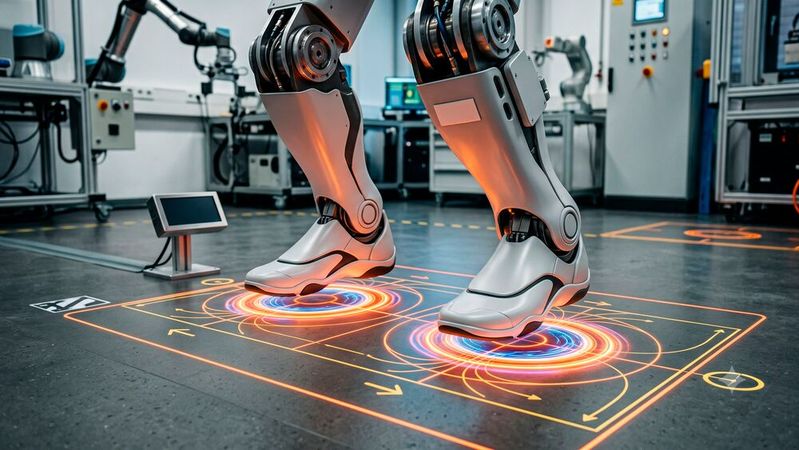
Wireless power supply: Position-tolerant inductive charging systems achieve high efficiencies and present an alternative to plug contacts or battery replacements.
(Image: Gemini / AI-generated)
Mobile and humanoid robots currently draw their energy mostly from batteries, which are depleted after just a few hours of operation. A traditional charging process via conductive plug contacts is, however, prone to corrosion and mechanical wear in industrial environments. Alternatives like battery swapping stations force the robot to interrupt its primary task and move to designated areas. For this reason, Fraunhofer IISB is focusing on inductive power transfer. Dr. Bernd Eckard, who heads the Power Electronics department at IISB in Erlangen (Germany), presented his solution during a lecture at the Humanoid Days at the University of Erlangen.
"Without efficient energy supply and power conversion, no robot will move. Even if it has the best actuators and the latest software, it still needs energy," says Dr. Eckardt. The concept of his research institute integrates the receiver coils directly into the soles of the robot's feet. In the floor of the workspace, the developers install an array of transmitter coils in parallel. This field operates on the same principle as a modern multi-zone induction cooktop. The system detects the exact position of the robot and activates only the coils where the robot's foot is actually placed.
A single receiver coil measures approximately twelve centimeters in diameter. This corresponds exactly to the width of a typical robot foot, making the components easy to integrate mechanically. Despite these compact dimensions, a single coil transfers a power of 3.6 kilowatts. If engineers install two coils per foot, a robot could theoretically draw up to 14 kilowatts of charging power through both legs.
Technically, the contactless power transfer is based on a so-called CLLC resonant converter. Unlike the inductive charging of electric cars, where a large air gap must be bridged, a robot stands directly on the floor. This virtually eliminates the gap in the Z-axis. As a result, the system achieves high coupling factors between 0.5 and 0.6. This strong magnetic coupling reduces the need for copper in the windings, making the coils lighter and more cost-effective to manufacture.
High Efficiency Prevents Thermal Issues
The optimized coupling and the use of resonance converters directly impact overall efficiency. The energy transfer from the ground to the robot's direct current circuit operates with an efficiency of 97 percent. This means the inductive system achieves the same efficiency as a conventional wired power supply.
This high efficiency prevents large amounts of power loss in the form of heat. Therefore, the system does not need to be cooled. For inductively charging smartphones, efficiency often ranges only between 80 to 85 percent, which is why these devices become noticeably hotter.
New Freedoms in Robot Design
The ability to continuously charge the robot during its work or at fixed workstations changes the fundamental system architecture. Designers can completely redefine the internal energy storage. Eckardt assesses the potential for mechanical design: "If you supply energy externally during the entire operation of the robot, we can theoretically do away with the onboard energy storage entirely, or at least design it to be very small, which in our view also saves significant weight."
A reduced battery mass not only lowers material costs but also decreases the energy the robot needs to expend just to move its own weight. Additionally, the charging system operates fully interoperably. A manufacturing company can install induction strips or so-called E-roads along main traffic routes. This infrastructure then flexibly and wear-free supplies both humanoid robots and conventional driverless transport systems with energy.
Date: 08.12.2025
Naturally, we always handle your personal data responsibly. Any personal data we receive from you is processed in accordance with applicable data protection legislation. For detailed information please see our privacy policy.
Consent to the use of data for promotional purposes
I hereby consent to Vogel Communications Group GmbH & Co. KG, Max-Planck-Str. 7-9, 97082 Würzburg including any affiliated companies according to §§ 15 et seq. AktG (hereafter: Vogel Communications Group) using my e-mail address to send editorial newsletters. A list of all affiliated companies can be found here
Newsletter content may include all products and services of any companies mentioned above, including for example specialist journals and books, events and fairs as well as event-related products and services, print and digital media offers and services such as additional (editorial) newsletters, raffles, lead campaigns, market research both online and offline, specialist webportals and e-learning offers. In case my personal telephone number has also been collected, it may be used for offers of aforementioned products, for services of the companies mentioned above, and market research purposes.
Additionally, my consent also includes the processing of my email address and telephone number for data matching for marketing purposes with select advertising partners such as LinkedIn, Google, and Meta. For this, Vogel Communications Group may transmit said data in hashed form to the advertising partners who then use said data to determine whether I am also a member of the mentioned advertising partner portals. Vogel Communications Group uses this feature for the purposes of re-targeting (up-selling, cross-selling, and customer loyalty), generating so-called look-alike audiences for acquisition of new customers, and as basis for exclusion for on-going advertising campaigns. Further information can be found in section “data matching for marketing purposes”.
In case I access protected data on Internet portals of Vogel Communications Group including any affiliated companies according to §§ 15 et seq. AktG, I need to provide further data in order to register for the access to such content. In return for this free access to editorial content, my data may be used in accordance with this consent for the purposes stated here. This does not apply to data matching for marketing purposes.
Right of revocation
I understand that I can revoke my consent at will. My revocation does not change the lawfulness of data processing that was conducted based on my consent leading up to my revocation. One option to declare my revocation is to use the contact form found at https://contact.vogel.de. In case I no longer wish to receive certain newsletters, I have subscribed to, I can also click on the unsubscribe link included at the end of a newsletter. Further information regarding my right of revocation and the implementation of it as well as the consequences of my revocation can be found in the data protection declaration, section editorial newsletter.



:quality(80)/p7i.vogel.de/wcms/8e/7e/8e7e0cda4c68699bcc48283a38739769/0133316747v1.jpeg "A little-known hidden champion! When people think of laser cutting, the first thing that comes to mind is the power of the laser beam—and it is impressive to see the sparks flying. But Air Liquide—an exhibitor at Euroblech, by the way—wants to make it clear that the process gas is also key to success. (Image:AI-generated)")
:quality(80)/p7i.vogel.de/wcms/20/fa/20fa35e0af203c3464f7e7fdbb57a685/0133281172v1.jpeg "Since 2003, Etzinger AG has been developing and manufacturing high-quality coffee grinders, pepper mills, and grinding mechanisms for professional and home use. (Image:Etzinger)")
:quality(80)/p7i.vogel.de/wcms/69/91/6991413943488b4a2f6fde9dcd88c5b0/0133256686v1.jpeg "The CMA-patented pendulum mount can compensate for radial tolerances of up to one millimeter. (Image:Schwiening)")
:quality(80)/p7i.vogel.de/wcms/0b/cd/0bcd6d502ffcd087c4fc12b7b760b3ce/0133317507v2v1.jpeg "The new Multi Center from J.G. Weisser. (Image:J.G. Weisser)")
:quality(80)/p7i.vogel.de/wcms/bd/4e/bd4ef09ab0f84932ea76ca0330ffe789/0133329802v1.jpeg "The robotics boom and its consequences: According to a study, a significant portion of value creation occurs in the electronics industry. (Image:Fraunhofer IPA)")
:quality(80)/p7i.vogel.de/wcms/35/81/35815f36be1b1c13f9abef4cea2a3e2b/0133171739v1.jpeg "Humanoid robots in industry: Despite impressive progress, many systems are still in the pilot phase. (Image:AI-generated)")
:quality(80)/p7i.vogel.de/wcms/81/dc/81dc63ed24c562521413023779495e7d/chris-kramerv1.jpeg "Chris Kramar, Director and General Manager of OEM Solutions for Germany, Austria, and Switzerland at Dell Technologies (Source: Dell Technologies)")
:quality(80)/p7i.vogel.de/wcms/bb/f5/bbf5342f532debc1bd7c09c2b9a0bf42/0133176497v1.jpeg "Over the past two years, AI has emerged as the most important growth driver in the industry. (Image: ©Gorodenkoff - stock.adobe.com)")
:quality(80)/p7i.vogel.de/wcms/e9/19/e91905d37afe605bc348a690a4fed72e/0133350592v1.jpeg "At Autodesk University, Autodesk is introducing new AI features for CAD and PLM. (Image:Autodesk)")
:quality(80)/p7i.vogel.de/wcms/98/73/98731d23cbd95ff22391993a74cfefbf/mit-bifurcatedcircuits-01-pressv1.jpeg "A sample of the variety of configurations that Bifur circuits can form. (Source: Courtesy of the researchers)")
:quality(80)/p7i.vogel.de/wcms/f4/3d/f43d1f4297d9ae0cd1b6d2adfcb5ffe1/0133276470v1.jpeg "Simulation: Electric arcs in the electrical industry, including associated field simulation. (Image:CADFEM)")
:quality(80)/p7i.vogel.de/wcms/3e/f1/3ef196715e1b291ec7ae84f02c875c63/0133310495v1.jpeg "The Next Phase of Ethernet in Vehicles: End-to-end Ethernet integrates all high-data-rate devices into the network, including displays and central high-performance computing units. (Image:Infineon Technologies)")
:quality(80)/p7i.vogel.de/wcms/b4/b8/b4b89c48bb797df7251706d4ee096a80/0133359349v1.jpeg "To advance modern rail transportation, Knorr-Bremse and CARS have signed a memorandum of understanding regarding the China Freight Cooperation Program. Pictured here is Rail Executive Board Member Nicolas Lange at the signing ceremony in Beijing. (Image: Knorr-Bremse)")
:quality(80)/p7i.vogel.de/wcms/99/8c/998cb26cfb3110e8444a4ecbfe2dc799/0133338279v1.jpeg "Electric car manufacturer Rivian is launching its R2 SUV in the U.S. (Image:Rivian)")
:quality(80)/p7i.vogel.de/wcms/cc/d1/ccd1607af856c9cff96c73a5ffccfcad/p90652283-highres-demonstrator-woodenv1.jpeg "The FSCM research project, which was recently completed, is delivering innovations close to production for plastics, metals, and design at BMW. (Source: BMW)")
:quality(80)/p7i.vogel.de/wcms/4c/53/4c534208d09a9b1ce597938715e7fc19/0133288763v1.jpeg "Logic Folding: In its latest Kirin 9050 Pro, Huawei uses hybrid bonding to distribute the computing units across two silicon layers in order to increase the effective transistor density without resorting to finer manufacturing processes. (Image:Huawei)")
:quality(80)/p7i.vogel.de/wcms/56/d1/56d131e0b5bd05ef47411e92ad740cb4/0133351029v1.jpeg "Researchers at DTU have developed a nanolaser in a semiconductor membrane. The structure concentrates charge carriers and the light field into a small area (shaded in blue). If data is transmitted on microchips using light instead of electrical signals, transmission speeds can be increased and energy losses reduced. (Image:Yi Yu, DTU)")
:quality(80)/p7i.vogel.de/wcms/5e/55/5e55101ddc6338f755fcf3244db1367f/0133331863v1.jpeg "For data center projects, it is becoming increasingly important to also obtain the consent of the affected community. (Image:Dall-E / AI-generated)")
:quality(80)/p7i.vogel.de/wcms/8d/f9/8df95d3f58408673986b3d643e6b63ba/0133252773v1.jpeg "TXC targets high-speed optical links in AI data centers with 312.5 MHz oscillators, among other solutions. As data rates increase, requirements for jitter and frequency stability become more demanding as well. (Bild: TXC)")
:fill(fff,0)/p7i.vogel.de/companies/69/88/69882c428938e/tmts2026-ticec-banner-en-2000px.png "tmts2026-ticec-banner-en-2000px (https://www.tmts.tw/en)")
:fill(fff,0)/p7i.vogel.de/companies/69/de/69de1b7403b0d/simtos-logo.jpeg "simtos-logo (SIMTOS)")
:quality(80)/p7i.vogel.de/wcms/2a/16/2a164f7cbaf53e75573f718f69560c03/-28c-29designbyfreepik2v1.jpeg "Humanoid robots could become one of the most important tools of modern industrial and service society within the next ten years. (Image:FreePik2)")
:quality(80)/p7i.vogel.de/wcms/c2/e6/c2e635c969f9d2cf3b93a518ced37444/0132293200v1.jpeg "Analysis of the magnetic design: The diagram shows how the lateral offset of the coils and the size of the air gap affect the coupling factor.(Image: Dr. Bernd Eckardt, Fraunhofer IISB)")
:quality(80)/p7i.vogel.de/wcms/08/c4/08c47d5f92cd60fdf430de94c4d29376/0132293518v1.jpeg "Sketching a dynamic charging concept (\"E|Road System\") that enables charging the robot via primary coils embedded in the floor directly during movement, without mechanical adjustments.(Image: Dr. Bernd Eckardt, Fraunhofer IISB)")
:quality(80)/p7i.vogel.de/wcms/d2/99/d299882c207d9bb29a80891cb0b99a0e/0132293203v1.jpeg "Technical detailed view of the system design for inductive power transfer with an equivalent circuit diagram, mathematical principles, and a graph showing efficiency as a function of quality factor (Q) and coupling factor (k).(Image: Dr. Bernd Eckardt, Fraunhofer IISB)")
:quality(80)/p7i.vogel.de/wcms/91/c0/91c04a57fbb9b43e389b48d7ad8c8846/0132293194v1.jpeg "Wireless power supply: Position-tolerant inductive charging systems achieve high efficiencies and present an alternative to plug contacts or battery replacements.(Image: Gemini / AI-generated)")
:quality(80)/p7i.vogel.de/wcms/ab/0c/ab0c1d78287e739a0c4e5bc90927e773/0132791903v1.jpeg "The \"DCI4Charge\" project demonstrates how companies can integrate direct current networks, charging infrastructure, and electric vehicles into a unified energy system. (Image:Fraunhofer IPA | Rainer Bez)")
:quality(80)/p7i.vogel.de/wcms/06/f6/06f6c0b0a9315eb409432cba3f157e1d/0130677175v1.jpeg "Cross-sectional view of the 750 kW electric machine with oil cooling and hairpin windings. (Image:Thomas Schriefer / Fraunhofer IISB)")