With customized automation solutions, the profitability of companies can be maximized. An important component are driverless transport systems in intralogistics. Five facts highlight the benefits.
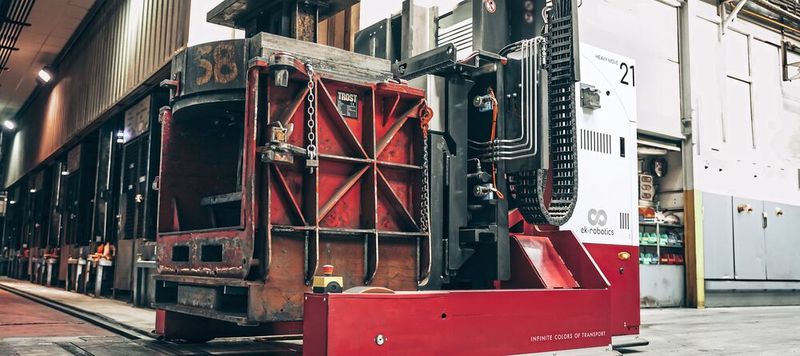
The presses at RHI Magnesita are serviced by two transport robots from EK Robotics. For the process-safe changeovers with the forms weighing up to 6.5 tons, accuracy in the millimeter range is required.
(Image: EK Robotics)
Due to the ongoing trend towards automation, an increasing number of companies, regardless of their size and industry affiliation, are integrating driverless transport systems (FTS) into their intralogistics.
Fact 1: Customized automation solutions
In modern industry, the use of driverless transport systems is becoming increasingly complex and demanding. To meet these escalating requirements, individual and precisely planned transport solutions are of importance. They must be tailored to the specific needs and environmental requirements of the user in order to ensure necessary efficiency and safety. High availability through continuous operation, coupled with lower personnel dependence, are clear advantages for users, as is a transparent overview of internal material flow. The intelligent networking of vehicles with the entire production offers great potential for optimized efficiency and profitability of a company. EK Robotics realizes customized transport solutions that are individually tailored from conception to implementation to specific requirements and environmental conditions. To date, EK Robotics has installed over 1,500 systems and delivered more than 12,500 driverless transport vehicles (FTF).
Fact 2: Material flow simulations ensure planning security
The implementation of an AGV system requires extensive preliminary work, in which experts need to precisely plan and program the maps for driving courses and specific transport steps. Using on-site 3D measurement, followed by a simulation of material flows, a digital twin of the planned system is created. Especially in complex intralogistics projects, it is crucial to collect as much data as possible in advance in order to precisely depict all relevant interrelationships. Ronald Kretschmer, Chief Sales Officer at EK Robotics, explains: "In this way, potential system limits, bottlenecks, blockages and the appropriate solution alternatives can be identified before actual implementation." A current example from the refractory industry illustrates the importance of simulation during the planning phase: The Austrian company RHI Magnesita decided early on to create a 3D point cloud of its refractory production. Through the 3D scan, millimeter-precise irregularities could be detected and particularly narrow driving course areas could be identified, facilitating the creation of a precise digital replica for further project planning. Based on these detailed measurements, an optimal layout of the driving courses was created in a dynamic simulation of the AGV system. By means of an envelope analysis, it was ensured that all vehicles can pass through the narrow driving course areas without problems in the real application. Using various simulation models, the optimal number of vehicles was determined at maximum throughput, considering set-up times, the placement of charging stations, and the transport routes for over 500 possible routes.
Fact 3: Automated niche solutions
EK Robotics also implements AGV systems that, due to their characteristics, belong to the niches of the automation industry. An example is the integration of two four-way stackers for the automated storage and retrieval in the mobile racking system at Warema, a manufacturer of sun protection systems. Since 2022, all transport routes from production to the loading gates in the shipping area have been automated. This also includes the storage of goods in the movable racking system: The transport robots specially made for this purpose serve around 2,000 spaces and store the goods, which are up to 5 meters long, in and out at a transfer height of up to 8 meters. The different transport requirements for the overall system are correspondingly complex and also require constant communication with many interfaces, such as the warehouse management system, the ERP, the transport manager, the mobile racking system, and the measurement station for weight and length control of Warema products.
Just as demanding and complex in implementation are transport solutions for permanent use outdoors. On the one hand, vehicle-side measures must be taken to protect electrical and electronic components against the influence of weather. On the other hand, certain requirements for the route must be met in terms of weather resistance, inclines, and measures at temperatures below 0 degrees Celsius. A surface must be used for the track that is both frost-resistant and resistant to strong sunlight. For example, highway concrete is particularly suitable. For companies like Baxter, MSD, JTI, and Gerolsteiner from the pharmaceutical, tobacco, and beverage industries, EK Robotics has integrated several outdoor systems that connect production and storage halls and are equipped with various special functions, such as a cooling unit.
Date: 08.12.2025
Naturally, we always handle your personal data responsibly. Any personal data we receive from you is processed in accordance with applicable data protection legislation. For detailed information please see our privacy policy.
Consent to the use of data for promotional purposes
I hereby consent to Vogel Communications Group GmbH & Co. KG, Max-Planck-Str. 7-9, 97082 Würzburg including any affiliated companies according to §§ 15 et seq. AktG (hereafter: Vogel Communications Group) using my e-mail address to send editorial newsletters. A list of all affiliated companies can be found here
Newsletter content may include all products and services of any companies mentioned above, including for example specialist journals and books, events and fairs as well as event-related products and services, print and digital media offers and services such as additional (editorial) newsletters, raffles, lead campaigns, market research both online and offline, specialist webportals and e-learning offers. In case my personal telephone number has also been collected, it may be used for offers of aforementioned products, for services of the companies mentioned above, and market research purposes.
Additionally, my consent also includes the processing of my email address and telephone number for data matching for marketing purposes with select advertising partners such as LinkedIn, Google, and Meta. For this, Vogel Communications Group may transmit said data in hashed form to the advertising partners who then use said data to determine whether I am also a member of the mentioned advertising partner portals. Vogel Communications Group uses this feature for the purposes of re-targeting (up-selling, cross-selling, and customer loyalty), generating so-called look-alike audiences for acquisition of new customers, and as basis for exclusion for on-going advertising campaigns. Further information can be found in section “data matching for marketing purposes”.
In case I access protected data on Internet portals of Vogel Communications Group including any affiliated companies according to §§ 15 et seq. AktG, I need to provide further data in order to register for the access to such content. In return for this free access to editorial content, my data may be used in accordance with this consent for the purposes stated here. This does not apply to data matching for marketing purposes.
Right of revocation
I understand that I can revoke my consent at will. My revocation does not change the lawfulness of data processing that was conducted based on my consent leading up to my revocation. One option to declare my revocation is to use the contact form found at https://contact.vogel.de. In case I no longer wish to receive certain newsletters, I have subscribed to, I can also click on the unsubscribe link included at the end of a newsletter. Further information regarding my right of revocation and the implementation of it as well as the consequences of my revocation can be found in the data protection declaration, section editorial newsletter.
Fact 4: AGVs minimize transport damage
The replacement of conventional forklifts with driverless transport vehicles significantly reduces the risk of accidents caused by human error. The transport robots follow preprogrammed routes and are equipped with state-of-the-art safety technology and 3D obstacle detection to protect people and objects. The automation of material flows in intralogistics thus enables the efficient use of existing skilled workers. In addition, transport robots are capable of taking on heavy, dangerous, and repetitive tasks.
Fact 5: Extend service life
Companies like Warema and Sinit Kunststoffwerke use analysis tools to monitor and optimize the performance of their AGVs over their lifetime. By using Software-as-a-Service solutions like the Smart Analytics Reporting App, short for Sara, evaluations are made and recommendations for sustainable system efficiency are derived. Users have the opportunity to follow the developments of their system over the duration of usage, evaluate the performance of the system, and gain insights into production times, system utilization and operating interruptions. Reporting and analysis tools like Sara identify optimization potential, peak performance, and conspicuous route sections.
The life cycle of AGVs, with adherence to maintenance intervals and retrofit programs, spans several decades. During this long period of use, the transport solutions lead to optimal material flow, improved safety at work, and reduced operating costs. The lifespan of an AGV is calculated in operational hours and depends on the specific application and intensity of use. Ronald Kretschmer explains, "For automated series floor conveyance vehicles, which come from renowned manufacturers and are retrofitted by us for automated operation, we calculate about 30,000 operating hours, which is at least ten years. For individually developed special vehicles, which are precisely tailored to the requirements of our customers, we even plan 60,000 to 80,000 operating hours. This equates to a lifespan of 20 to 30 years." But what happens after this time? Kretschmer says, "With foresight planning, the existing system can be gradually brought up-to-date and, if necessary, adapted to changed tasks." The retrofit program from EK Robotics enables the modernization of both the vehicles and the entire transport systems, thus preparing them for further operating hours.
An example is provided by a French pharmaceutical conglomerate. At a German location, insulin active ingredients and insulin pens are produced. An EK Robotics plant with twelve transport robots has been in operation 24 hours a day since 2006. The AGV system has been continuously optimized and carries out up to 1,400 transports every day. Seventeen years after the initial installation, the existing vehicles are being modernized and the overall system is being expanded by seven new transport robots. The retrofit package includes the integration of additional sensors, including two-sided monitoring of the telescopic extensions and load carrier detection for loads of up to 800 kilograms. Personal safety scanners, attached to all sides of the vehicles, ensure maximum safety on the 1,000-metre course with numerous narrow points. The new transport robots are also customized; equipped with laterally extendable telescopic forks, they transport pallets between storage areas, production, disposal, and the packaging area.



:quality(80)/p7i.vogel.de/wcms/68/a5/68a5ce0896756c1dcf48dbeceefafbd3/0132300990v1.jpeg "Christoph Geigges is President and CEO of Walter AG. Headquartered in Tübingen (Germany), the company is one of the world’s leading suppliers of precision tools for metalworking. Under Geigges’ leadership, this long-established company is increasingly transforming itself from a tool manufacturer into an engineering partner that supports the entire manufacturing process. (Image: Walter AG)")
:quality(80)/p7i.vogel.de/wcms/3e/7c/3e7c26f44c68545fc7318597b6b65903/0133649650v1.jpeg "The flexible Heller circular storage system can store and process pallets measuring both 630 millimeters by 630 millimeters and 800 millimeters by 800 millimeters—even in mixed-mode operation. This makes the entire production line particularly flexible. (Image:Brighter)")
:quality(80)/p7i.vogel.de/wcms/16/29/162983885950ec1df27ab441bfe88613/0133132549v1.jpeg "Bernd Hermeler is the CEO of Cemecon AG. He studied mechanical engineering at RWTH Aachen University (Germany)—the very university from which the company emerged as a spin-off 40 years ago. Today, Hermeler is responsible for the global strategy of the coating specialist, which, with branches in Europe, the U.S., China, Japan, and India, is considered the global technology leader in the coating of cutting tools. (Image: Cemecon AG)")
:quality(80)/p7i.vogel.de/wcms/af/81/af81b53cb4926dcadc20ba369a29d412/0132695968v1.jpeg "International venture capital is increasingly flowing into the machining industry. Here are the players that entrepreneurs and CEOs should keep an eye on right now. (Image: ©NDABCREATIVITY - stock.adobe.com)")
:quality(80)/p7i.vogel.de/wcms/88/dc/88dc38a1a0b5e016192ab83b0850fbd0/0133514708v1.jpeg "Scalable data sovereignty is the foundation for the transition from computationally intensive AI processing and growing data streams to sustainable, energy-efficient storage systems. (Image:Gemini / AI-generated)")
:quality(80)/p7i.vogel.de/wcms/1c/ef/1cef66e13c5cc02c5731fefcc99c00d2/0133697754v1.jpeg "Embodied AI in Industry: FMC³ Robotics combines AI-based perception and adaptation with traditional robot control to prepare robots for use in industrial manufacturing. (Image:FMC³/processed by AI)")
:quality(80)/p7i.vogel.de/wcms/db/ca/dbcae78eb8853b53fe122832fe3b2cba/0132914918v1.jpeg "Robotics in Flexible Manufacturing: As connectivity increases, so do the requirements for functional safety. (Image: Delta Electronics)")
:quality(80)/p7i.vogel.de/wcms/ea/18/ea18e84aed24bbe1c91937f30c2f7301/image1v1.jpeg "Kassow Robots' new product portfolio now includes seven 7-axis cobots. (Image: Kassow Robots (Image:)")
:quality(80)/p7i.vogel.de/wcms/90/30/90300137452b00d22f95113eff065ac3/fliehkraftkupplungen-und-bremsen-montage-centrifugal-clutches-and-brakes-assembly-1v1.jpeg "Installation: Centrifugal clutches should always be precisely matched to the machine. (Source: Amsbeck Machine Technology)")
:quality(80)/p7i.vogel.de/wcms/93/84/9384230e840a99a2015fdd3e0af11e2b/newsimage428236v1.jpeg "The crutch replicates the natural, biomechanical movement pattern of the human body. (Source: Leon Kast)")
:quality(80)/p7i.vogel.de/wcms/5b/a2/5ba21b3e5fcdd91f6bfe806f745ea723/isc-physioink-bild-3v1.jpeg "In the PhysioINK project, Fraunhofer researchers are developing bio-printing inks from the most common tissue proteins. Under the microscope, the living tissue cells (fibroblasts) are visible in the printed lattice structure: blue represents the cell nucleus, and green represents the cytoskeleton. (Source: Tobias Weigel/Fraunhofer ISC)")
:quality(80)/p7i.vogel.de/wcms/9c/16/9c16e4aa02594fe4bf82ead736562b07/directhop1-scaledv1.jpeg "Light as a feather, but without feathers: The University of Washington's robot, which weighs just one gram, uses a bionic direct-drive system to catapult itself into the air with centimeter-level precision. (Source: Mark Stone/University of Washington)")
:quality(80)/p7i.vogel.de/wcms/0a/50/0a50938be0b598b36efc4e5457ed56dd/forvia-siege-zen-massage-16-9-06v1.jpeg "Seat with massage function by Forvia. (Source: Forvia)")
:quality(80)/p7i.vogel.de/wcms/99/61/9961719acb89bc87fdecb1bba140481c/0133725593v1.jpeg "Ultrason (PSU, PESU, PPSU) is suitable for E&E components used in electric mobility or AI infrastructure, such as connectors for fiber-optic cables. (Image:BASF)")
:quality(80)/p7i.vogel.de/wcms/42/9b/429badd88cd4a74edb6491d10310349c/wayve-london-05v1.jpeg "Wayve is developing an AI software stack for automated driving. It appears that the Volkswagen Group has now opted for this technology. (Source: Wayve)")
:quality(80)/p7i.vogel.de/wcms/14/9f/149f934f87e5418748fa41a611586a4f/rawdon-gloverv1.jpeg "Rowdon Glover, Managing Director of Jaguar: “We are willing to accept polarization.” (Image:JLR)")
:quality(80)/p7i.vogel.de/wcms/36/f0/36f0472d20227013871aa790f4d48ac6/0133726018v1.jpeg "Ion beams can ablate, coat, or smooth surfaces down to the atomic level. Such processes are used, among other things, in optical chips, precision optics, and superconducting materials. (Image:AI-generated)")
:quality(80)/p7i.vogel.de/wcms/1f/47/1f47da6ee12c38a745eb478a04157a65/0133726100v1.jpeg "The schematic diagram shows the structure of a 3D NAND memory device with memory cells stacked on top of one another and vertical connections for high storage density. (Image:Dall-E / AI-generated)")
:quality(80)/p7i.vogel.de/wcms/70/59/7059db055d4eeb8dea752651a071f360/geralt-handshake-4608297v1.jpeg "The deal between Schneider Electric and PTC is intended to create end-to-end data flows for the industry. (Source: )")
:quality(80)/p7i.vogel.de/wcms/67/3d/673d8f6f14bd030b53b61800a0aeb06d/0133548286v1.jpeg "Overview: If even a single critical component is missing, the entire production process can come to a standstill. Proactive procurement is intended to mitigate such bottlenecks early on. (Image:Dall-E / AI-generated)")
:fill(fff,0)/images.vogel.de/vogelonline/companyimg/76800/76895/65.jpg "FAULHABER_120mm.jpg ()")
:fill(fff,0)/p7i.vogel.de/companies/69/de/69de1b7403b0d/simtos-logo.jpeg "simtos-logo (SIMTOS)")
:quality(80)/p7i.vogel.de/wcms/cc/22/cc22b45956c0f10edac654c2a6e72932/0118555795v1.jpeg "The retrofit program from EK Robotics enables the modernization of both the vehicles and the entire transport systems.(Image: EK Robotics)")
:quality(80)/p7i.vogel.de/wcms/fa/95/fa95dbb40249cb429061ef33d08651aa/0118472024v1.jpeg "Three driverless transport vehicles were developed for the transport between the presses and tunnel kiln at RHI Magnesita. The heavy transport achieves a total weight of 26 tons and is in operation 24/7.(Image: EK Robotics)")
:quality(80)/p7i.vogel.de/wcms/26/35/26351f97069b26e5256e3cd01f53ce9b/0118472015v1.jpeg "Driverless transport systems create efficient material flows and seamlessly link production and storage halls - even across the exterior.(Image: EK Robotics)")
:quality(80)/p7i.vogel.de/wcms/4f/d6/4fd6eeec1dec827d4c3e73b857c5a462/0118472013v1.jpeg "As part of the intralogistics at the Aylesbury, UK production site of Arla Foods, EK Robotics has delivered 90 Custom-Move vehicles that serve over 10,000 parking spaces in a ground-level block warehouse. Since the year 2014, the 90 transport robots have been in operation 24/7 at 365 days a year at an ambient temperature of two degrees Celsius.(Image: EK Robotics)")
:quality(80)/p7i.vogel.de/wcms/a0/ac/a0aca4e60a3fdae9d7798bb6c77d004c/0127164094v1.jpeg "At the automation system manufacturer Sigmatek, autonomous transport vehicles (AGVs) of the type Melkus Rack Stacker BLS4060 supply the automatic production lines for electronic assemblies, transport finished circuit boards, and thus relieve their human colleagues. They named them \"Sisi and Franz.\" (Image:Sigmatek)")
:quality(80)/p7i.vogel.de/wcms/ba/28/ba28ec056a82abd76758c8c87296c0d5/0130213997v1.jpeg "The Nexy automatic material call-off system (AMS) controls the replenishment of non-stocked materials or components. (Image:Steute Technologies GmbH & Co. KG, Löhne)")