Xpeng calls its P7+ model the "world's first AI-defined car". The term has been driving the industry ever since. The concept is more than just marketing. The technology is there, but it is lacking elsewhere.
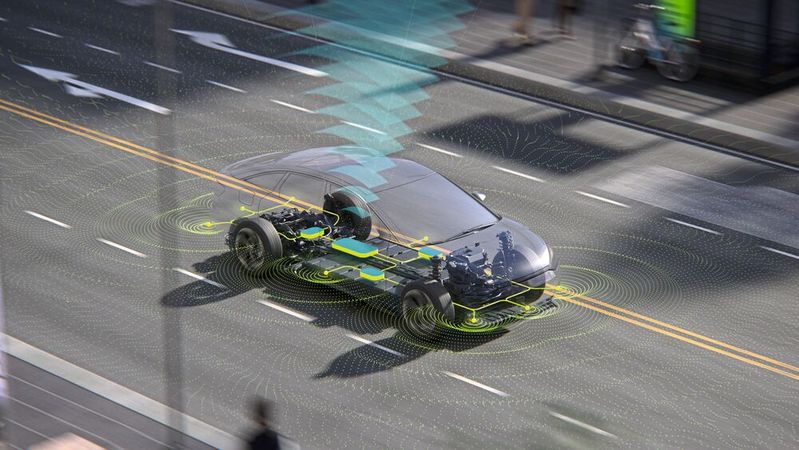
VW is developing a new E/E architecture for its future Chinese models. Experts say that the technology in this area is developing faster than the organizations.
(Image: Volkswagen AG)
The world's first AI-defined car - this was the claim with which Xpeng presented its P7+ model in November 2024. At the time, founder He Xiaopeng believed that artificial intelligence would fundamentally change mobility. That is why Xpeng wanted to be a pioneer for the new category of AI-defined vehicle (AIDV).
Specifically, the OEM promised: a level 2 assistance system improved by AI, particularly natural voice control, a braking distance of 35 meters (approx. 115 ft) and energy consumption of ten kilowatt hours per 100 kilometers (approx. 62 mi)—made possible by AI-optimized energy efficiency. The special feature: The AI allows the car to "learn" every two days, according to Xpeng.
Difference Between AIDV and SDV
Since then, the term AIDV has become increasingly popular in the industry. But what is the difference between an AI-defined vehicle and a software-defined vehicle? The market research company Omdia—commissioned by Here Technologies—surveyed almost 650 industry experts to find out. Based on the results, the authors of the study defined four phases of the software-defined vehicle (SDV)—from the connected vehicle (phase 1) to the "agentic vehicle" (phase 4).
For Omdia, AI is an integral part of this evolution. From phase 2 ("Augmented"), individual AI and machine-learning applications will be integrated (36% agreement in the survey). In phase 3, OEMs will become software-first companies. 39% of respondents expect AI and ML to be used here. The final phase 4 ("Agentic") describes intelligent agents as the culmination of the SDV concept.
Augustin Friedel, Associated Partner at MHP, is already observing the first AIDV architectures on the market. "Most AIDVs are SDVs, but not all SDVs are AIDVs," is his thesis, which he visualized in a graphic on Linkedin. There he names the manufacturers Geely, Xpeng and Nio as well as the supplier Huawei as AI-first companies that are already scaling the technology.
"AIDV: this is not a trend that requires a new platform, but is based on the new E/E architectures. This will gradually become more common over the next few years," observes Friedel.
The difference: with SDV, software defines what the car does—rule-based, deterministic, controllable through regular updates. With AIDV, on the other hand, AI models and data define how the vehicle behaves: probabilistic, context-dependent, self-learning across all domains.
AIDV Expands E/E Architectures
Omdia describes a scenario for these cross-functional E/E architectures: the car analyses data patterns, recognizes that the driver is heading to the airport and uses a camera to identify the driver's tiredness. The vehicle therefore increases the sensitivity of its monitoring systems and displays high-contrast warnings.
In May 2025, Suraj Gajendra, Vice President at ARM, also gave a striking example: "AI models process camera, radar and lidar data in real time and anticipate not only objects, but also driving behavior, road conditions and trajectories of other vehicles—before functions such as automatic emergency braking take effect."
Not All OEMs Have Access to Data
Geely, says Friedel, uses a kind of "AI master" as the central enabler for the AI-defined vehicle - a powerful base model plus smaller, specialized AI agents. This approach fundamentally distinguishes AIDV from SDV: instead of software updates with new or improved functions, there are continuous improvements to the AI models using data from the fleet.
This is where Friedel, Gajendra and the Omdia Report see a central problem in the current business model of the automotive industry when it comes to data. "Many OEMs have millions of vehicles with cameras in the field, but not all of them have access to the camera data because they belong to a supplier," says Friedel. The Omdia report defines data access in phase 3 as a core competence. Only from this point onwards would SDV investments bring significant returns. "In this phase, OEMs think about total cost of ownership instead of bills of materials," write the authors of the study. "Processors, sensors and memory create opportunities instead of costs."
Date: 08.12.2025
Naturally, we always handle your personal data responsibly. Any personal data we receive from you is processed in accordance with applicable data protection legislation. For detailed information please see our privacy policy.
Consent to the use of data for promotional purposes
I hereby consent to Vogel Communications Group GmbH & Co. KG, Max-Planck-Str. 7-9, 97082 Würzburg including any affiliated companies according to §§ 15 et seq. AktG (hereafter: Vogel Communications Group) using my e-mail address to send editorial newsletters. A list of all affiliated companies can be found here
Newsletter content may include all products and services of any companies mentioned above, including for example specialist journals and books, events and fairs as well as event-related products and services, print and digital media offers and services such as additional (editorial) newsletters, raffles, lead campaigns, market research both online and offline, specialist webportals and e-learning offers. In case my personal telephone number has also been collected, it may be used for offers of aforementioned products, for services of the companies mentioned above, and market research purposes.
Additionally, my consent also includes the processing of my email address and telephone number for data matching for marketing purposes with select advertising partners such as LinkedIn, Google, and Meta. For this, Vogel Communications Group may transmit said data in hashed form to the advertising partners who then use said data to determine whether I am also a member of the mentioned advertising partner portals. Vogel Communications Group uses this feature for the purposes of re-targeting (up-selling, cross-selling, and customer loyalty), generating so-called look-alike audiences for acquisition of new customers, and as basis for exclusion for on-going advertising campaigns. Further information can be found in section “data matching for marketing purposes”.
In case I access protected data on Internet portals of Vogel Communications Group including any affiliated companies according to §§ 15 et seq. AktG, I need to provide further data in order to register for the access to such content. In return for this free access to editorial content, my data may be used in accordance with this consent for the purposes stated here. This does not apply to data matching for marketing purposes.
Right of revocation
I understand that I can revoke my consent at will. My revocation does not change the lawfulness of data processing that was conducted based on my consent leading up to my revocation. One option to declare my revocation is to use the contact form found at https://contact.vogel.de. In case I no longer wish to receive certain newsletters, I have subscribed to, I can also click on the unsubscribe link included at the end of a newsletter. Further information regarding my right of revocation and the implementation of it as well as the consequences of my revocation can be found in the data protection declaration, section editorial newsletter.
The biggest hurdle is not technological, but organizational. "The technology is ready, but the organizations are not," is the key finding of the Omdia report. Organizational maturity is the primary bottleneck. Regardless of this, Gajendra stated in May 2025: "The software architecture always reflects the organizational structure."
Value Chains are Becoming More Fragmented
"The whole issue of orchestration, partnership management, recognizing early signals in the market and reacting to them—designing the architecture so flexibly that changes are possible. That is the main challenge," Friedel is convinced. This fundamentally changes the relationship between OEMs and suppliers. "Hardware-software separation will make the value chains more fragmented." The focus of this collaboration must be on the performance of overall systems— not on individual sub-areas.
In recent months, chip suppliers in particular have come to the fore. They now negotiate directly with the manufacturers. Won't this make tier 1 suppliers superfluous themselves? Friedel's answer: "Nvidia and Qualcomm see themselves as technology platforms, but not as solution providers. That is not their core competence." When it comes to implementation, scaling and volume, Tier 1s are needed "who know exactly how an OEM program works". The key question for European OEMs: can they manage the organizational transformation quickly enough to keep up technologically?
"The vehicle really interacts and engages in continuous communication—less command—oriented like Alexa, but more dialog-oriented," says Friedel, describing how the Xpeng AIDV works.



:quality(80)/p7i.vogel.de/wcms/eb/2b/eb2bd1b8487afe577b37363cd02f16ff/0113143253v1.jpeg "In our China Market Insider, we regularly provide you with relevant information straight from China. (Image:© Eisenhans - stock.adobe.com)")
:quality(80)/p7i.vogel.de/wcms/dd/b8/ddb8edc98c49b384734ab2432b297eb5/adobestock-1913662309--irene-stock-adobe-com-ki-generiertv1.jpeg "Rotary joints are used in grippers and swivel mechanisms to allow assemblies to rotate or swivel smoothly relative to one another, even under very high loads (illustrative image). (Source: Irene - stock.adobe.com / KI-generiert)")
:quality(80)/p7i.vogel.de/wcms/d1/ef/d1ef6b6f7d4543f7999980bacccaf22b/0133499261v1.jpeg "As the growing imbalance in trade relations with China continues to widen, the EU Chamber of Commerce foresees a day when trade with China will have to be seriously reevaluated ... (Image: AI-generated)")
:quality(80)/p7i.vogel.de/wcms/fe/1f/fe1fa5ee713f94deaba963dc24c3abc5/0133299273v1.jpeg "The Flexistar enables highly flexible production of laser-welded tubes thanks to its tool-free clamping system. (Image:Because Technology, LLC)")
:quality(80)/p7i.vogel.de/wcms/60/ef/60ef4f07e4829b2c2929befc0f353c58/0133511729v1.jpeg "Humanoid robots can match human performance in certain tasks. (Image:Gemini / AI-generated)")
:quality(80)/p7i.vogel.de/wcms/2e/99/2e99726b522e4b35b690e25eb6a42643/0133463991v1.jpeg "Robotics: In AMR applications, connection technology must reliably transmit power, signals, and data despite vibration and shock loads—in very confined spaces and in a way that allows for regular maintenance. (Image:Hyperever)")
:quality(80)/p7i.vogel.de/wcms/d0/18/d01801e3d5dbd7bc9d0b4f60408b630c/0133468429v1.jpeg "Quality requirements for film packaging are on the rise. At the same time, many companies are turning to recyclable film materials, which, however, have their own challenges. Fraunhofer researchers have therefore developed a fast system that detects problems in real time. (Image:Fraunhofer IKTS)")
:quality(80)/p7i.vogel.de/wcms/b1/06/b106cf44923ce39565c3264982fd20eb/0133414574v1.jpeg "Robots Build Robots: At the new Ubtech factory, automated systems even handle parts of the material supply and logistics for the production of humanoid robots. (Image:Ubtech)")
:quality(80)/p7i.vogel.de/wcms/c0/52/c052f405eb55fc3d08c4837e77206fc0/adobestock-2021845957--aucartstudio-stock-adobe-com-ki-generiertv1.jpeg "An innovation from China to combat extreme summer heat: A novel coating lowers temperatures. (Source: © AucArtStudio – stock.adobe.com_AI-generated)")
:quality(80)/p7i.vogel.de/wcms/66/a7/66a7b78159caeacce57136529688799f/0133503398v1.jpeg "Sunlight Makes Stone! These stone blocks weren't made the traditional way. Instead, they were additively manufactured from sand using a laser. In the future, however, the laser is set to be replaced by concentrated sunlight—if the startup Addisol is successful... (Image:Addisol / F. Fiedler)")
:quality(80)/p7i.vogel.de/wcms/72/b9/72b995c2c8d812c5e2115cbef31e035a/0133462727v1.jpeg "Eggl manufactures center hoods that are precisely tailored to each cooking island—whether standard size or custom shape. They are made entirely of stainless steel and are individually customized in terms of size and filter arrangement. (Image:SPI)")
:quality(80)/p7i.vogel.de/wcms/13/5d/135dfae6229ceaf5c55467a43e8f7257/adobestock-1879961393--ardi-stock-adobe-com-ki-generiertv1.jpeg "Annoying chatterboxes or awkward silences in response to questions—a moderator should specifically prepare for difficult situations in order to navigate them effectively. (Image:ardi - stock.adobe.com_AI-generated)")
:quality(80)/p7i.vogel.de/wcms/aa/a2/aaa2c6dd2daa24b485cddbf9297590c0/0133467318v1.jpeg "Battery Monitoring: Battery monitoring using electrochemical impedance spectroscopy offers several advantages. (Image:TI)")
:quality(80)/p7i.vogel.de/wcms/39/b2/39b21bf03be1683831862239a369987c/0133469638v1.jpeg "Data from autonomous vehicles and robots operating autonomously is in high demand, and Ruqi wants to capitalize on this. (Image:Ruqi Mobility)")
:quality(80)/p7i.vogel.de/wcms/8a/bb/8abbb6217220595edc1549ac9b84f307/0133429906v1.jpeg "The IAA in Hanover showcased the ambitions of Chinese commercial vehicle manufacturers in Europe. (Image:Wehner - VCG)")
:quality(80)/p7i.vogel.de/wcms/0c/53/0c5313ef91c14b6df0d0996efc33c8ad/jpg03568-bearbeitetv1.jpeg "The category winners of the 2027 German Car of the Year award. (Source: GCOTY)")
:quality(80)/p7i.vogel.de/wcms/48/15/4815da27c45973ca629a99b375ac3aef/0133509585v1.jpeg "Ventuno Q RoadTest: Designed to help the Element14 community gain practical insights from real-world tests using the Ventuno Q. (Image:Farnell/Element14)")
:quality(80)/p7i.vogel.de/wcms/17/2b/172bd132f9febdfcbcedba292ad0504d/aufmacherv1.jpeg "Micro-Epsilon offers a wide range of IO-Link-compatible sensors. (Source: Micro-Epsilon Messtechnik GmbH & Co. KG)")
:quality(80)/p7i.vogel.de/wcms/ca/b4/cab46fd26d19d6a2febca032048200b6/0133471827v1.jpeg "Photonics SDK for C and Python: Computational operations are now abstracted as standard mathematical functions. (Image:Q.ANT)")
:quality(80)/p7i.vogel.de/wcms/92/b2/92b2ed5299cde450c0764f4f64468395/0133505895v1.jpeg "The \"Iris 100\" test system for high-precision volume production of microLEDs uses a spectrometer and a high-resolution camera. (Image:Teradyne)")
:fill(fff,0)/images.vogel.de/vogelonline/companyimg/76800/76895/65.jpg "FAULHABER_120mm.jpg ()")
:fill(fff,0)/p7i.vogel.de/companies/69/88/69882c428938e/tmts2026-ticec-banner-en-2000px.png "tmts2026-ticec-banner-en-2000px (https://www.tmts.tw/en)")
:fill(fff,0)/p7i.vogel.de/companies/69/de/69de1b7403b0d/simtos-logo.jpeg "simtos-logo (SIMTOS)")
:quality(80)/p7i.vogel.de/wcms/f4/23/f4237da377044edc41a38afcf6c6d626/b2026cw00152-3840x2158v1v1.jpeg "AI agents in vehicles: this was the big topic for Volkswagen AG at the \"Auto China\" 2026 trade fair. (Image:Volkswagen AG)")
:quality(80)/p7i.vogel.de/wcms/a7/0e/a70e4486f8b26f75af2c87d8498890da/f1-20with-20flowers-5914x3328v1v1.jpeg "Huawei's automotive unit is doing very well. The division is generating high profits. (Image:Huawei)")
:quality(80)/p7i.vogel.de/wcms/12/33/1233e00dd83a287e5225169847b22799/0133224119v1.jpeg "The path to the software-defined vehicle leads from control modules and wiring harnesses to a centralized, networked E/E architecture. (Image:Dall-E / AI-generated)")
:quality(80)/p7i.vogel.de/wcms/5c/8e/5c8e0f3f4935b56cf9bb1ab773a1c9be/0131435539v1.jpeg "The software-defined vehicle is the decisive prerequisite for the next development stage of the car: the AI-defined vehicle (Image:Valeo)")