Agentive AI in EDAWhen AI No Longer Just Assists but Controls EDA Workflows
From
Susanne Braun
Susanne Braun | Translated by AI
9 min Reading Time
With the Fuse EDA AI Agent, Siemens EDA aims to reach the next level of AI-driven design automation. At its core is not another copilot but an agentive system designed to plan, execute, and monitor complex workflows across multiple EDA tools.
Agentive AI: The future of AI in EDA lies not in copilots but in the orchestration of many processes.
(Image: Siemens EDA)
AI in EDA did not start with generative AI. Machine learning methods have long been embedded in tools to accelerate simulations, make variations more manageable, or optimize individual design steps. What is currently changing is the ambition: AI is no longer meant to assist in isolated areas but to coordinate entire workflows across multiple tools. This direction was evident at several EDA and semiconductor events in 2026. Siemens EDA demonstrates what such an orchestrator could look like with the Fuse EDA AI Agent.
This year, the Fuse EDA AI Agent is a key focus for the company. Amit Gupta, Chief AI Strategy Officer and Senior Vice President and General Manager for Solido Custom IC at Siemens EDA, describes the move toward agent-based AI as a shift on two levels. On the one hand, AI and GPU acceleration are intended to accelerate the compute-intensive core functions of EDA tools, such as simulation, verification, or optimization. On the other hand, agent-based AI is aimed at increasing engineers' productivity by planning and executing complex workflows across multiple tools.
"Generative AI copilots were the industry's first response to this second need, but they are no longer sufficient," says Gupta. Given increasing design complexity and fragmented tool landscapes, manual scripts and isolated point solutions can no longer scale effectively.
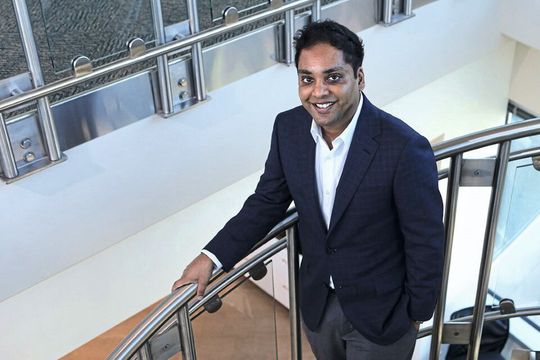
Change: The transition to agentive AI in the EDA sector is underway, says Amit Gupta of Siemens EDA.
(Image: Siemens EDA)
The Fuse EDA AI Agent builds on the Fuse EDA AI System and is designed to plan, execute, and adapt workflows in semiconductor and PCB system design across multiple tools. According to Siemens, this spans from early design and verification phases to physical implementation, timing closure, power optimization, DRC analyses, design-for-test, and manufacturing sign-off. With this, Siemens addresses a key bottleneck in many development environments: modern designs are no longer created in a single tool but through long, highly specialized toolchains. The more complex these become, the greater the effort required to coordinate them. Not only do the computations themselves take time, but also the handoffs between tools, the validation of intermediate results, and the feedback loops when a later step reveals issues.
Gupta expresses the ambition as significantly greater than that of a traditional assistance system: "This is precisely what the Fuse EDA AI Agent offers: the transition from AI features within individual tools to autonomous, end-to-end workflow orchestration." This allows customers to shorten design cycles without compromising quality standards. However, the extent of this effect in practice is likely to depend heavily on the specific tool landscape, data foundation, and process maturity within the company.
Tool coverage and integration
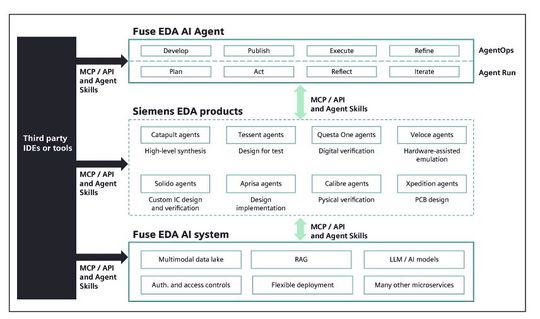
The Fuse EDA AI Agent, according to Siemens, covers key tools in its own EDA portfolio: Catapult, Questa One Agentic Toolkit, Aprisa, Solido, Veloce, and Calibre, as well as Xpedition and Hyperlynx for PCB workflows. Additionally, it supports Tessent for design-for-test and Calibre OPC for manufacturing preparation. Crucial for users with established tool landscapes: the agent is designed to integrate with third-party tools, custom workflows, and customer-specific models via the MCP architecture and an open framework. With this, Siemens is targeting not only individual toolchains but also heterogeneous EDA environments.
Why Generic AI isn't enough for EDA
Semiconductor and PCB development is not an environment where a general AI agent can simply be applied to existing tools. The processes are physics-driven, the data formats are specialized, the data volumes are vast, and the IP is highly sensitive. Generic agents quickly reach their limits here. They do not understand the significance of many EDA workflows, cannot reliably configure tools, and may lose context or draw incorrect conclusions when dealing with lengthy toolchains.
Gupta mentions in the interview five hurdles that Siemens had to address in the development of Fuse EDA AI Agent:
First, chip design is based on physical methods and empirical knowledge, which are hardly reflected in public training data. Therefore, a generic AI agent does not automatically know how to configure an EDA tool or meaningfully sequence a workflow.
Second, EDA workloads often run on secure local clusters with older schedulers and massive datasets, not in generic cloud frameworks. An agent must therefore integrate into existing HPC and enterprise infrastructures instead of assuming an idealized AI cloud environment.
Third, the size of modern toolchains can overwhelm standard models. The more tools, parameters, intermediate results, and dependencies a model must consider simultaneously, the greater the risk that the context is no longer processed cleanly or incorrect conclusions are drawn.
Fourth, many EDA data are in complex, partly binary formats such as waveforms, netlists, LEF/DEF, or GDSII. For AI to extract usable information from them, it requires specialized parsers and clean data preparation.
Fifth, sensitive IP requires robust security mechanisms. Role-based access, isolated execution environments, audit trails, and approval points by humans are therefore not accessories but prerequisites for productive agentive AI in EDA.
Siemens therefore positions Fuse not as a general AI assistant, but as a domain-specific architecture with an EDA data lake, specialized parsers, RAG framework, role-based access controls, audit trails, and human-in-the-loop control points. The security aspect is particularly important for the target group. Chip designs and PCB systems contain highly sensitive IP. An agent-based system that autonomously invokes tools and processes data must not only be powerful but also remain controllable.
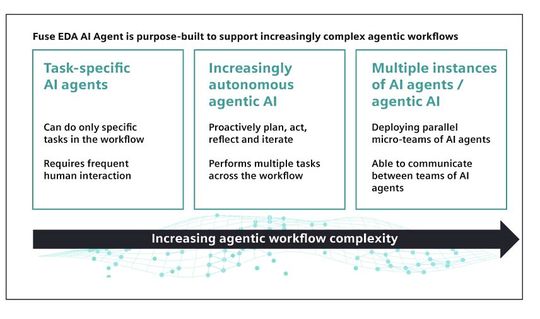
Technically, the Fuse EDA AI Agent is based on a modular architecture. For this, Siemens breaks down EDA processes into individual sub-processes, which are stored as executable work instructions. These "Agent Skills" describe which steps the agent should execute in which order and what expertise is required. Tools are dynamically recognized and invoked via the Model Context Protocol. A supervisor agent can plan tasks and distribute them to specialized worker agents. The goal is not to automate the entire design process in one step but to initially map clearly defined sub-processes reliably and later assemble them into larger workflows.
Date: 08.12.2025
Naturally, we always handle your personal data responsibly. Any personal data we receive from you is processed in accordance with applicable data protection legislation. For detailed information please see our privacy policy.
Consent to the use of data for promotional purposes
I hereby consent to Vogel Communications Group GmbH & Co. KG, Max-Planck-Str. 7-9, 97082 Würzburg including any affiliated companies according to §§ 15 et seq. AktG (hereafter: Vogel Communications Group) using my e-mail address to send editorial newsletters. A list of all affiliated companies can be found here
Newsletter content may include all products and services of any companies mentioned above, including for example specialist journals and books, events and fairs as well as event-related products and services, print and digital media offers and services such as additional (editorial) newsletters, raffles, lead campaigns, market research both online and offline, specialist webportals and e-learning offers. In case my personal telephone number has also been collected, it may be used for offers of aforementioned products, for services of the companies mentioned above, and market research purposes.
Additionally, my consent also includes the processing of my email address and telephone number for data matching for marketing purposes with select advertising partners such as LinkedIn, Google, and Meta. For this, Vogel Communications Group may transmit said data in hashed form to the advertising partners who then use said data to determine whether I am also a member of the mentioned advertising partner portals. Vogel Communications Group uses this feature for the purposes of re-targeting (up-selling, cross-selling, and customer loyalty), generating so-called look-alike audiences for acquisition of new customers, and as basis for exclusion for on-going advertising campaigns. Further information can be found in section “data matching for marketing purposes”.
In case I access protected data on Internet portals of Vogel Communications Group including any affiliated companies according to §§ 15 et seq. AktG, I need to provide further data in order to register for the access to such content. In return for this free access to editorial content, my data may be used in accordance with this consent for the purposes stated here. This does not apply to data matching for marketing purposes.
Right of revocation
I understand that I can revoke my consent at will. My revocation does not change the lawfulness of data processing that was conducted based on my consent leading up to my revocation. One option to declare my revocation is to use the contact form found at https://contact.vogel.de. In case I no longer wish to receive certain newsletters, I have subscribed to, I can also click on the unsubscribe link included at the end of a newsletter. Further information regarding my right of revocation and the implementation of it as well as the consequences of my revocation can be found in the data protection declaration, section editorial newsletter.
Step-by-step integration: The key is not in a solution that immediately takes over all tasks but in the definition of sub-processes that can eventually be combined.
(Image: Siemens EDA)
Gupta compares this approach to LEGO bricks: once enough of these building blocks in the form of automated sub-processes are in place, they can be combined into more comprehensive multi-tool workflows spanning the entire lifecycle. This marks an important distinction from the marketing narrative of fully autonomous chip design. In its current form, human control remains crucial. Engineers define intentions, monitor results, intervene in critical decisions, and retain responsibility for technical trade-offs.
In everyday practice, this could mean that developers no longer need to manually initiate, configure, and check every intermediate step. Instead, they describe a goal, such as an analysis or optimization, and the system takes over tool selection, workflow planning, execution, validation, and, if necessary, error correction within defined boundaries based on this specification. "What we give engineers back is time and the ability to focus their work on innovation," says Gupta. The operational burden of tool recognition, workflow planning, validation, and troubleshooting is expected to decrease.
The role of engineers would shift as a result. Gupta describes a longer-term vision in which engineers move from task execution to strategic oversight, supervising parallel agents that simultaneously optimize performance, energy consumption, and area. For companies, this raises not only a technical but also an organizational question. Who decides which tasks agents may independently take over? At which points are approvals still required, and how are results transparently documented?
However, some of the preparatory work shifts to the user companies themselves. Agentive systems benefit from clearly defined workflows, consistent data structures, and established approval points. Where processes are highly informal, script-based, or only documented in the minds of individual experts, the implementation is likely to be correspondingly more complex.
Nvidia as an Infrastructure Partner
The Fuse EDA AI Agent supports Nvidia GPUs, Nemotron models, and AI infrastructure from the Nvidia ecosystem. The Nemotron models are designed to work reliably in reasoning and tool-calling while also increasing throughput. This is crucial for industrial EDA applications because an agent does not simply respond once but plans many intermediate steps, invokes tools, and evaluates results. This increases the demands on reliability, computational power, and token costs.
Coordination: The architecture connects agent logic, Siemens EDA products, and the underlying Fuse EDA AI system with a database, RAG, AI models, and access controls.
(Image: Siemens EDA)
Or, to illustrate more clearly: In a simple chat, you ask a question and receive an answer. With an EDA agent, much more happens, as the agent has to plan, formulate intermediate steps, invoke tools, read back results, evaluate them, correct errors if necessary, and trigger the next step. Each of these steps can involve model calls and thus generate token consumption.
Gupta describes the collaboration with Nvidia as significant. The agent supports Nvidia GPUs, Nemotron models, and NIM infrastructure to execute complex workflows more reliably. Nemotron models offer "high precision and increased throughput for agent-based EDA tool calls." Siemens and Nvidia present the partnership as a step toward durable, autonomous agents that can securely operate complex engineering tools and coordinate tasks across extended workflows.
According to Siemens, Nvidia also uses the Fuse EDA solution in its own chip development. For Siemens, this is an important reference point; however, for users, the key factor remains how well such systems can integrate into existing, heterogeneous EDA landscapes. Especially in environments with multiple EDA vendors, established script landscapes, and strict IP requirements, the introduction of agent-based workflows is likely to be less of a plug-and-play matter and more of a gradual integration process.
For semiconductor and PCB development teams, the focus is less on individual product functions and more on the question of how far established EDA processes can actually be automated. Agent-based AI can accelerate routine workflows, tool transitions, analysis chains, and troubleshooting. However, it also highlights where processes are not properly defined, where data is missing, or where responsibilities have so far been informally managed.
This brings data quality, tool integration, access control, and governance into sharper focus. Additionally, the issue of traceability becomes crucial: the more steps an agent autonomously plans and executes, the more important it is to log decisions, tool calls, and intermediate results comprehensively. In productive EDA environments, it is not sufficient for a result to simply appear plausible. It must also be clear and traceable how the result was achieved.
The practical benefit will therefore largely depend on how well companies structure their existing workflows, which data sources can be made accessible, and how precisely responsibilities between humans and agents can be defined. For smaller, well-defined tasks, agent-based AI is likely to deliver tangible benefits more quickly. The vision becomes more challenging, however, when AI agents are tasked not only with automating individual steps but also with weighing multiple design goals against each other simultaneously: performance, power consumption, and chip area (PPA). These factors are closely interconnected; an improvement in one area can create new issues in another.
Gupta sees the transition already underway: "The shift from copilots to autonomous agents is not a distant vision. It is already happening." The Fuse EDA AI Agent should therefore be understood less as an isolated product innovation and more as a signal of a broader transformation. AI in EDA is no longer being conceived merely as an assistive function within individual tools. Instead, it is increasingly intended to connect workflows, prepare decisions, and autonomously coordinate technical processes.
For engineers, the question shifts from "What tasks can AI take off my plate?" to "Which parts of my development process can I entrust to a controlled agent system?" Whether agent-based AI in EDA quickly transitions from a demonstrator to a productive tool will likely be decided precisely at this point: in the balance between automation, control, and trust.



:quality(80)/p7i.vogel.de/wcms/17/b8/17b8af0cb725e0e1d3e8d72458bab260/siemens-meet-at-the-machinev1.jpeg "“Meet at the Machine” is Siemens’ new initiative, which aims to bring together machine builders, software, and automation technologies to accelerate innovation in the machine tool industry and help manufacturers become productive more quickly. (Source: Siemens)")
:quality(80)/p7i.vogel.de/wcms/8e/7e/8e7e0cda4c68699bcc48283a38739769/0133316747v1.jpeg "A little-known hidden champion! When people think of laser cutting, the first thing that comes to mind is the power of the laser beam—and it is impressive to see the sparks flying. But Air Liquide—an exhibitor at Euroblech, by the way—wants to make it clear that the process gas is also key to success. (Image:AI-generated)")
:quality(80)/p7i.vogel.de/wcms/20/fa/20fa35e0af203c3464f7e7fdbb57a685/0133281172v1.jpeg "Since 2003, Etzinger AG has been developing and manufacturing high-quality coffee grinders, pepper mills, and grinding mechanisms for professional and home use. (Image:Etzinger)")
:quality(80)/p7i.vogel.de/wcms/69/91/6991413943488b4a2f6fde9dcd88c5b0/0133256686v1.jpeg "The CMA-patented pendulum mount can compensate for radial tolerances of up to one millimeter. (Image:Schwiening)")
:quality(80)/p7i.vogel.de/wcms/38/79/38799bfbbccd938b64c67068cfa68780/0133329362v1.jpeg "What exactly enables machines to act on their own? (Image:Shutterstock)")
:quality(80)/p7i.vogel.de/wcms/1b/9f/1b9fc9f113fc66212e2c0e17a3edaf9f/org-blobs-user-response-file-output-f317796f-57b7-483f-9403-5d9ac8a816f5-plugin-output-call-kdigtepb7be7us8xvbota0mh-1672x940v1.png "According to Barclays data, Europe leads the global trade in actuator components. With a 34 percent share, the region ranks ahead of China, which has a 26.3 percent share. (Source: Statista | CC BY-ND 4.0, AI-generated)")
:quality(80)/p7i.vogel.de/wcms/f5/4c/f54c9fc59ccb0604ab9219188469a45f/image1v1.jpeg "Christopher Savoia, Global Head of the UR+ Ecosystem at Universal Robots, presents the new SP7 Smart Panel on a UR17g-1300 robot during the unveiling of Gen 7—UR’s 7th-generation robot platform—at IMTS in Chicago on September 14, 2026. (Image:Image: Teradyne Robotics)")
:quality(80)/p7i.vogel.de/wcms/bd/4e/bd4ef09ab0f84932ea76ca0330ffe789/0133329802v1.jpeg "The robotics boom and its consequences: According to a study, a significant portion of value creation occurs in the electronics industry. (Image:Fraunhofer IPA)")
:quality(80)/p7i.vogel.de/wcms/87/87/87870cf2b30aaef7b8a06212a4ef2c14/0133403885v1.jpeg "A digital twin and a real component demonstrate how closely simulation and manufacturing are converging. Stampack Xpress 2026.1 virtually models forming behavior and supports the validation of process and tool design. (Image:Stampack)")
:quality(80)/p7i.vogel.de/wcms/59/2a/592a7f2d0964e9e6846cae331f5daa3a/0133266065v1.jpeg "Perforated metal sheets are particularly well-suited for balcony railings, as they combine stability, privacy, and design versatility. (Image:Ripo Factory)")
:quality(80)/p7i.vogel.de/wcms/45/64/45642ff0fe0a6bec251b77739131d83b/abb-ferrari-hypersail-16-9-three-quarter-front-viewv1.jpeg "The Ferrari Hypersail is a 100-foot monohull wing-in-plane yacht powered entirely by renewable energy. (Source: ABB / Ferrari Hypersail)")
:quality(80)/p7i.vogel.de/wcms/3e/0e/3e0e3ea22e48410ceada53b02ffccb59/0133358454v1.jpeg "BYD top executive Stella Li plans to offer megawatt flash charging for commercial vehicles as well. (Image:VDA/IAA Transportation 2026)")
:quality(80)/p7i.vogel.de/wcms/e2/7d/e27de60472809cc58ac0d321066c9679/l1051833v1.jpeg "Geely has acquired a stake of just over 26 percent in Renault do Brasil. Geely models for the South American market are now also being produced at the Ayrton Senna plant in São José dos Pinhais. (Image:Renault)")
:quality(80)/p7i.vogel.de/wcms/1e/c1/1ec1495eb283200f4b7cb55de0c4dff7/20260917-110436643v1.jpeg "Ceremonial launch of Mercedes-Benz GLA production in Rastatt; among those in attendance was plant manager Marco Zwick (second from the right). (Source: Thomas Günnel – Automotive Industry)")
:quality(80)/p7i.vogel.de/wcms/76/f3/76f310eed0caebc79ff91195c29de08d/visual-siwa-treatment-optimizerv1.jpeg "A Mireo train from Siemens Mobility was used in the “Automated Train” project for a fully automated delivery and return trip on the open rail network. (Source: Siemens Mobility)")
:quality(80)/p7i.vogel.de/wcms/4c/53/4c534208d09a9b1ce597938715e7fc19/0133288763v1.jpeg "Logic Folding: In its latest Kirin 9050 Pro, Huawei uses hybrid bonding to distribute the computing units across two silicon layers in order to increase the effective transistor density without resorting to finer manufacturing processes. (Image:Huawei)")
:quality(80)/p7i.vogel.de/wcms/56/d1/56d131e0b5bd05ef47411e92ad740cb4/0133351029v1.jpeg "Researchers at DTU have developed a nanolaser in a semiconductor membrane. The structure concentrates charge carriers and the light field into a small area (shaded in blue). If data is transmitted on microchips using light instead of electrical signals, transmission speeds can be increased and energy losses reduced. (Image:Yi Yu, DTU)")
:quality(80)/p7i.vogel.de/wcms/5e/55/5e55101ddc6338f755fcf3244db1367f/0133331863v1.jpeg "For data center projects, it is becoming increasingly important to also obtain the consent of the affected community. (Image:Dall-E / AI-generated)")
:quality(80)/p7i.vogel.de/wcms/8d/f9/8df95d3f58408673986b3d643e6b63ba/0133252773v1.jpeg "TXC targets high-speed optical links in AI data centers with 312.5 MHz oscillators, among other solutions. As data rates increase, requirements for jitter and frequency stability become more demanding as well. (Bild: TXC)")
:quality(80)/p7i.vogel.de/wcms/40/b2/40b206348d8ee5dc2034ebded5099740/0131355751v1.jpeg "The program is intended to provide simplified access to modern EDA (Electronic Design Automation) software for smaller companies, start-ups and research institutions. (Image:Siemens EDA)")
:quality(80)/p7i.vogel.de/wcms/b4/01/b401c197e3591f2bec3fb84ae810ac80/0130096280v1.jpeg "Only prophecies of doom! Jensen Huang, the head of chip giant Nvidia, dismisses any concerns that the huge sums currently being invested in AI data centers will not turn a profit one day ... (Image:Nvidia)")
:quality(80)/p7i.vogel.de/wcms/1b/0b/1b0b5a01ca7796164093fbe99290256f/0132493860v1.jpeg "Macro shot of a production line for computer processors. (Image:Siemens EDA)")
:quality(80)/p7i.vogel.de/wcms/8d/ff/8dffe7518cc69b90ea89c7b37f7de781/0129470810v1.jpeg "Demo of the ChipStack AI Super Agent. (Image:Cadence)")