Quantum ComputingWhat Makes Logical Qubits Comparable—and What's Still Missing
A guest post by
Leon Koch* | Translated by AI
5 min Reading Time
Qubit counts alone are no longer enough: the new metric is called "logical qubits." But why are manufacturer roadmaps still misleading without circuit performance metrics? And why is error protection determined at the hardware level?
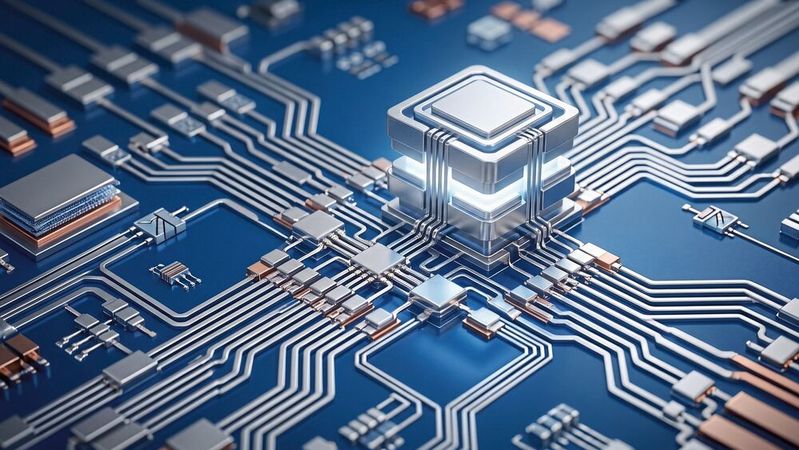
From the physical chip to a stable computing environment: The industrial viability of quantum processors is determined by circuit-level performance—not by qubit counts alone.
(Image: Gemini / AI-generated)
IBM’s roadmap is concrete: 200 logical qubits by 2029 and 100 million error-corrected operations—that is the stated goal of the Quantum Starling system. Other major providers are also increasingly focusing their communications on error-corrected systems. The new standard in quantum computing is logical qubits—that is, error-corrected, robust “virtual” qubits composed of multiple physical qubits—which are used to stably store and process quantum information.
The shift in communication reflects a genuine change in the quantum landscape. The realization that raw qubit counts are insufficient as a metric of progress has gained widespread acceptance. What has been missing from the public debate so far is a uniform framework for classifying these metrics: that is, transparent information on the assumptions and performance indicators used to define, generate, and evaluate a logical qubit.
What the Term Encapsulates—and What Gets Lost in the Process
Leon Koch, CEO, Peak Quantum
(Image: Moritz Sauer)
The number of physical qubits required for a single logical qubit depends on several factors: the error-correcting code used (Surface Code, Repetition Code, etc.), the target code distance, the underlying physical error rate, and the efficiency of the decoder. A logical qubit with a code distance of 3 and a physical error rate of 10⁻³ is not directly comparable to one with a code distance of 7 and a physical error rate of 10⁻⁴. The achievable logical error rate—that is, what matters for applications—can vary significantly depending on the assumptions and implementation.
Many current demonstrations of logical qubits primarily focus on error-corrected storage or limited logical operations. How a system behaves when executing longer, more application-oriented algorithms therefore often remains an open question. Just as a microprocessor cannot be evaluated based solely on its number of transistors—but must also be assessed in terms of clock frequency, cache architecture, and instruction throughput—quantum computers require circuit-level performance metrics. In other words, information on how many consecutive logical operations a system can actually execute without errors.
Quality Is Not a Single Value
For superconducting systems, the relevant quality profile is well known: coherence times, crosstalk between neighboring qubits, the temporal instability of qubit parameters, and leakage rates (transition to states outside the computational space) at the physical level. In addition, the quality of single-qubit and two-qubit operations, as well as circuit-level performance, serve as integrated system metrics.
These parameters interact: A processor with very good single-qubit gates but high crosstalk during two-qubit operations will quickly reach its limits in deep circuits—that is, those with many consecutive operations. Leakage is a particularly problematic type of error because it causes the system to leave the actual computational space, thereby compromising single-qubit operations. Such errors are not readily captured by many standard assumptions in quantum error correction and can accumulate over longer circuits.
This requires a holistic view of all levels of the system. Error analysis on quantum computers must evaluate an abstract error metric—such as the circuit-level or even the performance of error-corrected systems—in the context of physical qubits. Since computational errors in these systems are complex physical processes, these insights must be taken into account when designing higher-level components and, in some cases, resolved at the fundamental hardware level.
Circuit-Level Performance: The Metric That Should Be a Top Priority for Users
Individual gate fidelities describe components, not systems. What matters for applications is a different metric: How many consecutive operations can a system perform before too many errors render the result unusable? This circuit-level performance is harder to measure, but it is the parameter that most directly reflects industrial usability.
Date: 08.12.2025
Naturally, we always handle your personal data responsibly. Any personal data we receive from you is processed in accordance with applicable data protection legislation. For detailed information please see our privacy policy.
Consent to the use of data for promotional purposes
I hereby consent to Vogel Communications Group GmbH & Co. KG, Max-Planck-Str. 7-9, 97082 Würzburg including any affiliated companies according to §§ 15 et seq. AktG (hereafter: Vogel Communications Group) using my e-mail address to send editorial newsletters. A list of all affiliated companies can be found here
Newsletter content may include all products and services of any companies mentioned above, including for example specialist journals and books, events and fairs as well as event-related products and services, print and digital media offers and services such as additional (editorial) newsletters, raffles, lead campaigns, market research both online and offline, specialist webportals and e-learning offers. In case my personal telephone number has also been collected, it may be used for offers of aforementioned products, for services of the companies mentioned above, and market research purposes.
Additionally, my consent also includes the processing of my email address and telephone number for data matching for marketing purposes with select advertising partners such as LinkedIn, Google, and Meta. For this, Vogel Communications Group may transmit said data in hashed form to the advertising partners who then use said data to determine whether I am also a member of the mentioned advertising partner portals. Vogel Communications Group uses this feature for the purposes of re-targeting (up-selling, cross-selling, and customer loyalty), generating so-called look-alike audiences for acquisition of new customers, and as basis for exclusion for on-going advertising campaigns. Further information can be found in section “data matching for marketing purposes”.
In case I access protected data on Internet portals of Vogel Communications Group including any affiliated companies according to §§ 15 et seq. AktG, I need to provide further data in order to register for the access to such content. In return for this free access to editorial content, my data may be used in accordance with this consent for the purposes stated here. This does not apply to data matching for marketing purposes.
Right of revocation
I understand that I can revoke my consent at will. My revocation does not change the lawfulness of data processing that was conducted based on my consent leading up to my revocation. One option to declare my revocation is to use the contact form found at https://contact.vogel.de. In case I no longer wish to receive certain newsletters, I have subscribed to, I can also click on the unsubscribe link included at the end of a newsletter. Further information regarding my right of revocation and the implementation of it as well as the consequences of my revocation can be found in the data protection declaration, section editorial newsletter.
Quantum Volume was an initial attempt to quantify exactly that. The metric takes gate errors, connectivity, and coherence times into account collectively and condenses them into a single system metric. This basic idea has established itself in the industry as a basis for discussion, even though it classifies only a specific aspect of the system. CLOPS (Circuit Layer Operations Per Second) supplements this by adding the throughput aspect: How fast can a system actually execute circuits? Together, these two metrics provide a solid basis for evaluation.
What is still emerging in the field is a broader, more consistent, and more transparent application of such metrics across providers and platforms. As long as providers themselves decide which system metrics to publish and which not to, comparability between platforms remains an unresolved issue—regardless of how many well-developed metrics are theoretically available.
Hardware Fault Tolerance: Why the Starting Point Matters
The benchmark debate inevitably leads to a more fundamental question: How good is the physical hardware on which error correction relies? Anyone scaling up quantum processors must simultaneously improve their error rates; otherwise, system overhead will initially increase: calibration cycles become more complex, crosstalk management more resource-intensive, and QEC overhead also rises. Usable computing power thus fails to keep pace.
This has implications for architectural design. One approach that is gaining increasing attention is inherent error reduction: error protection built directly into the qubit’s hardware. The goal is to structurally suppress certain types of errors at the level of the superconducting circuit, thereby improving the starting point for error correction. This structurally reduces the QEC overhead. For example, this results in a lower requirement for physical qubits per logical qubit, as well as potentially lower demands on control electronics and calibration. Error correction remains necessary. However, the starting conditions shift, and with them, what can be achieved with fewer physical resources.
What the Industry Needs Now
When it comes to scientific publications, the community is disciplined: code distance, error-correcting codes, physical error rates, and measurement conditions are generally well documented in the technical literature. The problem lies one level higher—in the translation of these results into roadmaps and press releases. A figure like “200 logical qubits” does not automatically convey the context from the underlying paper: At what code distance? Under what physical error rate? Measured against what circuit-level performance? Without this information, it’s nearly impossible to contextualize a roadmap figure, no matter how concrete it may sound.
Added to this is a standardization problem: Even if individual teams measure rigorously, they do not necessarily follow the same conventions for definition and standardization. This structurally complicates comparisons between providers—regardless of how mature QV, CLOPS, or other circuit-level metrics may already be in individual cases.
The shift from qubit counts to logical qubits was long overdue. What must follow now is a more consistent disclosure of the full set of parameters in public communications. Furthermore, it is essential to examine the physical foundation itself. A significant portion of future scalability is already determined there—before the first error-correction layer is even implemented.
*Leon Koch is the co-founder and CEO of Peak Quantum, a Munich-based quantum computing company that develops inherently error-resilient, superconducting quantum processors. From 2020 to 2025, the physicist conducted research as part of his doctoral studies at the Technical University of Munich and the Walther Meissner Institute, with a particular focus on quantum computing and nanofabrication. Together with his team, he is working to make quantum computing commercially viable and to build a European ecosystem for scalable quantum computing. At Peak Quantum, he is responsible for strategy, technology development, and manufacturing.



:quality(80)/p7i.vogel.de/wcms/a0/1d/a01ddede6a787a4844122c2f42cfbce9/0133067101v1.jpeg "In solar module manufacturing, lasers are used for tasks such as patterning, drilling, and cutting delicate layers. Precise energy delivery is crucial to avoid damaging adjacent areas. (Image:Dall-E / AI-generated)")
:quality(80)/p7i.vogel.de/wcms/6c/98/6c98f4dd0780456713eee6379b3f534f/0132999605v1.jpeg "This specific project involved a similar surgical screw. (Image:KLS Martin)")
:quality(80)/p7i.vogel.de/wcms/e9/90/e9904998fceb618c13613a1660fdfc74/0133135112v1.jpeg "This saw blade lasts up to eight times longer than solid carbide counterparts. This is made possible by an innovative nanocrystalline diamond coating from Oerlikon Balzers, which can also be applied to drill bits and end mills. Here is some information from a project with a user ... (Image:Oerlikon Balzers)")
:quality(80)/p7i.vogel.de/wcms/5e/f8/5ef8d3b9a25951f1b4a3fac0f4b65281/0133131043v1.jpeg "Kasto has significantly improved its long-proven Kastossb automatic band saw and will be showcasing it at the upcoming AMB. For example, it now features an electromechanical saw feed mechanism that reduces energy consumption. Read here to find out what other new developments there are in the world of sawing ... (Image:Kasto)")
:quality(80)/p7i.vogel.de/wcms/13/8a/138a5d6686ba26ad35c8f7593c319359/0133105064v1.jpeg "LAPP uses an automation model to demonstrate how sensors, actuators, cables, and network components reliably transmit data to the cloud. (Image:Lapp)")
:quality(80)/p7i.vogel.de/wcms/88/86/88865040dd97ce19eeb5df398eb9f383/0113143253v1.jpeg "In our China Market Insider, we regularly provide you with relevant information straight from China. (Image:© Eisenhans - stock.adobe.com)")
:quality(80)/p7i.vogel.de/wcms/16/aa/16aa1c99cb3ee4fb784c7e8ed022b395/dlr-eu-1v1.jpeg "AI-based robotics has the potential to develop into an industry in Europe over the next ten to fifteen years that rivals today’s automotive industry in size and importance. Here, you can see how the DLR robot Rollin’ Justin independently performs an everyday task and waters a houseplant. (Image:DLR (CC BY-NC-ND 3.0))")
:quality(80)/p7i.vogel.de/wcms/8a/cc/8acca450df3db57ebc3902a2a6ec19d2/nvidia-omniverse-librariesv1.jpeg "AI agents prepare 3D scenes using sensor, material, and physics data for realistic simulations. (Source: Nvidia)")
:quality(80)/p7i.vogel.de/wcms/8f/82/8f827c555c5af559af362274a9503887/newsimage426603v1.jpeg "The composite material made of epoxy and glass fibers not only protects against flames but is also fully recyclable. (Source: Empa)")
:quality(80)/p7i.vogel.de/wcms/d3/ad/d3ad3f6529839a772acd8741ce83e439/0132390244v1.jpeg "If you make the wrong choice when seeking funding advice, you risk not only wasting time but also missing out on funding opportunities and suffering financial losses. (Image: ©alfa27 - stock.adobe.com)")
:quality(80)/p7i.vogel.de/wcms/b5/23/b523d58efd8b39df18f3b93d3c9d7269/2026-075-stromfreie-festkoerperkuehlung-aus-waerme-wird-kaeltev1.jpeg "Researchers at KIT and the University of Tsukuba are combining two nickel-titanium films that first convert heat into motion and then into cold. (Source: Concept by Yi-Ting Hsiau and Jingyuan Xu, KIT; visual design by Ella Maru Studio)")
:quality(80)/p7i.vogel.de/wcms/a4/b7/a4b7d453522f2cbb8e89f18b0f48a4e2/0131845932v1.jpeg "Hardly any stress! In the negotiations over VW’s drastic cost-cutting package, agreements have already been reached on several key points. VW CEO Oliver Blume calls this an encouraging sign. Read here to find out what happened on September 3... (Image:Volkswagen)")
:quality(80)/p7i.vogel.de/wcms/d2/36/d236c7089523726327e9d2d3a6c28f9b/0133152555v1.jpeg "To ensure that hydrogen, in addition to electric powertrains for trucks, becomes more widely adopted as an alternative propulsion option, several major companies are now collaborating. Here’s who they are and what exactly this is all about ... (Image:AI-generated)")
:quality(80)/p7i.vogel.de/wcms/3d/bf/3dbf2071d4f39b0a6ae4b1c444fbd4ab/marelli-microchipv1.jpeg "A new technology from Marelli and Microchip transmits graphics and video content from the vehicle's central computer directly to the vehicle's displays. (Source: Marelli / KI-generiert)")
:quality(80)/p7i.vogel.de/wcms/4e/7a/4e7abb847f19fc29ebd558479a089412/xiaomi-ifa-kvv1.jpeg "Xiaomi plans to import electric cars to Germany starting in 2027. Pictured: the Vision Gran Turismo electric hypercar concept. (Source: Xiaomi)")
:quality(80)/p7i.vogel.de/wcms/0d/da/0dda2dc67d266b0577dd243f8e6321dd/0133153751v1.jpeg "The rising demand for AI infrastructure is having a direct impact on the supply chain and exposing bottlenecks in production. (Image:Broadcom)")
:quality(80)/p7i.vogel.de/wcms/00/71/0071675c8d6f934225a970a9731b905e/0133122313v1.jpeg "From the physical chip to a stable computing environment: The industrial viability of quantum processors is determined by circuit-level performance—not by qubit counts alone. (Image:Gemini / AI-generated)")
:quality(80)/p7i.vogel.de/wcms/38/4d/384de4721339db429ec3a735dd541143/0133124795v1.jpeg "The massive AI industry surrounding Project Stargate is worth billions of dollars, but it also poses significant risks. (Image:Gemini / AI-generated)")
:quality(80)/p7i.vogel.de/wcms/73/f1/73f1b6ea230da6eec20134f3af51fa91/0133131975v1.jpeg "Hugging Face is considered a leading platform for open AI models. An acquisition would bring Nvidia closer to the entire value chain—from computing hardware to model development and distribution. (Image:freely licensed)")
:quality(80)/p7i.vogel.de/wcms/5b/c7/5bc7003ddba3d10d83c6b92bd1be7620/newsimage425297v1.png "The cooling system of a quantum computer keeps the quantum chips at temperatures close to absolute zero. Only under these conditions can they unfold their special quantum properties (artistic representation). (Source: B. Schröder/HZDR)")
:quality(80)/p7i.vogel.de/wcms/12/c6/12c6bb1b6dbcdd48fd89da058cf5c80e/0131939666v1.jpeg "Libra is expected to process more than 256 corrected logical qubits and enable approximately one million reliable logical quantum operations. As part of an expanded collaboration with AWS, the system is expected to be available in the cloud via Amazon Braket starting in 2028. (Image:QuEra)")
:quality(80)/p7i.vogel.de/wcms/2e/be/2ebe7a3fd5bc91773110a9b66e3e95cf/86592347v1.jpeg "Quantum computers exploit quantum mechanical effects such as superposition and entanglement to deliver enormous computing power. (Image:public domain)")