Industry models can transform industrial value creation by making hidden process knowledge scalable, identifying correlations, and ushering in a new era of data-driven business models.
The first wave of AI is digitizing work. Industry Models, as the next wave, identifies patterns.
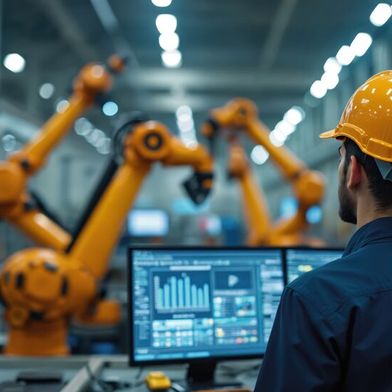
(Image: AI-generated)
In 2022, ChatGPT used generative artificial intelligence to make knowledge accessible to millions of people. Now the next wave of AI is on the horizon: transforming decades of accumulated knowledge about machines, processes, and industries into scalable digital intelligence.
Companies are working with language models, copilots, and AI agents. However, these efforts often focus on generating text, finding information, summarizing emails, and making knowledge accessible. For industry, this perspective is not enough. Industrial value creation is not limited to language. It consists of CAD data, bills of materials, tolerances, toolpaths, PLC codes, process parameters, time series, quality metrics, material properties, machine statuses, and, above all, experience: the knowledge of why a process works—or doesn’t work—under real-world conditions.
This is precisely where a development is taking shape that could have a significantly greater economic impact than the next corporate chatbot. Industrial Foundation Models—and, more broadly, Industry Models—promise to combine general AI capabilities with an industrial context. The key issue here is not merely how such systems are technically built, but what happens when specialized industrial knowledge becomes digitally accessible, reproducible, and commercializable on a large scale for the first time.
What are Industry Models?
The term “industry model” has not yet been fully standardized. In research and industry, terms such as “industrial foundation models,” “industry-specific foundation models,” or “domain foundation models” are more commonly used. From a business perspective, a broader definition is more helpful.
An industry model can be understood as a domain-specific AI system that combines general AI capabilities with industrial data, technical semantics, process knowledge, rules, tool access, and—where relevant—physical or mechanistic relationships. It does not, therefore, have to consist of a single large neural network. In practice, it can be a combination of a base model, company- or industry-specific context, software interfaces, knowledge structures, and specialized models.
The difference from many of today's AI applications lies in their purpose: A corporate chatbot makes existing knowledge discoverable. An industry model is designed to make industrial relationships reusable.
The Industrial Context Is the New Gold
Today, the AI debate focuses heavily on which model is the most powerful. For industrial companies, however, another question could become more important in the long run: Which system truly understands our business, our products, and our processes?
One terabyte of machine data does not in itself constitute a competitive advantage. Value is created when the machine, product, material, tool, program, parameters, result, and decision can be linked together.
Industrial Context = Data + Semantics + Process + Mechanism + Experience + Governance
This leads to a strategic shift: The base model can become more interchangeable. The industrial context, however, remains proprietary.
Experience and Knowledge Become a Scalable Asset
Today, industrial companies possess enormous amounts of knowledge that are economically valuable but have limited scalability. Some of this knowledge is embedded in software and documentation. However, a large portion resides in people: in the maintenance technician who can identify a fault pattern within seconds; in the design engineer who knows which solution will cause problems in production down the line; and in the application engineer who can immediately determine the critical control variables based on the material, machine, and process.
Industry models make it possible to systematically capture at least some of this knowledge, link it to real-world data, and reuse it for future decisions. This does not replace human expertise, but it does change its scalability.
Date: 08.12.2025
Naturally, we always handle your personal data responsibly. Any personal data we receive from you is processed in accordance with applicable data protection legislation. For detailed information please see our privacy policy.
Consent to the use of data for promotional purposes
I hereby consent to Vogel Communications Group GmbH & Co. KG, Max-Planck-Str. 7-9, 97082 Würzburg including any affiliated companies according to §§ 15 et seq. AktG (hereafter: Vogel Communications Group) using my e-mail address to send editorial newsletters. A list of all affiliated companies can be found here
Newsletter content may include all products and services of any companies mentioned above, including for example specialist journals and books, events and fairs as well as event-related products and services, print and digital media offers and services such as additional (editorial) newsletters, raffles, lead campaigns, market research both online and offline, specialist webportals and e-learning offers. In case my personal telephone number has also been collected, it may be used for offers of aforementioned products, for services of the companies mentioned above, and market research purposes.
Additionally, my consent also includes the processing of my email address and telephone number for data matching for marketing purposes with select advertising partners such as LinkedIn, Google, and Meta. For this, Vogel Communications Group may transmit said data in hashed form to the advertising partners who then use said data to determine whether I am also a member of the mentioned advertising partner portals. Vogel Communications Group uses this feature for the purposes of re-targeting (up-selling, cross-selling, and customer loyalty), generating so-called look-alike audiences for acquisition of new customers, and as basis for exclusion for on-going advertising campaigns. Further information can be found in section “data matching for marketing purposes”.
In case I access protected data on Internet portals of Vogel Communications Group including any affiliated companies according to §§ 15 et seq. AktG, I need to provide further data in order to register for the access to such content. In return for this free access to editorial content, my data may be used in accordance with this consent for the purposes stated here. This does not apply to data matching for marketing purposes.
Right of revocation
I understand that I can revoke my consent at will. My revocation does not change the lawfulness of data processing that was conducted based on my consent leading up to my revocation. One option to declare my revocation is to use the contact form found at https://contact.vogel.de. In case I no longer wish to receive certain newsletters, I have subscribed to, I can also click on the unsubscribe link included at the end of a newsletter. Further information regarding my right of revocation and the implementation of it as well as the consequences of my revocation can be found in the data protection declaration, section editorial newsletter.
*Julian Ziebarth is an entrepreneur, AI strategist, and founder of Ziebarth Industrial Technologies GmbH.