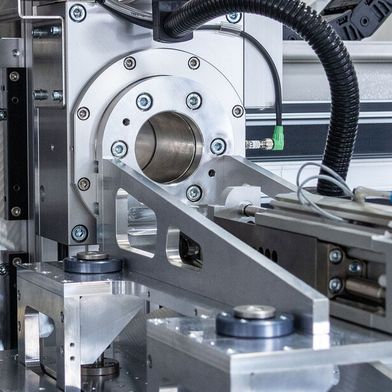
From an A4 stainless steel eccentric lever to a classic U-shaped handle with a new profile, all the way to tamper-proof controls for greater process reliability—the latest innovations in structural components.
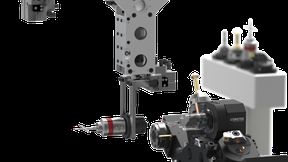
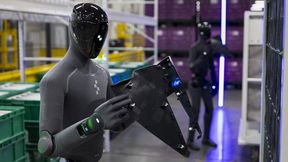
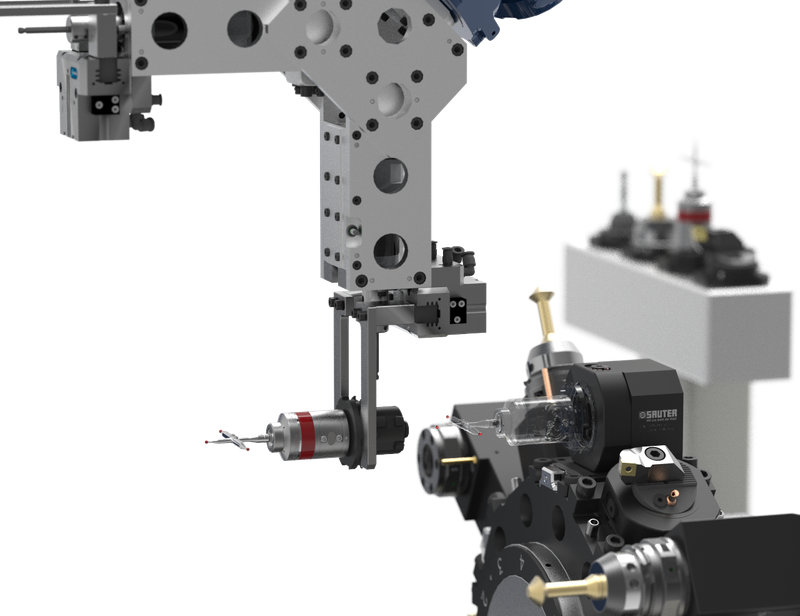
A robotic gripper performs a tool change using the Sauter SolidPro.
(Source: Sauter Precision Engineering)
Clamping Under Demanding Conditions
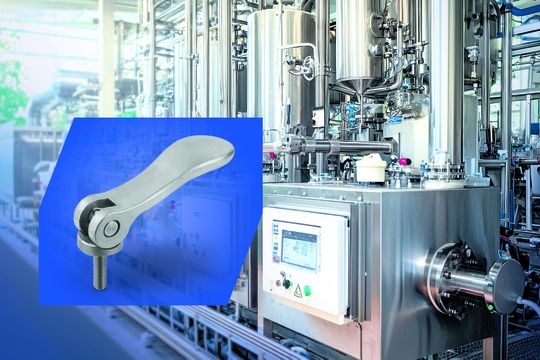
The A4 stainless steel eccentric levers are available with internal and external threads ranging from M3 to M10, as well as with inch threads ranging from 6-32 to 3/8-16. For the handle lever, you can choose between “electrolytically polished” or “shot-blasted” finishes.
(Source: Kipp, AdobeStock 968321373)
Designed to withstand salt, moisture, and the rigors of everyday use: Kipp has added new eccentric lever models made of durable A4 stainless steel to its product portfolio. Eccentric levers enable secure and quick clamping without any rotational movement of the component. The clamping force is generated by an eccentric on the handle lever. This presses the pressure disc linearly against the clamping surface. When the lever is returned to its original position, the clamping is released. The clamping process is torque-free and protects components and surfaces. The new A4 version is designed for environments where conventional stainless steel grades reach their limits. A4-grade stainless steel is corrosion- and acid-resistant and is also suitable for use in close proximity to saltwater. In such environments, components made of lower-grade stainless steel, such as A1 or A2, would show signs of corrosion prematurely.
Compact Sizes for Long-Stroke Clamps
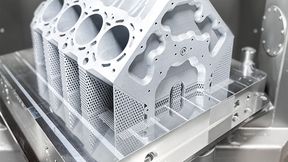
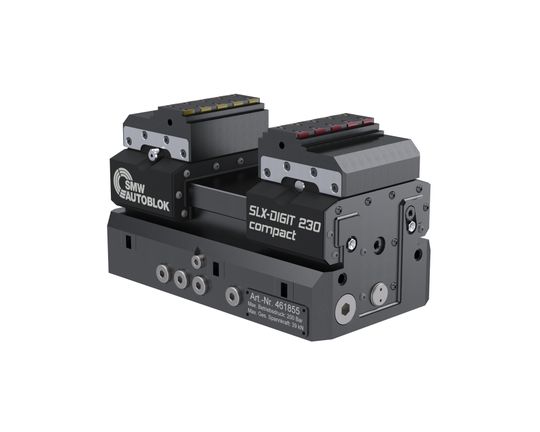
The SLX Digit 230 Compact hydraulic long-stroke clamping device features a continuously adjustable stroke and automated jaw change, all in a compact design.
(Source: SMW Autoblok)
SMW-Autoblok and SMW-Electronic have further expanded the range of applications for their SLX long-stroke clamps. The companies now offer both the SLX digit and the SLX e-motion in compact versions.With a length of 230 mm (9.1 inches), the SLX Digit 230 Compact takes up a good third less space than its “big brother,” the SLX Digit, which is 335 mm (13.2 inches) long. With a stroke of 35 mm (1.4 inches) per jaw, it enables the machining of a wide range of workpiece geometries. It has a clamping force of up to 39 kN. The 100 percent electrically driven SLX E-Motion 335 Compact expands the line of mechatronic long-stroke clamps. With a stroke of 55 mm (2.2 inches) per jaw, it achieves a clamping force of up to 27 kN. This allows it to process medium to large workpieces with a wide range of variations.
Classic Bow Handle with a New Profile
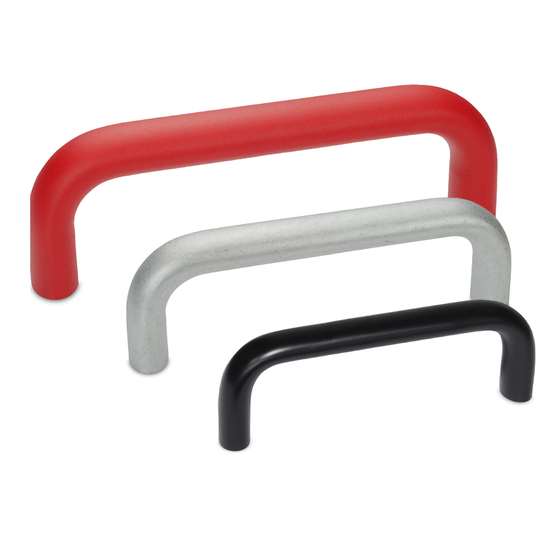
The GN 565 handle bars come standard with a UV-resistant, black, textured matte powder coat finish for outdoor use. Additionally, red or silver finishes, as well as anodized or polished surfaces, are available.
(Source: Ganter)
Ganter has enhanced the classic GN 565 bow handle with a newly dimensioned profile that offers an especially secure grip and allows for a wide variety of customization options. About half a century ago, the GN 565 bow handle was developed when the Mechanical Engineering Standards Committee was searching for solutions that were ergonomic, aesthetically pleasing, and affordable. The solution: an extruded aluminum profile that achieves its handle geometry through bending. This principle remains relevant today, including for the GN 565 standard, which has just been expanded. The new bow handle expands the standard’s upper dimensional limits: With a solid elliptical cross-section of 35x25 millimeters (1.38 × 0.98 inches) and mounting lengths between 250 and 500 millimeters (9.8 and 19.7 inches), it can withstand high loads. Perpendicular to the mounting plane, the handle can withstand up to 6,400 newtons; parallel to it, 5,900 newtons. Even heavy sliding doors or hatches can thus be easily operated.
Enabling Automated Tool Changes in Lathes
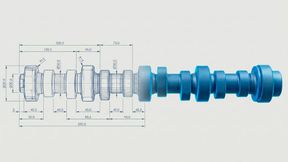
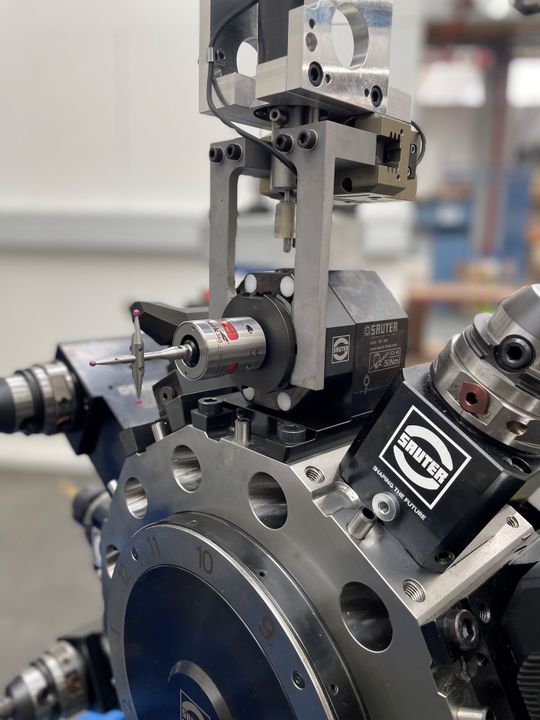
An adapter with a built-in probe is inserted into the Sauter SolidPro by a robotic arm.
(Source: Sauter)
Automated tool changing is common on milling machines, but it is still something completely new on lathes.With the Sauter SolidPro quick-change system, Sauter offers a tooling solution that makes automated tool changing on lathes technically feasible. The company is taking the next evolutionary step with a tool turret that handles the entire tool-changing process as a complete process chain. Part of this is an automated measurement system that captures the geometry of adapters to be reloaded. The data is uniquely assigned to the adapter and made available to the machine via the tool management system. In parallel, there is a storage unit from which a robot retrieves the appropriate adapters and uses the Sauter SolidPro quick-change system to install and remove them directly on the turret, static machining units, or directly on linear axes.
A Tamper-Proof Control Element for Greater Process Reliability
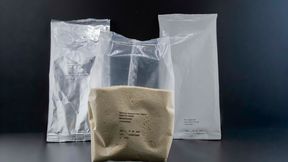
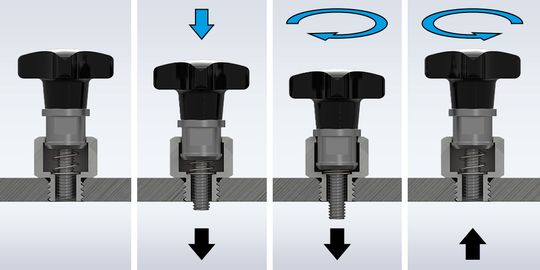
How Halder's tamper-proof control element works.
(Source: Erwin Halder)
Lost-proof controls play a crucial role in ensuring efficient and safe assembly processes. If set screws or clamping levers are lost, this not only results in additional effort to procure replacement parts but also often leads to delays in the production or assembly process. The new handle mount from Erwin Halder KG solves this problem by combining two proven functional principles into a single solution. The result: The control element remains permanently attached to the component and is always ready for use. To develop the handle mount, Halder relied on two proven standard elements from its own product range: handle screws and locking pins. The handle mount consists of a base body and a freely selectable operating element, such as a cross-head screw, a star-head screw, a clamping lever, or a knurled screw. The base body, made of electrogalvanized steel, is permanently screwed to the respective component.
Date: 08.12.2025
Naturally, we always handle your personal data responsibly. Any personal data we receive from you is processed in accordance with applicable data protection legislation. For detailed information please see our privacy policy.
Consent to the use of data for promotional purposes
I hereby consent to Vogel Communications Group GmbH & Co. KG, Max-Planck-Str. 7-9, 97082 Würzburg including any affiliated companies according to §§ 15 et seq. AktG (hereafter: Vogel Communications Group) using my e-mail address to send editorial newsletters. A list of all affiliated companies can be found here
Newsletter content may include all products and services of any companies mentioned above, including for example specialist journals and books, events and fairs as well as event-related products and services, print and digital media offers and services such as additional (editorial) newsletters, raffles, lead campaigns, market research both online and offline, specialist webportals and e-learning offers. In case my personal telephone number has also been collected, it may be used for offers of aforementioned products, for services of the companies mentioned above, and market research purposes.
Additionally, my consent also includes the processing of my email address and telephone number for data matching for marketing purposes with select advertising partners such as LinkedIn, Google, and Meta. For this, Vogel Communications Group may transmit said data in hashed form to the advertising partners who then use said data to determine whether I am also a member of the mentioned advertising partner portals. Vogel Communications Group uses this feature for the purposes of re-targeting (up-selling, cross-selling, and customer loyalty), generating so-called look-alike audiences for acquisition of new customers, and as basis for exclusion for on-going advertising campaigns. Further information can be found in section “data matching for marketing purposes”.
In case I access protected data on Internet portals of Vogel Communications Group including any affiliated companies according to §§ 15 et seq. AktG, I need to provide further data in order to register for the access to such content. In return for this free access to editorial content, my data may be used in accordance with this consent for the purposes stated here. This does not apply to data matching for marketing purposes.
Right of revocation
I understand that I can revoke my consent at will. My revocation does not change the lawfulness of data processing that was conducted based on my consent leading up to my revocation. One option to declare my revocation is to use the contact form found at https://contact.vogel.de. In case I no longer wish to receive certain newsletters, I have subscribed to, I can also click on the unsubscribe link included at the end of a newsletter. Further information regarding my right of revocation and the implementation of it as well as the consequences of my revocation can be found in the data protection declaration, section editorial newsletter.