According to Berylls by AlixPartners’ Top 25 Supplier Analysis, the first three quarters of 2026 brought stable margins to many suppliers. Europe remains an attractive market for the industry—but in Germany, high wage demands are putting more jobs at risk.
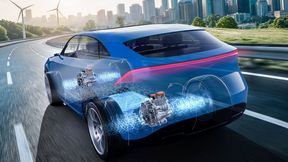
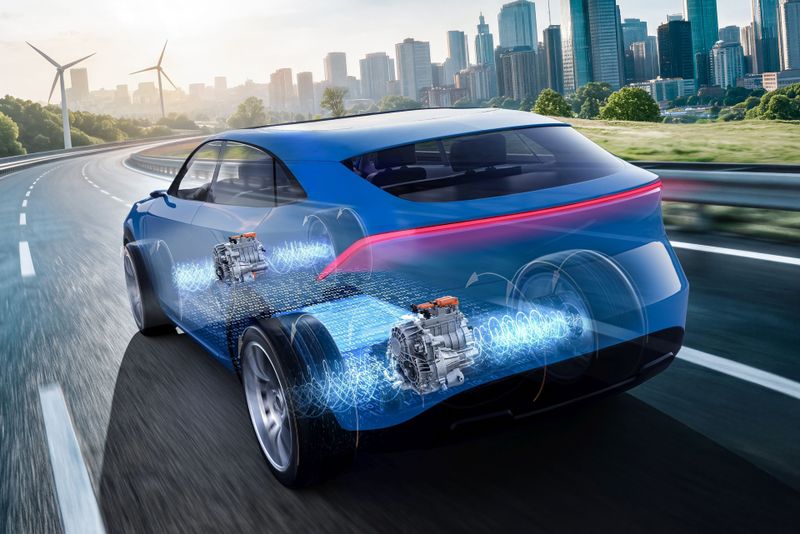
The top 25 suppliers managed to maintain their margins in 2026, despite lower sales. Pictured is ZF's new high-speed drive.
(Source: ZF)
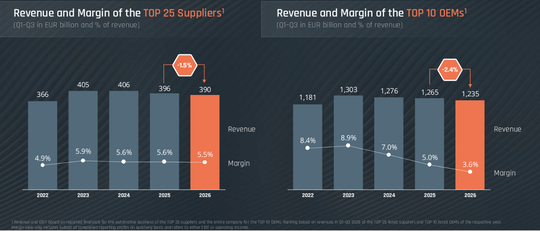
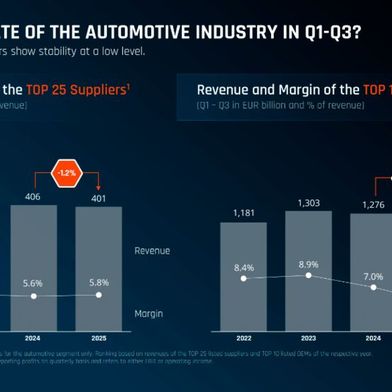
The year 2026 is not a lost year—at least from the perspective of the supplier industry. After all, the top 25 suppliers were able to maintain their margins despite lower sales. “The good news is clearly that suppliers are withstanding the steadily growing pressure. Although revenue for the top 25 fell by just under three percent to 390 billion euros (about 425 billion US dollars) in Q1–Q3 2026, However, the EBIT margin held steady at 5.5 percent—nearly on par with the previous year—and is 1.3 percentage points higher than that of the top 10 OEMs,” says Alexander Timmer, a partner at Berylls by AlixPartners, summarizing the situation at the end of the third quarter. Car manufacturers, on the other hand, continue to face headwinds: “The downward trend among OEMs is continuing. Our analysis shows that their operating margin is falling from 5.0 to 3.6 percent. Among suppliers, however, it is rising slightly. We haven’t seen suppliers’ margins exceed those of OEMs since before the pandemic.”
While the suppliers' EBIT margin remains roughly at the previous year's level at 5.5 percent, the downward trend continues among OEMs.
(Source: Berylls by AlixPartners)
As in previous years, the winners include tire manufacturers with margins above 13 percent—such as Continental and Bridgestone—but also Cummins, one of the world’s leading manufacturers of internal combustion engines, whose products are widely used as power generation units in the energy sector. However, the fact that tire manufacturing is no guarantee of satisfactory performance is evident in the case of Goodyear, where the margin is actually -1.9 percent.
At the same time, Europe’s industrial landscape is shifting. Since 2022, European suppliers have closed 89 plants, 46 of them in Germany. During the same period, Chinese competitors opened 56 new facilities. In Eastern and Southern Europe, about two-thirds of the new plants are now Chinese. With OEM sales down 4.6 percent, competition for orders and capacity utilization continues to intensify.
Rising Costs Are Putting Pressure on Limited Margins
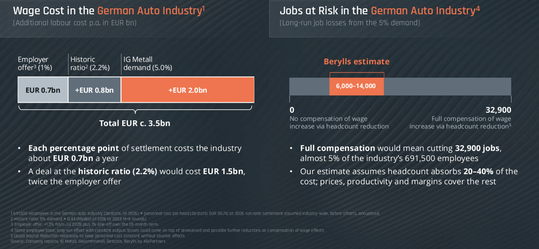
The cost structure is further exacerbating the situation. The 5 percent wage increase demanded by IG Metall could cost the German auto industry up to 3.5 billion euros (about 3.8 billion US dollars) annually and, in the long term, put 6,000 to 14,000 jobs at risk. At the same time, the OEMs are themselves under pressure with a margin of 4.2 percent and are likely to have only limited ability to absorb additional costs.
IG Metall's demand for a 5 percent wage increase could cost the German auto industry another 6,000 to 14,000 jobs.
(Source: Berylls by AlixPartners)
“Future success will not be determined by a one-size-fits-all industry formula, but by each individual company’s ability to consistently set its priorities,” summarizes Stefan Schneeberger, Associate Partner at Berylls by AlixPartners. The focus is on four key areas: prioritizing margin over volume, securing refinancing in a timely manner by 2027, adapting the European footprint to market conditions, and expanding the non-auto business only where it is economically viable.
Although the non-automotive business is growing by 31 percent, 13 of the 25 largest suppliers remain entirely dependent on the automotive sector. Diversification therefore remains an option—but, according to the analysis, it is not an end in itself. After all, the companies examined are generating just under one-third of their revenue this year from non-automotive products and services.
Consolidation Across the Entire Value Chain
"Our analysis shows that sales for the top 10 OEMs fell by 4.6 percent in Q1–Q3 2026, and their revenue declined by 2.4 percent. New markets such as India cannot close the gap, and while electric vehicles are driving higher sales volumes, they are not yet leading to higher margins. We expect a decline in the number of plants, models, and suppliers, not a recovery in sales volume,” says Jan-Philipp Schneider, Senior Consultant at Berylls by AlixPartners, assessing the outlook for the next twelve months. He therefore recommends that companies plan for stagnant sales volumes and take steps today—rather than tomorrow—to utilize and consolidate shared platforms and plants.
Date: 08.12.2025
Naturally, we always handle your personal data responsibly. Any personal data we receive from you is processed in accordance with applicable data protection legislation. For detailed information please see our privacy policy.
Consent to the use of data for promotional purposes
I hereby consent to Vogel Communications Group GmbH & Co. KG, Max-Planck-Str. 7-9, 97082 Würzburg including any affiliated companies according to §§ 15 et seq. AktG (hereafter: Vogel Communications Group) using my e-mail address to send editorial newsletters. A list of all affiliated companies can be found here
Newsletter content may include all products and services of any companies mentioned above, including for example specialist journals and books, events and fairs as well as event-related products and services, print and digital media offers and services such as additional (editorial) newsletters, raffles, lead campaigns, market research both online and offline, specialist webportals and e-learning offers. In case my personal telephone number has also been collected, it may be used for offers of aforementioned products, for services of the companies mentioned above, and market research purposes.
Additionally, my consent also includes the processing of my email address and telephone number for data matching for marketing purposes with select advertising partners such as LinkedIn, Google, and Meta. For this, Vogel Communications Group may transmit said data in hashed form to the advertising partners who then use said data to determine whether I am also a member of the mentioned advertising partner portals. Vogel Communications Group uses this feature for the purposes of re-targeting (up-selling, cross-selling, and customer loyalty), generating so-called look-alike audiences for acquisition of new customers, and as basis for exclusion for on-going advertising campaigns. Further information can be found in section “data matching for marketing purposes”.
In case I access protected data on Internet portals of Vogel Communications Group including any affiliated companies according to §§ 15 et seq. AktG, I need to provide further data in order to register for the access to such content. In return for this free access to editorial content, my data may be used in accordance with this consent for the purposes stated here. This does not apply to data matching for marketing purposes.
Right of revocation
I understand that I can revoke my consent at will. My revocation does not change the lawfulness of data processing that was conducted based on my consent leading up to my revocation. One option to declare my revocation is to use the contact form found at https://contact.vogel.de. In case I no longer wish to receive certain newsletters, I have subscribed to, I can also click on the unsubscribe link included at the end of a newsletter. Further information regarding my right of revocation and the implementation of it as well as the consequences of my revocation can be found in the data protection declaration, section editorial newsletter.
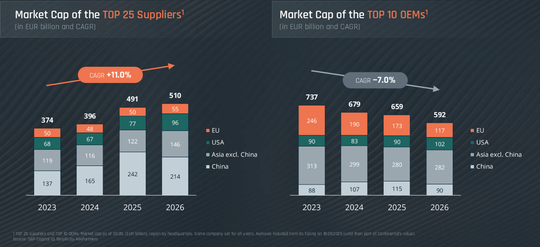
The market capitalization of suppliers rose by 11% annually to 510 billion euros, led by battery manufacturers; the market capitalization of OEMs fell by 7% annually.
(Source: Berylls by AlixPartners)
It is expected that pressure will increasingly shift to suppliers. OEMs will drive down prices—in part through modular design. The Chinese newcomers are taking a different approach. They are expanding into Europe. European companies can counter this trend by consistently linking price reductions to productivity gains, as well as by refinancing early and actively consolidating.
Jürgen Simon, partner at Berylls by AlixPartners: “By 2026, Germany will have already lost a net total of 40,000 jobs in the automotive industry and, since 2022, 38 supplier plants; the decline will continue through 2027 as plants are relocated to Eastern Europe and North Africa.” For policymakers and social partners, this means linking wages to productivity, lowering energy costs, and shortening approval times.
"Too Big to Fail" no Longer Applies
Size has not protected either Volkswagen (0.0 percent margin) or Europe’s suppliers in recent times. It has long been the case that flexibility and quality trump sheer size. Stefan Schneeberger: “For European suppliers, this calls for two measures: They must sharpen and strengthen their profile and also court the Chinese OEMs pushing into Europe—these OEMs need local suppliers, and the Europeans can score points here with their long-established automotive expertise, extending all the way to the aftermarket business. They could even turn out to be critical to the future success of Chinese OEMs in Europe.” Not least because entering the European market is proving more difficult than anticipated. At the same time, safety requirements for the development of new cars are becoming stricter in China. This is good news for consumers, but it is likely to noticeably slow down the “China speed” in the future.