Despite all the negative headlines, the year 2025 has developed well for suppliers, with their margin slightly increasing while it has decreased for OEMs. Berylls by AlixPartners now expects even tougher price negotiations in 2026.
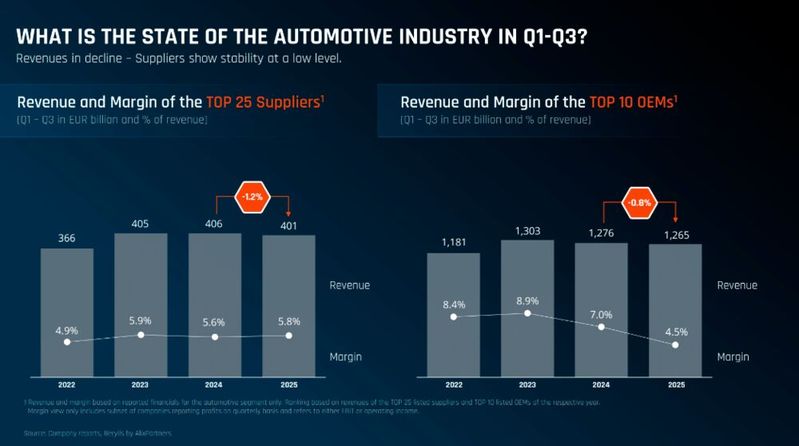
While the operating margin of OEMs drops to 4.5 percent, it slightly increases for the top 25 suppliers.
(Image: Berylls by AlixPartners)
Export bans on rare earths, supply shortages for chips, declining registration numbers in key global markets, geopolitical tensions – the automotive world is groaning under this multiple disruption. As a result, tens of thousands of jobs have been cut or are slated to be cut at major suppliers worldwide this year. Nevertheless, 2025 is not a lost year for the industry. Amid all the dark shadows, there are also bright spots.
At suppliers, the operating margin has risen from 5.5 percent to 5.8 percent compared to the previous year. Alexander Timmer, Partner at Berylls by AlixPartners, assesses the situation as follows: "The operating margin of OEMs drops from 6.3 to 4.5 percent. In contrast, it slightly increases for suppliers. We haven’t seen it exceed OEM margins since the pre-COVID era."
In fact, the OEMs have a profitability problem, but they are still robust in terms of liquidity. The situation is quite different for suppliers. Suppliers face significant difficulties with their liquidity, and their level of debt is high, both of which are real problems in times of rising interest rates.
This development is overlaid by declining revenues. Among the top 25 suppliers, revenues drop to 400 billion euros (~$464 Billion), while for the ten largest automakers, they shrink to 1,265 billion euros (~$1,47 Billion). The decline amounts to approximately 1.5 percent compared to the 2024 figures, and revenue decline was also recorded in the previous year.
The next year will prove to be challenging for the supplier industry — to put it mildly. OEMs will negotiate particularly hard on procurement. Stefan Schneeberger, supplier expert and Associate Partner at Berylls by AlixPartners, states: "The challenges faced by OEMs are leading to even tougher price negotiations and a stronger so-called pain-share demand. While the top 25 suppliers may be able to partially cushion this, the situation for mid-sized suppliers or non-listed German companies will heighten tensions further and create an urgent need for action."
Confidence Too Pronounced
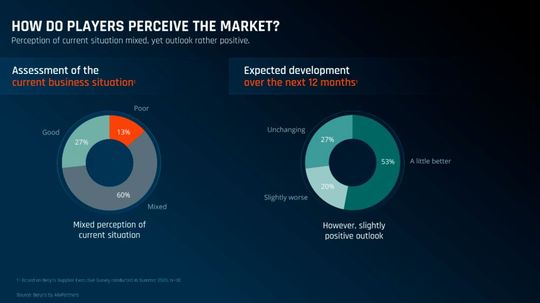
Suppliers do not expect a significant deterioration in their position, as revealed by a survey from Berylls by AlixPartners in the summer of 2025. It shows that suppliers are generally optimistic about the future. While 60 percent rate the current situation as "mixed," more than 50 percent expect a positive development over the next twelve months. However, an analysis of the results of the top 25 suppliers and top 10 OEMs suggests that this optimism may be somewhat overly pronounced. Berylls experts anticipate that 2026 will be as critical for suppliers as the pandemic crisis, with an increased risk of insolvency, especially for SMEs.
60 percent of suppliers rate the current situation as "mixed," while more than 50 percent expect a positive development in the next twelve months.
(Image: Berylls by AlixPartners)
According to Berylls, the coming year will mark a turning point for the industry. The focus on global efficiency will be replaced by increasingly regulated, regionalized, but also transparent supply chains. Localization, in particular, is an important part of a risk minimization trend fueled by U.S. policies and regulations for domestically created content (e.g., software). As a result, so-called reshoring has begun, bringing globally distributed development and production capacities back to individual countries or world regions such as the U.S. or Europe. At the same time, old alliances are losing significance while new ones are emerging, including for the procurement of raw materials, which are expected to be sourced more from Africa, Australia, or South America.
Build Trust with OEMs
Especially when it comes to the raw materials needed for e-mobility, it becomes evident how dependent Europe currently is on China and that substituting its supply of rare earths, graphite, or lithium before 2030 is not realistic. China's recent export restrictions on these raw materials highlight the necessity for supply chains to move away from rigid just-in-time or just-in-case models towards regionality, redundancy, and thus resilience.
Date: 08.12.2025
Naturally, we always handle your personal data responsibly. Any personal data we receive from you is processed in accordance with applicable data protection legislation. For detailed information please see our privacy policy.
Consent to the use of data for promotional purposes
I hereby consent to Vogel Communications Group GmbH & Co. KG, Max-Planck-Str. 7-9, 97082 Würzburg including any affiliated companies according to §§ 15 et seq. AktG (hereafter: Vogel Communications Group) using my e-mail address to send editorial newsletters. A list of all affiliated companies can be found here
Newsletter content may include all products and services of any companies mentioned above, including for example specialist journals and books, events and fairs as well as event-related products and services, print and digital media offers and services such as additional (editorial) newsletters, raffles, lead campaigns, market research both online and offline, specialist webportals and e-learning offers. In case my personal telephone number has also been collected, it may be used for offers of aforementioned products, for services of the companies mentioned above, and market research purposes.
Additionally, my consent also includes the processing of my email address and telephone number for data matching for marketing purposes with select advertising partners such as LinkedIn, Google, and Meta. For this, Vogel Communications Group may transmit said data in hashed form to the advertising partners who then use said data to determine whether I am also a member of the mentioned advertising partner portals. Vogel Communications Group uses this feature for the purposes of re-targeting (up-selling, cross-selling, and customer loyalty), generating so-called look-alike audiences for acquisition of new customers, and as basis for exclusion for on-going advertising campaigns. Further information can be found in section “data matching for marketing purposes”.
In case I access protected data on Internet portals of Vogel Communications Group including any affiliated companies according to §§ 15 et seq. AktG, I need to provide further data in order to register for the access to such content. In return for this free access to editorial content, my data may be used in accordance with this consent for the purposes stated here. This does not apply to data matching for marketing purposes.
Right of revocation
I understand that I can revoke my consent at will. My revocation does not change the lawfulness of data processing that was conducted based on my consent leading up to my revocation. One option to declare my revocation is to use the contact form found at https://contact.vogel.de. In case I no longer wish to receive certain newsletters, I have subscribed to, I can also click on the unsubscribe link included at the end of a newsletter. Further information regarding my right of revocation and the implementation of it as well as the consequences of my revocation can be found in the data protection declaration, section editorial newsletter.
"This resilience will develop away from being a cost factor and toward a differentiator for companies," explains Fabian Piontek, Partner and Managing Director at AlixPartners. "The industry must massively improve its resilience and thus its flexibility. This will enable it to build trust with OEMs and make long-term collaborations possible."
To secure a strong position in international comparison, suppliers should not only focus on operational resilience but also keep sustainability in mind, according to Piontek. Some of the new trends are indeed playing into the industry's hands: localized production, for instance, reduces transport emissions, both for raw materials and finished products. The traceability of the supply chain also shows positive effects. It supports compliance with CO₂ regulations and ethically oriented procurement policies. If sustainability and resilience improve simultaneously, companies could present a new value proposition—and thereby enhance their chances of increasing revenues and margins in the long term.
The Question is How Things Will Continue in and with China
It is not expected that global vehicle production will increase over the next twelve months—quite the opposite. Christian Grimmelt, Partner at Berylls by AlixPartners, summarizes the situation: "Supply chains and customs policies have the potential to necessitate a short-term downward revision of global vehicle production. Strong dependence on raw materials from China plays a decisive role here." In addition to the supply of raw materials from China, such as rare earths, graphite, and cobalt, access to Chinese component suppliers also has a significant impact, as demonstrated by the example of Nexperia. To strengthen the resilience of supply chains, companies should therefore focus not only on regionality but also on the qualification of new production technologies.
This Crisis Also Has Winners
No relief is expected from the U.S. either. "Import tariffs will lead to higher costs or reduced sales volumes for companies without U.S. production sites," says Fabian Piontek. However, manufacturers with their own production capacities in the U.S. will also face higher costs due to production relocations from the EU. This development, of course, also impacts suppliers. Overall, he assumes that revenues will continue to stagnate. Additionally, margins for suppliers are expected to come under pressure over the course of 2026—albeit to a lesser extent than for OEMs.
In fact, the development does not appear equally negative for all product groups. Stefan Schneeberger states: "Semiconductor manufacturers like Infineon, NXP, or ST Micro will continue to be the winners of the crisis, as they have been this year. Revenues and margins will reach record levels. Battery manufacturers also remain in the fast lane, driven by the increasing market penetration of electric vehicles. We expect a 32 percent BEV market share in new registrations worldwide by 2030." This is likely to bring significant revenue growth to battery manufacturers in 2026 and beyond.



:quality(80)/p7i.vogel.de/wcms/17/b8/17b8af0cb725e0e1d3e8d72458bab260/siemens-meet-at-the-machinev1.jpeg "“Meet at the Machine” is Siemens’ new initiative, which aims to bring together machine builders, software, and automation technologies to accelerate innovation in the machine tool industry and help manufacturers become productive more quickly. (Source: Siemens)")
:quality(80)/p7i.vogel.de/wcms/8e/7e/8e7e0cda4c68699bcc48283a38739769/0133316747v1.jpeg "A little-known hidden champion! When people think of laser cutting, the first thing that comes to mind is the power of the laser beam—and it is impressive to see the sparks flying. But Air Liquide—an exhibitor at Euroblech, by the way—wants to make it clear that the process gas is also key to success. (Image:AI-generated)")
:quality(80)/p7i.vogel.de/wcms/20/fa/20fa35e0af203c3464f7e7fdbb57a685/0133281172v1.jpeg "Since 2003, Etzinger AG has been developing and manufacturing high-quality coffee grinders, pepper mills, and grinding mechanisms for professional and home use. (Image:Etzinger)")
:quality(80)/p7i.vogel.de/wcms/69/91/6991413943488b4a2f6fde9dcd88c5b0/0133256686v1.jpeg "The CMA-patented pendulum mount can compensate for radial tolerances of up to one millimeter. (Image:Schwiening)")
:quality(80)/p7i.vogel.de/wcms/38/79/38799bfbbccd938b64c67068cfa68780/0133329362v1.jpeg "What exactly enables machines to act on their own? (Image:Shutterstock)")
:quality(80)/p7i.vogel.de/wcms/1b/9f/1b9fc9f113fc66212e2c0e17a3edaf9f/org-blobs-user-response-file-output-f317796f-57b7-483f-9403-5d9ac8a816f5-plugin-output-call-kdigtepb7be7us8xvbota0mh-1672x940v1.png "According to Barclays data, Europe leads the global trade in actuator components. With a 34 percent share, the region ranks ahead of China, which has a 26.3 percent share. (Source: Statista | CC BY-ND 4.0, AI-generated)")
:quality(80)/p7i.vogel.de/wcms/f5/4c/f54c9fc59ccb0604ab9219188469a45f/image1v1.jpeg "Christopher Savoia, Global Head of the UR+ Ecosystem at Universal Robots, presents the new SP7 Smart Panel on a UR17g-1300 robot during the unveiling of Gen 7—UR’s 7th-generation robot platform—at IMTS in Chicago on September 14, 2026. (Image:Image: Teradyne Robotics)")
:quality(80)/p7i.vogel.de/wcms/bd/4e/bd4ef09ab0f84932ea76ca0330ffe789/0133329802v1.jpeg "The robotics boom and its consequences: According to a study, a significant portion of value creation occurs in the electronics industry. (Image:Fraunhofer IPA)")
:quality(80)/p7i.vogel.de/wcms/87/87/87870cf2b30aaef7b8a06212a4ef2c14/0133403885v1.jpeg "A digital twin and a real component demonstrate how closely simulation and manufacturing are converging. Stampack Xpress 2026.1 virtually models forming behavior and supports the validation of process and tool design. (Image:Stampack)")
:quality(80)/p7i.vogel.de/wcms/59/2a/592a7f2d0964e9e6846cae331f5daa3a/0133266065v1.jpeg "Perforated metal sheets are particularly well-suited for balcony railings, as they combine stability, privacy, and design versatility. (Image:Ripo Factory)")
:quality(80)/p7i.vogel.de/wcms/45/64/45642ff0fe0a6bec251b77739131d83b/abb-ferrari-hypersail-16-9-three-quarter-front-viewv1.jpeg "The Ferrari Hypersail is a 100-foot monohull wing-in-plane yacht powered entirely by renewable energy. (Source: ABB / Ferrari Hypersail)")
:quality(80)/p7i.vogel.de/wcms/3e/0e/3e0e3ea22e48410ceada53b02ffccb59/0133358454v1.jpeg "BYD top executive Stella Li plans to offer megawatt flash charging for commercial vehicles as well. (Image:VDA/IAA Transportation 2026)")
:quality(80)/p7i.vogel.de/wcms/e2/7d/e27de60472809cc58ac0d321066c9679/l1051833v1.jpeg "Geely has acquired a stake of just over 26 percent in Renault do Brasil. Geely models for the South American market are now also being produced at the Ayrton Senna plant in São José dos Pinhais. (Image:Renault)")
:quality(80)/p7i.vogel.de/wcms/1e/c1/1ec1495eb283200f4b7cb55de0c4dff7/20260917-110436643v1.jpeg "Ceremonial launch of Mercedes-Benz GLA production in Rastatt; among those in attendance was plant manager Marco Zwick (second from the right). (Source: Thomas Günnel – Automotive Industry)")
:quality(80)/p7i.vogel.de/wcms/76/f3/76f310eed0caebc79ff91195c29de08d/visual-siwa-treatment-optimizerv1.jpeg "A Mireo train from Siemens Mobility was used in the “Automated Train” project for a fully automated delivery and return trip on the open rail network. (Source: Siemens Mobility)")
:quality(80)/p7i.vogel.de/wcms/4c/53/4c534208d09a9b1ce597938715e7fc19/0133288763v1.jpeg "Logic Folding: In its latest Kirin 9050 Pro, Huawei uses hybrid bonding to distribute the computing units across two silicon layers in order to increase the effective transistor density without resorting to finer manufacturing processes. (Image:Huawei)")
:quality(80)/p7i.vogel.de/wcms/56/d1/56d131e0b5bd05ef47411e92ad740cb4/0133351029v1.jpeg "Researchers at DTU have developed a nanolaser in a semiconductor membrane. The structure concentrates charge carriers and the light field into a small area (shaded in blue). If data is transmitted on microchips using light instead of electrical signals, transmission speeds can be increased and energy losses reduced. (Image:Yi Yu, DTU)")
:quality(80)/p7i.vogel.de/wcms/5e/55/5e55101ddc6338f755fcf3244db1367f/0133331863v1.jpeg "For data center projects, it is becoming increasingly important to also obtain the consent of the affected community. (Image:Dall-E / AI-generated)")
:quality(80)/p7i.vogel.de/wcms/8d/f9/8df95d3f58408673986b3d643e6b63ba/0133252773v1.jpeg "TXC targets high-speed optical links in AI data centers with 312.5 MHz oscillators, among other solutions. As data rates increase, requirements for jitter and frequency stability become more demanding as well. (Bild: TXC)")
:fill(fff,0)/images.vogel.de/vogelonline/companyimg/76800/76895/65.jpg "FAULHABER_120mm.jpg ()")
:fill(fff,0)/p7i.vogel.de/companies/69/88/69882c428938e/tmts2026-ticec-banner-en-2000px.png "tmts2026-ticec-banner-en-2000px (https://www.tmts.tw/en)")
:fill(fff,0)/p7i.vogel.de/companies/69/de/69de1b7403b0d/simtos-logo.jpeg "simtos-logo (SIMTOS)")
:quality(80)/p7i.vogel.de/wcms/83/ea/83eab3dde73d8a43c5bfa7cec2b53636/0131541608v2v1.jpeg "Globally, the supplier industry is struggling. The reasons are unfavorable exchange rates, weaker demand for electric vehicles outside of China, and increasing geopolitical and economic pressures. (Image: freely licensed on Pixabay)")
:quality(80)/p7i.vogel.de/wcms/5a/40/5a40f9a0f2694fd5ba3fcda47c7efc60/0128999689v1.jpeg "The SOP for the electric Macan (here at the Porsche plant in Leipzig) has been postponed multiple times. This is common for new electric cars in Europe and a problem for local suppliers, according to a recent Berylls study. (Image:Porsche AG)")