From
Claus-Peter Köth
| Translated by AI
9 min Reading Time
Jan Dannenberg and Alexander Timmer from Berylls by AlixPartners on the key findings of the "Global Top 100 Automotive Suppliers" study and their forecast for the 2026 financial year.
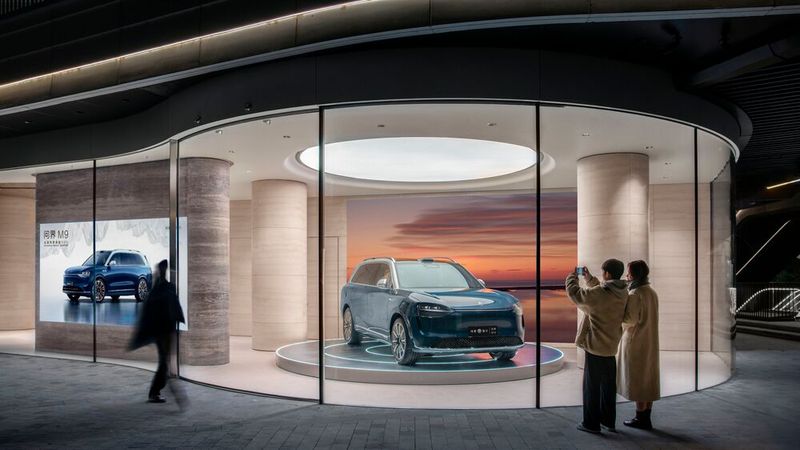
Huawei more than quintupled its automotive sales in 2024—and was profitable for the first time. Pictured: The Aito M9 in the flagship store in Shanghai.
(Image: Huawei)
Dr. Dannenberg, what are your key findings from the Top 100 Suppliers Study 2025?
Jan Dannenberg: Transformation and crisis continue to shape the image of the supplier industry in 2025. Two thirds of suppliers have shrunk compared to the previous year, profits are declining and staff reductions have accelerated. The established players in particular have suffered setbacks; however, this has also enabled nine companies to be included in the Top 100 for the first time.
Dr. Timmer, which result surprised you—at least in terms of its severity?
Alexander Timmer: The speed of the Chinese rise—even if we have been observing it for years. CATL is among the three largest suppliers worldwide for the first time. The company appeared in the ranking for the first time in 2018, when it was ranked 71st. This is a development that is unparalleled. And CATL is not an isolated case. In 2012, Weichai Power was represented in the ranking by just one Chinese company—today there are 15, compared to 13 in the previous year. Huawei and Fuyao also show how broad this rise has become.
Huawei more than quintupled its automotive sales in 2024 and brought the business to profitability for the first time, supported by AI-based driver assistance systems and cockpit software that were brought to market maturity together with domestic OEMs. Fuyao is growing differently—organically, highly profitably and with a clear focus on the premium segment. As the global market leader in automotive glass, the company is benefiting from the fact that modern vehicles require considerably more sophisticated glass—from ADAS-integrated windscreens to sensor-compatible panoramic roofs. This is driving up revenue per vehicle, regardless of the overall market volume.
Which suppliers were particularly successful in 2025—and why?
Timmer: As in previous years, semiconductor manufacturers (e.g. Renesas, ST Micro) were able to generate high, double-digit returns; however, they recorded the highest declines in sales. Tire manufacturers, such as Continental, Yokohama and Toyo, are also over 11% profitable, i.e. twice as high as the rest of the industry; the growth champions in this segment are exclusively Chinese players (Saliun, ZC Rubber). However, the high profit margins here are due to the aftermarket business.
The market share gains of Chinese OEMs have also ensured that sales of local tire manufacturers have risen sharply, which has also led to leaps in sales for battery manufacturers CALB and Gotion. The takeover of air conditioning manufacturer Hanon by Hankook and of Leoni by Luxshare-ICT improved their position by 29 and 92 ranks respectively! Huawei was able to grow organically by 93% with systems for automated driving.
Battery manufacturers from South Korea and Japan have experienced their worst year since being included in the ranking.
Alexander Timmer, Berylls by AlixPartners
Which suppliers or product groups were particularly hard hit?
Timmer: The battery manufacturers from South Korea and Japan have experienced their worst year since their inclusion in the ranking. Samsung SDI plummeted to 100th place—from 59th in the previous year—and suffered a drop in sales of almost 40 percent. The operating margin fell from plus 1.1 percent to minus 24.5 percent, the sixth consecutive quarter of losses. At minus 62 percent, Panasonic recorded the sharpest percentage drop in sales in the entire ranking; this shows the downside of a dependency on a single customer that has built up over the years.
Jan Dannenberg (left) and Alexander Timmer from Berylls by AlixPartners on the key findings of the latest "Global Top 100 Automotive Suppliers" study.
(Image: Berylls by AlixPartners)
The basic problem is the same whether you look at Samsung SDI, LG Energy Solution or SK on: The market for high-voltage batteries based on NMC has collapsed in North America. Semiconductor companies are also under pressure—ST Micro is down 28%, Infineon and Renesas are both down 12%. This is due to two developments: declining vehicle volumes in Europe and North America, which directly reduce chip demand, and the increasing substitution of Western suppliers by domestic semiconductor manufacturers in Chinese vehicles. Nevertheless, despite these declines, semiconductors remain by far the most profitable product group in the overall ranking with margins of over 20 percent.
How do European suppliers compare internationally?
Dannenberg: A third of the global top 100 come from Europe and, with a few exceptions, they suffered significant falls in turnover—on average around 4.5%. The same applies to the return on sales (EBIT or operating profit), which fell by minus 0.5 percentage points. The picture is similar for North American suppliers. Japanese and Korean suppliers have stagnated in terms of growth. The only players with growth of 18.5 percent are the 15 suppliers from China.
Date: 08.12.2025
Naturally, we always handle your personal data responsibly. Any personal data we receive from you is processed in accordance with applicable data protection legislation. For detailed information please see our privacy policy.
Consent to the use of data for promotional purposes
I hereby consent to Vogel Communications Group GmbH & Co. KG, Max-Planck-Str. 7-9, 97082 Würzburg including any affiliated companies according to §§ 15 et seq. AktG (hereafter: Vogel Communications Group) using my e-mail address to send editorial newsletters. A list of all affiliated companies can be found here
Newsletter content may include all products and services of any companies mentioned above, including for example specialist journals and books, events and fairs as well as event-related products and services, print and digital media offers and services such as additional (editorial) newsletters, raffles, lead campaigns, market research both online and offline, specialist webportals and e-learning offers. In case my personal telephone number has also been collected, it may be used for offers of aforementioned products, for services of the companies mentioned above, and market research purposes.
Additionally, my consent also includes the processing of my email address and telephone number for data matching for marketing purposes with select advertising partners such as LinkedIn, Google, and Meta. For this, Vogel Communications Group may transmit said data in hashed form to the advertising partners who then use said data to determine whether I am also a member of the mentioned advertising partner portals. Vogel Communications Group uses this feature for the purposes of re-targeting (up-selling, cross-selling, and customer loyalty), generating so-called look-alike audiences for acquisition of new customers, and as basis for exclusion for on-going advertising campaigns. Further information can be found in section “data matching for marketing purposes”.
In case I access protected data on Internet portals of Vogel Communications Group including any affiliated companies according to §§ 15 et seq. AktG, I need to provide further data in order to register for the access to such content. In return for this free access to editorial content, my data may be used in accordance with this consent for the purposes stated here. This does not apply to data matching for marketing purposes.
Right of revocation
I understand that I can revoke my consent at will. My revocation does not change the lawfulness of data processing that was conducted based on my consent leading up to my revocation. One option to declare my revocation is to use the contact form found at https://contact.vogel.de. In case I no longer wish to receive certain newsletters, I have subscribed to, I can also click on the unsubscribe link included at the end of a newsletter. Further information regarding my right of revocation and the implementation of it as well as the consequences of my revocation can be found in the data protection declaration, section editorial newsletter.
How have suppliers from China, South Korea, Japan and the USA developed?
Dannenberg: China is the clear winner. With 15 companies now in the ranking, Chinese suppliers have overtaken the USA for the first time, and eight of the ten biggest revenue winners come from China—across batteries, electronics and glass, across the board. CATL, CALB, Gotion, Huawei and Fuyao represent a rise that is no longer limited to individual segments. South Korea presents a mixed picture: Hyundai Mobis is holding steady, but battery manufacturers are deep in crisis— exacerbated by a currency effect, as the Korean won has weakened by over 8 percent against the euro.
Japan remains the most strongly represented nation in the ranking with 21 companies, but the overall picture is stagnant. The tire manufacturers stand out positively: Yokohama and Toyo Tire achieve margins of over 16 percent, and Renesas maintains a margin of over 30 percent despite a decline in sales—a value that no other company in the ranking achieves.
The USA is undergoing a high level of restructuring: Cummins is the exception, growing by six percent, while most others are shrinking. Activities at portfolio level are characteristic of the US suppliers. Dauch (formerly American Axle & Manufacturing) is taking over Dowlais (GKN Automotive, GKN Powder Metallurgy) and Dana is selling its off-highway business.
Major German suppliers are pinning their hopes on India as an automotive location—and rightly so?
Timmer: India will be the next major automotive market of importance. Positioning ourselves there today makes perfect sense. However, India will develop much more slowly as a consumer market than is the case in centrally managed China. As a "producer" of services (engineering, software, services), India is already an important mainstay for OEMs and suppliers. Having production sites in India in the future will become increasingly important for many suppliers.
To what extent is the EU-US conflict affecting the transatlantic auto parts trade?
Timmer: The figures speak for themselves: European imports from the USA will have fallen by 16% in 2025, while exports to the USA will have fallen by 17%. That sounds symmetrical, but it's not. Because the volume of European exports to the USA is around five times higher than vice versa, a similar percentage decline will hit the European side much harder in absolute terms.
The so-called Turnberry Deal of August 2025 has prevented the worst-case scenario—tariffs of up to 30%. An upper limit of 15 percent now applies to cars and car parts, which represents a noticeable reduction compared to the top rates of up to 27.5 percent. However, 15 percent is not the norm, but a permanent additional burden.
The actual consequence is of a structural nature: the conflict is massively accelerating the "local for local" logic: if you want to serve the US market in the long term, you increasingly have to produce there. This ties up capital in an environment in which financing has become more expensive anyway. At the same time, US producer prices are rising as a result of the tariff policy, while they are falling in Germany and China—the cost advantage of European suppliers on the US market continues to erode.
The Iran war has turned all the positive economic signs into the opposite.
Jan Dannenberg, Berylls by AlixPartners
What is your forecast for the 2026 financial year? Has the Iran crisis put a damper on the delicate hopes?
Dannenberg: The global manufacturing industry got off to a good start in 2026, including the automotive market. The Iran war has turned all the positive economic signs into the opposite: rising inflation, reluctance to buy, delays in investments, increased national debt, oil-related supply bottlenecks for production materials. It is to be hoped that the conflict will only last a short time, otherwise 2026 will be as bad as previous years.
Europe's suppliers' association CLEPA is calling for a tightening of the local content rules proposed by the EU Commission. What do you think of this initiative—can it be used to correct different competitive conditions?
Dannenberg: The demand is understandable. CLEPA sees around 350,000 jobs at risk by 2030, and 104,000 job cuts have already been announced between 2024 and 2025. The call for political protection is therefore a logical response. Specifically, CLEPA is calling for a threshold of 70 percent European added value for a vehicle to be considered "Made in Europe" in the first place—and warns against watering down the regulations by making them too easy to circumvent.
Whether this closes the competitive gap is another question. Local content rules can protect market shares, but they cannot transform cost structures. The cost advantage of Chinese suppliers has grown over decades—producer prices, energy costs, state subsidies. You can't make up for this with a percentage threshold.
What's more, OEMs are much more skeptical about the issue. The European manufacturers' association ACEA warns that Europe's industrial base would be weakened rather than strengthened by excessively tough local content protectionism. This divide between suppliers and OEMs is real and makes consistent implementation politically difficult. Local content can be a useful instrument—but only as part of a broader package of investment promotion, energy cost relief and accelerated technology transfer.
According to reports, the new Mercedes chief buyer is demanding massive price cuts from suppliers. Is there still room for maneuver?
Timmer: You have to answer that in a very differentiated way. Nothing can be done with today's structures: Suppliers with a focus on Western Europe, Japan or the USA are finished. Everyone has to relocate or build up capacities in "low-cost" countries, i.e. where wages (including social benefits), raw materials, energy, taxes, regulations and duties are significantly lower than in the West.
In Western structures, it is no longer possible to achieve the necessary increases in productivity required to keep up with the best in price competition. And in terms of costs, the best today are Chinese OEMs and suppliers. Mercedes and all automotive suppliers must measure themselves against this.
Price or cost reductions must be achieved. However, the consequences will be serious: In the past eight years, the German automotive industry has already lost twelve percent of its workforce. This trend will continue to accelerate and fuel the deindustrialization of Western countries.
In which automotive topics do you see good prospects for European suppliers in the medium term—or would it be better for companies to push ahead with their diversification?
Timmer: The honest answer is: both. In the core business, there are segments with a future—high-voltage components, ADAS systems, steer-by-wire. These are fields in which European suppliers still have a real edge in terms of expertise. Those who supply interchangeable mass-produced components, on the other hand, should have no illusions—the cost pressure there is structural and cannot be defined away by regulation.
When it comes to diversification, we see a clear movement in the data: The non-automotive share of the top 100 suppliers has risen from 35 to 37 percent within a year. The defense industry is developing into a serious second pillar, and the aftermarket is gaining in importance as a profit buffer. Diversification is not an admission of failure—for many suppliers, it is a more sensible strategy than waiting for a recovery of the core business, which will no longer come in this form. (kt)



:quality(80)/p7i.vogel.de/wcms/dd/92/dd928ba2e2956aa2bfff4888af8b08f8/photo--1v1.jpeg "Catalog product for extreme operating conditions: The new NRTVG guide carriage from Bosch Rexroth withstands extreme environmental conditions. (Source: Bosch Rexroth AG)")
:quality(80)/p7i.vogel.de/wcms/5a/9e/5a9e57e26964ba5c9d8719a9ee520bb3/0133310195v1.jpeg "Germany and the United Arab Emirates have signed an agreement to stand shoulder to shoulder in times of crisis. This will bring Germany many billions, to say the least.
From left: Sheikh Mohammed bin Sajed al-Nahjan and Federal Chancellor Friedrich Merz. (Image:dpa / K. Nietfeld)")
:quality(80)/p7i.vogel.de/wcms/ce/96/ce964ee3cbd875e63a809c3df1d2b01e/0133312918v1.jpeg "Do you also have a branch in China and are looking for a local partner there with whom you can work to strengthen your market position? If so, time is running out, as a survey by the German Chamber of Foreign Trade in Beijing reveals ... (Image: AI-generated)")
:quality(80)/p7i.vogel.de/wcms/a0/94/a09489b453e958dc8ffd85accab2aaf3/0130556732v1.jpeg "Mutares supported two of its portfolio companies to help them strengthen their position. It worked out perfectly. Now both have been sold. Read here to find out exactly what this is all about... (Image:Mutares)")
:quality(80)/p7i.vogel.de/wcms/81/dc/81dc63ed24c562521413023779495e7d/chris-kramerv1.jpeg "Chris Kramar, Director and General Manager of OEM Solutions for Germany, Austria, and Switzerland at Dell Technologies (Source: Dell Technologies)")
:quality(80)/p7i.vogel.de/wcms/bb/f5/bbf5342f532debc1bd7c09c2b9a0bf42/0133176497v1.jpeg "Over the past two years, AI has emerged as the most important growth driver in the industry. (Image: ©Gorodenkoff - stock.adobe.com)")
:quality(80)/p7i.vogel.de/wcms/01/61/01615a0939754c41e9d2c8971bf0b38a/web-image-kuka-kmf-1500p-300-dpi-1v1.jpeg "Thanks to its design, the KMF 1500P-CB is suitable for the stable and flexible handling of closed and open pallets. (Source: Kuka)")
:quality(80)/p7i.vogel.de/wcms/0b/ef/0bef343dfe1c7f83a1be01e7e83cc5ac/delta-fabrikv1.jpeg "Autonomous mobile manipulation robots can perform a wide range of tasks in a modern factory, from loading machines to quality control. (Image:Delta)")
:quality(80)/p7i.vogel.de/wcms/f4/3d/f43d1f4297d9ae0cd1b6d2adfcb5ffe1/0133276470v1.jpeg "Simulation: Electric arcs in the electrical industry, including associated field simulation. (Image:CADFEM)")
:quality(80)/p7i.vogel.de/wcms/1d/fb/1dfbb415cd837102a33ce21ecf052ec3/0133277411v1.jpeg "LED drivers: LED circuit boards connect the light fixture to the electronics. During design, the operating current, forward voltage, and temperature must be taken into account across the entire operating range. (Image: ©Maria - stock.adobe.com)")
:quality(80)/p7i.vogel.de/wcms/80/8a/808a0eccf49a2a4fe560bd1998506ef9/0133308770v1.jpeg "Just like that, the supports are gone! High-speed footage of the automated, ultrasound-based process for removing optimized support structures from additively manufactured metal parts. It will be presented for the first time at Formnext from November 17 to 20. (Image:Fraunhofer IAPT)")
:quality(80)/p7i.vogel.de/wcms/be/4d/be4d7294d3d171468dc0b83efa4f442c/0133268906v1.jpeg "Here, two experts from Lufthansa Technik are applying the “AeroSHARK” coating to an aircraft. Until now, Boeing has been using this coating, which mimics the skin structure of sharks. Now Airbus also wants to use it to make its aircraft more fuel-efficient. (Image:Lufthansa Technik)")
:quality(80)/p7i.vogel.de/wcms/39/86/398641ac031ac48fd402c27ffe4f0e0d/zf-screenshot-2026-09-09-131739v1.png "The decarbonization of commercial vehicles will be a key topic at IAA Transportation next week. ZF is advocating for a more technology-neutral approach. (Image:ZF)")
:quality(80)/p7i.vogel.de/wcms/94/1e/941e22de0ec2d22e9619c469ec79292b/20260731163822591v1.jpeg "The Chinese government wants its automakers to adhere to certain rules of conduct when operating abroad. (Image:Sany Truck)")
:quality(80)/p7i.vogel.de/wcms/33/f6/33f69ba076b4f655d74bd6788cf5c4a0/0133305882v1.jpeg "As they move toward production readiness, the BMW iX5 Hydrogen prototypes are undergoing an extensive testing program. (Image:BMW)")
:quality(80)/p7i.vogel.de/wcms/bb/02/bb02989aac1291557168fb36afc42343/0133288089v1.jpeg "In China, automakers will be held liable in the future if traffic rules are violated while in autonomous driving mode and, for example, an accident occurs. (Image:Created with AI)")
:quality(80)/p7i.vogel.de/wcms/6c/a6/6ca6c6410e051401d5596d5cc6dfa277/0133283570v1.jpeg "From Core to Platform: With MIPS, ARC, and RISC-V, competition is shifting from individual processor IP blocks to integrated compute platforms for specialized applications. (Image:Dall-E / AI-generated)")
:quality(80)/p7i.vogel.de/wcms/73/17/73174a2afe684fa12d7d6a57b29b20e2/0133305506v1.jpeg "AI data centers are a key driver of direct current technologies. (Image:Pixabay / Brian Penny / AI-generated)")
:quality(80)/p7i.vogel.de/wcms/08/b2/08b2ce49b6d6d11d5953064bb0a62f37/0133308791v1.jpeg "If what Anthropics is accusing its Chinese AI competitors of is true, then the industry is in for quite a shakeup! At stake is nothing less than Chinese AI systems—such as Kimi and Deepseek—that were actually trained indirectly using U.S. AI systems. (Image: AI-generated)")
:quality(80)/p7i.vogel.de/wcms/c4/b5/c4b5badd67b0037f23c1d69806a13d16/0133216860v1.jpeg "Fascinating Technology: ASML's NXE3800E EUV machine. (Image:ASML)")

:quality(80):fill(efefef,0)/p7i.vogel.de/wcms/69/ae/69ae6d6a29571/wpcover-eviom-lc-wp-aai.png "WPCover_Eviom_LC_WP_AAI")
:quality(80)/p7i.vogel.de/wcms/83/ea/83eab3dde73d8a43c5bfa7cec2b53636/0131541608v2v1.jpeg "Globally, the supplier industry is struggling. The reasons are unfavorable exchange rates, weaker demand for electric vehicles outside of China, and increasing geopolitical and economic pressures. (Image: freely licensed on Pixabay)")
:quality(80)/p7i.vogel.de/wcms/a7/0e/a70e4486f8b26f75af2c87d8498890da/f1-20with-20flowers-5914x3328v1v1.jpeg "Huawei's automotive unit is doing very well. The division is generating high profits. (Image:Huawei)")