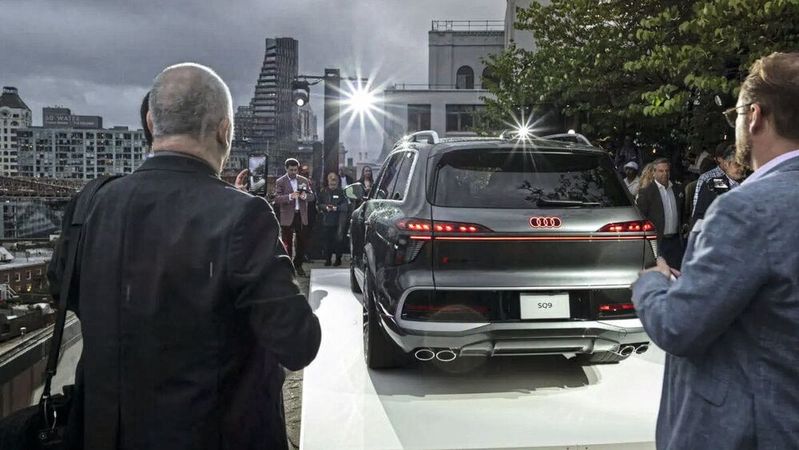
A rear-curved OLED on 0.1 mm (0.004-inch) glass, with 25,600 micro-LEDs illuminating the front: The Audi Q9 projects warning signals onto the road and into the taillight. Figures regarding segments, bending radius, and light points have been confirmed, but there is hardly any information on control, brightness, and service life.
OLEDWorks' Atala Wave technology enables third-generation digital OLED taillights in the Audi Q9 SUV.
(Image: Audi)
The Audi Q9 uses light in two places as an information channel. At the rear are curved digital OLED panels that display light signatures and warning symbols. At the front, digital Matrix LED headlights feature a micro-LED module that adaptively illuminates the road and projects driver-assistance functions onto the road. The two systems use different semiconductor technologies but share the same goal.
The Q3 as an Introduction to Segmentation
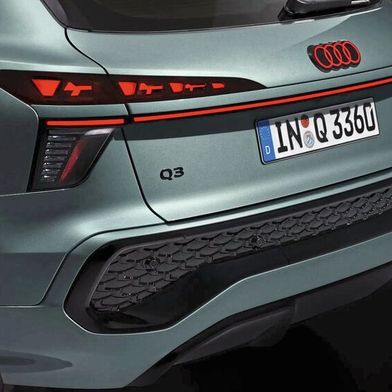
By late 2025, the Audi Q3’s digital OLED taillight technology showcased the shift from static lighting to a programmable exterior display. It uses 216 individually isolated segments, each controlled via an internal bus system. The key innovation is not the OLED panel alone, but the control system and its integration into the vehicle’s electronics. In the Q9, the number of segments increases to 512, while the basic concept remains the same.
Rear Light with an OLED as a Surface Light Source
OLEDs are area light sources. According to Audi, a stack of organic molecular layers emits light as soon as a voltage is applied. Unlike an LED, which is a point source, an OLED provides a uniform illuminated surface. Audi highlights high contrast, high homogeneity, minimal segment spacing, and a height of about one millimeter. According to Audi, an OLED display cannot produce the required brightness of a taillight or brake light. The segments of the taillight are therefore designed specifically for automotive use. They can be controlled individually and dimmed continuously.
According to Audi, the substrate glass is 0.1 mm thick. The panels can be bent to a radius of up to 200 mm (7.9 inches), allowing them to follow the contours of the car body. Audi cites visibility as the benefit: the light is visible even from side angles. Audi does not provide any specific measurements regarding this.
512 Segments on Six Panels
A total of 512 segments are distributed across six panels. The curved outer panel has 99 segments and, according to Audi, is the largest OLED panel ever used in an Audi. The middle panel has 84 segments, and the inner panel has 73. No details are available for the remaining three panels. OLEDWorks lists two panels made from Atala Wave and four from Atala Digital.
In the first generation of digital OLEDs, each lighting function had its own circuit. The digital taillights, on the other hand, are connected to the vehicle’s control unit via a bus system. Audi refers to “significantly more” possible functions. However, Audi does not specify the protocol, bandwidth, or update time.
The Q9 combines static, fully active, and partially active lighting signatures. According to Audi, this is the first time partially active signatures have been used. Up to eight digital signatures are possible at the front and rear. The three-dimensional effects at night have been described but not measured.
Rear Warning Signals
According to Audi, the taillight displays warning symbols that alert other road users to breakdowns, emergency braking, and accident scenes. This includes a warning triangle in the taillight signature. The connected exit warning displays its own signature when, for example, a cyclist or vehicles approach from behind while occupants are opening the door. An LED module in the side sill also projects a diamond shape onto the ground. Audi does not specify whether the exit warning is standard equipment or how the signal is transmitted to the vehicle.
Micro-LED Matrix with 25,600 Light Points
According to Audi, the digital Matrix LED headlights use a micro-LED module with 25,600 light points across a width of about 13 mm (0.51 inches). Each micro-LED measures about 40 µm. This allows high-resolution light patterns to be projected directly.
The system performs several tasks:
High beams: A high-resolution light distribution should be glare-free. Audi does not specify the resolution or switching times.
Marker Light: People near the roadway are specifically illuminated in the dark.
Lane Change Warning: If a vehicle is in the blind spot, the Lane Change Assistant projects a warning onto the road.
Lane Departure Warning: On rural roads and highways, a warning appears on the road surface if the driver unintentionally crosses the lane marking.
Slippery Road Warning: If the road is slippery, an ice crystal icon appears on the road.
Advanced turn signal: When turning or changing lanes at night, it projects a stylized turn signal onto the ground. The press release refers to it as “introduced for the first time in the Audi Q7.”
Stefan Berlitz, Head of Lighting Development at Audi, says: “At Audi, lighting is first and foremost about safety—that is, seeing and being seen.” Dr. Soeren Hartmann, a manager at OLEDWorks, says: “The team has transformed an ambitious concept into a robust automotive product.”
Date: 08.12.2025
Naturally, we always handle your personal data responsibly. Any personal data we receive from you is processed in accordance with applicable data protection legislation. For detailed information please see our privacy policy.
Consent to the use of data for promotional purposes
I hereby consent to Vogel Communications Group GmbH & Co. KG, Max-Planck-Str. 7-9, 97082 Würzburg including any affiliated companies according to §§ 15 et seq. AktG (hereafter: Vogel Communications Group) using my e-mail address to send editorial newsletters. A list of all affiliated companies can be found here
Newsletter content may include all products and services of any companies mentioned above, including for example specialist journals and books, events and fairs as well as event-related products and services, print and digital media offers and services such as additional (editorial) newsletters, raffles, lead campaigns, market research both online and offline, specialist webportals and e-learning offers. In case my personal telephone number has also been collected, it may be used for offers of aforementioned products, for services of the companies mentioned above, and market research purposes.
Additionally, my consent also includes the processing of my email address and telephone number for data matching for marketing purposes with select advertising partners such as LinkedIn, Google, and Meta. For this, Vogel Communications Group may transmit said data in hashed form to the advertising partners who then use said data to determine whether I am also a member of the mentioned advertising partner portals. Vogel Communications Group uses this feature for the purposes of re-targeting (up-selling, cross-selling, and customer loyalty), generating so-called look-alike audiences for acquisition of new customers, and as basis for exclusion for on-going advertising campaigns. Further information can be found in section “data matching for marketing purposes”.
In case I access protected data on Internet portals of Vogel Communications Group including any affiliated companies according to §§ 15 et seq. AktG, I need to provide further data in order to register for the access to such content. In return for this free access to editorial content, my data may be used in accordance with this consent for the purposes stated here. This does not apply to data matching for marketing purposes.
Right of revocation
I understand that I can revoke my consent at will. My revocation does not change the lawfulness of data processing that was conducted based on my consent leading up to my revocation. One option to declare my revocation is to use the contact form found at https://contact.vogel.de. In case I no longer wish to receive certain newsletters, I have subscribed to, I can also click on the unsubscribe link included at the end of a newsletter. Further information regarding my right of revocation and the implementation of it as well as the consequences of my revocation can be found in the data protection declaration, section editorial newsletter.
In addition, Audi claims to be the first manufacturer to use OLEDs as taillights in production vehicles. That was in 2016 in the TT RS. The first generation of digital OLEDs followed in 2020 in the Q5 and A8, and the second generation in 2024 in the Q6 e-tron and other model lines. According to Audi, the number of controllable segments increased tenfold. The third generation begins with the Q9.