Data centers generate a lot of heat. That is why efficient cooling is necessary. Ziehl-Abegg manufactures cooling and ventilation components using automated Trumpf machines.
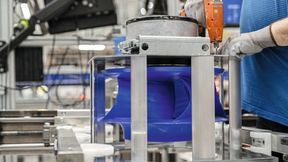
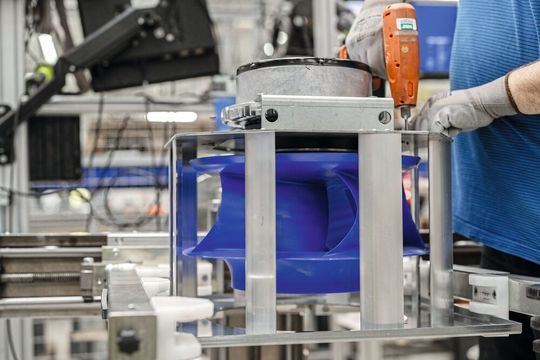
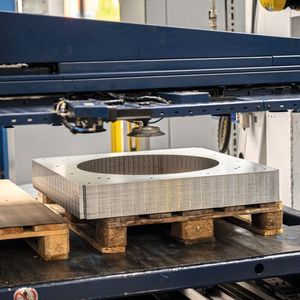
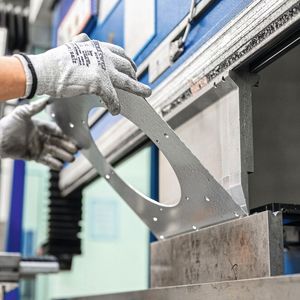
Ziehl-Abegg primarily manufactures frame parts, brackets, and other structural components for fans from sheet steel ranging in thickness from 0.5 to 10 millimeters.
(Image: Trumpf)
Digitalization, cloud services, and the AI boom are driving a growing demand for data centers worldwide. While large data centers were initially built mainly in the U.S., more and more are now being constructed in Europe as well. Today, it’s often big names like Google, Amazon, Meta, or Microsoft that come to mind in this context. Right in the thick of it, however, is Ziehl-Abegg. The fans produced by this family-owned company in Baden-Württemberg (Germany) provide the cooling needed to ensure that data centers can operate reliably. To meet the high demand, this medium-sized company relies on machines and automation solutions from Trumpf.
Cooling and Sheet Metal in the Data Center
Ziehl-Abegg’s solutions aren’t limited to data centers. In its core business, the company manufactures components for ventilation, air conditioning, and building cooling, as well as heat pumps. And just as in building cooling, for example, heat must be reliably dissipated in data center cooling. Traditionally, this is done using air conditioning and ventilation equipment. Liquid cooling solutions are also increasingly being used. Ziehl-Abegg fans are found in both applications.
Gallery
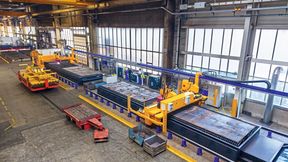
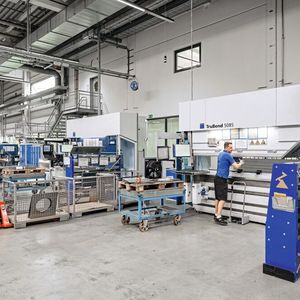
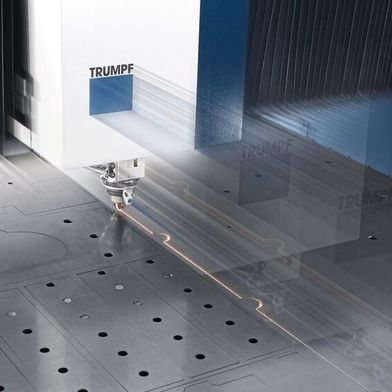
Ziehl-Abegg manufactures fan components such as frame parts, brackets, and other structural components from sheet steel ranging in thickness from 0.5 (0.02 inches) to 10 millimeters (0.39 inches). To this end, the company has an impressive fleet of Trumpf machines at its production facility in Kupferzell: four Tru Punch 5000 punching machines, one Tru Matic 7000 punch-laser machine, one Tru Laser 3030, and various bending machines. To handle the high volume of orders, the company is now operating on a three-shift schedule. “Fortunately, the machines had spare capacity that we can now utilize. They are built to run in three shifts,” explains Sebastian Wohlleben, Vice President of Operations EMEA at Ziehl-Abegg.
Automation as the Key to Success
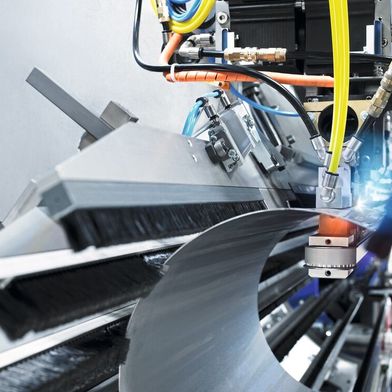
To achieve a high degree of automation, choosing the right machine is crucial. Products for data centers are often made from thin, large-format sheet metal. Punch-and-cut combination machines are frequently used for this purpose. “The advantage of punch-laser machines over standard laser cutting machines is that they can also perform forming operations. This means that if, for example, ventilation slots or threads need to be created in the sheet metal, punch-laser machines can achieve a very high degree of automation. Subsequent manual process steps can be completely eliminated and are integrated into the machine,” explains Stephan Mayer, CEO of Trumpf Machine Tools.
In addition, the level of automation in manufacturing at Ziehl-Abegg is very high. Thanks to solutions such as the Sheet Master or the Tool Master, the punching machines can operate with minimal staff. This makes it possible for one operator to oversee three machines at the same time. This is particularly important in times of a skilled labor shortage. That’s why the decision was made to use Trumpf machines: “We chose Trumpf because of the complete integration. The solutions go beyond mere sheet metal cutting. Trumpf’s advantage lies in system integration, the automatic loading and unloading of the machines, and the integration with software and nesting,” explains Joachim Ley, CEO of Ziehl-Abegg.
Automate, but Maintain Flexibility
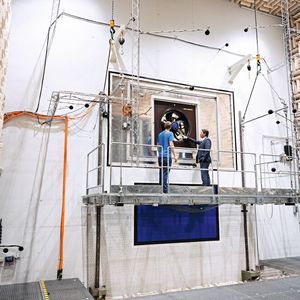
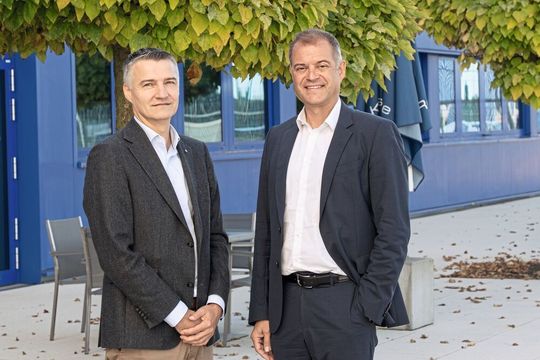
“Achieving a high level of automation while maintaining flexibility is incredibly challenging—and, in fact, a contradiction,” explains Stephan Mayer, CEO of Trumpf Machine Tools (left). However, the company has mastered this challenge: “That’s one of the strengths of Trumpf systems. They can economically produce both larger series and smaller batch sizes,” says Joachim Ley, CEO of Ziehl-Abegg.
(Image: Trumpf)
The heat pump trend, for example, illustrates just how quickly markets can change. While heat pumps suddenly became less popular a few years ago, demand is now rising more sharply again. At the same time, the expansion of data centers is gaining momentum. Furthermore, Ziehl-Abegg’s solution portfolio is so broad that varying components must be manufactured in different batch sizes. Therefore, it is important to be able to respond flexibly. “That’s a challenge, of course. Achieving a high level of automation while maintaining flexibility is incredibly demanding—and, in fact, somewhat of a contradiction.” In recent decades, automation was implemented wherever parts were always identical,” explains Mayer. For this reason, Trumpf is investing heavily in software. With success: “That’s one of the strengths of Trumpf systems. They can economically produce both larger series and smaller batch sizes,” praises Ley.
Date: 08.12.2025
Naturally, we always handle your personal data responsibly. Any personal data we receive from you is processed in accordance with applicable data protection legislation. For detailed information please see our privacy policy.
Consent to the use of data for promotional purposes
I hereby consent to Vogel Communications Group GmbH & Co. KG, Max-Planck-Str. 7-9, 97082 Würzburg including any affiliated companies according to §§ 15 et seq. AktG (hereafter: Vogel Communications Group) using my e-mail address to send editorial newsletters. A list of all affiliated companies can be found here
Newsletter content may include all products and services of any companies mentioned above, including for example specialist journals and books, events and fairs as well as event-related products and services, print and digital media offers and services such as additional (editorial) newsletters, raffles, lead campaigns, market research both online and offline, specialist webportals and e-learning offers. In case my personal telephone number has also been collected, it may be used for offers of aforementioned products, for services of the companies mentioned above, and market research purposes.
Additionally, my consent also includes the processing of my email address and telephone number for data matching for marketing purposes with select advertising partners such as LinkedIn, Google, and Meta. For this, Vogel Communications Group may transmit said data in hashed form to the advertising partners who then use said data to determine whether I am also a member of the mentioned advertising partner portals. Vogel Communications Group uses this feature for the purposes of re-targeting (up-selling, cross-selling, and customer loyalty), generating so-called look-alike audiences for acquisition of new customers, and as basis for exclusion for on-going advertising campaigns. Further information can be found in section “data matching for marketing purposes”.
In case I access protected data on Internet portals of Vogel Communications Group including any affiliated companies according to §§ 15 et seq. AktG, I need to provide further data in order to register for the access to such content. In return for this free access to editorial content, my data may be used in accordance with this consent for the purposes stated here. This does not apply to data matching for marketing purposes.
Right of revocation
I understand that I can revoke my consent at will. My revocation does not change the lawfulness of data processing that was conducted based on my consent leading up to my revocation. One option to declare my revocation is to use the contact form found at https://contact.vogel.de. In case I no longer wish to receive certain newsletters, I have subscribed to, I can also click on the unsubscribe link included at the end of a newsletter. Further information regarding my right of revocation and the implementation of it as well as the consequences of my revocation can be found in the data protection declaration, section editorial newsletter.
When it comes to automation, there’s no getting around the topic of artificial intelligence. Trumpf is integrating AI not only into its machines for service and predictive analytics, but also into its automation systems. The machine manufacturer is combining its expertise in sheet metal processing with the models of hyperscalers to develop industrial AI applications, such as image processing for sorting sheet metal.
The Data Center Boom: Is the End in Sight?
It is difficult to answer the question of whether and when the data center boom will slow down. “As in any economic cycle, the trend will eventually come to an end. Often, excess capacity develops, especially when there has been disproportionately high growth.” Currently, the AI trend is mainly taking place in North America, China, and to a lesser extent in Southeast Asia. In Europe, we’re still in the very early stages, which suggests that different cycles will follow at the regional level. We expect the boom to last at least another three years,” Ley explains. Whatever the future holds—with Trumpf, Ziehl-Abegg has a partner at its side that allows it to respond flexibly to trends.