Identifying Hot Spots During Fruit TransportDigital Twin for the Refrigerated Truck
From
Manuel Martin
| Translated by AI
4 min Reading Time
Although fruit is transported in refrigerated trucks, the temperature often varies within the load. Insufficiently pre-cooled pallets, unsuitable packaging, or improper stacking can create hot spots. Empa researchers have developed a digital twin of a refrigerated truck to optimize transport and better estimate the shelf life of food.
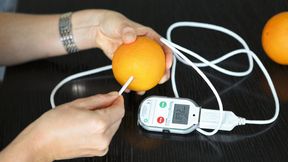
Perishable foods: Optimal temperatures during transport help prevent spoilage and quality loss.
(Image: Empa)
To ensure that fruit stays fresh after harvest, it must be cooled evenly even during transport. In practice, however, this is not so easy, because a fully loaded refrigerated truck is a complex system: Cool air must circulate between tightly stacked boxes and pallets. How well this works depends on the airflow velocity, the packaging, and the arrangement of the pallets. Often, however, the temperature is monitored by only a single sensor. While this sensor records a temperature curve over the entire trip, it measures only at its specific location. Empa researchers therefore aim to use a virtual refrigerated truck to visualize potential hot spots and their impact on the food. “Our digital twin simulates air circulation and heat transfer throughout the entire cargo area. This allows us to estimate the temperatures at various points within the load,” says Empa researcher Elisabeth Tobler.
A Virtual Refrigerated Truck
For example, Empa researchers digitally simulated a refrigerated truck loaded with oranges and lemons. The physics-based model calculates how the cooled air flows through the various types of packaging and how heat is transferred between the air and the fruit in the process. It also takes into account the temperatures of the fruit at the start of the trip as well as the small amount of heat they generate themselves through respiration. To test the digital twin of the refrigerated truck, the researchers fed it real-world data on the cargo, the initial temperatures, and the refrigerated air during the trip. They used a commercial shipment from Nafplion, Greece, to Pratteln, Switzerland, for this purpose. The 31 pallets of oranges and lemons were pre-cooled for about 24 hours and then transported for four days at a temperature of four to six degrees.
The researchers then compared the temperatures calculated by the digital twin with the actual measurement data. A total of 108 sensors had been placed at various locations within the load. 97 of them measured fruit temperatures, while the rest measured, among other things, the air temperature as well as the supply and return air from the refrigeration unit. “This was a challenging test for the digital twin,” says Tobler. “At the start, not all the fruit had cooled down evenly, and the oranges and lemons were in different types of packaging. Nevertheless, the model was able to accurately reproduce the most important temperature trends at most locations.”
Warm pallets affect the cargo
However, the measurements also revealed some discrepancies. During the trip, the oranges in the middle of the truck warmed up more than the Empa model had predicted: Their temperature rose from about 7.7 to as high as 10.8 degrees, even though the cooling air was significantly colder. “We suspected that, in addition to the monitored pallets, there were insufficiently pre-cooled pallets that were not equipped with sensors,” explains Tobler. In a second calculation, the researchers therefore increased their assumed initial temperature for these pallets from about 5.4 to 10 degrees. As a result, the simulated temperature trend matched the actual measurements much more closely. “In the simulation, we were able to trace how heat was transferred from one pallet to the next and carried further by the airflow. The model thus supported our hypothesis,” said the Empa researcher.
It also became apparent that a truck’s refrigeration system has only limited capacity to subsequently cool fruit that is already warm inside a tightly packed pallet. Refrigeration units are primarily designed to maintain the temperature of pre-cooled goods. If fruit is loaded while still too warm, it also affects adjacent pallets during transport.
Packaging also plays a crucial role. In the shipment studied, the lemon crates had ventilation openings on several sides, while the short sides of the orange cartons were closed. “When it comes to packaging, it’s not just about how it looks or how sturdy it is,” says Tobler. “It must also allow cool air to circulate around the produce. It’s equally important that the pallets are aligned evenly and that the openings aren’t blocked by adjacent boxes.”
Date: 08.12.2025
Naturally, we always handle your personal data responsibly. Any personal data we receive from you is processed in accordance with applicable data protection legislation. For detailed information please see our privacy policy.
Consent to the use of data for promotional purposes
I hereby consent to Vogel Communications Group GmbH & Co. KG, Max-Planck-Str. 7-9, 97082 Würzburg including any affiliated companies according to §§ 15 et seq. AktG (hereafter: Vogel Communications Group) using my e-mail address to send editorial newsletters. A list of all affiliated companies can be found here
Newsletter content may include all products and services of any companies mentioned above, including for example specialist journals and books, events and fairs as well as event-related products and services, print and digital media offers and services such as additional (editorial) newsletters, raffles, lead campaigns, market research both online and offline, specialist webportals and e-learning offers. In case my personal telephone number has also been collected, it may be used for offers of aforementioned products, for services of the companies mentioned above, and market research purposes.
Additionally, my consent also includes the processing of my email address and telephone number for data matching for marketing purposes with select advertising partners such as LinkedIn, Google, and Meta. For this, Vogel Communications Group may transmit said data in hashed form to the advertising partners who then use said data to determine whether I am also a member of the mentioned advertising partner portals. Vogel Communications Group uses this feature for the purposes of re-targeting (up-selling, cross-selling, and customer loyalty), generating so-called look-alike audiences for acquisition of new customers, and as basis for exclusion for on-going advertising campaigns. Further information can be found in section “data matching for marketing purposes”.
In case I access protected data on Internet portals of Vogel Communications Group including any affiliated companies according to §§ 15 et seq. AktG, I need to provide further data in order to register for the access to such content. In return for this free access to editorial content, my data may be used in accordance with this consent for the purposes stated here. This does not apply to data matching for marketing purposes.
Right of revocation
I understand that I can revoke my consent at will. My revocation does not change the lawfulness of data processing that was conducted based on my consent leading up to my revocation. One option to declare my revocation is to use the contact form found at https://contact.vogel.de. In case I no longer wish to receive certain newsletters, I have subscribed to, I can also click on the unsubscribe link included at the end of a newsletter. Further information regarding my right of revocation and the implementation of it as well as the consequences of my revocation can be found in the data protection declaration, section editorial newsletter.
A Complete View of the Entire Load
The digital twin can initially be used as a simulation tool. Logistics companies and manufacturers could use it, for example, to examine how new packaging, a changed pallet arrangement, or air circulation affects temperature distribution. According to Elisabeth Tobler, companies with standardized shipments that regularly use the same trucks, packaging, and loading patterns would benefit the most.
In the future, the model should also complement monitoring systems. To this end, it will be linked to real-time sensor data from an ongoing transport. The sensor provides the connection to reality, while the model uses this data to deduce the conditions throughout the cargo hold. “Much of the necessary data is already being collected. The key is to bring it all together and use it at the right place and the right time,” says Tobler. This would allow importers to identify, even before a shipment arrives, which pallets were exposed to higher temperatures and should be inspected more closely. Goods with a shorter expected shelf life could be brought to market earlier in a targeted manner. “In the long term, the goal is data-driven monitoring of the supply chain,” adds Empa researcher Thijs Defraeye. “The digital twin is not only intended to display temperatures, but also to help companies manage their transportation and the handling of incoming goods in a more targeted manner, thereby reducing food loss.”