A Reality Check for Elon Musk: The CEO of SpaceX had announced plans to build a complete in-house chip production chain from the ground up within a few years as part of his Terafab project. Now, however, Musk himself has confirmed that he has begun negotiations with TSMC. The focus is on manufacturing processes, operational expertise, and the question of who would ultimately control the potential new fab.
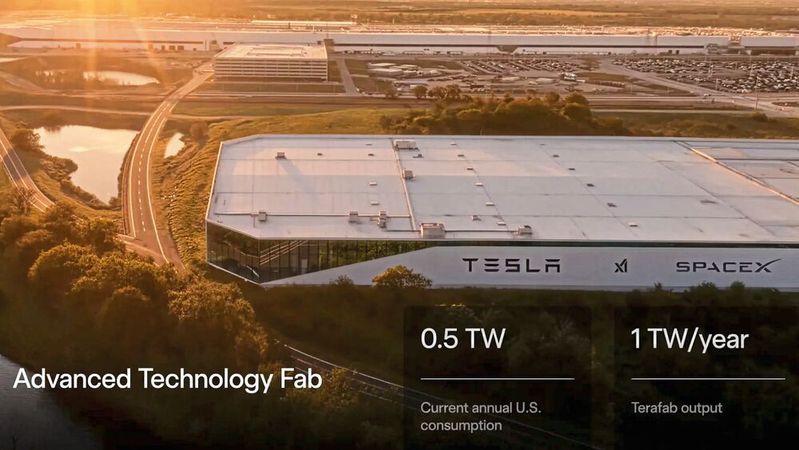
Rendering of the planned Terafab facility in Texas (presumably generated using AI). Elon Musk does not seem to be making progress with his plans to operate his own semiconductor manufacturing facility. The SpaceX CEO has confirmed that he is currently in talks with TSMC regarding a stake in the Terafab project.
Terafab is intended to go far beyond a conventional chip factory. The project aims to consolidate key stages of semiconductor production at a single location. These include the manufacturing of logic chips and possibly memory chips, the production of masks, as well as packaging and testing. The chips are intended for use in Tesla vehicles, Optimus robots, SpaceX, and xAI’s data centers, among other applications. Investments of approximately $16.8 billion have been cited for the first phase of expansion; in the long term, expenditures could be considerably higher across multiple project phases.
A Modern Factory Consists of More than just Machines
It is precisely this planned vertical integration that makes Terafab technically challenging. Setting up a modern manufacturing process involves more than just building cleanrooms and installing lithography, etching, or coating equipment. Thousands of individual process steps must be coordinated in such a way that transistors with reproducible characteristics are produced and the yield is economically viable. Process recipes, material control, measurement technology, failure analysis, and the ongoing optimization of yield are all part of the knowledge that leading manufacturers have built up over decades.
Added to this is the supply chain for manufacturing technology. Modern processes require, among other things, lithography systems from ASML as well as equipment from Lam Research, KLA, Tokyo Electron, and other specialists. Long lead times can apply, especially for machines in high demand. Even when sufficient capital is available, equipment must be procured, installed, qualified, and then commissioned as an integrated production line. Chemicals, wafers, gases, spare parts, and measurement technology must also be integrated into production.
This is precisely where one of the biggest hurdles for Musk’s companies lies. While Tesla, SpaceX, and xAI have extensive experience in developing their own electronics and specialized chips, they have not yet gained comparable experience in operating state-of-the-art semiconductor factories or in manufacturing processes. The expertise required for competitive manufacturing can therefore hardly be built up internally in the short term. Intel could close part of this gap with its 14A technology, while Samsung has already received a separate order to manufacture Tesla’s AI6 chips. TSMC’s involvement would also bring the expertise of the world’s largest contract manufacturer to the project.
TSMC Could Become an Operator Rather Than a Technology Supplier
One possible option is a model in which TSMC owns and operates a new factory itself. SpaceX or Terafab could provide financial backing, commit to fixed purchase volumes, or combine both approaches. Such a structure would at least partially resemble TSMC’s existing joint ventures in Japan and Europe: partners contribute capital and guarantee demand, while TSMC remains responsible for manufacturing processes and operations. For Musk, this would make it possible to secure his own, long-term reserved capacity without his companies having to manage a full-scale manufacturing operation themselves at first.
Another option would be a factory controlled primarily by SpaceX or Terafab, to which TSMC would contribute process expertise and operational experience. For TSMC, this model would be significantly less common. The company’s business model is based on using its own manufacturing technologies in fabs it controls for a wide range of customers. An arrangement in which a single customer controls the facility while also gaining access to core manufacturing know-how could therefore raise questions about the protection of process technology and neutrality toward other major customers. The option of building a separate TSMC expansion facility in Texas and integrating Musk’s company there as a major or anchor customer is therefore considered less likely to cause conflict.
It also remains unclear what manufacturing technology would be used in such a facility. Intel was originally its 14A process for Terafab. If TSMC were to operate a factory on its own, however, the company would likely use its own processes, which would require a redefinition of Intel’s role. Following news of the talks between Musk and TSMC, Intel’s stock price immediately dropped by 4%. Packaging could also offer a separate avenue for collaboration.
Date: 08.12.2025
Naturally, we always handle your personal data responsibly. Any personal data we receive from you is processed in accordance with applicable data protection legislation. For detailed information please see our privacy policy.
Consent to the use of data for promotional purposes
I hereby consent to Vogel Communications Group GmbH & Co. KG, Max-Planck-Str. 7-9, 97082 Würzburg including any affiliated companies according to §§ 15 et seq. AktG (hereafter: Vogel Communications Group) using my e-mail address to send editorial newsletters. A list of all affiliated companies can be found here
Newsletter content may include all products and services of any companies mentioned above, including for example specialist journals and books, events and fairs as well as event-related products and services, print and digital media offers and services such as additional (editorial) newsletters, raffles, lead campaigns, market research both online and offline, specialist webportals and e-learning offers. In case my personal telephone number has also been collected, it may be used for offers of aforementioned products, for services of the companies mentioned above, and market research purposes.
Additionally, my consent also includes the processing of my email address and telephone number for data matching for marketing purposes with select advertising partners such as LinkedIn, Google, and Meta. For this, Vogel Communications Group may transmit said data in hashed form to the advertising partners who then use said data to determine whether I am also a member of the mentioned advertising partner portals. Vogel Communications Group uses this feature for the purposes of re-targeting (up-selling, cross-selling, and customer loyalty), generating so-called look-alike audiences for acquisition of new customers, and as basis for exclusion for on-going advertising campaigns. Further information can be found in section “data matching for marketing purposes”.
In case I access protected data on Internet portals of Vogel Communications Group including any affiliated companies according to §§ 15 et seq. AktG, I need to provide further data in order to register for the access to such content. In return for this free access to editorial content, my data may be used in accordance with this consent for the purposes stated here. This does not apply to data matching for marketing purposes.
Right of revocation
I understand that I can revoke my consent at will. My revocation does not change the lawfulness of data processing that was conducted based on my consent leading up to my revocation. One option to declare my revocation is to use the contact form found at https://contact.vogel.de. In case I no longer wish to receive certain newsletters, I have subscribed to, I can also click on the unsubscribe link included at the end of a newsletter. Further information regarding my right of revocation and the implementation of it as well as the consequences of my revocation can be found in the data protection declaration, section editorial newsletter.
Discussions are still in the early stages, and—like virtually everything else related to the announced Terafab project—remain vague and unclear. But it seems that even Musk himself is now slowly realizing that the scale of the Terafab project cannot be managed through heavy investment alone: What matters most are proven processes, high yields, experienced operations teams, and a supply chain capable of reliably supporting complex chip manufacturing over many years.
This development brings to mind a statement made by C. C. Weis during the company’s annual shareholders’ meeting in early June 2026. In response to a shareholder’s question about Elon Musk’s plans to build a factory capable of producing one million wafers per month, the TSMC CEO replied: “As for Elon Musk’s ‘Terafab,’ I’d just say, ‘Good luck.’ It’s going to take quite a long time for that to [become a reality].” He added: “Over the past 30 to 40 years, we’ve constantly faced all kinds of competition, and we’re not afraid of competition. In the past, I believe we’ve come out on top, and I believe we’ll continue to do so.”
/Update: Oct. 7: Intel CEO Lip-Bu Tan confirmed to reporters that Intel will continue to hold a stake in Terafab. These developments suggest that Musk has not yet committed to a single manufacturing partner for Terafab, with both Intel and TSMC potentially playing a role. According to Trendforce, the project is expected to involve much closer manufacturing collaboration than a traditional customer-supplier relationship. The Korean business newspaper “Seoul Economic Daily” also quoted analysts who view Musk’s mention of TSMC as a negotiating tactic. The goal, they say, is to gain bargaining power over Intel with regard to pricing. Luke Lloyd, CEO of Equity Armor Investments, pointed to the U.S. government’s investments in Intel and argued that it is hard to imagine the chipmaker being replaced on a significant scale.



:quality(80)/p7i.vogel.de/wcms/ed/78/ed786ed6b280ff6c692908f01f715e3d/0113143253v1.jpeg "In our China Market Insider, we regularly provide you with relevant information straight from China. (Image:© Eisenhans - stock.adobe.com)")
:quality(80)/p7i.vogel.de/wcms/68/a5/68a5ce0896756c1dcf48dbeceefafbd3/0132300990v1.jpeg "Christoph Geigges is President and CEO of Walter AG. Headquartered in Tübingen (Germany), the company is one of the world’s leading suppliers of precision tools for metalworking. Under Geigges’ leadership, this long-established company is increasingly transforming itself from a tool manufacturer into an engineering partner that supports the entire manufacturing process. (Image: Walter AG)")
:quality(80)/p7i.vogel.de/wcms/3e/7c/3e7c26f44c68545fc7318597b6b65903/0133649650v1.jpeg "The flexible Heller circular storage system can store and process pallets measuring both 630 millimeters by 630 millimeters and 800 millimeters by 800 millimeters—even in mixed-mode operation. This makes the entire production line particularly flexible. (Image:Brighter)")
:quality(80)/p7i.vogel.de/wcms/16/29/162983885950ec1df27ab441bfe88613/0133132549v1.jpeg "Bernd Hermeler is the CEO of Cemecon AG. He studied mechanical engineering at RWTH Aachen University (Germany)—the very university from which the company emerged as a spin-off 40 years ago. Today, Hermeler is responsible for the global strategy of the coating specialist, which, with branches in Europe, the U.S., China, Japan, and India, is considered the global technology leader in the coating of cutting tools. (Image: Cemecon AG)")
:quality(80)/p7i.vogel.de/wcms/4b/7c/4b7c11f510878f154012d04c18a7c3cc/0133798118v1.jpeg "RobCo Becomes a Unicorn: The Munich-based robotics company has reached a valuation of more than one billion U.S. dollars and is driving the next generation of autonomous industrial robotics with Alfie. (Image:RobCo)")
:quality(80)/p7i.vogel.de/wcms/c8/a9/c8a96d5841d508c9e9c609c64168cbaa/0133758997v1.jpeg "Hospital Robotics: Neura Robotics' autonomous healthcare platform is designed to independently transport empty hospital beds between wards and floors. (Image:Neura Robotics)")
:quality(80)/p7i.vogel.de/wcms/88/dc/88dc38a1a0b5e016192ab83b0850fbd0/0133514708v1.jpeg "Scalable data sovereignty is the foundation for the transition from computationally intensive AI processing and growing data streams to sustainable, energy-efficient storage systems. (Image:Gemini / AI-generated)")
:quality(80)/p7i.vogel.de/wcms/1c/ef/1cef66e13c5cc02c5731fefcc99c00d2/0133697754v1.jpeg "Embodied AI in Industry: FMC³ Robotics combines AI-based perception and adaptation with traditional robot control to prepare robots for use in industrial manufacturing. (Image:FMC³/processed by AI)")
:quality(80)/p7i.vogel.de/wcms/a7/8a/a78a582a42a96aaaff38bd6b8f97a015/vishal-lal-mit-kernuhrv1.jpeg "It's ticking: Researchers have stabilized the first atomic clock. (Source: PTB)")
:quality(80)/p7i.vogel.de/wcms/36/f9/36f96a206fc408c9a632ce849de1f7fa/newsimage428299v1.jpeg "Polystyrene is used in protective packaging for televisions and electronic devices, in decorative moldings and baseboards for interior home construction, and even in Petri dishes. (Source: Hereon/Marcel Schwickerath)")
:quality(80)/p7i.vogel.de/wcms/90/30/90300137452b00d22f95113eff065ac3/fliehkraftkupplungen-und-bremsen-montage-centrifugal-clutches-and-brakes-assembly-1v1.jpeg "Installation: Centrifugal clutches should always be precisely matched to the machine. (Source: Amsbeck Machine Technology)")
:quality(80)/p7i.vogel.de/wcms/93/84/9384230e840a99a2015fdd3e0af11e2b/newsimage428236v1.jpeg "The crutch replicates the natural, biomechanical movement pattern of the human body. (Source: Leon Kast)")
:quality(80)/p7i.vogel.de/wcms/50/23/5023ffaefac8f9a47286b368143b88eb/0133801078v1.jpeg "Life isn't exactly a walk in the park for Porsche right now. And now Porsche management is saying that next year will be even worse. Read here to find out why that's supposed to be the case... (Image: Porsche)")
:quality(80)/p7i.vogel.de/wcms/2f/ab/2fabf62cdd2f57cb279e00931c91c869/0133794991v1.jpeg "The Atto 2 SUV is one of BYD's most popular plug-in hybrids. (Image:BYD)")
:quality(80)/p7i.vogel.de/wcms/e9/6e/e96e34d467ca1017f2a689275ae07302/0133815122v1.jpeg "Porsche CEO Leiters has shared new information about the company's model plans. (Image:Porsche)")
:quality(80)/p7i.vogel.de/wcms/0a/50/0a50938be0b598b36efc4e5457ed56dd/forvia-siege-zen-massage-16-9-06v1.jpeg "Seat with massage function by Forvia. (Source: Forvia)")
:quality(80)/p7i.vogel.de/wcms/4d/eb/4debf44ac7c0349544c70033bb9a182c/0133750488v1.jpeg "AI-enabled hardware: is a prerequisite for successful AI projects. (Image:Tung Lam)")
:quality(80)/p7i.vogel.de/wcms/36/f0/36f0472d20227013871aa790f4d48ac6/0133726018v1.jpeg "Ion beams can ablate, coat, or smooth surfaces down to the atomic level. Such processes are used, among other things, in optical chips, precision optics, and superconducting materials. (Image:AI-generated)")
:quality(80)/p7i.vogel.de/wcms/1f/47/1f47da6ee12c38a745eb478a04157a65/0133726100v1.jpeg "The schematic diagram shows the structure of a 3D NAND memory device with memory cells stacked on top of one another and vertical connections for high storage density. (Image:Dall-E / AI-generated)")
:quality(80)/p7i.vogel.de/wcms/b6/06/b6060e0b986e103e442b3971b6c0724c/0133731535v1.jpeg "Rendering of the planned Terafab facility in Texas (presumably generated using AI). Elon Musk does not seem to be making progress with his plans to operate his own semiconductor manufacturing facility. The SpaceX CEO has confirmed that he is currently in talks with TSMC regarding a stake in the Terafab project. (Image:SpaceX)")
:fill(fff,0)/images.vogel.de/vogelonline/companyimg/76800/76895/65.jpg "FAULHABER_120mm.jpg ()")
:fill(fff,0)/p7i.vogel.de/companies/69/88/69882c428938e/tmts2026-ticec-banner-en-2000px.png "tmts2026-ticec-banner-en-2000px (https://www.tmts.tw/en)")
:fill(fff,0)/p7i.vogel.de/companies/69/de/69de1b7403b0d/simtos-logo.jpeg "simtos-logo (SIMTOS)")
:quality(80)/p7i.vogel.de/wcms/e4/54/e454fcca7009b106cda2e228992a7a47/0130565746v1.jpeg "Hand in hand: Intel CEO Lip-Bu Tan enters into a strategic partnership with his company in the grandiose Terafab project. But the scope, timeframe and purpose remain vague. (Image:SemWiki/X)")
:quality(80)/p7i.vogel.de/wcms/78/a0/78a04b7ad83462b9e5fcefb897e8e7a3/0131840217v1.jpeg "Elon Musk's space company SpaceX is launching a catch-up race against its two competitors in the development of generative AI tools. To achieve this, they have dug deep into their pockets and casually acquired Cursor. (Image: SpaceX)")
:quality(80)/p7i.vogel.de/wcms/e4/54/e454fcca7009b106cda2e228992a7a47/0130565746v1.jpeg "Hand in hand: Intel CEO Lip-Bu Tan enters into a strategic partnership with his company in the grandiose Terafab project. But the scope, timeframe and purpose remain vague. (Image:SemWiki/X)")
:quality(80)/p7i.vogel.de/wcms/8d/fe/8dfe4efea68edaaa40058dfea8f3da2f/0130519880v1.jpeg "Chip giant Intel has made gains on the US stock market, according to reports today. This is actually unusual for the current state of affairs. There is also news that Intel wants to get involved in Elon Musk's Terafab project ... (Image:Chipcheck)")