When ENGEL first unveiled a tie-bar-less injection moulding machine at the K trade fair in Düsseldorf in 1989, the reaction was mixed: technical fascination on one hand, open scepticism on the other. At that time, few would have predicted that this “revolutionary” design would evolve into one of the most successful technologies in injection moulding machinery.
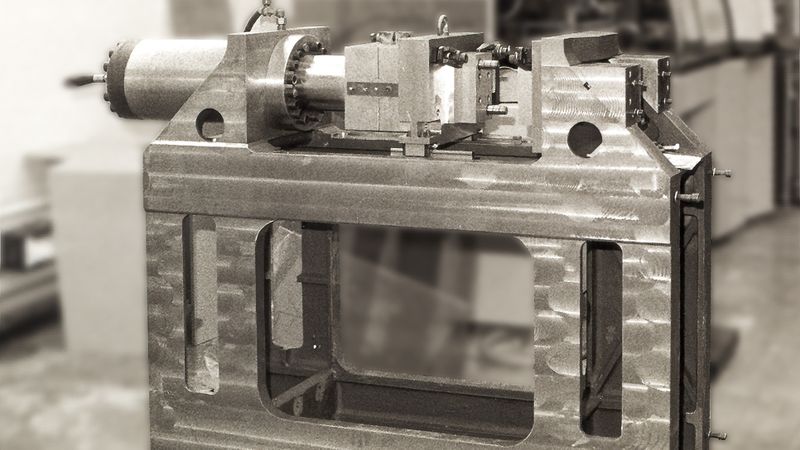
The first tie-bar-less frame in the laboratory. A revolutionary concept that became a global success thanks to its significant customer benefits.
(Image: ENGEL)
Today, 35 years later, ENGEL looks back on more than 85,000 tie-bar-less machines delivered worldwide – and continues to drive this innovation forward with a consistent focus on customer needs. At this year’s K 2025, ENGEL is presenting a world première: a new electric tie-bar-less injection moulding machine.
Customer Benefit as the Starting Point
The impetus for developing a tie-bar-less machine came from practical experience: A customer told ENGEL how much the four tie-bars interfered with mould set-up and how much easier mould changes would be without them in the way. The development department at ENGEL picked up on this idea and examined whether it would be possible to design the clamping unit of an injection moulding machine entirely without tie-bars. A simple idea – yet a major leap in design. Up until that point, it was regarded as an unshakeable principle in mechanical engineering that an injection moulding machine had to have four tie-bars, regardless of size or application. The tie-bar-less clamping unit marked a radical new beginning in engineering.
Technical pioneering work from Upper Austria
The breakthrough was achieved with a novel joint principle that compensates for the asymmetry of force application in the C-frame. Instead of guiding the platen over tie-bars as previously done, the mould is clamped via a solid frame – with a freely movable bending-bar joint between the moving platen and the clamping piston. This Flex-Link element, now patented and further developed under the name Force Divider, ensures that the mould halves remain absolutely parallel. It also provides for an even distribution of clamping force across all cavities of the platen and thus over the entire mould surface. This marked the birth of a new generation of machines that not only impressed technically but also opened up new freedoms in mould design. The first complete series went into production in 1990 – the name victory became the official product name in 2000.
Experience and evolution across four generations
What began with a lever pin in the prototype has been systematically developed over several generations. ENGEL has continuously refined the joint system of its tie-bar-less machines, evolving from manually lubricated slide bearings to today’s Flex-Link with decentralised force application. At the same time, the machine series has been progressively expanded and enhanced with new drive technologies. Today, the tie-bar-less machine portfolio from ENGEL comprises three variants:
Hydraulic, under the victory line, for flexible and universal use in technical moulding
Hybrid, under the e-victory line, featuring an electric injection unit for technical parts requiring higher precision
Electric, under the victory electric line, designed for particularly demanding applications such as high-volume precision components
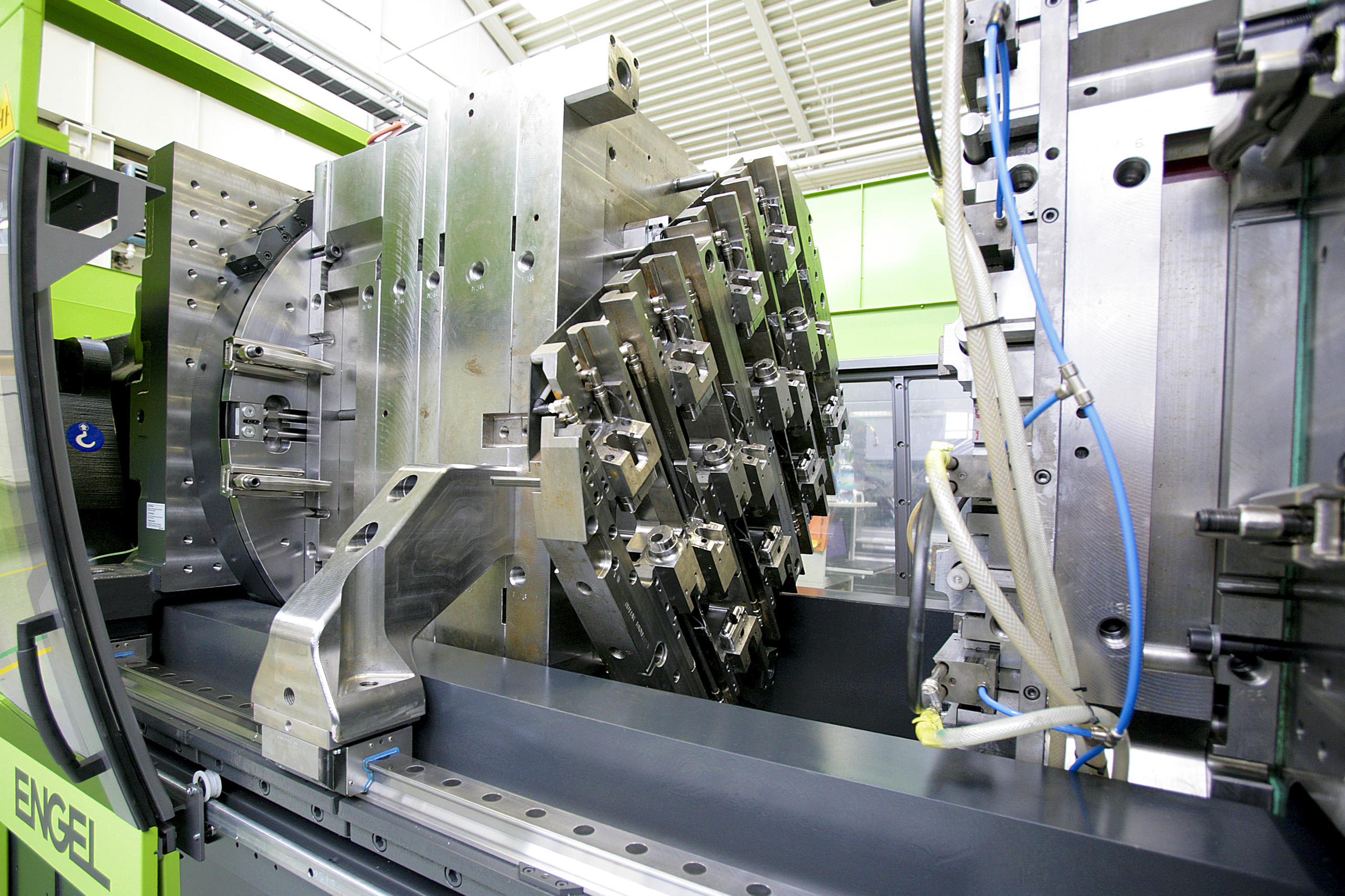
Thanks to their tie-bar-less technology, the ENGEL victory series provides ample space for large moulds and extensive automation. The generously sized platen often eliminates the need to invest in a larger machine.
(Image: ENGEL)
These three variants all share the advantages of the tie-bar-less clamping unit: maximum utilisation of the mould mounting surface, faster mould changes, ergonomic access to the mould area, and flexible automation concepts.Another economic advantage of the large, open mould area is that it allows the use of very large and complex moulds on machines with comparatively low clamping force.
Success through Consistency of Principles
ENGEL’s continued unique position in the field of tie-bar-less technology is not only due to its early lead in technology. The company has also secured its position through continuous development and comprehensive patent protection. It became clear early on that the benefits go far beyond simplified mould changes. Especially for high-cavity moulds with a small projected area, the tie-bar-less design allows for the use of smaller machines with significantly lower energy consumption and reduced investment costs.
Energy Efficiency by Principle
A milestone in the development was the introduction of the ecodrive servo-hydraulic drive technology, which reduces the energy consumption of hydraulic machines to the level of all-electric ones. In combination with the tie-bar-less clamping unit, this results in an ideal solution for demanding applications with high requirements for energy efficiency. Today, ENGEL equips all hydraulic and hybrid injection moulding machines with ecodrive as standard.
The fact that the tie-bar-less machine technology remains as relevant today as it was 35 years ago is evident above all in its adaptability. Whether for cleanroom applications, multi-component technology, or highly automated production cells – ENGEL’s tie-bar-less injection moulding machines can be configured in a modular and needs-based way. In doing so, they stay true to their core principle: maximum efficiency through functional simplification.
Outlook for K 2025: Next Stage of Evolution with a World Premiere
At the K 2025 trade fair, ENGEL will present the next evolutionary stage of its electric tie-bar-less technology for the first time. The focus is on design advancements that create additional benefits for users. The goal is to address customers’ specific requirements even more precisely – just as it was 35 years ago, when a simple question led to a completely new machine concept.
Date: 08.12.2025
Naturally, we always handle your personal data responsibly. Any personal data we receive from you is processed in accordance with applicable data protection legislation. For detailed information please see our privacy policy.
Consent to the use of data for promotional purposes
I hereby consent to Vogel Communications Group GmbH & Co. KG, Max-Planck-Str. 7-9, 97082 Würzburg including any affiliated companies according to §§ 15 et seq. AktG (hereafter: Vogel Communications Group) using my e-mail address to send editorial newsletters. A list of all affiliated companies can be found here
Newsletter content may include all products and services of any companies mentioned above, including for example specialist journals and books, events and fairs as well as event-related products and services, print and digital media offers and services such as additional (editorial) newsletters, raffles, lead campaigns, market research both online and offline, specialist webportals and e-learning offers. In case my personal telephone number has also been collected, it may be used for offers of aforementioned products, for services of the companies mentioned above, and market research purposes.
Additionally, my consent also includes the processing of my email address and telephone number for data matching for marketing purposes with select advertising partners such as LinkedIn, Google, and Meta. For this, Vogel Communications Group may transmit said data in hashed form to the advertising partners who then use said data to determine whether I am also a member of the mentioned advertising partner portals. Vogel Communications Group uses this feature for the purposes of re-targeting (up-selling, cross-selling, and customer loyalty), generating so-called look-alike audiences for acquisition of new customers, and as basis for exclusion for on-going advertising campaigns. Further information can be found in section “data matching for marketing purposes”.
In case I access protected data on Internet portals of Vogel Communications Group including any affiliated companies according to §§ 15 et seq. AktG, I need to provide further data in order to register for the access to such content. In return for this free access to editorial content, my data may be used in accordance with this consent for the purposes stated here. This does not apply to data matching for marketing purposes.
Right of revocation
I understand that I can revoke my consent at will. My revocation does not change the lawfulness of data processing that was conducted based on my consent leading up to my revocation. One option to declare my revocation is to use the contact form found at https://contact.vogel.de. In case I no longer wish to receive certain newsletters, I have subscribed to, I can also click on the unsubscribe link included at the end of a newsletter. Further information regarding my right of revocation and the implementation of it as well as the consequences of my revocation can be found in the data protection declaration, section editorial newsletter.



:quality(80)/p7i.vogel.de/wcms/6d/95/6d956e9b146a47bc6e731d42f48635ef/0131573143v1v1.jpeg "Can be done! The EU states have voted and are evidently of the opinion that the planned US tariff deal should be implemented ... (Image: F. Schneidler)")
:quality(80)/p7i.vogel.de/wcms/57/3e/573e5f8be45ba0d96122888a75ee68c0/0132000673v1.jpeg "EU Economic Affairs Commissioner Valdis Dombrovskis, speaking in the context of a reform of corporate tax rules, promises: “Our proposals for tax simplification include changes that will make life easier for businesses.” Read more here ... (Image:EU)")
:quality(80)/p7i.vogel.de/wcms/5b/99/5b99952e2dabf8632a55cfb60394c123/0131999764v1.jpeg "Billions are at stake! The preliminary proceedings for a project involving the construction of several cruise ships (stock photo) to be built by Meyer Werft and MSC are well underway ... (Image:Meyer Shipyard)")
:quality(80)/p7i.vogel.de/wcms/1f/8c/1f8cd24f2125a5bde27edde12d055d4b/0132000259v1.jpeg "No launch! Rheinmetall had hoped to land a contract for six F126-class frigates as a maritime construction project. But the federal government has now put a stop to the whole thing. Rheinmetall’s stock price dropped a bit further. Meanwhile, TKMS is now celebrating a government contract... (Image:dpa)")
:quality(80)/p7i.vogel.de/wcms/49/54/495466c2d41b13c5c3da89d985429692/adobestock-2071878125v1.jpeg "Until now, workers had to painstakingly inspect power lines by hand, a tough and dangerous job. The robotic snake takes over the riskiest climbing tasks for them. (Source: © Kingdola – stock.adobe.com/AI-generated)")
:quality(80)/p7i.vogel.de/wcms/04/f9/04f98d448f0b24db6ab7286148771e88/0132016788v1v1.jpeg "Humanoid robots are considered the automation of the future, where competencies from different disciplines come together. The Automatica 2027 trade fair, organized by Messe München (Germany), will therefore highlight this topic on a grand scale ... (Image: Image)")
:quality(80)/p7i.vogel.de/wcms/d1/71/d1718d8308b51d2e5c13e9772eb98841/thailand-20fastpass-main-20-282-29-3723x2094v1.jpeg "(Source: The Thailand Board of Investment (BOI))")
:quality(80)/p7i.vogel.de/wcms/12/c6/12c6bb1b6dbcdd48fd89da058cf5c80e/0131939666v1.jpeg "Libra is expected to process more than 256 corrected logical qubits and enable approximately one million reliable logical quantum operations. As part of an expanded collaboration with AWS, the system is expected to be available in the cloud via Amazon Braket starting in 2028. (Image:QuEra)")
:quality(80)/p7i.vogel.de/wcms/59/a1/59a13912afd2a517786fdf39b7ea588d/e7748318ea51436399aeab5985ffc9d6de9318ddv1v1.jpeg "The new process significantly reduces lead times and costs while expanding access to high-performance composite materials in new markets, including Advanced Air Mobility (AAM) and the defense industry. (Image:Greene Tweed)")
:quality(80)/p7i.vogel.de/wcms/e3/45/e34566a2ac2d4671f4f10db122da321e/newsimage423114v1.jpeg "Evonik is developing catalysts and adsorbents for the purification of pyrolysis oil to enable its use as a raw material in petrochemical processes. (Image: Evonik Industries AG)")
:quality(80)/p7i.vogel.de/wcms/0c/69/0c690993f08fd7b6df7a2b171c5a7182/3j4a2182-20widev1.jpeg "Virtual models today make it possible to realistically test, combine, and automatically validate mechanical, electrical, and software functions already in the early phases. (Source: Gofore)")
:quality(80)/p7i.vogel.de/wcms/36/01/36016b727118d3f3fe313cc5aab23027/94048294v1.jpeg "For new product ideas, costs play a crucial role. With design-to-cost methods, it is possible to plan precisely how to save costs most effectively. (Image: public domain)")
:quality(80)/p7i.vogel.de/wcms/c6/51/c651a799feffa5755a3c0bada56f1a8d/download-20-281-29v1.jpeg "An airbag system from ZF is designed to protect passengers in cars even when they are involved in an accident while in comfortable seating positions. (Source: ZF Friedrichshafen)")
:quality(80)/p7i.vogel.de/wcms/c5/97/c5970168e6bc3c0538715b5071836637/homelink-20console-2560x1439v1v1.jpeg "Gentex integrates Home Link into its rearview mirrors. Automakers can also integrate the supplier's product into their infotainment systems. (Image:Gentex)")
:quality(80)/p7i.vogel.de/wcms/7f/81/7f8112067de570333f3a730b9ed72a26/iaa-20mobility-202025-jf-1-01491-7953x4471v1v1.jpeg "\"AITO\" is the joint automotive brand of Seres and Huawei. With this new brand, Seres is seeking to become more independent from the electronics conglomerate. (Image:VDA/IAA Mobility)")
:quality(80)/p7i.vogel.de/wcms/a1/87/a187d1463ebbed0941233bc14bdde451/0131954862v1.jpeg "A new high-performance dispenser is now included with the Alpitronics HYC1000. (Image:Alpitronic)")
:quality(80)/p7i.vogel.de/wcms/cb/ff/cbfffaca40b8bb65e465e17dc7688c54/0131954057v1v1.jpeg "Excerpt from the existing editor extensions of the Open VSX Registry: The focus of development environments is increasingly shifting from local tools to external infrastructures. However, this has noticeable impacts on development processes themselves. (Image: Open VSX Registry)")
:quality(80)/p7i.vogel.de/wcms/cd/f3/cdf3648d8783d6ffdb387f68f406a135/0132008979v2v1.jpeg "OpenAI CEO Sam Altman (left) and Broadcom CEO Hock Tan (right) at the joint presentation of the jointly developed AI chip. (Image: OpenAI)")
:quality(80)/p7i.vogel.de/wcms/7e/da/7eda3e3c5b4046c7399e6bac74390828/0132004704v1.jpeg "Qualcomm is going on the AI offensive: With the Dragonfly C1000 CPU, the company aims to position itself as a strong provider of processors for AI workloads in data centers. At the same time, it plans to expand its China business by partnering with TikTok parent company Bytedance to produce ASICs for AI inference that do not fall under US trade restrictions. Additionally, the AI software startup Modular Technologies was acquired for $3.9 billion. (Image:Qualcomm)")
:quality(80)/p7i.vogel.de/wcms/3d/69/3d69a2ac15675566050d304cbb7c595a/0132006001v1.jpeg "The productivity paradox: AI speeds up code development, but according to GitLab’s AI Accountability Report, control, traceability, and governance are becoming the new bottleneck in the software delivery process. (Image:Dall-E / AI-generated)")
:fill(fff,0)/p7i.vogel.de/companies/69/88/69882c428938e/tmts2026-ticec-banner-en-2000px.png "tmts2026-ticec-banner-en-2000px (https://www.tmts.tw/en)")
:fill(fff,0)/p7i.vogel.de/companies/69/de/69de1b7403b0d/simtos-logo.jpeg "simtos-logo (SIMTOS)")
:quality(80)/p7i.vogel.de/wcms/c9/9c/c99c57d6ca20002966fec4a251bc7262/image-1-duo-700-small-1920x1079v1.jpeg "Functionalised rear-end-lights are produced on the ENGEL duo 700 – with high precision and using clearmelt and foilmelt in a single integrated process with a compact footprint. (Image: ENGEL)")
:quality(80)/p7i.vogel.de/wcms/c9/9c/c99c57d6ca20002966fec4a251bc7262/image-1-duo-700-small-1920x1079v1.jpeg "Functionalised rear-end-lights are produced on the ENGEL duo 700 – with high precision and using clearmelt and foilmelt in a single integrated process with a compact footprint. (Image: ENGEL)")
:quality(80)/p7i.vogel.de/wcms/eb/9f/eb9f3da11ab6e979c15c195ff516b2ec/0130128194v1.jpeg "Clamping force 110,000 kilonewtons! This is the largest injection molding machine in the world currently under construction. It is being built at Engel in Austria and bears the name Duo 1200 US. Eight tie bars ensure stability. Find out more about this giant of plastics processing ... (Image:Angels)")