In our series “Technology Explained in a Nutshell,” we regularly showcase masterpieces of engineering and special innovations. Today: the rolling bearing—an unassuming machine component without which modern mechanical and plant engineering would be virtually unthinkable.
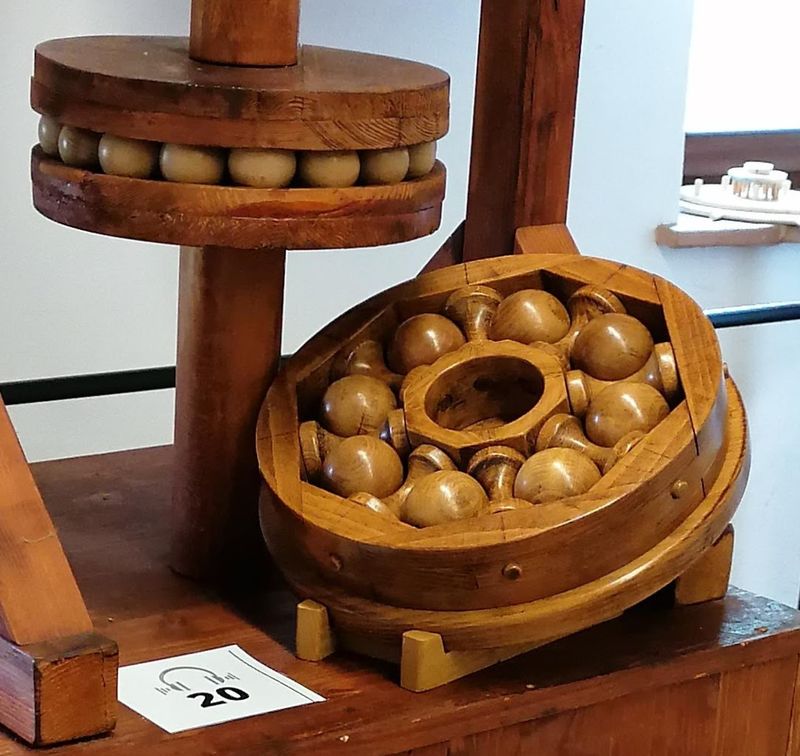
Replica of Leonardo da Vinci's ball bearing: The inventor used wooden balls. Spacers prevent the balls from rubbing against each other.
Rolling bearings support rotating shafts, transmit forces between the shaft and the housing, and reduce friction in the process. They are found in many machines and systems, such as electric motors, gearboxes, and pumps. The history of rolling bearings ranges from simple wooden rollers to high-precision, sensor-monitored components for automated machines.
From Rolling Under Load to Roller Bearings
The basic principle is simple: A load is easier to move when it does not slide across a surface but rolls on rollers or balls. Even the builders of antiquity used logs to transport heavy stones and building components.
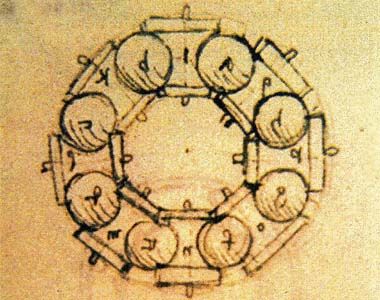
This design for a ball bearing by Leonardo da Vinci has survived to this day.
(Drawing: Leonardo da Vinci)
An early precursor to a ball bearing was found in a Roman shipwreck in Lake Nemis, Italy. A wooden structure containing balls likely enabled a platform to rotate.
Leonardo da Vinci also studied friction in the 15th and 16th centuries. His notes contain sketches of balls moving along raceways, as well as early concepts for a cage that separates the rolling elements from one another. At that time, the balls were made of wood and, by today’s standards, were not particularly durable. Nevertheless, the concept of roller bearings became established in industry by the end of the 16th century. Gradually, the technology was further developed, and new areas of application were explored. Important areas of application during this period included wagons, carriages, and mills.
The First Patented Ball Bearing
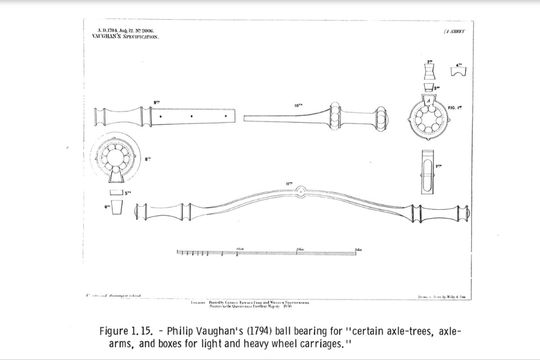
In 1794, Philip Vaughan secured a patent for a ball bearing for carriages: iron balls are placed between the wheel and the axle of a carriage to reduce friction.
Welsh ironworker Philip Vaughan took an important step forward. In 1794, he was granted British Patent No. 2006 for an improved bearing system for wagon axles. In his design, iron balls rolled in grooves between the axle and the bearing housing.
The cast-iron balls were significantly more durable than wooden balls, but they still lacked precision. A modern ball cage was not yet available either. The balls could touch one another and shift their position within the bearing. At that time, the ability to produce large numbers of balls with identical diameters and high roundness was lacking, which hindered reliable mass production.
Friedrich Fischer Shapes the Ball
In 1883, Friedrich Fischer, an engineer from Schweinfurt (Germany), made a significant breakthrough. He developed the so-called ball mill, which made it possible to grind hardened steel balls cost-effectively and bring them to uniform dimensions.
This development fundamentally changed bearing technology. This is because a rolling bearing functions reliably only when the rolling elements are nearly the same size. Even slight dimensional deviations lead to uneven load distribution. Individual balls are then overloaded, while others bear hardly any load.
Fischer's ball-grinding machine paved the way for industrial production. His company gave rise to the bearing manufacturer FAG, which was later acquired by Schaeffler. The precision steel balls were initially used in bicycles, other vehicles, and machinery. As bicycles, railroads, automobiles, and electric drives became more widespread, the demand for high-performance bearings grew rapidly.
Additional patents from the following years demonstrate the need for low-friction motion and the progress of the technology. In 1898, for example, Henry Timken filed a patent in the United States for the tapered roller bearing. A year later, he founded the Timken Roller Bearing Company (now the Timken Company).
How do modern roller bearings work?
A rolling bearing consists of four main components in its basic design:
Inner ring: It is usually mounted on the shaft.
Outer ring: It is usually inserted into a housing bore.
Rolling elements: Balls or rollers transmit the forces.
Cage: It guides the rolling elements and keeps them spaced apart.
The inner and outer rings have precisely ground raceways. The rolling elements roll between these raceways. A rolling bearing replaces the sliding friction between the shaft and the housing with significantly lower rolling friction.
Seals or cover plates protect the bearing from dust, moisture, and other contaminants. At the same time, they keep the lubricant inside the bearing. Depending on the application, the bearings contain grease or oil. Lubrication reduces friction and wear, dissipates heat, and prevents direct metal-to-metal contact.
The Breakthrough with the Pendulum Ball Bearing
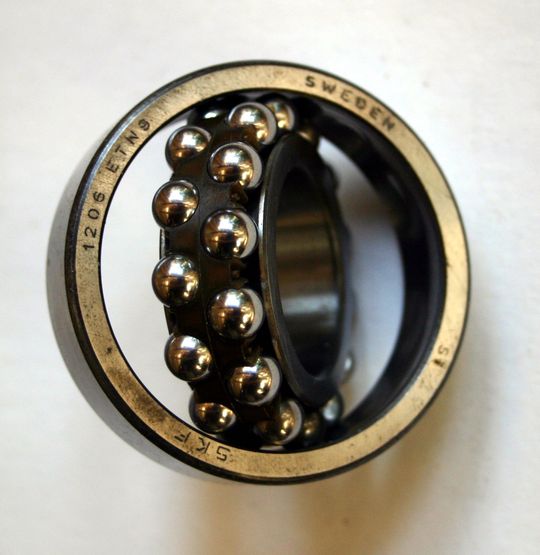
Self-aligning ball bearings compensate for a slight misalignment between the outer and inner rings.
A fundamental problem with early rigid roller bearings was misalignment. Manufacturing and assembly tolerances meant that, in practice, the shaft, bearing, and housing were not always precisely aligned. In addition, shafts can flex under load. A rigid bearing then tilts. The load is no longer distributed evenly across the rolling elements, and service life is reduced.
Date: 08.12.2025
Naturally, we always handle your personal data responsibly. Any personal data we receive from you is processed in accordance with applicable data protection legislation. For detailed information please see our privacy policy.
Consent to the use of data for promotional purposes
I hereby consent to Vogel Communications Group GmbH & Co. KG, Max-Planck-Str. 7-9, 97082 Würzburg including any affiliated companies according to §§ 15 et seq. AktG (hereafter: Vogel Communications Group) using my e-mail address to send editorial newsletters. A list of all affiliated companies can be found here
Newsletter content may include all products and services of any companies mentioned above, including for example specialist journals and books, events and fairs as well as event-related products and services, print and digital media offers and services such as additional (editorial) newsletters, raffles, lead campaigns, market research both online and offline, specialist webportals and e-learning offers. In case my personal telephone number has also been collected, it may be used for offers of aforementioned products, for services of the companies mentioned above, and market research purposes.
Additionally, my consent also includes the processing of my email address and telephone number for data matching for marketing purposes with select advertising partners such as LinkedIn, Google, and Meta. For this, Vogel Communications Group may transmit said data in hashed form to the advertising partners who then use said data to determine whether I am also a member of the mentioned advertising partner portals. Vogel Communications Group uses this feature for the purposes of re-targeting (up-selling, cross-selling, and customer loyalty), generating so-called look-alike audiences for acquisition of new customers, and as basis for exclusion for on-going advertising campaigns. Further information can be found in section “data matching for marketing purposes”.
In case I access protected data on Internet portals of Vogel Communications Group including any affiliated companies according to §§ 15 et seq. AktG, I need to provide further data in order to register for the access to such content. In return for this free access to editorial content, my data may be used in accordance with this consent for the purposes stated here. This does not apply to data matching for marketing purposes.
Right of revocation
I understand that I can revoke my consent at will. My revocation does not change the lawfulness of data processing that was conducted based on my consent leading up to my revocation. One option to declare my revocation is to use the contact form found at https://contact.vogel.de. In case I no longer wish to receive certain newsletters, I have subscribed to, I can also click on the unsubscribe link included at the end of a newsletter. Further information regarding my right of revocation and the implementation of it as well as the consequences of my revocation can be found in the data protection declaration, section editorial newsletter.
Swedish engineer Sven Wingquist developed a solution for this: In 1907, he filed a patent application for a double-row self-aligning ball bearing. The outer raceway for the two rows of balls is designed as a hollow sphere. It can compensate for limited misalignment between the shaft and the housing. As a result, it is less sensitive to misalignment caused, for example, by shaft deflection.
That same year, Svenska Kullagerfabriken—SKF for short—was founded in Gothenburg. Wingquist’s pendulum ball bearings brought the company international recognition. They were particularly important for textile machinery, where long shafts and large distances between bearings often led to misalignment.
This design marked a turning point in the history of the roller bearing: what had been a delicate precision part became a robust machine component that operates reliably even under adverse installation conditions. At the beginning of the 20th century, a number of roller bearing manufacturers were founded. The precision components they produced quickly spread worldwide.
A Variety of Rolling Bearing Designs Emerges
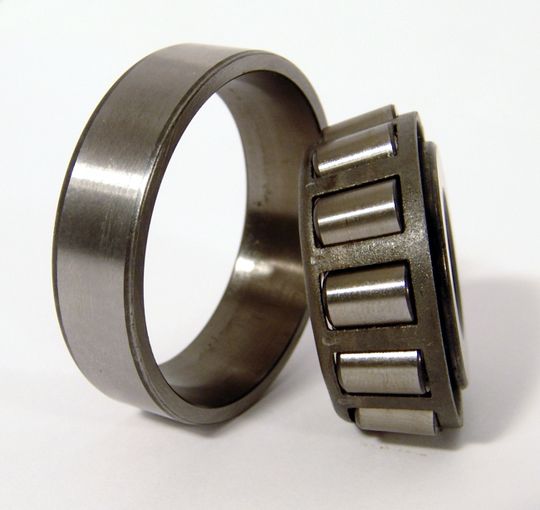
Tapered roller bearings are one of the many types of rolling bearings available today.
Over time, a wide variety of rolling bearing designs have emerged. The most noticeable—but by no means the only—difference lies in the rolling elements: balls have only a small contact area with the raceway. This reduces friction and enables high rotational speeds. Rollers, on the other hand, have a larger contact area. They can therefore withstand higher radial forces. Depending on their shape, they are classified as cylindrical, spherical, tapered, self-aligning, needle, or toroidal rollers. The choice of design depends, among other things, on radial and axial forces, the direction of the load, rotational speed, installation space, stiffness, lubrication, and environmental conditions, for example:
Deep-groove ball bearings are versatile bearings that primarily support radial forces and limited axial forces and are suitable for high rotational speeds.
Angular contact ball bearings transmit combined radial and axial forces. Multiple bearings can be arranged in pairs to increase axial stiffness.
Cylindrical roller bearings offer high radial load capacity. Depending on the design, they may also accommodate axial displacement of the shaft.
Tapered roller bearings transmit both radial and axial forces. They are used, among other applications, in vehicle wheel bearings and transmissions.
Needle roller bearings use particularly slender rollers. They achieve a high load-carrying capacity with a low radial height.
Self-aligning roller bearings are designed for high loads and compensate for minor misalignments, similar to self-aligning ball bearings.
Erich Franke developed wire roller bearings based on the design principle of cross-roller bearings. The rolling elements run on wires embedded in the surrounding structure. This enables particularly space-saving rotary joints.
New Materials for Rolling Bearings
Modern rolling bearings are primarily made of high-purity, hardened chrome or case-hardened steels. Heat treatments improve hardness, toughness, and fatigue strength. For special applications, there are rolling bearings made partly or entirely of ceramic, glass, stainless steel, or plastic.
Insulating layers on the rings reduce damage caused by the flow of current, such as when used in frequency converters. Hybrid bearings go one step further: Their rings are made of steel, but the rolling elements are made of insulating ceramic, typically silicon nitride or zirconia. Ceramic balls offer additional advantages: they are lighter and more durable than steel balls. However, because they are more difficult to machine, these roller bearings also come at a slightly higher price.
The Rolling Bearing Is Becoming Smart
For a long time, rolling bearings did not provide any data on their condition. The first sensor bearings appeared in the late 1980s. Initially, they were used for ABS systems in the automotive sector and for rail vehicles. Later, sensor bearings were introduced for condition monitoring of industrial machinery. They typically measure temperature and vibrations. From these signals, characteristic fault frequencies can be derived that indicate wear.
In conjunction with system control and data analysis, this enables condition-based maintenance: A bearing is no longer replaced at fixed intervals; instead, maintenance is performed when measurement data actually indicates the onset of damage. This practice reduces unplanned downtime and prevents the replacement of components that are still functional. Such monitoring systems are already available for rail vehicles, for example.
From a Simple Machine Element to a System Component
Today, rolling bearings play a key role in determining the efficiency, noise levels, precision, and service life of many machines. That is why researchers and industry continue to work on making these components more efficient and sustainable. What began with wooden rollers and balls to reduce friction has evolved into precision components for networked machines and systems.



:quality(80)/p7i.vogel.de/wcms/d9/43/d943b0ce33bdf921f37f14655bb0c376/cuscinetto-a-sfere-di-leonardo-da-vinci-in-una-mostra-su-leonardo-da-vinci-al-mulino-di-mora-bassa---morabassa-croppedv1.jpeg "Replica of Leonardo da Vinci's ball bearing: The inventor used wooden balls. Spacers prevent the balls from rubbing against each other. (Source: Capricornis crispus)")
:quality(80)/p7i.vogel.de/wcms/17/b8/17b8af0cb725e0e1d3e8d72458bab260/siemens-meet-at-the-machinev1.jpeg "“Meet at the Machine” is Siemens’ new initiative, which aims to bring together machine builders, software, and automation technologies to accelerate innovation in the machine tool industry and help manufacturers become productive more quickly. (Source: Siemens)")
:quality(80)/p7i.vogel.de/wcms/8e/7e/8e7e0cda4c68699bcc48283a38739769/0133316747v1.jpeg "A little-known hidden champion! When people think of laser cutting, the first thing that comes to mind is the power of the laser beam—and it is impressive to see the sparks flying. But Air Liquide—an exhibitor at Euroblech, by the way—wants to make it clear that the process gas is also key to success. (Image:AI-generated)")
:quality(80)/p7i.vogel.de/wcms/20/fa/20fa35e0af203c3464f7e7fdbb57a685/0133281172v1.jpeg "Since 2003, Etzinger AG has been developing and manufacturing high-quality coffee grinders, pepper mills, and grinding mechanisms for professional and home use. (Image:Etzinger)")
:quality(80)/p7i.vogel.de/wcms/b1/06/b106cf44923ce39565c3264982fd20eb/0133414574v1.jpeg "Robots Build Robots: At the new Ubtech factory, automated systems even handle parts of the material supply and logistics for the production of humanoid robots. (Image:Ubtech)")
:quality(80)/p7i.vogel.de/wcms/38/79/38799bfbbccd938b64c67068cfa68780/0133329362v1.jpeg "What exactly enables machines to act on their own? (Image:Shutterstock)")
:quality(80)/p7i.vogel.de/wcms/1b/9f/1b9fc9f113fc66212e2c0e17a3edaf9f/org-blobs-user-response-file-output-f317796f-57b7-483f-9403-5d9ac8a816f5-plugin-output-call-kdigtepb7be7us8xvbota0mh-1672x940v1.png "According to Barclays data, Europe leads the global trade in actuator components. With a 34 percent share, the region ranks ahead of China, which has a 26.3 percent share. (Source: Statista | CC BY-ND 4.0, AI-generated)")
:quality(80)/p7i.vogel.de/wcms/f5/4c/f54c9fc59ccb0604ab9219188469a45f/image1v1.jpeg "Christopher Savoia, Global Head of the UR+ Ecosystem at Universal Robots, presents the new SP7 Smart Panel on a UR17g-1300 robot during the unveiling of Gen 7—UR’s 7th-generation robot platform—at IMTS in Chicago on September 14, 2026. (Image:Image: Teradyne Robotics)")
:quality(80)/p7i.vogel.de/wcms/ca/46/ca462051dfb9a1fb37ca4053762af9df/org-blobs-user-response-file-output-908c701c-3b37-491e-bb5c-35fc3d336575-plugin-output-call-182851v1.png "Through extreme compression, high-energy lasers transform simple plastics into high-purity nanodiamonds. What was once used in planetary physics is now opening up entirely new possibilities for quantum sensors, novel catalysts, and extremely hard materials. (Illustrative image) (Source: VCG / AI-generated)")
:quality(80)/p7i.vogel.de/wcms/7c/7a/7c7a5eada63c7a36a365391c292f76d4/hot-fire-jarvisv1.jpeg "(Developed in record time: A “JARVIS-class” jet engine capable of up to 100 pounds of thrust. It was designed in a four-week sprint using generative AI and established CAD/CAE tools.MIT)")
:quality(80)/p7i.vogel.de/wcms/87/87/87870cf2b30aaef7b8a06212a4ef2c14/0133403885v1.jpeg "A digital twin and a real component demonstrate how closely simulation and manufacturing are converging. Stampack Xpress 2026.1 virtually models forming behavior and supports the validation of process and tool design. (Image:Stampack)")
:quality(80)/p7i.vogel.de/wcms/59/2a/592a7f2d0964e9e6846cae331f5daa3a/0133266065v1.jpeg "Perforated metal sheets are particularly well-suited for balcony railings, as they combine stability, privacy, and design versatility. (Image:Ripo Factory)")
:quality(80)/p7i.vogel.de/wcms/24/d5/24d546b8c00887feaef1cbc207b9e2af/0133433032v1.jpeg "Mahle CEO Arnd Franz was recently asked about his vision for the future of the commercial vehicle business—particularly regarding the industry's transition to electric vehicles... (Image:Kai R. Joachim / Mahle)")
:quality(80)/p7i.vogel.de/wcms/8b/c5/8bc5c0c40b6d706aca4e3f3ddcc99958/0133387335v1.jpeg "At InnoTrans, Stadler is unveiling for the first time its new four-axle EURO DuFour locomotive for freight service, which SBB Cargo has ordered. Compared to the existing fleet, it is expected to be significantly more energy-efficient in operation. (Image:Stadler)")
:quality(80)/p7i.vogel.de/wcms/49/97/49978469e969283ccb68531ebef1f412/klaus-zellmer-1v1.jpeg "Klaus Zellmer will become CEO of Volvo no later than October 2027. (Source: Volvo)")
:quality(80)/p7i.vogel.de/wcms/cf/e1/cfe1f3824102bd030f4fe5e4e13e1e0e/0133433007v1.jpeg "The situation in the German automotive manufacturing industry is not exactly rosy, especially when viewed in the context of global competition. Read here to find out what a recent analysis of the situation reveals ... (Image:AI-generated)")
:quality(80)/p7i.vogel.de/wcms/f3/d9/f3d91ebfd703e24d4065b0ae7898e46b/0133177388v1.jpeg "The Evolution of Coding: In the past, programs were written by hand and fed into the computer using punch cards and switches. Today, in the age of “vibe coding,” computers can largely program themselves. (Image:Dall-E / AI-generated)")
:quality(80)/p7i.vogel.de/wcms/00/cd/00cd7c51cf41652dbb295c14634cd34f/0133438409v1.jpeg "Flash memory from Spansion dating back to 2004, before the company merged with Cypress. Infineon is divesting its NOR flash and FRAM memory business. Winbond, which is acquiring the division for $1.12 billion, plans to continue operating it as a separate company under the Spansion name starting next year. (Image:Raimond Spekking / CC BY-SA 4.0 / Wikimedia Commons)")
:quality(80)/p7i.vogel.de/wcms/09/dc/09dcc37616c3a9d5d7a289c97a352a89/0133428369v1.jpeg "(Image:Gemini / AI-generated)")
:quality(80)/p7i.vogel.de/wcms/4c/53/4c534208d09a9b1ce597938715e7fc19/0133288763v1.jpeg "Logic Folding: In its latest Kirin 9050 Pro, Huawei uses hybrid bonding to distribute the computing units across two silicon layers in order to increase the effective transistor density without resorting to finer manufacturing processes. (Image:Huawei)")
:fill(fff,0)/images.vogel.de/vogelonline/companyimg/76800/76895/65.jpg "FAULHABER_120mm.jpg ()")
:quality(80)/p7i.vogel.de/wcms/21/03/21032b49e5f946f0cd13eeeef2f3cfed/franke-drehverbindung-materialmix-freiv1.png "Possible materials for the housings of wire race bearings (from left clockwise): 3D-printed structure, carbon, steel, plastic, brass, aluminum, bronze, stainless steel (Source: Franke)")
:quality(80)/p7i.vogel.de/wcms/73/41/73412c1a6fe312e62e55bdb9bd223fdc/0128086375v1.jpeg "Specifically for cleanrooms such as in battery production or the semiconductor industry, Igus has developed a new cleanroom-compatible ball bearing made of wear-resistant high-performance plastics. (Image:Igus)")
:quality(80)/p7i.vogel.de/wcms/21/03/21032b49e5f946f0cd13eeeef2f3cfed/franke-drehverbindung-materialmix-freiv1.png "Possible materials for the housings of wire race bearings (from left clockwise): 3D-printed structure, carbon, steel, plastic, brass, aluminum, bronze, stainless steel (Source: Franke)")