Silicon carbide was long considered a key material for electric cars, solar inverters, and battery storage. Now SiC is gaining a new growth driver: AI data centers. In China, demand and prices are rising again. After the ruinous price war of 2025, the industry is hoping for a new cycle.
Power supply solutions for data centers are booming, making SiC applications highly sought after.
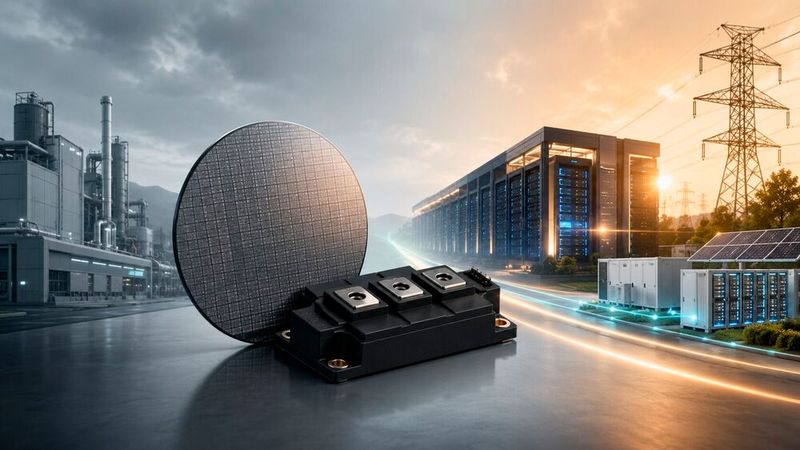
(Image: Dall-E / AI-generated)
In China, the artificial intelligence boom is becoming the new growth driver for silicon carbide. SiC had its commercial breakthrough in electric cars, solar inverters, and battery storage. Now, data center operators are discovering it as a key technology for their power supply; a trend that was confirmed not least at Computex and PCIM 2026.
Just a year ago, the market was embroiled in a destructive price war that crushed many smaller providers and ruined margins. But now prices are rising again, reports the Chinese technology portal 36Kr. "In 2026, demand for silicon carbide (SiC) has surged, triggering a wave of price increases across the industry that sweeps away the gloom created by the price wars of 2025," writes 36Kr.
There is hope that a new growth cycle for the industry has begun. The previous one, which occurred before last year's ruinous price war, was driven by demand from the energy transition. In electric vehicles, SiC transistors improve drivetrain efficiency, increase range, and reduce weight and space requirements. In solar systems and battery storage, they reduce losses during power conversion. The material was also used in consumer electronics.
Electromobility, photovoltaics, and energy storage had rapidly driven the commercialization of silicon carbide. However, the current wave of new demand clearly stems from the boom in AI infrastructure. In data centers, power density is rising rapidly, with the power of individual server racks climbing from the kilowatt to the megawatt range.
800 HVDC as Key
To efficiently distribute such amounts of power, the AI industry is shifting its architecture to 800 volts and high-voltage direct current, known in technical jargon as HVDC for High Voltage Direct Current. The physical properties that have long made SiC attractive for increasingly demanding power electronics are now also making it the new favorite for powering the AI industry. The material withstands high voltages, loses little energy during switching, and endures high temperatures.
More and more SiC semiconductors are therefore found in HVDC systems, semiconductor transformers, so-called solid-state transformers (SST), in server power supplies, and in the power distribution of data centers. A SiC-based semiconductor transformer can directly convert the medium AC voltage from the grid into the 800-volt DC power needed by an AI cluster.
The Chinese investment bank Kaiyuan Securities estimates that by 2030, nearly half of the total SiC demand could come from AI infrastructure. The same pattern is visible in the global market. The global market for silicon carbide grew by more than 28 percent in 2024 to nearly 3.8 billion euros (approx. $4.1 billion) and could swell to around 17 billion euros (approx. $18.3 billion) by 2030, according to the market research firm "Global Information."
The global market leaders are benefiting from this trend, including the German company Infineon, the European firm STMicroelectronics, Onsemi, Rohm, and the American pioneer Wolfspeed, which had faced tough times in the interim.
Attentive Competition
At the same time, Chinese manufacturers are growing rapidly and capturing increasingly large market shares. In substrates, the most technically demanding part of the value chain, Chinese companies SICC and TankeBlue already account for about half of the global market for six-inch wafers, reports 36Kr. The transition to eight-inch wafers has begun, but there is still enormous demand for the previous generation, particularly in China.
At China Resources Microelectronics, revenue from silicon carbide power components and modules more than doubled in 2025, according to the company. Shenzhen Basic Semiconductor's SiC modules are now reportedly found in more than 50 vehicle models from over ten automakers. Additionally, the railway technology company CRRC is building a high-frequency SiC auxiliary inverter in Zhuzhou, which is used, among other places, on line 5 of the Shenzhen subway.
Date: 08.12.2025
Naturally, we always handle your personal data responsibly. Any personal data we receive from you is processed in accordance with applicable data protection legislation. For detailed information please see our privacy policy.
Consent to the use of data for promotional purposes
I hereby consent to Vogel Communications Group GmbH & Co. KG, Max-Planck-Str. 7-9, 97082 Würzburg including any affiliated companies according to §§ 15 et seq. AktG (hereafter: Vogel Communications Group) using my e-mail address to send editorial newsletters. A list of all affiliated companies can be found here
Newsletter content may include all products and services of any companies mentioned above, including for example specialist journals and books, events and fairs as well as event-related products and services, print and digital media offers and services such as additional (editorial) newsletters, raffles, lead campaigns, market research both online and offline, specialist webportals and e-learning offers. In case my personal telephone number has also been collected, it may be used for offers of aforementioned products, for services of the companies mentioned above, and market research purposes.
Additionally, my consent also includes the processing of my email address and telephone number for data matching for marketing purposes with select advertising partners such as LinkedIn, Google, and Meta. For this, Vogel Communications Group may transmit said data in hashed form to the advertising partners who then use said data to determine whether I am also a member of the mentioned advertising partner portals. Vogel Communications Group uses this feature for the purposes of re-targeting (up-selling, cross-selling, and customer loyalty), generating so-called look-alike audiences for acquisition of new customers, and as basis for exclusion for on-going advertising campaigns. Further information can be found in section “data matching for marketing purposes”.
In case I access protected data on Internet portals of Vogel Communications Group including any affiliated companies according to §§ 15 et seq. AktG, I need to provide further data in order to register for the access to such content. In return for this free access to editorial content, my data may be used in accordance with this consent for the purposes stated here. This does not apply to data matching for marketing purposes.
Right of revocation
I understand that I can revoke my consent at will. My revocation does not change the lawfulness of data processing that was conducted based on my consent leading up to my revocation. One option to declare my revocation is to use the contact form found at https://contact.vogel.de. In case I no longer wish to receive certain newsletters, I have subscribed to, I can also click on the unsubscribe link included at the end of a newsletter. Further information regarding my right of revocation and the implementation of it as well as the consequences of my revocation can be found in the data protection declaration, section editorial newsletter.
The scaling enabled by their domestic market is also making Chinese SiC manufacturers increasingly successful internationally. "Driven by demand from AI infrastructure, electric vehicles, solar energy, energy storage, and consumer electronics, China's silicon carbide suppliers are evolving from a story of import substitution to a story of global competitiveness," writes 36Kr.
Chinese companies are managing to establish themselves in more and more supply chains that were dominated by international providers just a few years ago. Overall, however, the trend is strong enough to lift both Chinese and international manufacturers out of last year's slump.
"Within just one year, the silicon carbide industry has moved from the darkest days of a price war to the first signs of a new upswing," writes the Chinese technology portal. This time, however, the new cycle will no longer be driven solely by applications such as electric vehicles and renewable energy but unmistakably by the "explosive growth of AI infrastructure."



:quality(80)/p7i.vogel.de/wcms/8e/7e/8e7e0cda4c68699bcc48283a38739769/0133316747v1.jpeg "A little-known hidden champion! When people think of laser cutting, the first thing that comes to mind is the power of the laser beam—and it is impressive to see the sparks flying. But Air Liquide—an exhibitor at Euroblech, by the way—wants to make it clear that the process gas is also key to success. (Image:AI-generated)")
:quality(80)/p7i.vogel.de/wcms/20/fa/20fa35e0af203c3464f7e7fdbb57a685/0133281172v1.jpeg "Since 2003, Etzinger AG has been developing and manufacturing high-quality coffee grinders, pepper mills, and grinding mechanisms for professional and home use. (Image:Etzinger)")
:quality(80)/p7i.vogel.de/wcms/69/91/6991413943488b4a2f6fde9dcd88c5b0/0133256686v1.jpeg "The CMA-patented pendulum mount can compensate for radial tolerances of up to one millimeter. (Image:Schwiening)")
:quality(80)/p7i.vogel.de/wcms/0b/cd/0bcd6d502ffcd087c4fc12b7b760b3ce/0133317507v2v1.jpeg "The new Multi Center from J.G. Weisser. (Image:J.G. Weisser)")
:quality(80)/p7i.vogel.de/wcms/bd/4e/bd4ef09ab0f84932ea76ca0330ffe789/0133329802v1.jpeg "The robotics boom and its consequences: According to a study, a significant portion of value creation occurs in the electronics industry. (Image:Fraunhofer IPA)")
:quality(80)/p7i.vogel.de/wcms/35/81/35815f36be1b1c13f9abef4cea2a3e2b/0133171739v1.jpeg "Humanoid robots in industry: Despite impressive progress, many systems are still in the pilot phase. (Image:AI-generated)")
:quality(80)/p7i.vogel.de/wcms/81/dc/81dc63ed24c562521413023779495e7d/chris-kramerv1.jpeg "Chris Kramar, Director and General Manager of OEM Solutions for Germany, Austria, and Switzerland at Dell Technologies (Source: Dell Technologies)")
:quality(80)/p7i.vogel.de/wcms/bb/f5/bbf5342f532debc1bd7c09c2b9a0bf42/0133176497v1.jpeg "Over the past two years, AI has emerged as the most important growth driver in the industry. (Image: ©Gorodenkoff - stock.adobe.com)")
:quality(80)/p7i.vogel.de/wcms/e9/19/e91905d37afe605bc348a690a4fed72e/0133350592v1.jpeg "At Autodesk University, Autodesk is introducing new AI features for CAD and PLM. (Image:Autodesk)")
:quality(80)/p7i.vogel.de/wcms/98/73/98731d23cbd95ff22391993a74cfefbf/mit-bifurcatedcircuits-01-pressv1.jpeg "A sample of the variety of configurations that Bifur circuits can form. (Source: Courtesy of the researchers)")
:quality(80)/p7i.vogel.de/wcms/f4/3d/f43d1f4297d9ae0cd1b6d2adfcb5ffe1/0133276470v1.jpeg "Simulation: Electric arcs in the electrical industry, including associated field simulation. (Image:CADFEM)")
:quality(80)/p7i.vogel.de/wcms/3e/f1/3ef196715e1b291ec7ae84f02c875c63/0133310495v1.jpeg "The Next Phase of Ethernet in Vehicles: End-to-end Ethernet integrates all high-data-rate devices into the network, including displays and central high-performance computing units. (Image:Infineon Technologies)")
:quality(80)/p7i.vogel.de/wcms/b4/b8/b4b89c48bb797df7251706d4ee096a80/0133359349v1.jpeg "To advance modern rail transportation, Knorr-Bremse and CARS have signed a memorandum of understanding regarding the China Freight Cooperation Program. Pictured here is Rail Executive Board Member Nicolas Lange at the signing ceremony in Beijing. (Image: Knorr-Bremse)")
:quality(80)/p7i.vogel.de/wcms/99/8c/998cb26cfb3110e8444a4ecbfe2dc799/0133338279v1.jpeg "Electric car manufacturer Rivian is launching its R2 SUV in the U.S. (Image:Rivian)")
:quality(80)/p7i.vogel.de/wcms/cc/d1/ccd1607af856c9cff96c73a5ffccfcad/p90652283-highres-demonstrator-woodenv1.jpeg "The FSCM research project, which was recently completed, is delivering innovations close to production for plastics, metals, and design at BMW. (Source: BMW)")
:quality(80)/p7i.vogel.de/wcms/4c/53/4c534208d09a9b1ce597938715e7fc19/0133288763v1.jpeg "Logic Folding: In its latest Kirin 9050 Pro, Huawei uses hybrid bonding to distribute the computing units across two silicon layers in order to increase the effective transistor density without resorting to finer manufacturing processes. (Image:Huawei)")
:quality(80)/p7i.vogel.de/wcms/56/d1/56d131e0b5bd05ef47411e92ad740cb4/0133351029v1.jpeg "Researchers at DTU have developed a nanolaser in a semiconductor membrane. The structure concentrates charge carriers and the light field into a small area (shaded in blue). If data is transmitted on microchips using light instead of electrical signals, transmission speeds can be increased and energy losses reduced. (Image:Yi Yu, DTU)")
:quality(80)/p7i.vogel.de/wcms/5e/55/5e55101ddc6338f755fcf3244db1367f/0133331863v1.jpeg "For data center projects, it is becoming increasingly important to also obtain the consent of the affected community. (Image:Dall-E / AI-generated)")
:quality(80)/p7i.vogel.de/wcms/8d/f9/8df95d3f58408673986b3d643e6b63ba/0133252773v1.jpeg "TXC targets high-speed optical links in AI data centers with 312.5 MHz oscillators, among other solutions. As data rates increase, requirements for jitter and frequency stability become more demanding as well. (Bild: TXC)")
:fill(fff,0)/p7i.vogel.de/companies/69/88/69882c428938e/tmts2026-ticec-banner-en-2000px.png "tmts2026-ticec-banner-en-2000px (https://www.tmts.tw/en)")
:fill(fff,0)/p7i.vogel.de/companies/69/de/69de1b7403b0d/simtos-logo.jpeg "simtos-logo (SIMTOS)")
:quality(80)/p7i.vogel.de/wcms/71/e8/71e8a9d24bbbc0de4c4dcc8235d31970/0130870631v1.jpeg "Bosch now offers the third generation of its silicon carbide power semiconductors for a wide range of automotive applications. (Image:Bosch)")
:quality(80)/p7i.vogel.de/wcms/c7/76/c776b1187f738ffcedb7042624c22f89/0131277913v1.jpeg "Figure 1: Air-to-water heat pump for residential buildings. (Picture: ©MNStudio - stock.adobe.com / AI-generated)")
:quality(80)/p7i.vogel.de/wcms/0f/b2/0fb28656d39754b67a76b90b42243cda/0129655768v1.jpeg "Driven by GaN wafer production at 300 millimeters, Infineon's GaN products deliver outstanding performance with clear application benefits. (Image:Infineon Technologies AG)")