Hydropower often remains unused where the current seems too weak. However, even weak currents can be harnessed: An American-German inventor duo developed a modular system consisting of a Hydro-Transition-Unit and paired rotors. The research project resulted in an internationally active, market-ready startup.
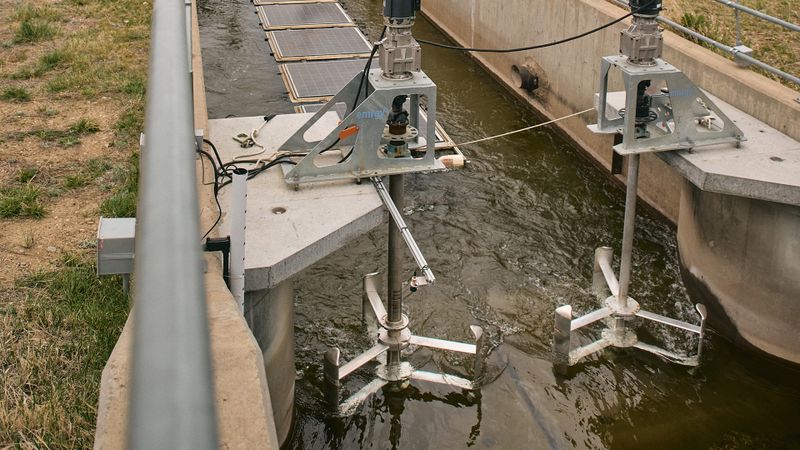
The technology is also suitable for shallow canals.
(Source: Emrgy)
Hydropower is the largest source of renewable energy worldwide. According to the International Energy Agency, hydropower generates almost as much energy as all other renewable sources combined. Nevertheless, enormous potential remains untapped. Emily Morris and Professor Thorsten Stoesser have developed a decentralized hydropower plant that enables the utilization of new sites: it harnesses the flow of water in canals and waterways where conventional hydropower plants would not be economically viable. For their work, the inventor duo was selected as finalists in the "Non-EPO Countries" category of the European Inventor Award 2026.
How Can Hydropower Be Utilized in Existing Canals and Waterways?
Conventional hydropower plants come in various sizes, from large hydropower plants with dams to micro-hydropower plants, which usually utilize the natural water flow. In many of these smaller systems, the water flows past the turbines or moves through them at low speed, resulting in relatively low power generation.
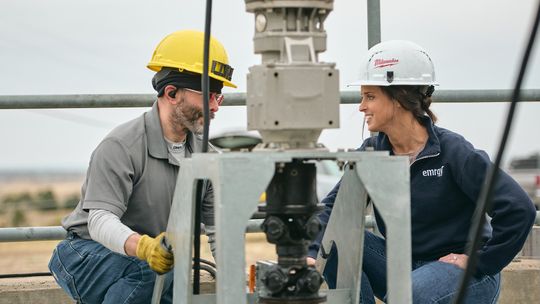
Emily Morris (r.), the founder and CEO of Emrgy, together with Prof. Thorsten Stoesser, developed a modular hydropower technology and turned it into a business idea.
(Source: Emrgy)
The solution developed by Morris and Stoesser takes a new approach: the modular system generates electricity directly in existing canals. The core of the concept is a "Hydro-Transition Unit," which directs and narrows the water flow so that the water passes through the turbines at a higher speed. This accelerated water flow generates more energy in shallow, slow-moving waterways.
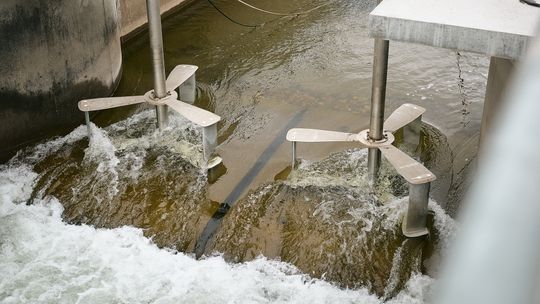
The system consists of paired, counter-rotating Darrieus rotors on a vertical axis—a configuration that is also suitable for shallow canals and variable water levels. Each module typically generates 5 to 25 kilowatts. The modular principle allows for gradual expansion of the system over time along a water channel. Standardized turbine components, modular channels, and assembly based on a cassette principle enable quick installation and removal of the modules for maintenance without interrupting the water flow.
The structural design of the Hydro-Transition Unit is intentionally simple and primarily relies on gravity and friction between the concrete foundation and the canal bed. The hydrodynamic forces acting on the unit can be calculated based on water pressure and flow conditions, allowing for a robust assessment of the system's stability. The development team then added an appropriate safety factor to ensure the unit remains stable during operation. This approach avoids complex anchoring or major structural interventions.
What began as a small scientific project with a single flume and a handful of students has evolved into a technology that is used in real canals.
Thorsten Stoesser, Professor, University College London
Inspiration through a Request from the Girl Scouts
The origin of the technology dates back to 2008. At the time, Stoesser was an assistant professor at the Georgia Institute of Technology. The Girl Scouts of Georgia asked him about ways to generate electricity for their camp using tidal currents. This prompted Stoesser to begin testing hydrokinetic devices in a water channel. Around the same time, Morris was working at the company AMT on drivetrain technologies for shipping. When that project took a different direction, she recognized the potential to apply similar engineering concepts to electricity generation with hydropower in shallow waters.
Founding of the Company Emrgy
Each module uses two rotors and generates about 5 to 25 kilowatts.
(Source: Emrgy)
In 2014, Morris founded the company Emrgy in Atlanta to commercialize the technology. She combined Stoesser's research in hydrodynamics with a modular, scalable engineering approach. One of the biggest hurdles in commercialization was securing funding to move beyond laboratory experiments and small-scale tests. The early phases required patience, perseverance, and support, as the technology had to be tested, optimized, and validated step by step before being deemed reliable for real-world operation. The company then faced the challenging task of finding canal operators willing to take a calculated risk and implement a new technology in their infrastructure. Ultimately, the technical challenge was not only to make the system efficient but also to ensure it was robust, easy to use, and convincing in terms of long-term maintenance.
Date: 08.12.2025
Naturally, we always handle your personal data responsibly. Any personal data we receive from you is processed in accordance with applicable data protection legislation. For detailed information please see our privacy policy.
Consent to the use of data for promotional purposes
I hereby consent to Vogel Communications Group GmbH & Co. KG, Max-Planck-Str. 7-9, 97082 Würzburg including any affiliated companies according to §§ 15 et seq. AktG (hereafter: Vogel Communications Group) using my e-mail address to send editorial newsletters. A list of all affiliated companies can be found here
Newsletter content may include all products and services of any companies mentioned above, including for example specialist journals and books, events and fairs as well as event-related products and services, print and digital media offers and services such as additional (editorial) newsletters, raffles, lead campaigns, market research both online and offline, specialist webportals and e-learning offers. In case my personal telephone number has also been collected, it may be used for offers of aforementioned products, for services of the companies mentioned above, and market research purposes.
Additionally, my consent also includes the processing of my email address and telephone number for data matching for marketing purposes with select advertising partners such as LinkedIn, Google, and Meta. For this, Vogel Communications Group may transmit said data in hashed form to the advertising partners who then use said data to determine whether I am also a member of the mentioned advertising partner portals. Vogel Communications Group uses this feature for the purposes of re-targeting (up-selling, cross-selling, and customer loyalty), generating so-called look-alike audiences for acquisition of new customers, and as basis for exclusion for on-going advertising campaigns. Further information can be found in section “data matching for marketing purposes”.
In case I access protected data on Internet portals of Vogel Communications Group including any affiliated companies according to §§ 15 et seq. AktG, I need to provide further data in order to register for the access to such content. In return for this free access to editorial content, my data may be used in accordance with this consent for the purposes stated here. This does not apply to data matching for marketing purposes.
Right of revocation
I understand that I can revoke my consent at will. My revocation does not change the lawfulness of data processing that was conducted based on my consent leading up to my revocation. One option to declare my revocation is to use the contact form found at https://contact.vogel.de. In case I no longer wish to receive certain newsletters, I have subscribed to, I can also click on the unsubscribe link included at the end of a newsletter. Further information regarding my right of revocation and the implementation of it as well as the consequences of my revocation can be found in the data protection declaration, section editorial newsletter.
Pilot Project Proceeds as Planned
Thanks to a partnership with the city of Atlanta, the startup was able to test its system at full scale in a wastewater treatment plant and refine the concept of the "Hydro-Transition Unit." "Overall, the pilot project went largely as planned, which was encouraging as many of our assumptions from earlier development phases were confirmed," Stoesser and Morris state in writing. "The most significant technical challenge was the variability of water flow during normal operation. The flow rate changed by about 30 percent throughout the day, with the highest flow rates occurring in the late morning. This highlighted the importance of designing the system to operate efficiently and reliably under variable flow conditions—not just under ideal, steady conditions."
This early demonstration plant led to further projects, including one with Denver Water. The U.S. Department of Energy also supported the young company from the very beginning. Good communication and a strong technical concept helped build trust in the company and its technology. "Personal conversations were very important because they allowed us to clearly explain the technology and directly address concerns," the two founders report. "In the end, it was crucial to show that the potential outcome is significant, while the technical and financial risks are comparatively small and manageable."
Outlook: International Growth Plans
Today, Emrgy has agreements with 48 water and irrigation associations. These provide access to around 19,000 kilometers (approx. 11,800 miles) of canal infrastructure in the U.S. and enable the gradual deployment of decentralized hydropower plants along existing waterways. The company is active not only in the U.S. but also in New Zealand. Deployment in other countries, such as Italy and Thailand, is planned. Irrigation canals and the tailwater channels of hydropower plants are particularly promising from the provider's perspective, as they often feature predictable flows and similar operational requirements in many regions of the world. Although regulatory frameworks differ from country to country, the fundamental technical and permitting issues in these controlled water systems are often comparable.



:quality(80)/p7i.vogel.de/wcms/0b/cd/0bcd6d502ffcd087c4fc12b7b760b3ce/0133317507v2v1.jpeg "The new Multi Center from J.G. Weisser. (Image:J.G. Weisser)")
:quality(80)/p7i.vogel.de/wcms/6a/ef/6aef8ea2d02622844db469c705a21222/0133322968v1v1.jpeg "Canada and the U.S. have been locked in a trade dispute ever since Donald Trump was re-elected as U.S. president. In the long run, however, Canada could end up being the loser. That is why the country is turning more toward its trading partner, the EU. Something very special is set to emerge... (Image:AI-generated)")
:quality(80)/p7i.vogel.de/wcms/dd/92/dd928ba2e2956aa2bfff4888af8b08f8/photo--1v1.jpeg "Catalog product for extreme operating conditions: The new NRTVG guide carriage from Bosch Rexroth withstands extreme environmental conditions. (Source: Bosch Rexroth AG)")
:quality(80)/p7i.vogel.de/wcms/5a/9e/5a9e57e26964ba5c9d8719a9ee520bb3/0133310195v1.jpeg "Germany and the United Arab Emirates have signed an agreement to stand shoulder to shoulder in times of crisis. This will bring Germany many billions, to say the least.
From left: Sheikh Mohammed bin Sajed al-Nahjan and Federal Chancellor Friedrich Merz. (Image:dpa / K. Nietfeld)")
:quality(80)/p7i.vogel.de/wcms/81/dc/81dc63ed24c562521413023779495e7d/chris-kramerv1.jpeg "Chris Kramar, Director and General Manager of OEM Solutions for Germany, Austria, and Switzerland at Dell Technologies (Source: Dell Technologies)")
:quality(80)/p7i.vogel.de/wcms/bb/f5/bbf5342f532debc1bd7c09c2b9a0bf42/0133176497v1.jpeg "Over the past two years, AI has emerged as the most important growth driver in the industry. (Image: ©Gorodenkoff - stock.adobe.com)")
:quality(80)/p7i.vogel.de/wcms/01/61/01615a0939754c41e9d2c8971bf0b38a/web-image-kuka-kmf-1500p-300-dpi-1v1.jpeg "Thanks to its design, the KMF 1500P-CB is suitable for the stable and flexible handling of closed and open pallets. (Source: Kuka)")
:quality(80)/p7i.vogel.de/wcms/0b/ef/0bef343dfe1c7f83a1be01e7e83cc5ac/delta-fabrikv1.jpeg "Autonomous mobile manipulation robots can perform a wide range of tasks in a modern factory, from loading machines to quality control. (Image:Delta)")
:quality(80)/p7i.vogel.de/wcms/98/73/98731d23cbd95ff22391993a74cfefbf/mit-bifurcatedcircuits-01-pressv1.jpeg "A sample of the variety of configurations that Bifur circuits can form. (Source: Courtesy of the researchers)")
:quality(80)/p7i.vogel.de/wcms/f4/3d/f43d1f4297d9ae0cd1b6d2adfcb5ffe1/0133276470v1.jpeg "Simulation: Electric arcs in the electrical industry, including associated field simulation. (Image:CADFEM)")
:quality(80)/p7i.vogel.de/wcms/1d/fb/1dfbb415cd837102a33ce21ecf052ec3/0133277411v1.jpeg "LED drivers: LED circuit boards connect the light fixture to the electronics. During design, the operating current, forward voltage, and temperature must be taken into account across the entire operating range. (Image: ©Maria - stock.adobe.com)")
:quality(80)/p7i.vogel.de/wcms/80/8a/808a0eccf49a2a4fe560bd1998506ef9/0133308770v1.jpeg "Just like that, the supports are gone! High-speed footage of the automated, ultrasound-based process for removing optimized support structures from additively manufactured metal parts. It will be presented for the first time at Formnext from November 17 to 20. (Image:Fraunhofer IAPT)")
:quality(80)/p7i.vogel.de/wcms/fe/a8/fea8f62ea056f3c5334931f38cb80c76/0133324887v1v1.jpeg "It's flying off the shelves! The ID.Polo electric compact car seems to be living up to Volkswagen's expectations. After all, there are already more than 30,000 orders. The three sister models are also selling well... (Image:Volkswagen)")
:quality(80)/p7i.vogel.de/wcms/cb/00/cb0048b5a5df1a016d82aafa60aab9a9/35fa3e8bcf12df84fcc0b7ade728c03dv1.jpeg "Xiaomi has unveiled four new models. The large SUVs all have a gasoline engine to charge the battery. (Image:Xiaomi)")
:quality(80)/p7i.vogel.de/wcms/6c/f3/6cf31c04485bcabbf3e7c0f605dd9986/iaa2026-bosch-sdv-truckv1.jpeg "In commercial vehicles as well, vehicle functions that were previously distributed are now being consolidated onto central computing platforms—for example, for the cockpit or vehicle domains—and software and hardware are being consistently decoupled. (Source: Bosch)")
:quality(80)/p7i.vogel.de/wcms/21/59/21592b60cc226c533272207ee4b1562c/25dt244-001v1.jpeg "Daimler Truck is showcasing the Actros with several powertrain options at the IAA Transportation; the focus is on battery-electric and hydrogen-powered systems. (Source: Daimler Truck)")
:quality(80)/p7i.vogel.de/wcms/b4/85/b48565f20a330043d0cd8c5f708f779f/0133316091v2v1.jpeg "The open Chiisai standard supports the cross-vendor development of HALs, middleware, and embedded software for small microcontrollers. (Image:Vector Informatics)")
:quality(80)/p7i.vogel.de/wcms/6c/a6/6ca6c6410e051401d5596d5cc6dfa277/0133283570v1.jpeg "From Core to Platform: With MIPS, ARC, and RISC-V, competition is shifting from individual processor IP blocks to integrated compute platforms for specialized applications. (Image:Dall-E / AI-generated)")
:quality(80)/p7i.vogel.de/wcms/73/17/73174a2afe684fa12d7d6a57b29b20e2/0133305506v1.jpeg "AI data centers are a key driver of direct current technologies. (Image:Pixabay / Brian Penny / AI-generated)")
:quality(80)/p7i.vogel.de/wcms/08/b2/08b2ce49b6d6d11d5953064bb0a62f37/0133308791v1.jpeg "If what Anthropics is accusing its Chinese AI competitors of is true, then the industry is in for quite a shakeup! At stake is nothing less than Chinese AI systems—such as Kimi and Deepseek—that were actually trained indirectly using U.S. AI systems. (Image: AI-generated)")
:fill(fff,0)/p7i.vogel.de/companies/68/a4/68a47beec75ce/logo-cmyk-de.jpeg "logo-cmyk-de (https://www.datatec.eu/)")
:fill(fff,0)/p7i.vogel.de/companies/69/88/69882c428938e/tmts2026-ticec-banner-en-2000px.png "tmts2026-ticec-banner-en-2000px (https://www.tmts.tw/en)")
:fill(fff,0)/p7i.vogel.de/companies/69/de/69de1b7403b0d/simtos-logo.jpeg "simtos-logo (SIMTOS)")
:quality(80)/p7i.vogel.de/wcms/eb/92/eb9267f5522dd1664e0ee125a11c4c4b/adobestock-308282197--c2-a9-20malp-20-e2-80-93-20stock-adobe-com-4700x2643v1v1.jpeg "A new liquid air storage system is expected to generate 180 million kilowatt hours of electricity per year, enough to supply 30,000 households with electricity for a whole year. (Image:malp - stock.adobe.com.jpeg)")
:quality(80)/p7i.vogel.de/wcms/00/c3/00c3f0f623f1b22935c99a2d364e2b6f/4082x2406v1.jpeg "EPFL researchers have unveiled ScaFi (short for “Scalable Fish”), a robot modeled after fish such as cod and mackerel. Its size can be adjusted as needed. (2026 CREATE Lab EPFL)")