When discussing AI hardware manufacturers, one name always comes up: Nvidia, as the company is now leading in the production of GPUs for AI calculations. However, South Korea wants to free itself from the AI market leader, with state subsidies and Samsung.
In South Korea, companies are trying to compete with Nvidia by creating their own AI chips.
The company most often associated with AI chip production currently is Nvidia. The corporation is known for its GPUs (Graphics Processing Units), which are used not only for graphic applications, but also for AI calculations and machine learning, and just recently, CEO Jensen Huang, as part of the Blackwell announcement, spoke of no less than "driving a new industrial revolution".
When it comes to the production of AI hardware, Nvidia is therefore on everyone's lips, but there is an increasing effort in South Korea to free itself from dependency on the AI superpower and to lift previously unexplored possibilities in the global market for AI computing.
Although South Korea is home to two of the world's largest memory chip manufacturers, Samsung and SK hynix, the country lags behind the US in the field of AI chips. Some fabless manufacturers want to challenge the American market presence of Nvidia and Qualcomm with the help of Samsung and state subsidies.
Rebellions: Generative AI with Samsung's HBM3E
The start-up Rebellions has teamed up with Samsung's contract manufacturing division to develop a next-generation AI chip. This generative AI chip, using Samsung's high-end memory chip HBM3E, is set to debut in the second half of 2024. "We expect this will be a new alternative for global companies running large AI data centers," said Rebellions CEO Sunghyun Park to Nikkei Asia.
For this project, Rebellions recently secured almost 170 billion won (nearly 120 million euros) from venture capital firms in a Series B financing round.
Sapeon: Deliveries starting in June with TSMC support
The SK Telecom spin-off, Sapeon, plans to start shipping its AI chips to customers from June 2024; the product was already introduced at the end of 2023. "The chips are made by the Taiwan Semiconductor Manufacturing Co. with its 7-nanometer manufacturing technology, one of its most advanced processes," according to Nikkei Asia.
"Sapeon is at the forefront of AI semiconductor development and plays a leading role in advancing related markets," CEO Soojung Ryu said in a statement following the signing of an agreement with a subsidiary of Japanese telecommunications giant NTT Docomo.
Naver prefers Samsung
Naver offers the largest South Korean search engine and associated services, some of which use artificial intelligence. At the end of March 2024, it became known that the company's management decided to invest more than $750 million in the acquisition of AI chips from Samsung, instead of Nvidia hardware. Additionally, Naver had already decided in October 2023 to move away from using Nvidia GPUs and instead use Intel CPUs.
The Mach-1 AI chips from Samsung are said to be used for the Naver Place AI mapping service. The Samsung chips were not supposed to launch until 2025, but it is believed that Naver will receive a large quantity in advance (via Tom's Hardware).
The Mach-1 chips are in direct competition with Nvidia's H100 chips, provided they offer a similar performance. However, the Samsung product is said to cost only a tenth and also offers increased energy efficiency. It's no big secret that AI applications consume large amounts of energy and thus incur high costs, which is why more economical AI chips offer another advantage. Whether Samsung's product will deliver on the promises of performance at lower costs remains to be seen.
South Korea: Government Support
Also, the South Korean government is providing 300 billion won (just over 200 million euros) through the Semiconductor Ecosystem Fund to make investments in local companies in the fabless, materials, parts, and equipment sectors. Similarly, fabless companies in the semiconductor production sector can secure low-interest loans. With the AI chip market offering great growth opportunities, especially since the popular chat GPT application from OpenAI became widely available, it will be interesting to see in the coming years whether and who can attack Nvidia's quasi-monopoly in this regard. (sb)
Date: 08.12.2025
Naturally, we always handle your personal data responsibly. Any personal data we receive from you is processed in accordance with applicable data protection legislation. For detailed information please see our privacy policy.
Consent to the use of data for promotional purposes
I hereby consent to Vogel Communications Group GmbH & Co. KG, Max-Planck-Str. 7-9, 97082 Würzburg including any affiliated companies according to §§ 15 et seq. AktG (hereafter: Vogel Communications Group) using my e-mail address to send editorial newsletters. A list of all affiliated companies can be found here
Newsletter content may include all products and services of any companies mentioned above, including for example specialist journals and books, events and fairs as well as event-related products and services, print and digital media offers and services such as additional (editorial) newsletters, raffles, lead campaigns, market research both online and offline, specialist webportals and e-learning offers. In case my personal telephone number has also been collected, it may be used for offers of aforementioned products, for services of the companies mentioned above, and market research purposes.
Additionally, my consent also includes the processing of my email address and telephone number for data matching for marketing purposes with select advertising partners such as LinkedIn, Google, and Meta. For this, Vogel Communications Group may transmit said data in hashed form to the advertising partners who then use said data to determine whether I am also a member of the mentioned advertising partner portals. Vogel Communications Group uses this feature for the purposes of re-targeting (up-selling, cross-selling, and customer loyalty), generating so-called look-alike audiences for acquisition of new customers, and as basis for exclusion for on-going advertising campaigns. Further information can be found in section “data matching for marketing purposes”.
In case I access protected data on Internet portals of Vogel Communications Group including any affiliated companies according to §§ 15 et seq. AktG, I need to provide further data in order to register for the access to such content. In return for this free access to editorial content, my data may be used in accordance with this consent for the purposes stated here. This does not apply to data matching for marketing purposes.
Right of revocation
I understand that I can revoke my consent at will. My revocation does not change the lawfulness of data processing that was conducted based on my consent leading up to my revocation. One option to declare my revocation is to use the contact form found at https://contact.vogel.de. In case I no longer wish to receive certain newsletters, I have subscribed to, I can also click on the unsubscribe link included at the end of a newsletter. Further information regarding my right of revocation and the implementation of it as well as the consequences of my revocation can be found in the data protection declaration, section editorial newsletter.



:quality(80)/p7i.vogel.de/wcms/d1/ef/d1ef6b6f7d4543f7999980bacccaf22b/0133499261v1.jpeg "As the growing imbalance in trade relations with China continues to widen, the EU Chamber of Commerce foresees a day when trade with China will have to be seriously reevaluated ... (Image: AI-generated)")
:quality(80)/p7i.vogel.de/wcms/fe/1f/fe1fa5ee713f94deaba963dc24c3abc5/0133299273v1.jpeg "The Flexistar enables highly flexible production of laser-welded tubes thanks to its tool-free clamping system. (Image:Because Technology, LLC)")
:quality(80)/p7i.vogel.de/wcms/1b/5a/1b5ac72f83db4dbee3ff91e51bc398f4/0133496095v1.jpeg "BASF announces that it will take the next step toward producing the polyurethane precursor MDI in India ... (Image:BASF)")
:quality(80)/p7i.vogel.de/wcms/3f/cf/3fcfa390902944ffcf24e7fe973cc3ee/0133486258v1.jpeg "Do you need to create secure connections on structures using blind rivets, but space is tight? Then you should take a closer look at the Universalgrip from Gesipa ... (Image: Gesipa)")
:quality(80)/p7i.vogel.de/wcms/2e/99/2e99726b522e4b35b690e25eb6a42643/0133463991v1.jpeg "Robotics: In AMR applications, connection technology must reliably transmit power, signals, and data despite vibration and shock loads—in very confined spaces and in a way that allows for regular maintenance. (Image:Hyperever)")
:quality(80)/p7i.vogel.de/wcms/d0/18/d01801e3d5dbd7bc9d0b4f60408b630c/0133468429v1.jpeg "Quality requirements for film packaging are on the rise. At the same time, many companies are turning to recyclable film materials, which, however, have their own challenges. Fraunhofer researchers have therefore developed a fast system that detects problems in real time. (Image:Fraunhofer IKTS)")
:quality(80)/p7i.vogel.de/wcms/b1/06/b106cf44923ce39565c3264982fd20eb/0133414574v1.jpeg "Robots Build Robots: At the new Ubtech factory, automated systems even handle parts of the material supply and logistics for the production of humanoid robots. (Image:Ubtech)")
:quality(80)/p7i.vogel.de/wcms/38/79/38799bfbbccd938b64c67068cfa68780/0133329362v1.jpeg "What exactly enables machines to act on their own? (Image:Shutterstock)")
:quality(80)/p7i.vogel.de/wcms/66/a7/66a7b78159caeacce57136529688799f/0133503398v1.jpeg "Sunlight Makes Stone! These stone blocks weren't made the traditional way. Instead, they were additively manufactured from sand using a laser. In the future, however, the laser is set to be replaced by concentrated sunlight—if the startup Addisol is successful... (Image:Addisol / F. Fiedler)")
:quality(80)/p7i.vogel.de/wcms/72/b9/72b995c2c8d812c5e2115cbef31e035a/0133462727v1.jpeg "Eggl manufactures center hoods that are precisely tailored to each cooking island—whether standard size or custom shape. They are made entirely of stainless steel and are individually customized in terms of size and filter arrangement. (Image:SPI)")
:quality(80)/p7i.vogel.de/wcms/13/5d/135dfae6229ceaf5c55467a43e8f7257/adobestock-1879961393--ardi-stock-adobe-com-ki-generiertv1.jpeg "Annoying chatterboxes or awkward silences in response to questions—a moderator should specifically prepare for difficult situations in order to navigate them effectively. (Image:ardi - stock.adobe.com_AI-generated)")
:quality(80)/p7i.vogel.de/wcms/ca/46/ca462051dfb9a1fb37ca4053762af9df/org-blobs-user-response-file-output-908c701c-3b37-491e-bb5c-35fc3d336575-plugin-output-call-182851v1.png "Through extreme compression, high-energy lasers transform simple plastics into high-purity nanodiamonds. What was once used in planetary physics is now opening up entirely new possibilities for quantum sensors, novel catalysts, and extremely hard materials. (Illustrative image) (Source: VCG / AI-generated)")
:quality(80)/p7i.vogel.de/wcms/aa/a2/aaa2c6dd2daa24b485cddbf9297590c0/0133467318v1.jpeg "Battery Monitoring: Battery monitoring using electrochemical impedance spectroscopy offers several advantages. (Image:TI)")
:quality(80)/p7i.vogel.de/wcms/8a/bb/8abbb6217220595edc1549ac9b84f307/0133429906v1.jpeg "The IAA in Hanover showcased the ambitions of Chinese commercial vehicle manufacturers in Europe. (Image:Wehner - VCG)")
:quality(80)/p7i.vogel.de/wcms/0c/53/0c5313ef91c14b6df0d0996efc33c8ad/jpg03568-bearbeitetv1.jpeg "The category winners of the 2027 German Car of the Year award. (Source: GCOTY)")
:quality(80)/p7i.vogel.de/wcms/27/c9/27c917e021a143e590dee34a9f481978/0133504594v1.jpeg "In 2025, there were more electric cars among new registrations in the EU than ever before. (Image: ©Halfpoint - stock.adobe.com)")
:quality(80)/p7i.vogel.de/wcms/11/2e/112eabc5fb41e1a401f0e93e9326ef51/0133489329v1.jpeg "A sandbox limits the actions an AI agent can take, but it is not an impenetrable barrier. Only multiple independent layers of protection prevent an escape from immediately granting access to production systems. (Image:freely licensed)")
:quality(80)/p7i.vogel.de/wcms/18/ba/18bae45f9e6f7cacc203d56f3bc26e3c/0133455937v1.jpeg "Google did not make the incidents public until after receiving an inquiry from the “Wall Street Journal.” (Image:Google)")
:quality(80)/p7i.vogel.de/wcms/65/58/655895abe42a598e146fe47baf7c54db/0133441212v1.jpeg "Wukong, a 72-qubit quantum processor manufactured by Origin Quantum. (Image:Origin Quantum)")
:quality(80)/p7i.vogel.de/wcms/63/68/6368c6e0861d6e25bbd25a8878ca5973/newsimage427467v1.jpeg "How can individual manipulated AI agents influence the decisions of entire networks? A new theoretical model shows the conditions under which misinformation spreads. (Source: CISPA)")
:fill(fff,0)/images.vogel.de/vogelonline/companyimg/76800/76895/65.jpg "FAULHABER_120mm.jpg ()")
:fill(fff,0)/p7i.vogel.de/companies/69/88/69882c428938e/tmts2026-ticec-banner-en-2000px.png "tmts2026-ticec-banner-en-2000px (https://www.tmts.tw/en)")
:fill(fff,0)/p7i.vogel.de/companies/69/de/69de1b7403b0d/simtos-logo.jpeg "simtos-logo (SIMTOS)")
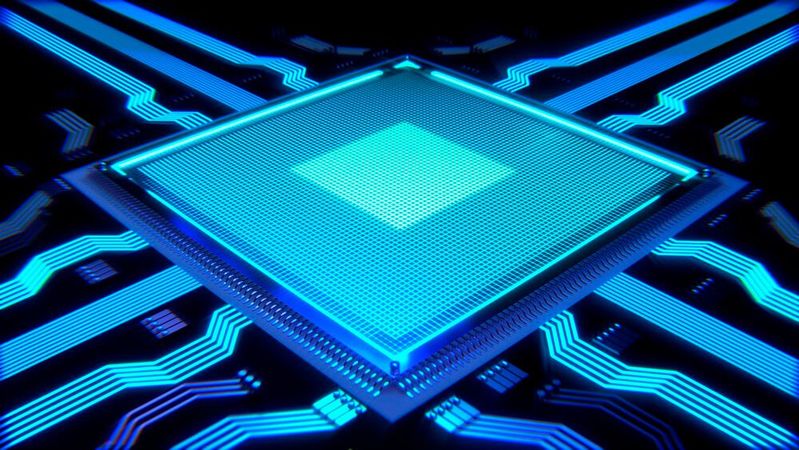
:quality(80)/p7i.vogel.de/wcms/6a/b2/6ab286e245bf720f08d43d14621def42/0117334644.jpeg "With the Blackwell AI chip, Nvidia aims to usher in the next generation of artificial intelligence. (Image:Nvidia)")
:quality(80)/p7i.vogel.de/wcms/5c/6b/5c6b52f55eced3f21a82b49b4d29972c/0129641027v1.jpeg "Bytedance has popularized the short video format with the TikTok app, among other things. AI is used in many of the Group's products. (Image:Bytedance)")
:quality(80)/p7i.vogel.de/wcms/cc/de/ccde430f4429d51c9ede08bbc1644c41/0128808423v1.jpeg "Memory technologies: A symbolic image. (Image:Dall-E / AI-generated)")