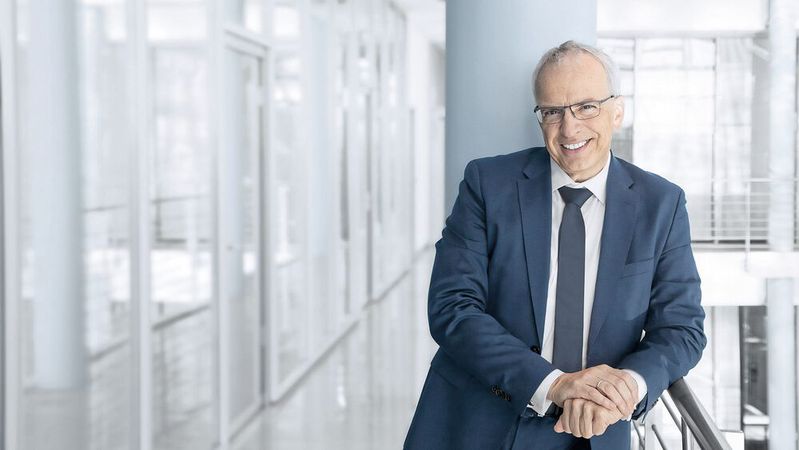
Current AI applications allow pneumatic systems to be optimized and monitored with AI, even without deep specialist knowledge of artificial intelligence, explains Festo digitization expert Eberhard Klotz.
Eberhard Klotz is a longtime Global Sales Director for Industry 4.0/Digitalisation at Festo.
(Image: Festo)
Under the term "Automation Experience," Festo offers various AI tools. What can users do with them?
Eberhard Klotz: There are three main focuses: the prediction of component or machine failure, quality approaches, meaning whether the machine or plant will still produce the required quality tomorrow, and energy topics: if, for example, an energy profile drifts away, maintenance is informed or error patterns are derived.
Our solution is special because, as Festo, we come from mechanics and mechatronics, and therefore naturally bring extensive experience with wear parts and motion profiles of machines and systems. Together with the software, we offer much better value creation than a software company or start-up with little production experience can.
Are there cases that can be predicted well or less well with AI?
These algorithms are always particularly effective in rapidly recurring and fast-running processes. Then I have typical behavior patterns of good states, as well as errors with a certain frequency, and that’s what these algorithms need. Because these applications work based on statistical probability. For applications that run very slowly and where an error pattern only occurs every seven years, these algorithms are not suitable.
To train and deploy AI for these use cases, a lot of data is needed. Where does Festo get this information from?
We have our own manufacturing facility where we can collect data. And: We have been conducting our own tests in trials for decades, where we could learn everything relevant from the data. This means that our standard AI apps come with a wealth of prior knowledge, and the algorithms are pre-trained. However, in customer projects, the basic rule is that the data remains the property of the customer: On-site, only the good state of the real application/control chain is briefly trained.
We started working on AI projects more than ten years ago. By now, we have so much experience and over 100 successful customer projects behind us that we can offer small algorithms encapsulated in so-called Docker containers. This means the customer no longer needs an AI specialist but can download this app from the app store and simply commission it themselves.
A machine builder can also realize new business models with it, with the advantage that they don't have to hire an AI specialist or develop the software, but simply use an app and offer, for example, a digital maintenance service. Their customer has the option to book the service or not—as they wish.
What about existing plants?
This solution is suitable for all customers who currently have no solution to monitor pneumatics.
But in which cases is it also sensible?
The classic PLC only checks whether the cylinder has arrived at the front or not. Pneumatics is inherently a very robust and reliable technology. Therefore, many customers have the mindset that you install pneumatics and forget about it because you don't need to worry about it. Nevertheless, there are applications that cause more wear and tear because the environmental conditions are so demanding, such as welding, cement dust in the air, or high heat. Such factors can lead to higher wear, and for all those customers, there is the possibility to monitor the system or machine with AI to avoid unplanned downtime.
Another application case relates to demographic change: when experienced employees retire, it is often a problem to fill the position. And know-how is lost. Anomaly detection by AI offers the possibility to replace some of this employee experience.
What has your experience been so far?
Our experience from the past ten years is that customers who have used these apps have all been successful. For example, maintenance improved by 20 to 25 percent in terms of less unplanned downtime and reduced repair times because I can read from the diagnostic messages what is broken. And as an operator, I don't have to search for the damage first; instead, I can see beforehand when a cylinder or an electric axis is drifting away.
Date: 08.12.2025
Naturally, we always handle your personal data responsibly. Any personal data we receive from you is processed in accordance with applicable data protection legislation. For detailed information please see our privacy policy.
Consent to the use of data for promotional purposes
I hereby consent to Vogel Communications Group GmbH & Co. KG, Max-Planck-Str. 7-9, 97082 Würzburg including any affiliated companies according to §§ 15 et seq. AktG (hereafter: Vogel Communications Group) using my e-mail address to send editorial newsletters. A list of all affiliated companies can be found here
Newsletter content may include all products and services of any companies mentioned above, including for example specialist journals and books, events and fairs as well as event-related products and services, print and digital media offers and services such as additional (editorial) newsletters, raffles, lead campaigns, market research both online and offline, specialist webportals and e-learning offers. In case my personal telephone number has also been collected, it may be used for offers of aforementioned products, for services of the companies mentioned above, and market research purposes.
Additionally, my consent also includes the processing of my email address and telephone number for data matching for marketing purposes with select advertising partners such as LinkedIn, Google, and Meta. For this, Vogel Communications Group may transmit said data in hashed form to the advertising partners who then use said data to determine whether I am also a member of the mentioned advertising partner portals. Vogel Communications Group uses this feature for the purposes of re-targeting (up-selling, cross-selling, and customer loyalty), generating so-called look-alike audiences for acquisition of new customers, and as basis for exclusion for on-going advertising campaigns. Further information can be found in section “data matching for marketing purposes”.
In case I access protected data on Internet portals of Vogel Communications Group including any affiliated companies according to §§ 15 et seq. AktG, I need to provide further data in order to register for the access to such content. In return for this free access to editorial content, my data may be used in accordance with this consent for the purposes stated here. This does not apply to data matching for marketing purposes.
Right of revocation
I understand that I can revoke my consent at will. My revocation does not change the lawfulness of data processing that was conducted based on my consent leading up to my revocation. One option to declare my revocation is to use the contact form found at https://contact.vogel.de. In case I no longer wish to receive certain newsletters, I have subscribed to, I can also click on the unsubscribe link included at the end of a newsletter. Further information regarding my right of revocation and the implementation of it as well as the consequences of my revocation can be found in the data protection declaration, section editorial newsletter.
Do additional sensors need to be installed?
Take a pneumatic cylinder as an example: To use the app, certain standards must be met, such as needing two end switches. From their signals, position and acceleration data are derived. If a customer wants more precision, additional data, such as compressed air flow profiles, can be used.
How is Festo planning to proceed in the AI field?
With the AI apps, we reached a turning point and are now moving from project business to mass business. We believe that the AI apps will be worthwhile for a very, very large number of customers.
The next steps are to add other AI areas, for example, to make robots more flexible. Assistance systems to guide machines are also a large field of work from our perspective. It would also be interesting to monitor larger manufacturing processes with AI. (jv)
Eberhard Klotz
He first completed a degree in communications engineering and continued his academic education with a European Executive MBA at Henley Management College and the University of West London. His career path led him to Siemens and Bosch, among others. He has been with Festo since 1990. Klotz is now Global Sales Director for Industry 4.0 and Digitalization.



:quality(80)/p7i.vogel.de/wcms/eb/2b/eb2bd1b8487afe577b37363cd02f16ff/0113143253v1.jpeg "In our China Market Insider, we regularly provide you with relevant information straight from China. (Image:© Eisenhans - stock.adobe.com)")
:quality(80)/p7i.vogel.de/wcms/dd/b8/ddb8edc98c49b384734ab2432b297eb5/adobestock-1913662309--irene-stock-adobe-com-ki-generiertv1.jpeg "Rotary joints are used in grippers and swivel mechanisms to allow assemblies to rotate or swivel smoothly relative to one another, even under very high loads (illustrative image). (Source: Irene - stock.adobe.com / KI-generiert)")
:quality(80)/p7i.vogel.de/wcms/d1/ef/d1ef6b6f7d4543f7999980bacccaf22b/0133499261v1.jpeg "As the growing imbalance in trade relations with China continues to widen, the EU Chamber of Commerce foresees a day when trade with China will have to be seriously reevaluated ... (Image: AI-generated)")
:quality(80)/p7i.vogel.de/wcms/fe/1f/fe1fa5ee713f94deaba963dc24c3abc5/0133299273v1.jpeg "The Flexistar enables highly flexible production of laser-welded tubes thanks to its tool-free clamping system. (Image:Because Technology, LLC)")
:quality(80)/p7i.vogel.de/wcms/60/ef/60ef4f07e4829b2c2929befc0f353c58/0133511729v1.jpeg "Humanoid robots can match human performance in certain tasks. (Image:Gemini / AI-generated)")
:quality(80)/p7i.vogel.de/wcms/2e/99/2e99726b522e4b35b690e25eb6a42643/0133463991v1.jpeg "Robotics: In AMR applications, connection technology must reliably transmit power, signals, and data despite vibration and shock loads—in very confined spaces and in a way that allows for regular maintenance. (Image:Hyperever)")
:quality(80)/p7i.vogel.de/wcms/d0/18/d01801e3d5dbd7bc9d0b4f60408b630c/0133468429v1.jpeg "Quality requirements for film packaging are on the rise. At the same time, many companies are turning to recyclable film materials, which, however, have their own challenges. Fraunhofer researchers have therefore developed a fast system that detects problems in real time. (Image:Fraunhofer IKTS)")
:quality(80)/p7i.vogel.de/wcms/b1/06/b106cf44923ce39565c3264982fd20eb/0133414574v1.jpeg "Robots Build Robots: At the new Ubtech factory, automated systems even handle parts of the material supply and logistics for the production of humanoid robots. (Image:Ubtech)")
:quality(80)/p7i.vogel.de/wcms/c0/52/c052f405eb55fc3d08c4837e77206fc0/adobestock-2021845957--aucartstudio-stock-adobe-com-ki-generiertv1.jpeg "An innovation from China to combat extreme summer heat: A novel coating lowers temperatures. (Source: © AucArtStudio – stock.adobe.com_AI-generated)")
:quality(80)/p7i.vogel.de/wcms/66/a7/66a7b78159caeacce57136529688799f/0133503398v1.jpeg "Sunlight Makes Stone! These stone blocks weren't made the traditional way. Instead, they were additively manufactured from sand using a laser. In the future, however, the laser is set to be replaced by concentrated sunlight—if the startup Addisol is successful... (Image:Addisol / F. Fiedler)")
:quality(80)/p7i.vogel.de/wcms/72/b9/72b995c2c8d812c5e2115cbef31e035a/0133462727v1.jpeg "Eggl manufactures center hoods that are precisely tailored to each cooking island—whether standard size or custom shape. They are made entirely of stainless steel and are individually customized in terms of size and filter arrangement. (Image:SPI)")
:quality(80)/p7i.vogel.de/wcms/13/5d/135dfae6229ceaf5c55467a43e8f7257/adobestock-1879961393--ardi-stock-adobe-com-ki-generiertv1.jpeg "Annoying chatterboxes or awkward silences in response to questions—a moderator should specifically prepare for difficult situations in order to navigate them effectively. (Image:ardi - stock.adobe.com_AI-generated)")
:quality(80)/p7i.vogel.de/wcms/aa/a2/aaa2c6dd2daa24b485cddbf9297590c0/0133467318v1.jpeg "Battery Monitoring: Battery monitoring using electrochemical impedance spectroscopy offers several advantages. (Image:TI)")
:quality(80)/p7i.vogel.de/wcms/39/b2/39b21bf03be1683831862239a369987c/0133469638v1.jpeg "Data from autonomous vehicles and robots operating autonomously is in high demand, and Ruqi wants to capitalize on this. (Image:Ruqi Mobility)")
:quality(80)/p7i.vogel.de/wcms/8a/bb/8abbb6217220595edc1549ac9b84f307/0133429906v1.jpeg "The IAA in Hanover showcased the ambitions of Chinese commercial vehicle manufacturers in Europe. (Image:Wehner - VCG)")
:quality(80)/p7i.vogel.de/wcms/0c/53/0c5313ef91c14b6df0d0996efc33c8ad/jpg03568-bearbeitetv1.jpeg "The category winners of the 2027 German Car of the Year award. (Source: GCOTY)")
:quality(80)/p7i.vogel.de/wcms/28/28/2828c5261714321afb0bab67bf771823/0133353387v1.jpeg "The 130-meter-long China Zorrilla draws its power from a battery system with a capacity of more than 40 MWh. Eight electric motors drive an equal number of water jets. (Image:Incat Australia Pty Ltd)")
:quality(80)/p7i.vogel.de/wcms/48/15/4815da27c45973ca629a99b375ac3aef/0133509585v1.jpeg "Ventuno Q RoadTest: Designed to help the Element14 community gain practical insights from real-world tests using the Ventuno Q. (Image:Farnell/Element14)")
:quality(80)/p7i.vogel.de/wcms/17/2b/172bd132f9febdfcbcedba292ad0504d/aufmacherv1.jpeg "Micro-Epsilon offers a wide range of IO-Link-compatible sensors. (Source: Micro-Epsilon Messtechnik GmbH & Co. KG)")
:quality(80)/p7i.vogel.de/wcms/ca/b4/cab46fd26d19d6a2febca032048200b6/0133471827v1.jpeg "Photonics SDK for C and Python: Computational operations are now abstracted as standard mathematical functions. (Image:Q.ANT)")
:fill(fff,0)/images.vogel.de/vogelonline/companyimg/76800/76895/65.jpg "FAULHABER_120mm.jpg ()")
:fill(fff,0)/p7i.vogel.de/companies/69/88/69882c428938e/tmts2026-ticec-banner-en-2000px.png "tmts2026-ticec-banner-en-2000px (https://www.tmts.tw/en)")
:fill(fff,0)/p7i.vogel.de/companies/69/de/69de1b7403b0d/simtos-logo.jpeg "simtos-logo (SIMTOS)")
:quality(80)/p7i.vogel.de/wcms/b3/22/b32228ff13056ec8422931a4f6c69ad0/0130672660v1.jpeg "0130672660v1 (Image:Stefanie Michel)")
:quality(80)/p7i.vogel.de/wcms/51/80/5180c4de993e1b059628f21fcb09237d/0132213451v1.jpeg "On the granite plate (top) stands a machine or testing system that is to be decoupled from vibrations. The inductive distance sensor (middle) continuously measures the distance to the granite plate (the target is a fixed steel disc). Supplied with these values, the controller quickly and precisely adjusts the level of the air spring (right). (Image: Baumer)")