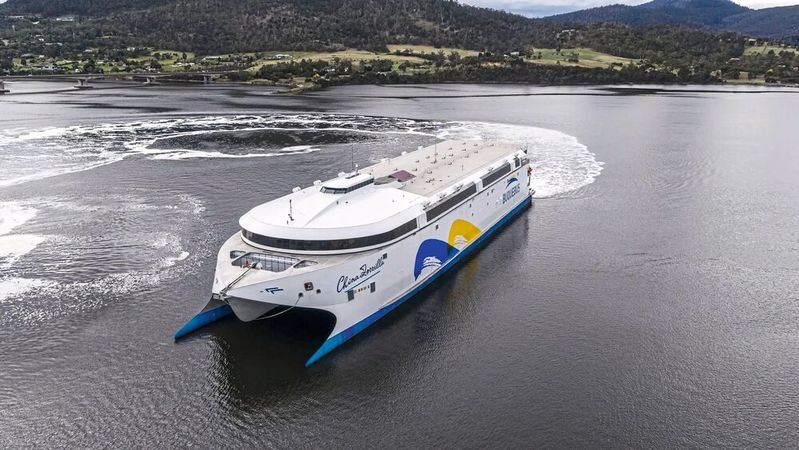
The Australian shipyard Incat has built a 130-meter-long electric vessel for the South American ferry operator Buquebus. Named after the Uruguayan actress China Zorrilla, the ferry combines a battery storage system with a capacity of more than 40 megawatt-hours with eight electric waterjet propulsion systems.
The 130-meter-long China Zorrilla draws its power from a battery system with a capacity of more than 40 MWh. Eight electric motors drive an equal number of water jets.
(Image: Incat Australia Pty Ltd)
Ships with internal combustion engines pollute their surroundings with more than just carbon dioxide. Nitrogen oxides, sulfur oxides, and particulate matter are released directly into the air in areas where people live or where sensitive ecosystems are to be protected. This problem is particularly evident in Norwegian fjords: high rock faces and weather conditions with little air exchange can cause the exhaust fumes from large passenger ships to linger in the valley for extended periods of time.
Norway has therefore established emissions standards for its World Heritage fjords. Starting in early 2026, zero-emissions requirements will initially apply to passenger ships under 10,000 GT (gross tonnage). For larger ships, the regulation will take effect in 2032. The fjords affected are the Nærøyfjord, Aurlandsfjord, Geirangerfjord, Sunnylvsfjord, and Tafjord. According to the Norwegian government, the regulations are intended not only to protect the fjords but also to accelerate the development of appropriate marine technology. Where available, shore power must also be used. As an alternative to fully zero-emission propulsion systems, the regulations permit the use of biogas under certain conditions.
A power plant-scale battery system
The China Zorrilla, built for the operator Buquebus, demonstrates the scale that battery-electric ships can now achieve. The 130-meter-long aluminum catamaran is designed to carry up to 2,100 passengers, including crew, as well as 225 cars between Colonia del Sacramento in Uruguay and Buenos Aires. In September 2026, the ship arrived in Uruguay after being transported to South America on the semi-submersible vessel Black Marlin from the Incat shipyard in Hobart, Australia. The crossing of the Pacific Ocean was therefore not made using the ship’s own electric propulsion system.
The energy storage system provides more than 40 MWh. By way of comparison, that is equivalent to the battery capacity of about 500 electric cars, each with a capacity of 80 kWh. According to the shipyard, the batteries together weigh more than 250 metric tons. This results in a rough energy density for the entire installed system of no more than 160 Wh/kg. However, in addition to the cells, this weight also includes housings, electrical connections, cooling systems, and safety equipment.
The batteries are manufactured by Corvus Energy and are part of the Dolphin NxtGen series. This series was specifically developed for applications in which gravimetric and volumetric energy density play a more significant role than on slow-moving, short-distance ferries. Corvus describes the system as the largest battery system ever installed on a ship. The classification of the China Zorrilla as the “world’s largest electric ship” is also based on manufacturer specifications and refers to battery-electric ships. There is no independent global ranking.
Eight powertrains distribute the power
Wärtsilä supplies not only individual components, but also the majority of the electric propulsion system. The system includes the battery modules, the energy management system, the power converters, the DC distribution system, eight electric motors, and the propulsion control system. Each motor drives a WXJ1100 axial water jet.
The configuration with eight propulsion systems differs significantly from a conventional solution with just a few large main engines. It distributes power across multiple propulsion units and allows for a layout tailored to the catamaran hull. At the same time, this increases the number of inverters, motors, and cooling circuits that need to be controlled. The energy management system must monitor the battery’s state of charge, distribute the available power, and prevent individual components from exceeding their thermal or electrical limits.
Water jets are particularly well-suited for fast ships with shallow drafts. Since there is no exposed propeller beneath the hull, they are also less prone to grounding. However, it is not yet possible to independently assess whether the unusual eight-jet configuration actually achieves the claimed efficiency gains in real-world operation. There is a lack of publicly available data on engine power, cruising speed, and energy consumption per crossing.
The port will become part of the drive system
From a systems engineering perspective, an electric ferry does not end at the ship’s side. The system includes a grid connection, transformer technology, power electronics, charging cables or automatic connectors, as well as coordination with the schedule. With a storage capacity of 40 MWh, even a charging power of several megawatts cannot be compared to the short charging times of an electric car.
Date: 08.12.2025
Naturally, we always handle your personal data responsibly. Any personal data we receive from you is processed in accordance with applicable data protection legislation. For detailed information please see our privacy policy.
Consent to the use of data for promotional purposes
I hereby consent to Vogel Communications Group GmbH & Co. KG, Max-Planck-Str. 7-9, 97082 Würzburg including any affiliated companies according to §§ 15 et seq. AktG (hereafter: Vogel Communications Group) using my e-mail address to send editorial newsletters. A list of all affiliated companies can be found here
Newsletter content may include all products and services of any companies mentioned above, including for example specialist journals and books, events and fairs as well as event-related products and services, print and digital media offers and services such as additional (editorial) newsletters, raffles, lead campaigns, market research both online and offline, specialist webportals and e-learning offers. In case my personal telephone number has also been collected, it may be used for offers of aforementioned products, for services of the companies mentioned above, and market research purposes.
Additionally, my consent also includes the processing of my email address and telephone number for data matching for marketing purposes with select advertising partners such as LinkedIn, Google, and Meta. For this, Vogel Communications Group may transmit said data in hashed form to the advertising partners who then use said data to determine whether I am also a member of the mentioned advertising partner portals. Vogel Communications Group uses this feature for the purposes of re-targeting (up-selling, cross-selling, and customer loyalty), generating so-called look-alike audiences for acquisition of new customers, and as basis for exclusion for on-going advertising campaigns. Further information can be found in section “data matching for marketing purposes”.
In case I access protected data on Internet portals of Vogel Communications Group including any affiliated companies according to §§ 15 et seq. AktG, I need to provide further data in order to register for the access to such content. In return for this free access to editorial content, my data may be used in accordance with this consent for the purposes stated here. This does not apply to data matching for marketing purposes.
Right of revocation
I understand that I can revoke my consent at will. My revocation does not change the lawfulness of data processing that was conducted based on my consent leading up to my revocation. One option to declare my revocation is to use the contact form found at https://contact.vogel.de. In case I no longer wish to receive certain newsletters, I have subscribed to, I can also click on the unsubscribe link included at the end of a newsletter. Further information regarding my right of revocation and the implementation of it as well as the consequences of my revocation can be found in the data protection declaration, section editorial newsletter.
The port of Colonia is reported to have an electrical connection capacity of 15 MW. If the full power were available to the ship on a continuous basis, a theoretical full charge of 40 MWh would take at least 2 hours and 40 minutes. This does not yet take into account conversion losses or a reduction in power output toward the end of the charging process.
In regular service, however, a full charge is neither necessary nor practical. It is more likely that the vessel will operate within a specified state-of-charge window: During layover, only the energy consumed during the previous voyage is recharged. This reduces the required charging time and can help preserve the battery. This requires that travel time, layover time, energy consumption, and available grid power be precisely coordinated.
This is precisely where the strength of electric ferries lies. They operate on recurring routes between the same ports. Charging infrastructure is therefore needed only at a few specific locations. DNV (the Norwegian classification and inspection society) also points out that, according to the original plan, the China Zorrilla is to be charged at both ends of its route. This would reduce the necessary energy buffer—provided that sufficiently high-capacity charging stations are installed on both the Argentine and Uruguayan sides.
Local zero emissions is more than just climate protection
The electric propulsion system eliminates local exhaust emissions while the vessel is underway. In ports and narrow fjords, this applies not only to CO₂ but especially to nitrogen oxides, sulfur compounds, and soot particles. The carbon footprint, however, depends on how the charging current is generated. If it comes primarily from renewable sources, indirect greenhouse gas emissions also decrease significantly. If the ship is charged with carbon-intensive electricity, part of the emissions is simply shifted from the ship to the power plant.
In addition, electric motors can reduce vibrations and engine noise. At higher speeds, however, flow, water jet, and wave noise persist. Nor do wave impact, interference from port facilities, antifouling coatings, and other environmental impacts of shipping disappear simply by replacing the propulsion system. “Emissions-free” therefore primarily describes operation without direct exhaust emissions—not a ship without any environmental impact whatsoever.
For fjords, however, the local impact is particularly relevant. A large ship does not emit its exhaust gases on the open sea, but in some cases just a few hundred meters away from towns, mountain slopes, and protected areas. A battery-electric propulsion system completely eliminates this source of emissions while the ship is underway. Even a hybrid propulsion system offers this advantage only if the internal combustion engine remains actually shut off while within the protected zone.
Ferries are a realistic starting point
The China Zorrilla does not mean that container ships equipped with massive batteries will also be crossing oceans in the future. The energy density of liquid fuels remains orders of magnitude higher than that of a battery system. As the distance traveled increases, so does the size of the energy storage system, whose mass, in turn, increases the ship’s fuel consumption. This relationship imposes strict limitations on purely battery-electric ocean-going vessels.
The most promising areas of application are therefore, for now, ferries, sightseeing boats, harbor vessels, and other ships with predictable routes. In these applications, operators can limit the required range, recharge frequently, and make intensive use of the infrastructure. Lightweight aluminum hulls, hydrodynamically optimized shapes, and more efficient propulsion systems will be just as important as advances in battery cell technology. Every kilowatt-hour saved reduces storage mass, charging power, and investment costs simultaneously.
For longer distances, hybrid concepts are likely to dominate. Batteries can power the ship during port calls and voyages through protected areas, handle peak loads, and keep internal combustion engines operating at more efficient operating points. Fuel cells, biofuels, methanol, or other energy sources may also be considered as complementary options. Which concept proves most economically and environmentally sound depends more on the route profile than on the size of the ship alone.
The next tests will take place at the plant
The China Zorrilla must demonstrate whether the entire system—comprising the vessel, battery, charging station, and power grid—can support reliable regular service. Published data on usable battery capacity, charging power, crossing time, speed, energy reserve, and actual energy consumption are still lacking. Equally unclear are the aging of the battery system—which has a capacity of more than 40 MWh—and the costs of a future replacement. Only the operational data will reveal how much of the installed capacity is used daily and to what extent high charging rates affect service life and cost-effectiveness.
For fixed connections over short and medium distances, however, this technical approach makes sense. Electric ferries can transport large numbers of passengers while relieving ports, coastal cities, and sensitive natural areas of direct exhaust emissions. Norway’s fjords demonstrate why this benefit goes far beyond simply setting a size record. (mr)



:quality(80)/p7i.vogel.de/wcms/eb/2b/eb2bd1b8487afe577b37363cd02f16ff/0113143253v1.jpeg "In our China Market Insider, we regularly provide you with relevant information straight from China. (Image:© Eisenhans - stock.adobe.com)")
:quality(80)/p7i.vogel.de/wcms/dd/b8/ddb8edc98c49b384734ab2432b297eb5/adobestock-1913662309--irene-stock-adobe-com-ki-generiertv1.jpeg "Rotary joints are used in grippers and swivel mechanisms to allow assemblies to rotate or swivel smoothly relative to one another, even under very high loads (illustrative image). (Source: Irene - stock.adobe.com / KI-generiert)")
:quality(80)/p7i.vogel.de/wcms/d1/ef/d1ef6b6f7d4543f7999980bacccaf22b/0133499261v1.jpeg "As the growing imbalance in trade relations with China continues to widen, the EU Chamber of Commerce foresees a day when trade with China will have to be seriously reevaluated ... (Image: AI-generated)")
:quality(80)/p7i.vogel.de/wcms/fe/1f/fe1fa5ee713f94deaba963dc24c3abc5/0133299273v1.jpeg "The Flexistar enables highly flexible production of laser-welded tubes thanks to its tool-free clamping system. (Image:Because Technology, LLC)")
:quality(80)/p7i.vogel.de/wcms/60/ef/60ef4f07e4829b2c2929befc0f353c58/0133511729v1.jpeg "Humanoid robots can match human performance in certain tasks. (Image:Gemini / AI-generated)")
:quality(80)/p7i.vogel.de/wcms/2e/99/2e99726b522e4b35b690e25eb6a42643/0133463991v1.jpeg "Robotics: In AMR applications, connection technology must reliably transmit power, signals, and data despite vibration and shock loads—in very confined spaces and in a way that allows for regular maintenance. (Image:Hyperever)")
:quality(80)/p7i.vogel.de/wcms/d0/18/d01801e3d5dbd7bc9d0b4f60408b630c/0133468429v1.jpeg "Quality requirements for film packaging are on the rise. At the same time, many companies are turning to recyclable film materials, which, however, have their own challenges. Fraunhofer researchers have therefore developed a fast system that detects problems in real time. (Image:Fraunhofer IKTS)")
:quality(80)/p7i.vogel.de/wcms/b1/06/b106cf44923ce39565c3264982fd20eb/0133414574v1.jpeg "Robots Build Robots: At the new Ubtech factory, automated systems even handle parts of the material supply and logistics for the production of humanoid robots. (Image:Ubtech)")
:quality(80)/p7i.vogel.de/wcms/c0/52/c052f405eb55fc3d08c4837e77206fc0/adobestock-2021845957--aucartstudio-stock-adobe-com-ki-generiertv1.jpeg "An innovation from China to combat extreme summer heat: A novel coating lowers temperatures. (Source: © AucArtStudio – stock.adobe.com_AI-generated)")
:quality(80)/p7i.vogel.de/wcms/66/a7/66a7b78159caeacce57136529688799f/0133503398v1.jpeg "Sunlight Makes Stone! These stone blocks weren't made the traditional way. Instead, they were additively manufactured from sand using a laser. In the future, however, the laser is set to be replaced by concentrated sunlight—if the startup Addisol is successful... (Image:Addisol / F. Fiedler)")
:quality(80)/p7i.vogel.de/wcms/72/b9/72b995c2c8d812c5e2115cbef31e035a/0133462727v1.jpeg "Eggl manufactures center hoods that are precisely tailored to each cooking island—whether standard size or custom shape. They are made entirely of stainless steel and are individually customized in terms of size and filter arrangement. (Image:SPI)")
:quality(80)/p7i.vogel.de/wcms/13/5d/135dfae6229ceaf5c55467a43e8f7257/adobestock-1879961393--ardi-stock-adobe-com-ki-generiertv1.jpeg "Annoying chatterboxes or awkward silences in response to questions—a moderator should specifically prepare for difficult situations in order to navigate them effectively. (Image:ardi - stock.adobe.com_AI-generated)")
:quality(80)/p7i.vogel.de/wcms/aa/a2/aaa2c6dd2daa24b485cddbf9297590c0/0133467318v1.jpeg "Battery Monitoring: Battery monitoring using electrochemical impedance spectroscopy offers several advantages. (Image:TI)")
:quality(80)/p7i.vogel.de/wcms/39/b2/39b21bf03be1683831862239a369987c/0133469638v1.jpeg "Data from autonomous vehicles and robots operating autonomously is in high demand, and Ruqi wants to capitalize on this. (Image:Ruqi Mobility)")
:quality(80)/p7i.vogel.de/wcms/8a/bb/8abbb6217220595edc1549ac9b84f307/0133429906v1.jpeg "The IAA in Hanover showcased the ambitions of Chinese commercial vehicle manufacturers in Europe. (Image:Wehner - VCG)")
:quality(80)/p7i.vogel.de/wcms/0c/53/0c5313ef91c14b6df0d0996efc33c8ad/jpg03568-bearbeitetv1.jpeg "The category winners of the 2027 German Car of the Year award. (Source: GCOTY)")
:quality(80)/p7i.vogel.de/wcms/28/28/2828c5261714321afb0bab67bf771823/0133353387v1.jpeg "The 130-meter-long China Zorrilla draws its power from a battery system with a capacity of more than 40 MWh. Eight electric motors drive an equal number of water jets. (Image:Incat Australia Pty Ltd)")
:quality(80)/p7i.vogel.de/wcms/48/15/4815da27c45973ca629a99b375ac3aef/0133509585v1.jpeg "Ventuno Q RoadTest: Designed to help the Element14 community gain practical insights from real-world tests using the Ventuno Q. (Image:Farnell/Element14)")
:quality(80)/p7i.vogel.de/wcms/17/2b/172bd132f9febdfcbcedba292ad0504d/aufmacherv1.jpeg "Micro-Epsilon offers a wide range of IO-Link-compatible sensors. (Source: Micro-Epsilon Messtechnik GmbH & Co. KG)")
:quality(80)/p7i.vogel.de/wcms/ca/b4/cab46fd26d19d6a2febca032048200b6/0133471827v1.jpeg "Photonics SDK for C and Python: Computational operations are now abstracted as standard mathematical functions. (Image:Q.ANT)")
:fill(fff,0)/images.vogel.de/vogelonline/companyimg/76800/76895/65.jpg "FAULHABER_120mm.jpg ()")
:quality(80)/p7i.vogel.de/wcms/b0/95/b09529a8952b5b03f1fa096af571967c/0129618836v1.jpeg "The Aurora Botnia ferry currently has the largest battery capacity of any RoPax ship in the world. (Image:Wasaline)")
:quality(80)/p7i.vogel.de/wcms/53/ef/53ef65b954ddefadb2956dea1ca24369/bild1-deutz-agritechnica-4047x2275v1v1.jpeg "Telehandlers are pioneers in the application of electric drives. Pictured here: a Magni telehandler with a Deutz battery. (Image:Deutz AG)")