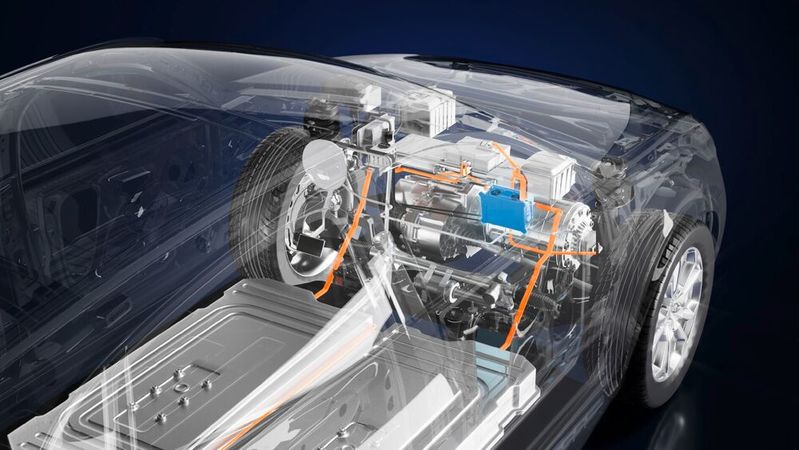
The electric drivetrain plays a central role in the ongoing transformation of the automotive industry. High precision in measurement and analysis tasks is crucial for improving performance, range, efficiency and reliability.
Electrical drive trains require a multidimensional concept of performance characterization. Rohde & Schwarz has developed the MXO 3 oscilloscope series for this purpose.
(Image: Rohde & Schwarz)
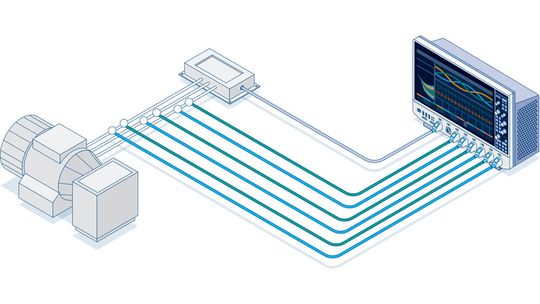
The electrification trend in the automotive industry brings with it several new challenges in powertrain optimization: from controlling power conversion and efficiency to validating motor control algorithms, mitigating electromagnetic interference (EMI) and ensuring error-free digital communication for battery management. Modern multi-channel oscilloscopes (Fig. 1) and in particular the MXO series from Rohde & Schwarz are proving to be indispensable for engineers who want to optimize these systems with the help of comprehensive and precise measurement functions.
Figure 1: Oscilloscopes support multi-channel measurements of transient measurement curves for analyzing drivetrain behavior
(Image: Rohde & Schwarz)
Electric drivetrains require a multi-dimensional approach to performance characterization. This includes voltage and current waveform analysis, pulse response evaluation, motor control validation and harmonic distortion mitigation. By thoroughly understanding the behavior of a powertrain under a wide range of operating conditions, engineers can ensure seamless integration and optimal functionality.
The analysis of voltage and current measurement curves plays an important role in optimizing power conversion efficiency. Engineers analyze the voltage and current at critical points within the powertrain to determine the efficiency and power factor of the various conversion stages and identify potential for improvement. Another key aspect of powertrain optimization is the validation of motor control. Precise motor control is crucial for responsive and efficient operation of the electric powertrain. Engineers must validate motor control algorithms to ensure that reliably predictable behavior is achieved according to the control inputs. This validation process requires precise measurement of both current and voltage waveforms as well as evaluation of the motor control system's response behavior.
Transient analysis helps to understand how the powertrain reacts to sudden changes in load or power conditions and can identify potential weak points that require further optimization. Furthermore, reducing harmonic distortion is crucial for high power quality and long-term drivetrain reliability. Harmonics in electrical systems can affect power quality. Their reduction therefore plays an important role in overall performance.
Rohde & Schwarz MXO series oscilloscopes make it easy to tackle the complexity of optimizing electrical powertrains. Unlike traditional power analyzers, whose domain is essentially static measurements, oscilloscopes provide dynamic insight into time-varying behavior. This capability is critical for analyzing the real-world performance of an electric powertrain, capturing short-term effects in real time and cross-correlating signal anomalies in different domains using the device's eight channels.
The new oscilloscopes are designed for processing the complex signal details of electrical drive trains. With a vertical resolution of 18 bit in high-definition (HD) mode and an acquisition rate of up to 4.5 million waveforms per second, they support precise and accurate waveform analysis. This level of detail is crucial for analysing behaviour in the time and frequency domain and helps engineers to effectively diagnose and optimize complex drive systems.
Records Over Long Periods of Time
The new oscilloscope from Rohde & Schwarz is perfect for this application. In addition to a high acquisition rate and precise HD resolution, the MXO 3 series offers an eight-channel input with a long recording length of 125 million sampling points per channel as standard. These features are ideal for simultaneous voltage and current measurements across three phases (Fig. 2).
Figure 2: Three-phase signals are often very noisy. With its eight channels, the MXO supports three voltage and three current measurements. The two remaining channels are available for monitoring the PWM controller and recording mechanical sensor signals.
(Image: Rohde & Schwarz)
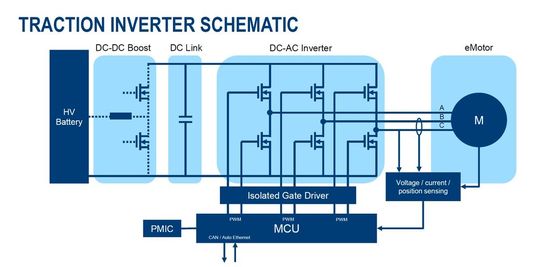
This is particularly important for the analysis of three-phase inverters that drive electric motors (Figure 3), as it enables a holistic view of the gate switching behavior of the inverter and its influence on motor performance. Thanks to the large memory depth across several channels, the device enables high sampling rates even for recordings over long periods of time. This capability is particularly valuable for analyzing the typically long response times of electrical drive trains, as engineers can record and evaluate detailed measurement curve data over longer time axes. This allows anomalies or inefficiencies to be identified that might not have been detected with shorter recording lengths.
Date: 08.12.2025
Naturally, we always handle your personal data responsibly. Any personal data we receive from you is processed in accordance with applicable data protection legislation. For detailed information please see our privacy policy.
Consent to the use of data for promotional purposes
I hereby consent to Vogel Communications Group GmbH & Co. KG, Max-Planck-Str. 7-9, 97082 Würzburg including any affiliated companies according to §§ 15 et seq. AktG (hereafter: Vogel Communications Group) using my e-mail address to send editorial newsletters. A list of all affiliated companies can be found here
Newsletter content may include all products and services of any companies mentioned above, including for example specialist journals and books, events and fairs as well as event-related products and services, print and digital media offers and services such as additional (editorial) newsletters, raffles, lead campaigns, market research both online and offline, specialist webportals and e-learning offers. In case my personal telephone number has also been collected, it may be used for offers of aforementioned products, for services of the companies mentioned above, and market research purposes.
Additionally, my consent also includes the processing of my email address and telephone number for data matching for marketing purposes with select advertising partners such as LinkedIn, Google, and Meta. For this, Vogel Communications Group may transmit said data in hashed form to the advertising partners who then use said data to determine whether I am also a member of the mentioned advertising partner portals. Vogel Communications Group uses this feature for the purposes of re-targeting (up-selling, cross-selling, and customer loyalty), generating so-called look-alike audiences for acquisition of new customers, and as basis for exclusion for on-going advertising campaigns. Further information can be found in section “data matching for marketing purposes”.
In case I access protected data on Internet portals of Vogel Communications Group including any affiliated companies according to §§ 15 et seq. AktG, I need to provide further data in order to register for the access to such content. In return for this free access to editorial content, my data may be used in accordance with this consent for the purposes stated here. This does not apply to data matching for marketing purposes.
Right of revocation
I understand that I can revoke my consent at will. My revocation does not change the lawfulness of data processing that was conducted based on my consent leading up to my revocation. One option to declare my revocation is to use the contact form found at https://contact.vogel.de. In case I no longer wish to receive certain newsletters, I have subscribed to, I can also click on the unsubscribe link included at the end of a newsletter. Further information regarding my right of revocation and the implementation of it as well as the consequences of my revocation can be found in the data protection declaration, section editorial newsletter.
Figure 3: Simplified block diagram of a generic three-phase drive inverter, illustrating the complexity of gate control via MCU.
(Image: Rohde & Schwarz)
The fast Fourier transform (FFT) for spectrum analysis is another essential function for optimizing electrical powertrains. The MXO 3's hardware-accelerated processor analyzes more than 40,000 FFTs per second, enabling rapid identification of EMI problems and measurement of harmonics. This data is important for the development of effective filtering and shielding concepts to reduce electromagnetic interference, especially when using wide-bandgap technologies such as silicon carbide transistors, which enable faster switching processes but also have an increased EMI potential.
Thanks to the ASIC (MXO-EP) implemented in the hardware, the oscilloscope also offers a digital trigger system with very high sensitivity (up to 0.0001 of a vertical subdivision). This makes it possible to detect extremely small interference peaks and anomalies in transistor gate operation. This precision is crucial to ensure sufficient dead times between switching operations in inverter circuits and to avoid conditions such as shoot-through events, where high-side and low-side gates are unintentionally conducting simultaneously. The standard zone triggering also makes it particularly easy to set up trigger conditions. A zone is defined directly on the touchscreen. If a measurement curve passes through this area, a trigger event is triggered.
While the MXO 5 series also offers an eight-channel architecture as well as higher bandwidth options of up to 2 GHz and even more powerful signal processing—ideal for demanding analyses for debugging motor drives—the MXO 3 series is characterized by its compact design. It can easily be positioned in the immediate vicinity of the test object and is even suitable for measurements in the field.
Optimize Inverter Drive Control
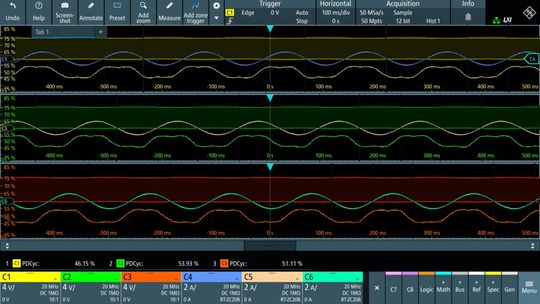
One of the central optimization tasks in electric drivetrains is the conversion of the battery's DC voltage into an AC voltage suitable for the motor using an inverter. The performance of the inverter depends largely on the timing behavior and the switching processes of the totem pole gates, which are controlled by means of pulse width modulation (PWM). Correct analysis of the switching logic and timing across all three phases is crucial for high efficiency and optimum drive performance. The MXO oscilloscopes support this analysis with tools for the time and frequency domain. The digital trigger and the zone trigger help to detect interference peaks in gate signals, while the HD resolution enables precise observation of the finest measurement curve details. The tracking function for standard measurements visualizes the pulse widths measured over the entire acquisition period as a time-dependent measurement line (track waveform) and thus provides deeper insights into the PWM behaviour (Fig. 4).
Figure 4: MXO 3 series oscilloscope with channels C1, C2 and C3 at the inverter voltage outputs to the motor. T1, T2 and T3 are each the track waveform of the voltage pulse width. Thanks to the MXO 3's deep memory, the motor's start-up behavior, which lasts several seconds, can also be observed.
(Image: Rohde & Schwarz)
With the MXO, users can activate as many track waveforms as automated measurements are available. In addition, the FFT functions are indispensable for analyzing the spectral content of PWM signals. They support engineers in the development of control algorithms that minimize switching losses and electromagnetic interference.
The switch from IGBTs to wide-bandgap transistors, such as those based on silicon carbide (SiC), is motivated by higher switching speeds and lower conduction losses. However, this change brings with it new challenges, particularly with regard to interference emissions and reliable gate control. The fast FFT analyses and the highly sensitive digital trigger of the MXO oscilloscopes are decisive aids in this context (Fig. 5).
Figure 5: MXO series oscilloscopes can use mask tests or zone triggers to isolate events within a trace. The track function visualizes the PWM pulse width in trace T1 (purple).
(Image: Rohde & Schwarz)
They make it possible to identify EMI problems resulting from faster switching transients and shoot-through events due to insufficient dead time control. By visualizing the entire switching process, designs can be refined to achieve maximum efficiency and stability. (se)
Choong Cheong Wong is R&D Software Engineer at Rohde & Schwarz Asia



:quality(80)/p7i.vogel.de/wcms/17/b8/17b8af0cb725e0e1d3e8d72458bab260/siemens-meet-at-the-machinev1.jpeg "“Meet at the Machine” is Siemens’ new initiative, which aims to bring together machine builders, software, and automation technologies to accelerate innovation in the machine tool industry and help manufacturers become productive more quickly. (Source: Siemens)")
:quality(80)/p7i.vogel.de/wcms/8e/7e/8e7e0cda4c68699bcc48283a38739769/0133316747v1.jpeg "A little-known hidden champion! When people think of laser cutting, the first thing that comes to mind is the power of the laser beam—and it is impressive to see the sparks flying. But Air Liquide—an exhibitor at Euroblech, by the way—wants to make it clear that the process gas is also key to success. (Image:AI-generated)")
:quality(80)/p7i.vogel.de/wcms/20/fa/20fa35e0af203c3464f7e7fdbb57a685/0133281172v1.jpeg "Since 2003, Etzinger AG has been developing and manufacturing high-quality coffee grinders, pepper mills, and grinding mechanisms for professional and home use. (Image:Etzinger)")
:quality(80)/p7i.vogel.de/wcms/69/91/6991413943488b4a2f6fde9dcd88c5b0/0133256686v1.jpeg "The CMA-patented pendulum mount can compensate for radial tolerances of up to one millimeter. (Image:Schwiening)")
:quality(80)/p7i.vogel.de/wcms/38/79/38799bfbbccd938b64c67068cfa68780/0133329362v1.jpeg "What exactly enables machines to act on their own? (Image:Shutterstock)")
:quality(80)/p7i.vogel.de/wcms/1b/9f/1b9fc9f113fc66212e2c0e17a3edaf9f/org-blobs-user-response-file-output-f317796f-57b7-483f-9403-5d9ac8a816f5-plugin-output-call-kdigtepb7be7us8xvbota0mh-1672x940v1.png "According to Barclays data, Europe leads the global trade in actuator components. With a 34 percent share, the region ranks ahead of China, which has a 26.3 percent share. (Source: Statista | CC BY-ND 4.0, AI-generated)")
:quality(80)/p7i.vogel.de/wcms/f5/4c/f54c9fc59ccb0604ab9219188469a45f/image1v1.jpeg "Christopher Savoia, Global Head of the UR+ Ecosystem at Universal Robots, presents the new SP7 Smart Panel on a UR17g-1300 robot during the unveiling of Gen 7—UR’s 7th-generation robot platform—at IMTS in Chicago on September 14, 2026. (Image:Image: Teradyne Robotics)")
:quality(80)/p7i.vogel.de/wcms/bd/4e/bd4ef09ab0f84932ea76ca0330ffe789/0133329802v1.jpeg "The robotics boom and its consequences: According to a study, a significant portion of value creation occurs in the electronics industry. (Image:Fraunhofer IPA)")
:quality(80)/p7i.vogel.de/wcms/87/87/87870cf2b30aaef7b8a06212a4ef2c14/0133403885v1.jpeg "A digital twin and a real component demonstrate how closely simulation and manufacturing are converging. Stampack Xpress 2026.1 virtually models forming behavior and supports the validation of process and tool design. (Image:Stampack)")
:quality(80)/p7i.vogel.de/wcms/59/2a/592a7f2d0964e9e6846cae331f5daa3a/0133266065v1.jpeg "Perforated metal sheets are particularly well-suited for balcony railings, as they combine stability, privacy, and design versatility. (Image:Ripo Factory)")
:quality(80)/p7i.vogel.de/wcms/45/64/45642ff0fe0a6bec251b77739131d83b/abb-ferrari-hypersail-16-9-three-quarter-front-viewv1.jpeg "The Ferrari Hypersail is a 100-foot monohull wing-in-plane yacht powered entirely by renewable energy. (Source: ABB / Ferrari Hypersail)")
:quality(80)/p7i.vogel.de/wcms/3e/0e/3e0e3ea22e48410ceada53b02ffccb59/0133358454v1.jpeg "BYD top executive Stella Li plans to offer megawatt flash charging for commercial vehicles as well. (Image:VDA/IAA Transportation 2026)")
:quality(80)/p7i.vogel.de/wcms/e2/7d/e27de60472809cc58ac0d321066c9679/l1051833v1.jpeg "Geely has acquired a stake of just over 26 percent in Renault do Brasil. Geely models for the South American market are now also being produced at the Ayrton Senna plant in São José dos Pinhais. (Image:Renault)")
:quality(80)/p7i.vogel.de/wcms/1e/c1/1ec1495eb283200f4b7cb55de0c4dff7/20260917-110436643v1.jpeg "Ceremonial launch of Mercedes-Benz GLA production in Rastatt; among those in attendance was plant manager Marco Zwick (second from the right). (Source: Thomas Günnel – Automotive Industry)")
:quality(80)/p7i.vogel.de/wcms/76/f3/76f310eed0caebc79ff91195c29de08d/visual-siwa-treatment-optimizerv1.jpeg "A Mireo train from Siemens Mobility was used in the “Automated Train” project for a fully automated delivery and return trip on the open rail network. (Source: Siemens Mobility)")
:quality(80)/p7i.vogel.de/wcms/4c/53/4c534208d09a9b1ce597938715e7fc19/0133288763v1.jpeg "Logic Folding: In its latest Kirin 9050 Pro, Huawei uses hybrid bonding to distribute the computing units across two silicon layers in order to increase the effective transistor density without resorting to finer manufacturing processes. (Image:Huawei)")
:quality(80)/p7i.vogel.de/wcms/56/d1/56d131e0b5bd05ef47411e92ad740cb4/0133351029v1.jpeg "Researchers at DTU have developed a nanolaser in a semiconductor membrane. The structure concentrates charge carriers and the light field into a small area (shaded in blue). If data is transmitted on microchips using light instead of electrical signals, transmission speeds can be increased and energy losses reduced. (Image:Yi Yu, DTU)")
:quality(80)/p7i.vogel.de/wcms/5e/55/5e55101ddc6338f755fcf3244db1367f/0133331863v1.jpeg "For data center projects, it is becoming increasingly important to also obtain the consent of the affected community. (Image:Dall-E / AI-generated)")
:quality(80)/p7i.vogel.de/wcms/8d/f9/8df95d3f58408673986b3d643e6b63ba/0133252773v1.jpeg "TXC targets high-speed optical links in AI data centers with 312.5 MHz oscillators, among other solutions. As data rates increase, requirements for jitter and frequency stability become more demanding as well. (Bild: TXC)")
:fill(fff,0)/images.vogel.de/vogelonline/companyimg/76800/76895/65.jpg "FAULHABER_120mm.jpg ()")


:quality(80)/p7i.vogel.de/wcms/ae/ef/aeefd454917c2812921ef0ec7a698c0b/0129906834v1.jpeg "NXP has developed a method of bringing laboratory-quality battery cell diagnostics directly into electric vehicles. (Image:NXP)")
:quality(80)/p7i.vogel.de/wcms/d7/dc/d7dcb6a8e3fbefbf1db738f128108aa6/0130804280v1.jpeg "Zone trigger: When conventional edge or pattern triggers reach their limits, the time has come for the zone trigger. By simply drawing zones on the oscilloscope display, rare anomalies can be isolated with pinpoint accuracy. (Picture:Rohde & Schwarz)")
:quality(80)/p7i.vogel.de/wcms/2a/2f/2a2fc1bb2a6941d1e5c795c047c969ce/0132945015v1.jpeg "Developers at the lab workplace: For WBG-based power converters and highly dynamic loads, precise efficiency and loss analysis require the time-synchronized acquisition of electrical, transient, and thermal parameters. (Image:Yokogawa)")