Manufacturing components using megacasting saves money in production. But what happens when the components need to be repaired?
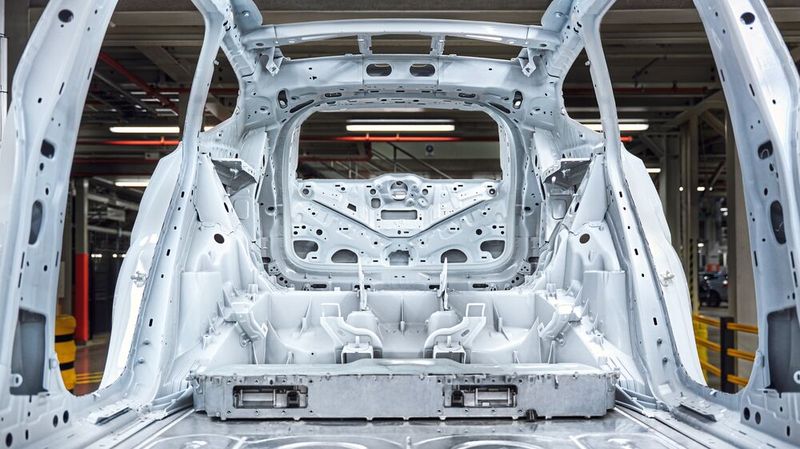
In January 2026, Volvo presented the rear end of the EX 60 model as a structural casting.
(Image: Volvo)
Elon Musk did not invent the electric car—but he was the first to put it into mass production. Nor did he invent the production of ever larger and more integrated components using die casting—this trend is older than the Tesla brand. But he took it to new extremes in the production of the Models 3 and Y, for which he had complete front and rear cars produced "from a single cast" in huge die-casting machines. Perhaps even more importantly, he gave this process a name that was typical of him and sounded as spectacular as possible: Gigacasting.
This has now become established in the industry, although experts such as Sebastian Lüttig, Partner and Director Mobility and Transportation at the management consultancy Schlegel & Partner, prefer to speak of megacasting. "Gigacasting comes mainly from Tesla-speak," explained Lüttig in his presentation at the Würzburg Bodywork and Damage Days on March 20, 2026.
A New Dimension in Aluminum Die Casting
In principle, the process is no different to conventional aluminum die casting—just in a new dimension. According to Sebastian Lüttig, we talk about megacasting when the clamping force of the mold exceeds 6,600 US tons. The greater the clamping force, the larger the parts that can be cast—it's as simple as that.
The largest systems now installed in the automotive industry have even reached 11,000 US tons of clamping force, and larger ones are already being planned. This means that individual parts with a surface area of several square feet can be produced.
One Cast Part Replaces up to 100 Sheet Metal Parts
The appeal of this production method for car manufacturers lies in the integration of parts. Depending on the complexity of the comparative design, a large cast part replaces 70 to 100 components. This not only saves an enormous amount of working time, but also weight, as many material overlaps and joining elements are eliminated. As a result, costs are reduced by 15 to 30 percent compared to a conventionally manufactured assembly, according to Sebastian Lüttig—Tesla is even talking about 40 percent.
And it is indeed to Tesla's credit that its vehicles are significantly lighter than comparable competitor models. The vehicle price is also lower than that of other "Made in Germany" models, although the proportion of body production cannot be precisely quantified.
Advantages of the Process
No wonder that more and more OEMs are now relying on this production technology. Most strongly in China, of course, where several favorable factors come together:
A new vehicle platform has to be designed for the use of large castings—something that Chinese manufacturers are currently doing anyway.
Large quantities are necessary to amortize the high investment costs—Sebastian Lüttig speaks of 300,000 to 500,000 units over the lifetime of the vehicle model.
More Car Manufacturers Use Megacasting
But there are also an increasing number of users in Europe: Volvo, for example, has invested heavily in large casting technology. The traditional Torslanda plant was converted for the start of production of the battery-electric SUV model EX60 and supplemented with two casting systems from the Swiss manufacturer Bühler with a clamping force of 9,300 US tons. These will be used to produce the entire rear end of the EX60 in one piece.
According to Sebastian Lüttig, Volkswagen, Mercedes-Benz and Ford are also driving the process forward, while Nissan and Toyota are building up capacities for this technology in Japan. BMW, on the other hand, continues to rely more on classic steel body construction, such as the current Audi A6. Overall, the expert predicts annual growth of 33 percent in the production of large cast parts.
And How Can this Be Repaired?
But don't these large parts also lead to major problems during body repairs? The repair of accident damage to the body structure has so far been based on the method of cutting out damaged parts and replacing them. But if you have to replace "half the car", won't you reach the limits of cost-effectiveness much more quickly? In other words, are cars with large cast parts ultimately disposable cars that have to be scrapped after every major collision?
This question was addressed by several experts at the "Würzburg Bodywork and Damage Days", an event organized by our colleagues from kfz-betrieb. These included Helge Kiebach, Managing Director of the Institute of Automotive Technology. In his remarks, he referred in particular to the Tesla Model Y—by far the most widely used car to date with one or two large cast parts in the body structure; Tesla also produced the front end of the car using this technology for a certain period of time. However, this part was later replaced by a conventional structure. The reasons for this are unclear.
Date: 08.12.2025
Naturally, we always handle your personal data responsibly. Any personal data we receive from you is processed in accordance with applicable data protection legislation. For detailed information please see our privacy policy.
Consent to the use of data for promotional purposes
I hereby consent to Vogel Communications Group GmbH & Co. KG, Max-Planck-Str. 7-9, 97082 Würzburg including any affiliated companies according to §§ 15 et seq. AktG (hereafter: Vogel Communications Group) using my e-mail address to send editorial newsletters. A list of all affiliated companies can be found here
Newsletter content may include all products and services of any companies mentioned above, including for example specialist journals and books, events and fairs as well as event-related products and services, print and digital media offers and services such as additional (editorial) newsletters, raffles, lead campaigns, market research both online and offline, specialist webportals and e-learning offers. In case my personal telephone number has also been collected, it may be used for offers of aforementioned products, for services of the companies mentioned above, and market research purposes.
Additionally, my consent also includes the processing of my email address and telephone number for data matching for marketing purposes with select advertising partners such as LinkedIn, Google, and Meta. For this, Vogel Communications Group may transmit said data in hashed form to the advertising partners who then use said data to determine whether I am also a member of the mentioned advertising partner portals. Vogel Communications Group uses this feature for the purposes of re-targeting (up-selling, cross-selling, and customer loyalty), generating so-called look-alike audiences for acquisition of new customers, and as basis for exclusion for on-going advertising campaigns. Further information can be found in section “data matching for marketing purposes”.
In case I access protected data on Internet portals of Vogel Communications Group including any affiliated companies according to §§ 15 et seq. AktG, I need to provide further data in order to register for the access to such content. In return for this free access to editorial content, my data may be used in accordance with this consent for the purposes stated here. This does not apply to data matching for marketing purposes.
Right of revocation
I understand that I can revoke my consent at will. My revocation does not change the lawfulness of data processing that was conducted based on my consent leading up to my revocation. One option to declare my revocation is to use the contact form found at https://contact.vogel.de. In case I no longer wish to receive certain newsletters, I have subscribed to, I can also click on the unsubscribe link included at the end of a newsletter. Further information regarding my right of revocation and the implementation of it as well as the consequences of my revocation can be found in the data protection declaration, section editorial newsletter.
Info
The British research institute Thatcham Research carried out crash tests to determine the severity of an accident that would damage a large cast part in a Tesla Model Y to such an extent that it would have to be replaced. According to the Allianz Center for Technology, AZT, which was also involved in the investigation, these tests confirmed that large cast parts would hardly need to be replaced after typical impact constellations and speeds.
This would require a significantly higher crash intensity compared to everyday accidents. In summary, the study by Thatcham and AZT assesses the impact of large castings on insurance claims as low. This is also indicated by the type class of the Tesla Model Y, which, contrary to initial forecasts, is not conspicuous.
Even more surprising may be a Thatcham study published in September 2025, which showed that the repair costs for a Tesla with a megacast rear end are even lower than for a conventionally designed car. "Our research shows that megacasting, when properly implemented with comprehensive repair guidelines, can offer significant benefits for insurers, consumers and the environment," said Richard Billyeald, Chief Research & Operations Officer at Thatcham Research. "Tesla Model Y repair costs have been consistently lower than comparable vehicles with conventional bodywork."
Partial replacements, for example, cost $2,900, around $2,900 at current exchange rates, less than the Model 3's traditional multi-piece steel rear structure, while full replacements save £519, €600. Similar patterns emerged when compared to other manufacturers' vehicles, for example the Mercedes EQE, Hyundai Ioniq 5 and several internal combustion engine vehicles. One of the reasons: Tesla has very inexpensive replacement parts for the rear extensions of the large casting, 31 pounds, $40 each.
Well-Protected Cast Component
"The component in the rear of the Model Y is well protected," reported Helge Kiebach. In other words, it sits deep under the outer skin. "We have hardly found any cases where it has been damaged." It is also possible to repair sections, as Tesla has specifications for this—for example for welding cracks. Damaged sections of the large cast part can also be replaced with repair panels that can be glued and riveted in place.
"It is important," emphasized Kiebach, "to follow the individual guidelines for each vehicle." At Tesla, there are differences in body construction depending on the model year and manufacturing plant, even if the vehicles look the same on the outside. The car manufacturer estimates that it takes 46 hours to completely replace the cast part in the rear. The replacement part costs around $2,000.
Bernd Grüninger, Head of Expert Reports at Dekra, added the experts' empirical values. For example, only in five percent of accidents involving a car of this type are the large cast parts affected at all. And only in 1.5 percent of cases would the cost of the claim actually increase—the latter being a finding of the insurer Allianz.
This means that in many cases, accidents that cause such severe structural damage are not repaired anyway—the vehicle is a total loss.
Some Manufacturers Refuse Repairs
When it comes to ease of repair, it is not possible to draw conclusions about the market as a whole from Tesla or other established manufacturers. Helge Kiebach and Bernd Grüninger referred to vehicle concepts from Asia in which the large cast parts extend directly behind the outer skin or are positioned very close to the wheel.
This can quickly lead to damage to these components, even in the event of moderate accident severity. There are also manufacturers who completely refuse to repair these parts.
Experience With Chinese Manufacturers
In a panel discussion, K&L entrepreneur Peter Vogel shared his experiences of everyday workshop life with Chinese manufacturers: "Some people haven't even thought about how the car should be repaired. Then they say: 'You're the workshop, you must know that'."
Bernd Grüninger from Dekra also points out the difficulties of producing a reliable expert opinion for such vehicles. In any case, experts face additional challenges with large castings. In the event of major damage, a vehicle measurement is mandatory in order to determine whether the large cast part could be damaged. Extensive disassembly work is also necessary for a visual inspection. Crack detection equipment would then also have to be part of the expert's equipment, said Grüninger. Insurers must also learn to accept the additional work involved in assessing damage, added Michael Zierau, Head of Technology at the Central Association of Bodywork and Vehicle Technology.
Ultimately, it is the same as with all other new technologies: reputable and experienced car manufacturers take care of the repairability of their vehicles, and with new and unknown suppliers it becomes difficult—whether with large castings or not.



:quality(80)/p7i.vogel.de/wcms/9e/23/9e23111e49d73012e9e3b7c69428ad5c/0134019347v1.jpeg "The Dominant VA45 high-helix tap from Bass, made of lead-free brass. The long chips, which result from the absence of lead, are clearly visible. (Image:Bass, Inc.)")
:quality(80)/p7i.vogel.de/wcms/1d/09/1d0999956ef87709b72ab1d0402ba207/csf-minis-gruppe-final-01-outputv1.jpeg "Since mid-2026, Harmonic Drive has been offering its CSF Mini gearheads in size 7 as well, in six variants designed for different installation scenarios. (Source: Harmonic Drive)")
:quality(80)/p7i.vogel.de/wcms/ab/08/ab08675922c3a7edea45128248b45b00/0133857009v1.jpeg "In the aerospace industry—one of the most demanding sectors of all—the Shanghai-based company TOPNC has already made a name for itself. (Image:TOPNC)")
:quality(80)/p7i.vogel.de/wcms/ff/48/ff48b1154746e79128935f28bd73ba0e/0113143253v1.jpeg "In our China Market Insider, we regularly provide you with relevant information straight from China. (Image:© Eisenhans - stock.adobe.com)")
:quality(80)/p7i.vogel.de/wcms/6e/bb/6ebb687f573be847aa611b413c6a33b1/0134094461v1.jpeg "From left: Sepp Hochreiter, founder of Nxai and AI researcher, and David Reger, founder and CEO of Neura Robotics, are excited about their collaboration on Physical AI. (Image:Neura)")
:quality(80)/p7i.vogel.de/wcms/89/01/890193a30c52ffd4811d18db82170952/0113143253v1.jpeg "In our China Market Insider, we regularly provide you with relevant information straight from China. (Image:© Eisenhans - stock.adobe.com)")
:quality(80)/p7i.vogel.de/wcms/6b/8a/6b8ac7cd85db2d1d1f6ab30957648711/schaeffler-news-taicanglighthouse6v1.jpeg "At the Lighthouse Factory, robots assemble linear and rotary actuators, among other components. (Source: Schaeffler)")
:quality(80)/p7i.vogel.de/wcms/4f/5a/4f5a2417df55dae5967e90b331e0bbc5/physical-ai-robotics-ariv1.jpeg "With new hardware and software solutions, the productive use of AI in industry is becoming increasingly prominent. (Source: Nvidia)")
:quality(80)/p7i.vogel.de/wcms/c3/68/c368b4f6821557ec497c64bc17fe9f8d/adobestock-2051843806--kaliel-stock-adobe-com-ki-generiertv1.jpeg "To truly harness the full potential of virtual product development, teams and management must radically change their mindset. (Source: © kaliel – stock.adobe.com_AI-generated)")
:quality(80)/p7i.vogel.de/wcms/a3/c1/a3c19e028b66a6fd7c373ab94981631d/paprika-gripperv1.jpeg "For the final, additively manufactured gripper base, SoftGripping chose PA 2200, a material based on polyamide 12 (PA12). It offers balanced mechanical properties and high load-bearing capacity, making it ideal for robust gripper solutions with integrated pneumatics. (Source: SoftGripping GmbH)")
:quality(80)/p7i.vogel.de/wcms/51/b8/51b8e08d2105fdd9952aff385f154192/graphic-2-adma1v1.png "The new surface hardening process enhances the performance of corrosion-resistant alloys by improving their tribological and mechanical surface properties, while preserving the properties of the base material. (Source: Bodycote)")
:quality(80)/p7i.vogel.de/wcms/96/ef/96effc239916cb7e0f396ab75627b8c0/image-space-testingv1.jpeg "Two scientists in front of a vacuum chamber used for testing: As technical instruments for spaceflight become more sensitive, the test facilities are becoming a critical system. (Source: Busch Group)")
:quality(80)/p7i.vogel.de/wcms/4c/61/4c61e3d5582715f2cadafc911480a20a/0132455124v1.jpeg "Mercedes-Benz has announced that it is moving away from its platform-based manufacturing strategy. Management expects a modular design concept to deliver greater benefits... (Image:Mercedes-Benz)")
:quality(80)/p7i.vogel.de/wcms/0d/14/0d14c9be5fc47bc256002ce3df435f21/keb-automation-drive-controller-marinev1.jpeg "Certified for ships, offshore applications, and more: the Combivert F6 Drive Controllers from KEB Automation. (Source: KEB Automation / Miss Irine)")
:quality(80)/p7i.vogel.de/wcms/ba/d3/bad3d62389a59fe3cdbac386a0dce64b/0134098250v1.jpeg "Following initial tests with its robotaxis in Europe, Pony.ai now plans to bring robot trucks to Europe as well. (Image:Pony.ai)")
:quality(80)/p7i.vogel.de/wcms/78/d1/78d124651f6149aa9f33913fc00ef98a/bertrandt-standort-tschechienv1.jpeg "Bertrandt has opened a new facility in the Czech Republic—near Škoda. (Source: Bertrandt)")
:quality(80)/p7i.vogel.de/wcms/27/47/27472d923d2d60f883a5682cb7987558/0134050215v1.jpeg "China's semiconductor industry: At the China International Industry Fair (CIIF) in Shanghai, the chip industry was given its own exhibition area for the first time in 2026. More than 300 companies showcased their technologies and solutions for industrial manufacturing at the “IC Ecosystem Show.” (Image:CIIF)")
:quality(80)/p7i.vogel.de/wcms/bc/20/bc2034a1ba033f00e539d91bcc70e403/bopla-bonext-1-rgbv1.jpeg "A translucent base allows for ambient lighting, either as a design feature or to visually indicate status. (Source: Bopla)")
:quality(80)/p7i.vogel.de/wcms/cd/23/cd239aa506b3ace30e62f44c83fa31ca/0134051508v1.jpeg "Figure 1: Schematic representation of the DAB (Dual Active Bridge) topology. (Image:Texas Instruments)")
:quality(80)/p7i.vogel.de/wcms/8b/35/8b35660420abba32fb891a4c5cc42fbd/0134018092v1.jpeg "Long-range UVC LED with lens and reflector: Close-up of a square LED with a transparent, dome-shaped lens on a dark base plate. The hermetically sealed housing ensures greater reliability and durability under demanding environmental conditions. (Image:FBH_Schurian)")
:fill(fff,0)/images.vogel.de/vogelonline/companyimg/76800/76895/65.jpg "FAULHABER_120mm.jpg ()")
:fill(fff,0)/p7i.vogel.de/companies/69/de/69de1b7403b0d/simtos-logo.jpeg "simtos-logo (SIMTOS)")
:quality(80):fill(efefef,0)/p7i.vogel.de/wcms/67/ad/67adf4a647532/elatec-wp-machine-authentication.png "Elatec WP Machine Authentication")
:quality(80)/p7i.vogel.de/wcms/22/e7/22e7cf0857f827770c2b2a5257e7fa6c/0113143253v1.jpeg "In our China Market Insider, we regularly provide you with relevant information directly from China. (Image:© Eisenhans - stock.adobe.com)")
:quality(80)/p7i.vogel.de/wcms/14/55/14557f745dd068ff945ea0db2fd61a7a/0130985504v1.jpeg "Entering the future: Volvo CEO Håkan Samuelsson drove the first series-production EX60 off the production line himself at the start-of-production event. (Image:Thorsten Weigl/Volvo Cars)")