Mahle has unveiled a range extender for heavy electric trucks ahead of the IAA Transportation. It is designed to increase the range to over 800 kilometers (approx. 500 miles) and facilitate the transition from diesel.
Mahle plans to showcase its system approach for the electrification of heavy commercial vehicles at the IAA Transportation 2026.
(Image: Mahle)
The truck remains the most important means of transportation for goods. It scores points for flexibility, delivers door-to-door, and beats rail in terms of costs—not only in Germany. Its significance is unlikely to diminish. However, road freight transport faces an expensive challenge: it must become more climate-friendly while cost pressures continue to rise.
The sector is responsible for a large share of transportation-related greenhouse gas emissions. Transforming it is no easy task. The industry is increasingly turning to battery-electric trucks—provided they can compete with their diesel counterparts in terms of total operating costs, range, and charging time.
Range on Challenging Routes
The Stuttgart (Germany)-based supplier Mahle aims to make it easier for transport companies to transition from diesel to battery-powered trucks. Ahead of the IAA Transportation, the company presented a new range extender to the press. "Range-extender e-trucks combine the sustainability of electric drives with the flexibility and range of combustion engines. They support the cost-sensitive transport industry in reducing total operating costs over the vehicle's lifecycle and facilitate climate-friendly investments. Furthermore, range-extender BEVs contribute to achieving Europe's CO2 fleet targets," explained Arnd Franz, Chairman of the Group Management Board and CEO of Mahle, at the company's TechDay on July 21, 2026. Under the motto "Electrified. Efficient. Economical.," Mahle will showcase the system from September 15 to 20, 2026, at the IAA Transportation in Hanover—alongside other products aimed at enhancing sustainability and efficiency in transport. The range extender will make its world debut there.
With the new unit on board, a battery-electric truck should be able to handle all daily driving tasks, according to Mahle. Marco Warth, Head of Corporate Development, puts it this way: "Our range extender is an intelligent emergency generator that kicks in at the right moment and significantly increases the range."
At the heart of the system is a high-voltage generator with a continuous output of 110 kW and a peak output of up to 130 kW, driven by a compact combustion engine. It supplies power to the electric drive even on demanding routes and under full load. According to the supplier, its architecture can be adapted to different power requirements and regional markets. Thanks to a newly developed oil cooling system, the generator achieves a power density of more than 7 kW per kilogram—saving weight and simplifying interfaces.
Mahle has designed the range extender as a standalone unit: the generator, combustion engine, thermal and fluid management, fuel tank, AdBlue tank, and exhaust aftertreatment are housed in a compact box. It fits into the standard battery space of an electric truck, allowing integration into existing vehicle platforms without significant effort. The system replaces about one-third of the battery capacity, meaning the truck requires a smaller battery. This saves approximately 400 kilograms of axle load on the rear axle, reducing the vehicle weight by around 600 kilograms. Ultimately, a range-extender BEV truck is expected to achieve a range of over 800 kilometers (approx. 500 miles), according to the company: around 400 kilometers (approx. 250 miles) from the battery and the remaining 400 kilometers from the range extender.
In range-extender operation, the truck emits over 80 percent less CO2 than a conventional drivetrain, according to the company. When the biofuel-capable engine runs on biodiesel HVO100, the truck operates almost CO2-free. A thermal management system with 48 kW high-temperature and 15 kW low-temperature cooling capacity ensures stable operation under heavy-load conditions.
Date: 08.12.2025
Naturally, we always handle your personal data responsibly. Any personal data we receive from you is processed in accordance with applicable data protection legislation. For detailed information please see our privacy policy.
Consent to the use of data for promotional purposes
I hereby consent to Vogel Communications Group GmbH & Co. KG, Max-Planck-Str. 7-9, 97082 Würzburg including any affiliated companies according to §§ 15 et seq. AktG (hereafter: Vogel Communications Group) using my e-mail address to send editorial newsletters. A list of all affiliated companies can be found here
Newsletter content may include all products and services of any companies mentioned above, including for example specialist journals and books, events and fairs as well as event-related products and services, print and digital media offers and services such as additional (editorial) newsletters, raffles, lead campaigns, market research both online and offline, specialist webportals and e-learning offers. In case my personal telephone number has also been collected, it may be used for offers of aforementioned products, for services of the companies mentioned above, and market research purposes.
Additionally, my consent also includes the processing of my email address and telephone number for data matching for marketing purposes with select advertising partners such as LinkedIn, Google, and Meta. For this, Vogel Communications Group may transmit said data in hashed form to the advertising partners who then use said data to determine whether I am also a member of the mentioned advertising partner portals. Vogel Communications Group uses this feature for the purposes of re-targeting (up-selling, cross-selling, and customer loyalty), generating so-called look-alike audiences for acquisition of new customers, and as basis for exclusion for on-going advertising campaigns. Further information can be found in section “data matching for marketing purposes”.
In case I access protected data on Internet portals of Vogel Communications Group including any affiliated companies according to §§ 15 et seq. AktG, I need to provide further data in order to register for the access to such content. In return for this free access to editorial content, my data may be used in accordance with this consent for the purposes stated here. This does not apply to data matching for marketing purposes.
Right of revocation
I understand that I can revoke my consent at will. My revocation does not change the lawfulness of data processing that was conducted based on my consent leading up to my revocation. One option to declare my revocation is to use the contact form found at https://contact.vogel.de. In case I no longer wish to receive certain newsletters, I have subscribed to, I can also click on the unsubscribe link included at the end of a newsletter. Further information regarding my right of revocation and the implementation of it as well as the consequences of my revocation can be found in the data protection declaration, section editorial newsletter.
Revised Engine Components
Mahle has also improved the combustion engine to reduce consumption and operating costs. The new Power Cell Unit (PCU) operates more powerfully, durably, and efficiently. The also-new oil management system—comprising an oil filter, oil cooling, bypass valve, and optional additional functions—is said to reduce material costs by up to 20 percent, the CO2 footprint by up to 50 percent, and weight by up to 25 percent, depending on the housing material, according to the supplier. Additionally, the component is more durable, which reduces total operating costs. Both the PCU and the oil management module are also suitable for other drivetrain types and will debut at the IAA Transportation.
"Our range extender is the key to decoupling the market ramp-up of battery-electric trucks from the insufficient pace of infrastructure development," said Marco Warth at the TechDay. "When the charging station is occupied, weather conditions or traffic jams require alternative routes, when the infrastructure reaches its limits, when other fleets are stranded—an e-truck with a range extender keeps going! Operational availability remains ensured, even during peak times."
Without Rare Earths
As its second world premiere, Mahle is introducing the Contactless Transmitter E-Motor (MCT) at the IAA Transportation—developed for electric drive axles of heavy-duty vehicles. It operates without permanent magnets and thus without rare earth materials. Compared to permanent magnet synchronous machines (PMSM), the MCT saves up to three kilograms of rare earth magnets per vehicle, according to Mahle—further reducing the ecological footprint of the drivetrain.
The new motor weighs ten percent less and operates more efficiently at the same cost compared to permanent magnet electric motors in real driving cycles, according to the company. Its advantage lies in a higher efficiency across a significantly broader range of various driving scenarios. The MCT delivers a peak output of 370 kW and generates over 900 Nm of torque at 3,900 revolutions per minute. In the VECTO cycle, the EU's simulation tool for the fuel efficiency of new vehicles, the motor achieves an efficiency of 95 percent.
With its electrification products for commercial vehicles, Mahle claims to be one of the market leaders in Europe and aims to expand its presence among Chinese manufacturers, who are increasingly pushing into Europe with battery-electric trucks. "We want to grow with high-performance technologies and market-ready products for electrification," said Franz at TechDay.
Mahle Relies on Multiple Drive Systems in Parallel
Despite all the advancements in electrification, Mahle believes that the combustion engine will remain the dominant drivetrain for commercial vehicles globally: its share is expected to drop only slightly from the current approximately 83 percent to about 73 percent by 2035. Even if the ramp-up of electromobility proceeds as planned, the CO2 emissions of the conventional fleet would remain at 2010 levels, said Arnd Franz, citing figures from the International Energy Agency (IEA). "Therefore, it is clear: alongside electrification, the supply of sustainable fuels such as HVO100 and bio-LNG must be massively advanced."
According to Mahle, biofuels are already available on a large scale today and immediately reduce CO2 emissions—especially in existing vehicle fleets. For the past two years, the supplier has been operating its Global Biomobility Center in Brazil, which focuses on advancing biofuels, biomaterials, and their applications. The research facility is currently working on numerous projects, including the more efficient design of biofuel engines and multi-fuel engines, as well as the development of new sustainable materials.
Mahle also considers hydrogen and its derivatives to be an important lever on the path to climate-neutral transportation. The company is therefore involved in all major hydrogen engine projects currently underway.
The conversion of hydrogen into electricity in fuel cells is considered by the supplier as one of the most promising drivetrain concepts for the future—at the same time, the commercial vehicle sector is seen as key to establishing a hydrogen economy. Mahle is participating in numerous major development projects in Europe and Asia. Franz summarizes it as follows: "For the future of the hydrogen economy, one thing is clear: without commercial vehicles with hydrogen drives, the transition will only succeed with massive and therefore high-risk government subsidies."
Politics Must Provide Reliable Framework Conditions
Technology alone will not achieve climate targets, Franz emphasized. Reliable political frameworks are needed. For Europe, he called for an honest review of CO2 fleet regulations for heavy-duty vehicles—ideally in parallel with the revision of AFIR by the end of 2026. The goals must remain ambitious but should be more closely aligned with market realities, infrastructure, and technical feasibility.
"Technology diversity is crucial," Franz continued. Battery electric systems, hydrogen, and renewable fuels for combustion engines must jointly contribute to CO2 reduction. Range extender systems should also be recognized as pragmatic accelerators of electrification and be considered in regulations. Franz additionally called for a reliable foundation for the market ramp-up of the various energy carriers: charging infrastructure, hydrogen refueling stations, and economically viable depot concepts are critical prerequisites for the productive use of commercial vehicles.
Successful transformation succeeds where regulation, infrastructure, funding, and industrial policy interact, said Franz. Europe should focus more on a coordinated approach.
"The transformation to climate-neutral road freight transport is technically feasible and economically manageable," said the Mahle CEO. However, this can only be achieved if industry, politics, and customers act in unison.



:quality(80)/p7i.vogel.de/wcms/d9/43/d943b0ce33bdf921f37f14655bb0c376/cuscinetto-a-sfere-di-leonardo-da-vinci-in-una-mostra-su-leonardo-da-vinci-al-mulino-di-mora-bassa---morabassa-croppedv1.jpeg "Replica of Leonardo da Vinci's ball bearing: The inventor used wooden balls. Spacers prevent the balls from rubbing against each other. (Source: Capricornis crispus)")
:quality(80)/p7i.vogel.de/wcms/17/b8/17b8af0cb725e0e1d3e8d72458bab260/siemens-meet-at-the-machinev1.jpeg "“Meet at the Machine” is Siemens’ new initiative, which aims to bring together machine builders, software, and automation technologies to accelerate innovation in the machine tool industry and help manufacturers become productive more quickly. (Source: Siemens)")
:quality(80)/p7i.vogel.de/wcms/8e/7e/8e7e0cda4c68699bcc48283a38739769/0133316747v1.jpeg "A little-known hidden champion! When people think of laser cutting, the first thing that comes to mind is the power of the laser beam—and it is impressive to see the sparks flying. But Air Liquide—an exhibitor at Euroblech, by the way—wants to make it clear that the process gas is also key to success. (Image:AI-generated)")
:quality(80)/p7i.vogel.de/wcms/20/fa/20fa35e0af203c3464f7e7fdbb57a685/0133281172v1.jpeg "Since 2003, Etzinger AG has been developing and manufacturing high-quality coffee grinders, pepper mills, and grinding mechanisms for professional and home use. (Image:Etzinger)")
:quality(80)/p7i.vogel.de/wcms/b1/06/b106cf44923ce39565c3264982fd20eb/0133414574v1.jpeg "Robots Build Robots: At the new Ubtech factory, automated systems even handle parts of the material supply and logistics for the production of humanoid robots. (Image:Ubtech)")
:quality(80)/p7i.vogel.de/wcms/38/79/38799bfbbccd938b64c67068cfa68780/0133329362v1.jpeg "What exactly enables machines to act on their own? (Image:Shutterstock)")
:quality(80)/p7i.vogel.de/wcms/1b/9f/1b9fc9f113fc66212e2c0e17a3edaf9f/org-blobs-user-response-file-output-f317796f-57b7-483f-9403-5d9ac8a816f5-plugin-output-call-kdigtepb7be7us8xvbota0mh-1672x940v1.png "According to Barclays data, Europe leads the global trade in actuator components. With a 34 percent share, the region ranks ahead of China, which has a 26.3 percent share. (Source: Statista | CC BY-ND 4.0, AI-generated)")
:quality(80)/p7i.vogel.de/wcms/f5/4c/f54c9fc59ccb0604ab9219188469a45f/image1v1.jpeg "Christopher Savoia, Global Head of the UR+ Ecosystem at Universal Robots, presents the new SP7 Smart Panel on a UR17g-1300 robot during the unveiling of Gen 7—UR’s 7th-generation robot platform—at IMTS in Chicago on September 14, 2026. (Image:Image: Teradyne Robotics)")
:quality(80)/p7i.vogel.de/wcms/ca/46/ca462051dfb9a1fb37ca4053762af9df/org-blobs-user-response-file-output-908c701c-3b37-491e-bb5c-35fc3d336575-plugin-output-call-182851v1.png "Through extreme compression, high-energy lasers transform simple plastics into high-purity nanodiamonds. What was once used in planetary physics is now opening up entirely new possibilities for quantum sensors, novel catalysts, and extremely hard materials. (Illustrative image) (Source: VCG / AI-generated)")
:quality(80)/p7i.vogel.de/wcms/7c/7a/7c7a5eada63c7a36a365391c292f76d4/hot-fire-jarvisv1.jpeg "(Developed in record time: A “JARVIS-class” jet engine capable of up to 100 pounds of thrust. It was designed in a four-week sprint using generative AI and established CAD/CAE tools.MIT)")
:quality(80)/p7i.vogel.de/wcms/87/87/87870cf2b30aaef7b8a06212a4ef2c14/0133403885v1.jpeg "A digital twin and a real component demonstrate how closely simulation and manufacturing are converging. Stampack Xpress 2026.1 virtually models forming behavior and supports the validation of process and tool design. (Image:Stampack)")
:quality(80)/p7i.vogel.de/wcms/59/2a/592a7f2d0964e9e6846cae331f5daa3a/0133266065v1.jpeg "Perforated metal sheets are particularly well-suited for balcony railings, as they combine stability, privacy, and design versatility. (Image:Ripo Factory)")
:quality(80)/p7i.vogel.de/wcms/24/d5/24d546b8c00887feaef1cbc207b9e2af/0133433032v1.jpeg "Mahle CEO Arnd Franz was recently asked about his vision for the future of the commercial vehicle business—particularly regarding the industry's transition to electric vehicles... (Image:Kai R. Joachim / Mahle)")
:quality(80)/p7i.vogel.de/wcms/8b/c5/8bc5c0c40b6d706aca4e3f3ddcc99958/0133387335v1.jpeg "At InnoTrans, Stadler is unveiling for the first time its new four-axle EURO DuFour locomotive for freight service, which SBB Cargo has ordered. Compared to the existing fleet, it is expected to be significantly more energy-efficient in operation. (Image:Stadler)")
:quality(80)/p7i.vogel.de/wcms/49/97/49978469e969283ccb68531ebef1f412/klaus-zellmer-1v1.jpeg "Klaus Zellmer will become CEO of Volvo no later than October 2027. (Source: Volvo)")
:quality(80)/p7i.vogel.de/wcms/cf/e1/cfe1f3824102bd030f4fe5e4e13e1e0e/0133433007v1.jpeg "The situation in the German automotive manufacturing industry is not exactly rosy, especially when viewed in the context of global competition. Read here to find out what a recent analysis of the situation reveals ... (Image:AI-generated)")
:quality(80)/p7i.vogel.de/wcms/f3/d9/f3d91ebfd703e24d4065b0ae7898e46b/0133177388v1.jpeg "The Evolution of Coding: In the past, programs were written by hand and fed into the computer using punch cards and switches. Today, in the age of “vibe coding,” computers can largely program themselves. (Image:Dall-E / AI-generated)")
:quality(80)/p7i.vogel.de/wcms/00/cd/00cd7c51cf41652dbb295c14634cd34f/0133438409v1.jpeg "Flash memory from Spansion dating back to 2004, before the company merged with Cypress. Infineon is divesting its NOR flash and FRAM memory business. Winbond, which is acquiring the division for $1.12 billion, plans to continue operating it as a separate company under the Spansion name starting next year. (Image:Raimond Spekking / CC BY-SA 4.0 / Wikimedia Commons)")
:quality(80)/p7i.vogel.de/wcms/09/dc/09dcc37616c3a9d5d7a289c97a352a89/0133428369v1.jpeg "(Image:Gemini / AI-generated)")
:quality(80)/p7i.vogel.de/wcms/4c/53/4c534208d09a9b1ce597938715e7fc19/0133288763v1.jpeg "Logic Folding: In its latest Kirin 9050 Pro, Huawei uses hybrid bonding to distribute the computing units across two silicon layers in order to increase the effective transistor density without resorting to finer manufacturing processes. (Image:Huawei)")
:fill(fff,0)/images.vogel.de/vogelonline/companyimg/76800/76895/65.jpg "FAULHABER_120mm.jpg ()")
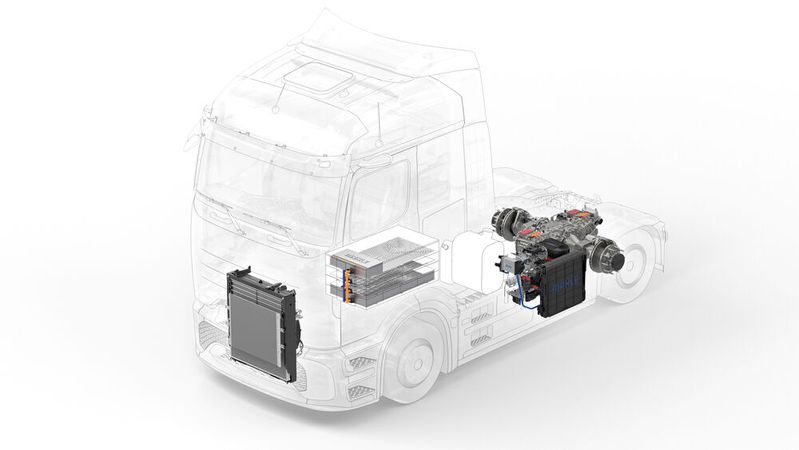
:quality(80)/p7i.vogel.de/wcms/ea/34/ea34f3ad5d23c16ca841842b201f9e7d/0132562661v1.jpeg "The new range extender system from Mahle for heavy trucks.(Image: Mahle)")
:quality(80)/p7i.vogel.de/wcms/1b/bd/1bbda2e8a6e89f73132034b0fc4606fe/0132562668v1.jpeg "The high-voltage generator is the central element of the range extender system. It is designed to provide enough energy for propulsion even when the truck is fully loaded.(Image: Mahle)")
:quality(80)/p7i.vogel.de/wcms/f5/a5/f5a53cc0af5bc6080642624475ea67ce/0132562673v1.jpeg "Mahle has developed a new MCT e-motor for use in electric drive axles of heavy commercial vehicles. The motor operates without permanent magnets (= without rare earths).(Image: Mahle)")
:quality(80)/p7i.vogel.de/wcms/c9/33/c9335b559f90f14e7bac9a5a35c2a3e1/0132562676v1.jpeg "The so-called Power-Cell Unit is an improved piston for sustainable, CO2-free fuels.(Image: Mahle)")
:quality(80)/p7i.vogel.de/wcms/24/d5/24d546b8c00887feaef1cbc207b9e2af/0133433032v1.jpeg "Mahle CEO Arnd Franz was recently asked about his vision for the future of the commercial vehicle business—particularly regarding the industry's transition to electric vehicles... (Image:Kai R. Joachim / Mahle)")
:quality(80)/p7i.vogel.de/wcms/21/59/21592b60cc226c533272207ee4b1562c/25dt244-001v1.jpeg "Daimler Truck is showcasing the Actros with several powertrain options at the IAA Transportation; the focus is on battery-electric and hydrogen-powered systems. (Source: Daimler Truck)")