ElectromobilityKey to the mobility transition: Charging and energy management intelligently combined
From
Dr. Moritz Bohland * | Translated by AI
4 min Reading Time
The transition from vehicles with internal combustion engines to electric cars is essential for climate protection. However, the electrification of transport brings challenges that can slow down the mobility transition. In particular, the simultaneous use of several charging stations leads to higher electricity demand, which puts more strain on the networks. Lack of capacity can also reduce charging speeds, and peak loads drive up costs for charging infrastructure operators.
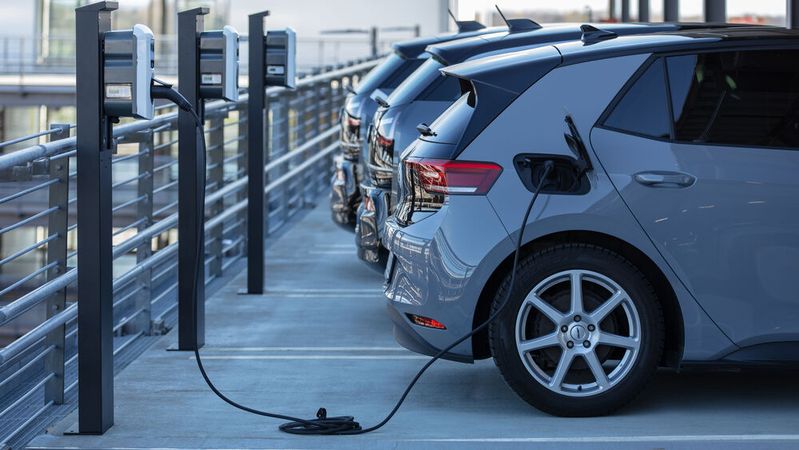
In order for electromobility to prevail, it is not enough to bring electric vehicles onto the road. Intelligent charging and energy management is also necessary.
(Image: reev)
Charging processes for plug-in hybrid and electric vehicles can be efficiently managed and distributed over time because electric cars are usually charged during longer idle times—for example, at home, at work, or while shopping. This allows for an optimized use of the charging infrastructure that is both cost-efficient and grid-friendly. Intelligent energy management systems (EMS) play a central role here, as they specifically control the load and redistribute the available energy.
Cloud-based load management for cost-efficient energy distribution
In addition to traditional hardware-based EMS, cloud-based systems are a cost-effective, secure, and popular alternative: Cloud solutions are particularly interesting for medium to large charging infrastructures because they can be extended to installations with up to several hundred charging points without additional wiring. By using fallback values stored in the system, the EMS remains functional even if the internet connection is interrupted by reverting to predefined power limits.
It is also a great advantage if the EMS can be integrated into the platform for charging management. A comprehensive platform with a single dashboard enables efficient control while reducing administrative effort. An example of this is the reev Balancer, a cloud-based EMS that extends the reev charging software with energy management functionality. Operators of charging infrastructures can control and manage their charging stations with the charging software. The reev Balancer as a supplement avoids consumption peaks throughout the day and uses the available power as cost-efficiently as possible.
Static and dynamic load management
In energy management, a distinction is made between static and dynamic load management. Both systems redistribute the load intelligently to prevent unbalanced loads or overloads. The difference lies in the leeway available for load distribution. In static load management, the power intended for the charging infrastructure is determined in advance. This is then evenly distributed across the charging points.
Dynamic load management, on the other hand, is more flexible and uses the available load more efficiently. A hardware component is also needed on-site for cloud-based EMS: An energy meter continuously measures the building's power consumption. In the case of the reev Balancer, an IoT gateway subsequently transmits the measurement data to the cloud so that the system can calculate the power currently available for the charging infrastructure. Since the system monitors the power supply in real-time, more power can be allocated to the charging infrastructure when the building load is low.
Technology behind energy management
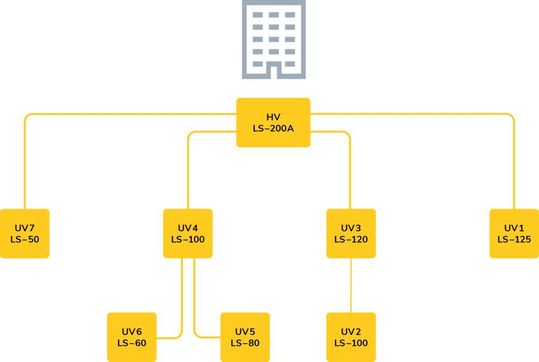
Energy management is based on phase-accurate load management. Buildings with multiple charging points usually have a central main distribution board (MDB), which supplies several sub-distribution boards (SDB). These sub-distribution boards can, in turn, have additional SDBs connected. This is a typical concept for expanding charging infrastructures.
Example setup of main distribution board and sub-distribution boards in an expanding charging infrastructure
(Image: reev)
Each sub-distribution has set capacity limits that must not be exceeded. The EMS takes these into account to avoid overloading the various distributions. The power consumption of the charging infrastructure must be distributed not only across the distributions but also evenly across the three phases of the three-phase current. If the three phases within a three-phase system are not evenly loaded, this is referred to as unbalanced loads, which can stress the neutral conductor and lead to damage to the network infrastructure.
This plays an important role, especially for plug-in hybrid vehicles (PHEV) and some battery electric vehicles (BEV) that draw their power single-phase or two-phase. This automatically causes some imbalance. Depending on the network structure and the number of charging points connected, there are various challenges.
If the neutral conductor has to compensate for the unequal current of the phases, high charging power can lead to thermal damage or network failures.
In addition, the different loading of the phases leads to voltage drops, which can damage electronic devices in the building and the charging infrastructure.
Date: 08.12.2025
Naturally, we always handle your personal data responsibly. Any personal data we receive from you is processed in accordance with applicable data protection legislation. For detailed information please see our privacy policy.
Consent to the use of data for promotional purposes
I hereby consent to Vogel Communications Group GmbH & Co. KG, Max-Planck-Str. 7-9, 97082 Würzburg including any affiliated companies according to §§ 15 et seq. AktG (hereafter: Vogel Communications Group) using my e-mail address to send editorial newsletters. A list of all affiliated companies can be found here
Newsletter content may include all products and services of any companies mentioned above, including for example specialist journals and books, events and fairs as well as event-related products and services, print and digital media offers and services such as additional (editorial) newsletters, raffles, lead campaigns, market research both online and offline, specialist webportals and e-learning offers. In case my personal telephone number has also been collected, it may be used for offers of aforementioned products, for services of the companies mentioned above, and market research purposes.
Additionally, my consent also includes the processing of my email address and telephone number for data matching for marketing purposes with select advertising partners such as LinkedIn, Google, and Meta. For this, Vogel Communications Group may transmit said data in hashed form to the advertising partners who then use said data to determine whether I am also a member of the mentioned advertising partner portals. Vogel Communications Group uses this feature for the purposes of re-targeting (up-selling, cross-selling, and customer loyalty), generating so-called look-alike audiences for acquisition of new customers, and as basis for exclusion for on-going advertising campaigns. Further information can be found in section “data matching for marketing purposes”.
In case I access protected data on Internet portals of Vogel Communications Group including any affiliated companies according to §§ 15 et seq. AktG, I need to provide further data in order to register for the access to such content. In return for this free access to editorial content, my data may be used in accordance with this consent for the purposes stated here. This does not apply to data matching for marketing purposes.
Right of revocation
I understand that I can revoke my consent at will. My revocation does not change the lawfulness of data processing that was conducted based on my consent leading up to my revocation. One option to declare my revocation is to use the contact form found at https://contact.vogel.de. In case I no longer wish to receive certain newsletters, I have subscribed to, I can also click on the unsubscribe link included at the end of a newsletter. Further information regarding my right of revocation and the implementation of it as well as the consequences of my revocation can be found in the data protection declaration, section editorial newsletter.
Moreover, an unequal load distribution can cause protective devices such as circuit breakers to trip erroneously.
All these disturbances can impair the charging operation in the short or long term. EMS prevent these problems by intelligently redistributing the load.
Full charge ahead: prioritizing user groups
E-car owners have different needs that an EMS can accommodate. Individual charging points, users, or user groups can be prioritized to distribute charging power according to requirements. An example is giving preference to a vehicle that quickly needs to be used for fieldwork. Even when the power grid is overloaded and distribution network operators intervene under §14a EnWG, the EMS allows for targeted power redistribution. At the same time, prioritized vehicles continue to charge at full speed.
A widespread use of EMS not only reduces the load on power grids but also prevents the need for power throttling. Intelligent energy management systems are therefore a key to meeting the increasing demands of charging infrastructure and driving the mobility transition.
Integrative concept for the future
The combination of charging and energy management creates high flexibility that supports the expansion of charging infrastructure. Intelligent load distribution ensures stable operation, relieves power grids, and reduces costs. These systems are essential to meet the increasing demand for charging infrastructure and to shape the mobility transition sustainably. (se)
*Dr. Moritz Bohland is Head of Business Operations at reev.



:quality(80)/p7i.vogel.de/wcms/cf/fc/cffc25779317b5b1e42cba9cfcd52bbc/0132927530v1.jpeg "The analysts were wrong again, as Japan was able to increase its export volume far more than predicted. Here are some numbers and facts about Nippon's economic situation... (Image:AI-generated)")
:quality(80)/p7i.vogel.de/wcms/6f/12/6f122ac26fd08f621f7b14f421fc435c/0132930817v1.jpeg "The Federal Statistical Office has taken a closer look at the first half of 2026 in terms of trade. Among other findings, it revealed that China is once again Germany's top trading partner... (Image:AI-generated)")
:quality(80)/p7i.vogel.de/wcms/3c/26/3c2635fb73f283b2d0e6ede46a2c2f9f/0113143253v1.jpeg "In our China Market Insider, we regularly provide you with relevant information directly from China. (Image:© Eisenhans - stock.adobe.com)")
:quality(80)/p7i.vogel.de/wcms/21/b6/21b61c2ac1df28254fb0dad1574fb2d7/0132853015v1.jpeg "The rose-gold, TiAlSiN-based coating material InoxaCon contributes significantly to the stability and service life of HPTec's new RQR-350 milling tool. It enables safe and efficient automated processes in the manufacturing of surgical instruments. (Image:Cemecon)")
:quality(80)/p7i.vogel.de/wcms/07/b3/07b368b6d067acdbb49c1e88b0cd8e9d/0131022521v1.jpeg "The seven-axis collaborative robot from Yamaha Motor is equipped with Harting connectors. (Image:Yamaha Motor)")
:quality(80)/p7i.vogel.de/wcms/dc/64/dc64212882d6898cd5b44fcbeb5aedbb/image1v1.jpeg "The cobots from Rheinmetall Yardstick Robotics use all-in-one servo drives from Synapticon. (Image: Rheinmetall Yardstick Robotics) (Image:)")
:quality(80)/p7i.vogel.de/wcms/a7/38/a73840cb81da9dc3c503f4c04bf66b96/0132892768v1.jpeg "Unitree's IPO symbolizes the high expectations for humanoid robots and embodied AI. (Image:Dall-E / AI-generated)")
:quality(80)/p7i.vogel.de/wcms/1c/a5/1ca5e3ef5d834c3a42de8909c872e3c6/0132876444v1.jpeg "The autonomous transport system Active Shuttle marketed by Bosch Rexroth has been sold to Neura Robotics. (Image:Bosch Rexroth)")
:quality(80)/p7i.vogel.de/wcms/c8/a1/c8a170f594765cecbdafbc139b96d91a/0132860586v1.jpeg "V-shaped grooves, known as riblets, are directly incorporated into the paint. They reduce overall drag by 50 percent, resulting in significant fuel savings. (Image:Trumpf)")
:quality(80)/p7i.vogel.de/wcms/c9/80/c98042b5898cde9670b4c3ae1efbc656/adobestock-165496610v1.jpeg "In just 45 days, the team from Stauff India completely renewed the hydraulic piping of a steel plant. The key factor here was the right pipe connection system. (Source: Stauff)")
:quality(80)/p7i.vogel.de/wcms/41/fc/41fc456ff1ff8f30807924663e8df127/img-0942v1.jpeg "In industrial additive manufacturing, the production strategy must influence the design from the very beginning. (Source: Materialise)")
:quality(80)/p7i.vogel.de/wcms/44/fe/44fe86a16c26c09bb363b3671bf0b930/0132847771v1.jpeg "CoreTechnologie (CT) points out that the 3D printing software 4D_Additive has been equipped with additional application possibilities. Here you can learn more about what the new version 1.8 can do – such as generating complex lattice structures or optimizing faulty data ... (Image:CT)")
:quality(80)/p7i.vogel.de/wcms/d1/42/d142e0e90738d0335c4ed7936f030e6a/0132948392v1.jpeg "Its production was long delayed, but now Tesla's electric truck Semi is being built in the USA. If the Elon Musk company has its way, it will soon also be seen on Europe's roads... (Image: Tesla)")
:quality(80)/p7i.vogel.de/wcms/5b/88/5b88d94e6a43f2b857462cd1921f7386/0132281427v1.jpeg "The eTurbo solves a well-known turbocharger problem: by combining an exhaust gas turbocharger and a permanently excited synchronous motor into a highly integrated core assembly, the compressor achieves sufficient speed even when the exhaust energy is actually not yet sufficient. (Image: BorgWarner)")
:quality(80)/p7i.vogel.de/wcms/75/fe/75feffb63bc6275786606d78a8d797c4/0132901853v1.jpeg "Steyr Motors reports similar business results as last year. Here you can learn more about the details of the Austrian company's situation ... (Image:E-Steyr)")
:quality(80)/p7i.vogel.de/wcms/57/d2/57d2b75d884c18866b46e776126fb46b/org-blobs-user-response-file-output-dac07b02-0e97-4452-9a3a-26528da583b3-file-1787126178766-jpgv1.jpeg "The memory manufacturer CXMT has had an extremely successful IPO. Among the investors are several car manufacturers. (Image:KI-generiert)")
:quality(80)/p7i.vogel.de/wcms/65/74/6574fcb9fb6b589ef577767613f5397c/0132928076v1.jpeg "Compact and standardized: CubeSats enable cost-effective space missions and are increasingly serving as a platform for testing new technologies—from sensors and communications to innovative power supply systems. (Image:City Labs, Inc.)")
:quality(80)/p7i.vogel.de/wcms/07/f6/07f6c430c86bf0d5d915268b881ada49/0132895094v1.jpeg "FOUP wafer cassette for 300-mm semiconductor manufacturing in TSMC's Fab 12. (Image:TSMC)")
:quality(80)/p7i.vogel.de/wcms/59/25/59258a3771bf03dd3461d0378884464d/0132928076v1.jpeg "Compact and standardized: CubeSats enable cost-effective space missions and increasingly serve as platforms for testing new technologies—from sensors and communication to innovative energy supply systems. (Image: City Labs, Inc.)")
:quality(80)/p7i.vogel.de/wcms/22/82/22826566c11220ed61efac5982fb94a2/0132896083v1.jpeg "Electrodes made from paper and copper paste deliver comparable signal quality to the established gold standard. They perform significantly better in all environmental impact analyses. (Image:Screentec)")
:quality(80)/p7i.vogel.de/wcms/d0/1e/d01e4b705166c8e76bfffae2b3f3a2c2/0126157872v1.jpeg "Unlike passenger cars, electrified trucks, buses, and vans require significantly higher charging capacities. (Image:Sungrow)")
:quality(80)/p7i.vogel.de/wcms/8e/c9/8ec975064f4a4cbe027aa15166acb9bf/0130922769v1.jpeg "The OM M-Series marks a structural change in the architecture of charging infrastructure. (Image:ABB E-Mobility)")