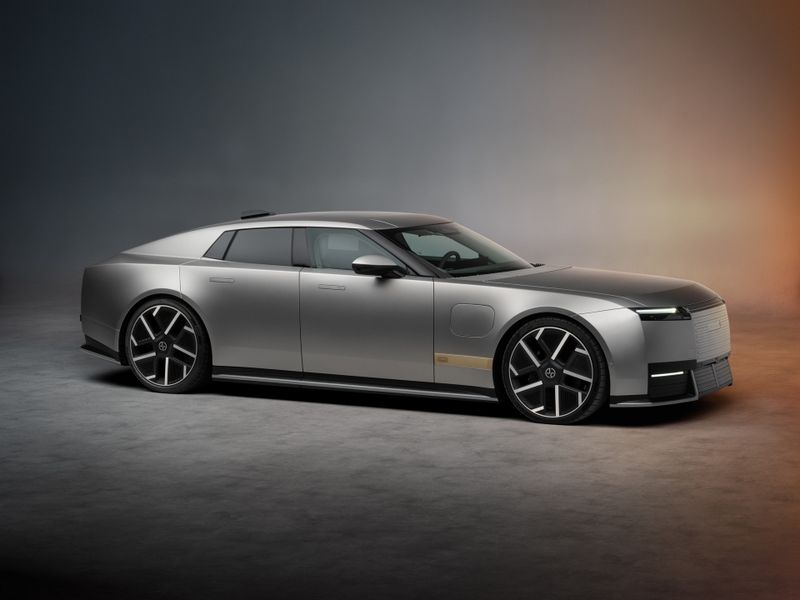
With the Type 01, Jaguar is unveiling the first model since the brand's relaunch: a GT.
Two years ago, JLR announced a relaunch of the Jaguar brand. The Type 01 is now the first model to be unveiled.
(Source: JLR)
Jaguar has unveiled its first model since the brand's relaunch. The Type 01 is an electric four-door sedan that the company is positioning as a luxury grand tourer. It starts at 165,000 euros. According to Jaguar, orders will be accepted starting in early 2027. The car will be built in the United Kingdom.
Power is provided by three electric motors: a 260-kW (349-hp) motor on the front axle and two 310-kW (416-hp) motors on the rear axle. According to Jaguar, the system output is up to 757 kW (1,015 hp), with a maximum torque of 1,365 Newton-meters(1,007 lb-ft). The Type 01 accelerates from 0 to 100 km/h (62 mph) in 3.2 seconds and from 100 to 180 km/h (62 to 112 mph) in 4.0 seconds. All-wheel steering reduces the turning radius to 11.5 meters (37.7 feet), and the weight distribution is 50:50. The suspension features adjustable air springs and active dampers.
720-Kilometer Range, 350-kW Charging Power
The usable battery capacity is 118 kWh with an 850-volt architecture. The expected WLTP range is up to 720 kilometers (447 miles). At a constant speed of 120 km/h (75 mph), Jaguar cites a range of up to 515 kilometers (320 miles). According to the company, up to 320 kilometers (199 miles) of range can be recharged in 13 minutes using a fast charger with up to 350 kW. It takes about 22 minutes to charge from 10 to 80 percent. At 400-volt charging stations, split charging allows for up to 250 kW, and up to 22 kW on the AC side.
Active cooling air fins and a three-stage retractable rear spoiler contribute to the car's efficiency. The drag coefficient is 0.23. That would be the best figure Jaguar has ever achieved.
The Type 01 is 5,235 millimeters (206.1 inches) long and 1,403 millimeters (55.2 inches) high. It comes standard with 23-inch wheels; 21-inch wheels are available as an option. The trunk has a capacity of over 450 liters (15.9 cubic feet), expanding to up to 1,000 liters (35.3 cubic feet) with the rear seats folded down. In the cockpit, a 24-inch OLED display is positioned in front of the driver. Instead of a rearview mirror, a camera feed provides a view of the area behind the vehicle.
According to Jaguar, the central cockpit computer and the driver-assistance system are based on Nvidia technology. The stability control system is from Bosch (VDC 2.0), and the tires were developed by Pirelli in collaboration with Jaguar. The audio system is from Meridian.
"The Type 01 is the foundation of the brand," said Jaguar CEO Rawdon Glover. It is a vehicle that makes no compromises between design and technology as the brand reinvents itself.
Technology in Detail: How Jaguar Gains Space and Rigidity
To kick things off, Jaguar has released two infographics on architecture and powertrain. The Type 01 is built on the new JEA electric architecture, which integrates the body and battery into a single structure. The wheelbase is approximately 3.2 meters (10 feet 6 inches), and the torsional stiffness is 51.7 kilonewton-meters per degree (about 38,100 pound-feet per degree). According to Jaguar, this is the highest value the brand has ever achieved for an integrated body and battery structure.
Front End and Battery: According to Jaguar, a patented structure called the “Tri-Apex Node” distributes forces of up to 26 metric tons. This allows the battery and control systems to be moved further forward, in front of the A-pillar. According to Jaguar, the space saved adds about 150 PS (148 hp) and 112 kilometers (about 70 miles) of range. The high-voltage junction box is located between the front wheels and also serves as a strut bridge for the front axle. This increases rigidity and contributes to the 50:50 weight distribution.
The underfloor battery is split into two sections. This preserves legroom in the rear, and the front seats are positioned low. The connections for the 200 prismatic cells are located on the sides rather than on top. According to the manufacturer, this means that 80 percent of the pack’s height consists of active material. The cell chemistry is a nickel-manganese-cobalt mixture containing more than 90 percent nickel.
Date: 08.12.2025
Naturally, we always handle your personal data responsibly. Any personal data we receive from you is processed in accordance with applicable data protection legislation. For detailed information please see our privacy policy.
Consent to the use of data for promotional purposes
I hereby consent to Vogel Communications Group GmbH & Co. KG, Max-Planck-Str. 7-9, 97082 Würzburg including any affiliated companies according to §§ 15 et seq. AktG (hereafter: Vogel Communications Group) using my e-mail address to send editorial newsletters. A list of all affiliated companies can be found here
Newsletter content may include all products and services of any companies mentioned above, including for example specialist journals and books, events and fairs as well as event-related products and services, print and digital media offers and services such as additional (editorial) newsletters, raffles, lead campaigns, market research both online and offline, specialist webportals and e-learning offers. In case my personal telephone number has also been collected, it may be used for offers of aforementioned products, for services of the companies mentioned above, and market research purposes.
Additionally, my consent also includes the processing of my email address and telephone number for data matching for marketing purposes with select advertising partners such as LinkedIn, Google, and Meta. For this, Vogel Communications Group may transmit said data in hashed form to the advertising partners who then use said data to determine whether I am also a member of the mentioned advertising partner portals. Vogel Communications Group uses this feature for the purposes of re-targeting (up-selling, cross-selling, and customer loyalty), generating so-called look-alike audiences for acquisition of new customers, and as basis for exclusion for on-going advertising campaigns. Further information can be found in section “data matching for marketing purposes”.
In case I access protected data on Internet portals of Vogel Communications Group including any affiliated companies according to §§ 15 et seq. AktG, I need to provide further data in order to register for the access to such content. In return for this free access to editorial content, my data may be used in accordance with this consent for the purposes stated here. This does not apply to data matching for marketing purposes.
Right of revocation
I understand that I can revoke my consent at will. My revocation does not change the lawfulness of data processing that was conducted based on my consent leading up to my revocation. One option to declare my revocation is to use the contact form found at https://contact.vogel.de. In case I no longer wish to receive certain newsletters, I have subscribed to, I can also click on the unsubscribe link included at the end of a newsletter. Further information regarding my right of revocation and the implementation of it as well as the consequences of my revocation can be found in the data protection declaration, section editorial newsletter.
Body: The aluminum side panel, approximately three meters long, is pressed into five smooth surfaces that converge at a single point. According to Jaguar, this went beyond the capabilities of conventional simulation and required 1,500 hours of meticulous work. Only 133 millimeters (5.2 inches) remain between the wheel well and the hood. The elliptical opening leaves room for suspension travel. At 140 km/h (87 mph), the rear generates approximately four kilograms of downforce, according to Jaguar, contributing to a cW value of 0.23.
Powertrain: The silicon carbide inverters switch variably between 2 and 20 kilohertz. When cruising, they can shut off the rear motors, which adds up to 29 kilometers (18 miles) of range. Torque is distributed in a 30:70 ratio between the front and rear axles; according to Jaguar, the traction control system responds in one millisecond. The rear unit, with its two motors, achieves a torque density of 51 Newton-meters per kilogram (37.6 pound-feet per kilogram). The thermal management system redirects heat in a targeted manner. For every kilowatt of energy used, it generates about three kilowatts of heating power and extracts heat even from outside air at minus 15 degrees (5 °F).



:quality(80)/p7i.vogel.de/wcms/68/a5/68a5ce0896756c1dcf48dbeceefafbd3/0132300990v1.jpeg "Christoph Geigges is President and CEO of Walter AG. Headquartered in Tübingen (Germany), the company is one of the world’s leading suppliers of precision tools for metalworking. Under Geigges’ leadership, this long-established company is increasingly transforming itself from a tool manufacturer into an engineering partner that supports the entire manufacturing process. (Image: Walter AG)")
:quality(80)/p7i.vogel.de/wcms/3e/7c/3e7c26f44c68545fc7318597b6b65903/0133649650v1.jpeg "The flexible Heller circular storage system can store and process pallets measuring both 630 millimeters by 630 millimeters and 800 millimeters by 800 millimeters—even in mixed-mode operation. This makes the entire production line particularly flexible. (Image:Brighter)")
:quality(80)/p7i.vogel.de/wcms/16/29/162983885950ec1df27ab441bfe88613/0133132549v1.jpeg "Bernd Hermeler is the CEO of Cemecon AG. He studied mechanical engineering at RWTH Aachen University (Germany)—the very university from which the company emerged as a spin-off 40 years ago. Today, Hermeler is responsible for the global strategy of the coating specialist, which, with branches in Europe, the U.S., China, Japan, and India, is considered the global technology leader in the coating of cutting tools. (Image: Cemecon AG)")
:quality(80)/p7i.vogel.de/wcms/af/81/af81b53cb4926dcadc20ba369a29d412/0132695968v1.jpeg "International venture capital is increasingly flowing into the machining industry. Here are the players that entrepreneurs and CEOs should keep an eye on right now. (Image: ©NDABCREATIVITY - stock.adobe.com)")
:quality(80)/p7i.vogel.de/wcms/db/ca/dbcae78eb8853b53fe122832fe3b2cba/0132914918v1.jpeg "Robotics in Flexible Manufacturing: As connectivity increases, so do the requirements for functional safety. (Image: Delta Electronics)")
:quality(80)/p7i.vogel.de/wcms/ea/18/ea18e84aed24bbe1c91937f30c2f7301/image1v1.jpeg "Kassow Robots' new product portfolio now includes seven 7-axis cobots. (Image: Kassow Robots (Image:)")
:quality(80)/p7i.vogel.de/wcms/c8/d0/c8d0c68a98e4eff417e2bacc58da92b7/aveva-world-media-kitv1.jpeg "Predictive maintenance should not be a matter of plant size or budget, but rather a matter of the proper integration of data collection, analysis, and feedback to operators. (Source: Aveva)")
:quality(80)/p7i.vogel.de/wcms/f2/3b/f23bff6710f706981c703b3110407075/geralt-traffic-signs-663368v1.jpeg "Nearly all of the manufacturing companies surveyed worldwide measure AI outcomes in some form, but only 49 percent rigorously calculate the ROI of AI. (Source: )")
:quality(80)/p7i.vogel.de/wcms/90/30/90300137452b00d22f95113eff065ac3/fliehkraftkupplungen-und-bremsen-montage-centrifugal-clutches-and-brakes-assembly-1v1.jpeg "Installation: Centrifugal clutches should always be precisely matched to the machine. (Source: Amsbeck Machine Technology)")
:quality(80)/p7i.vogel.de/wcms/93/84/9384230e840a99a2015fdd3e0af11e2b/newsimage428236v1.jpeg "The crutch replicates the natural, biomechanical movement pattern of the human body. (Source: Leon Kast)")
:quality(80)/p7i.vogel.de/wcms/5b/a2/5ba21b3e5fcdd91f6bfe806f745ea723/isc-physioink-bild-3v1.jpeg "In the PhysioINK project, Fraunhofer researchers are developing bio-printing inks from the most common tissue proteins. Under the microscope, the living tissue cells (fibroblasts) are visible in the printed lattice structure: blue represents the cell nucleus, and green represents the cytoskeleton. (Source: Tobias Weigel/Fraunhofer ISC)")
:quality(80)/p7i.vogel.de/wcms/9c/16/9c16e4aa02594fe4bf82ead736562b07/directhop1-scaledv1.jpeg "Light as a feather, but without feathers: The University of Washington's robot, which weighs just one gram, uses a bionic direct-drive system to catapult itself into the air with centimeter-level precision. (Source: Mark Stone/University of Washington)")
:quality(80)/p7i.vogel.de/wcms/99/61/9961719acb89bc87fdecb1bba140481c/0133725593v1.jpeg "Ultrason (PSU, PESU, PPSU) is suitable for E&E components used in electric mobility or AI infrastructure, such as connectors for fiber-optic cables. (Image:BASF)")
:quality(80)/p7i.vogel.de/wcms/42/9b/429badd88cd4a74edb6491d10310349c/wayve-london-05v1.jpeg "Wayve is developing an AI software stack for automated driving. It appears that the Volkswagen Group has now opted for this technology. (Source: Wayve)")
:quality(80)/p7i.vogel.de/wcms/14/9f/149f934f87e5418748fa41a611586a4f/rawdon-gloverv1.jpeg "Rowdon Glover, Managing Director of Jaguar: “We are willing to accept polarization.” (Image:JLR)")
:quality(80)/p7i.vogel.de/wcms/b3/b9/b3b9b5cef51ae3708c518a48a62ea5e9/silver-front-7-8v1.jpeg "Two years ago, JLR announced a relaunch of the Jaguar brand. The Type 01 is now the first model to be unveiled. (Source: JLR)")
:quality(80)/p7i.vogel.de/wcms/70/59/7059db055d4eeb8dea752651a071f360/geralt-handshake-4608297v1.jpeg "The deal between Schneider Electric and PTC is intended to create end-to-end data flows for the industry. (Source: )")
:quality(80)/p7i.vogel.de/wcms/67/3d/673d8f6f14bd030b53b61800a0aeb06d/0133548286v1.jpeg "Overview: If even a single critical component is missing, the entire production process can come to a standstill. Proactive procurement is intended to mitigate such bottlenecks early on. (Image:Dall-E / AI-generated)")
:quality(80)/p7i.vogel.de/wcms/b3/8d/b38d7e914a0a51c24db7e93c8a8420e2/0133672676v1.jpeg "Figure 1: Today, the AT cut is most commonly used for quartz crystals. The double-twisted SC cut further enhances the stability and aging resistance of OCXO oscillators. (Image:Q-Tech)")
:quality(80)/p7i.vogel.de/wcms/40/34/4034915f85470ad8264659267e4f02d0/0133655653v1.jpeg "Cariad, Volkswagen's software subsidiary, continues to struggle. Now, another round of layoffs has been announced, which will result in the loss of many jobs ... (Image:Cariad)")
:fill(fff,0)/images.vogel.de/vogelonline/companyimg/76800/76895/65.jpg "FAULHABER_120mm.jpg ()")
:quality(80)/p7i.vogel.de/wcms/cb/dd/cbddb39e0325cb3b4340d61d22c6019b/design-34v1.jpeg "The rear of the Type 01 features distinctive spoiler edges. Its drag coefficient is 0.23.(Source: JLR)")
:quality(80)/p7i.vogel.de/wcms/ed/e2/ede27f2330a77468aa1104694bcc7e8b/design-facev1.jpeg "The front of the Type 01 is massive.(Source: JLR)")
:quality(80)/p7i.vogel.de/wcms/1e/e6/1ee6934a1272fb23274ca7079098284f/side-viewv1.jpeg "The Jaguar Type 01 is 5.2 meters long and 1.4 meters high.(Source: JLR)")
:quality(80)/p7i.vogel.de/wcms/65/9d/659dd95d6b7981f9cd524ec97a856426/type01-front-cabin-16x9v1.jpeg "The cockpit has virtually no buttons or switches.(Source: JLR)")
:quality(80)/p7i.vogel.de/wcms/2e/58/2e58c664e733dd182666606f850c5da4/0133400664v1.jpeg "The IM6 is sort of the crossover version of the IM5. (Image:MG Motor)")
:quality(80)/p7i.vogel.de/wcms/8e/bc/8ebc09e8e8a70c194c76876af520316e/a263148-large-4961x2789v1v1.jpeg "Audi has unveiled the Nuvolari super sports car. (Image: Audi)")