Standard cameras often reach their limits. In the Vision Channel session, IDS explains how a specific requirement turns into a customized camera—from the idea to EMC tests to series production, with transparent steps, clear costs, and manufacturing in Obersulm (Germany).
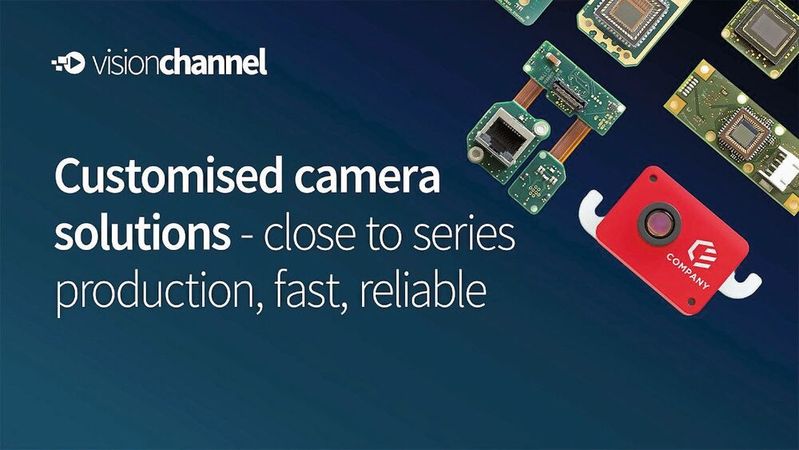
Custom solutions: IDS also manufactures industrial cameras to measure.
(Image: IDS Imaging Development Systems)
Those planning industrial image processing quickly encounter details that standard products cannot fully address: limited installation space, harsh environments, different connectors, pre-assembled optics, fixed IP addresses, or frozen firmware. In a live session, project manager Moritz Fuchs from IDS walks through the entire process of custom developments: "We don't start from scratch," says Fuchs. "We build on a series camera and a modular toolkit."
Between Initial Contact And Series Production: A Process With Clear Gates
In the initial meeting, whether via Teams, Zoom, on-site in Obersulm (Germany), or at the customer's location, the team clarifies background information and options. IDS then evaluates feasibility together with development and production, while the customer provides additional requirements. This is followed by a concept phase with proposals, during which both parties agree on the technology, one-time development efforts (NRE), and series prices. Implementation only begins once the specifications and calculations are finalized.
Depending on the project, engineers modify only the mechanics, adapt electronic schematics, or combine both. During development, IDS shares CAD data or schematics for customer approval. Procurement for prototypes then begins. Simultaneously, the team leverages internal resources to accelerate the process: an SMD production line for electronics, 3D printing, and a mechanical lab for rapid prototyping. Testing and validation run on two tracks: internally at IDS and with the customer in the target system.
Electromagnetic compatibility is particularly critical. Here, the in-house EMC chamber helps test early prototypes under real conditions. “This shortens the overall time from project start to series approval,” says Fuchs. Climate chambers are also available to cover temperature and humidity profiles. If a test cycle yields new insights, another loop follows without long waiting times for external lab slots.
What IDS Customizes—And What it Doesn’t
Typical customizations include pre-mounted and calibrated S-mount lenses set to defined working distances, alternative connectors (e.g., RJ45 or M12), preconfigured network settings, or customized mechanical designs. The electronics range from round circuit boards to flexible PCBs for tight installation spaces. IDS fulfills white-label requests through housing prints as well as brand-compliant firmware and software branding. “We approve every quality stage together,” emphasizes Fuchs, noting that the customer is always present at each gate.
IDS sets clear boundaries with firmware: Branding and targeted function customizations are possible, but the team does not undertake complete new developments for customers. The goal remains to strengthen the standard products technically and build adaptations upon them. This reduces risks, accelerates certifications, and keeps costs manageable.
Series Production, Change Management, And Longevity
Once the design is stable, series production takes place, like the prototypes, in Obersulm. The industrial engineering department adapts tools and processes for special parts, yet the modular production remains flexible. IDS promises long-term availability and defined change management. This ensures planning reliability for customers, even if components are discontinued or new variants are developed.
During the Q&A session, Fuchs addresses common concerns: custom solutions are not automatically expensive or difficult to maintain when built consistently close to series production, using modular components and transparent approvals. An everyday example: instead of ordering costly injection molding tools early on, 3D printing allows for rapid fit prototypes, reduces error risks, and postpones investments to the right moment.
External partners also showed interest, for example, in sensor assembly for small quantities or chip-on-board processes in cleanroom environments. Fuchs remained open to discussions, but the message of the session was clear: those with special requirements will find a structured path at IDS, from the first idea to series production. The modular design, close coordination with the customer, and development close to series production aim to accelerate the process, reduce risks, and enable a long-term, sustainable solution. (mc)
Date: 08.12.2025
Naturally, we always handle your personal data responsibly. Any personal data we receive from you is processed in accordance with applicable data protection legislation. For detailed information please see our privacy policy.
Consent to the use of data for promotional purposes
I hereby consent to Vogel Communications Group GmbH & Co. KG, Max-Planck-Str. 7-9, 97082 Würzburg including any affiliated companies according to §§ 15 et seq. AktG (hereafter: Vogel Communications Group) using my e-mail address to send editorial newsletters. A list of all affiliated companies can be found here
Newsletter content may include all products and services of any companies mentioned above, including for example specialist journals and books, events and fairs as well as event-related products and services, print and digital media offers and services such as additional (editorial) newsletters, raffles, lead campaigns, market research both online and offline, specialist webportals and e-learning offers. In case my personal telephone number has also been collected, it may be used for offers of aforementioned products, for services of the companies mentioned above, and market research purposes.
Additionally, my consent also includes the processing of my email address and telephone number for data matching for marketing purposes with select advertising partners such as LinkedIn, Google, and Meta. For this, Vogel Communications Group may transmit said data in hashed form to the advertising partners who then use said data to determine whether I am also a member of the mentioned advertising partner portals. Vogel Communications Group uses this feature for the purposes of re-targeting (up-selling, cross-selling, and customer loyalty), generating so-called look-alike audiences for acquisition of new customers, and as basis for exclusion for on-going advertising campaigns. Further information can be found in section “data matching for marketing purposes”.
In case I access protected data on Internet portals of Vogel Communications Group including any affiliated companies according to §§ 15 et seq. AktG, I need to provide further data in order to register for the access to such content. In return for this free access to editorial content, my data may be used in accordance with this consent for the purposes stated here. This does not apply to data matching for marketing purposes.
Right of revocation
I understand that I can revoke my consent at will. My revocation does not change the lawfulness of data processing that was conducted based on my consent leading up to my revocation. One option to declare my revocation is to use the contact form found at https://contact.vogel.de. In case I no longer wish to receive certain newsletters, I have subscribed to, I can also click on the unsubscribe link included at the end of a newsletter. Further information regarding my right of revocation and the implementation of it as well as the consequences of my revocation can be found in the data protection declaration, section editorial newsletter.
Future-Proof Authentication with Universal RFID Readers



:quality(80)/p7i.vogel.de/wcms/0b/cd/0bcd6d502ffcd087c4fc12b7b760b3ce/0133317507v2v1.jpeg "The new Multi Center from J.G. Weisser. (Image:J.G. Weisser)")
:quality(80)/p7i.vogel.de/wcms/6a/ef/6aef8ea2d02622844db469c705a21222/0133322968v1v1.jpeg "Canada and the U.S. have been locked in a trade dispute ever since Donald Trump was re-elected as U.S. president. In the long run, however, Canada could end up being the loser. That is why the country is turning more toward its trading partner, the EU. Something very special is set to emerge... (Image:AI-generated)")
:quality(80)/p7i.vogel.de/wcms/dd/92/dd928ba2e2956aa2bfff4888af8b08f8/photo--1v1.jpeg "Catalog product for extreme operating conditions: The new NRTVG guide carriage from Bosch Rexroth withstands extreme environmental conditions. (Source: Bosch Rexroth AG)")
:quality(80)/p7i.vogel.de/wcms/5a/9e/5a9e57e26964ba5c9d8719a9ee520bb3/0133310195v1.jpeg "Germany and the United Arab Emirates have signed an agreement to stand shoulder to shoulder in times of crisis. This will bring Germany many billions, to say the least.
From left: Sheikh Mohammed bin Sajed al-Nahjan and Federal Chancellor Friedrich Merz. (Image:dpa / K. Nietfeld)")
:quality(80)/p7i.vogel.de/wcms/81/dc/81dc63ed24c562521413023779495e7d/chris-kramerv1.jpeg "Chris Kramar, Director and General Manager of OEM Solutions for Germany, Austria, and Switzerland at Dell Technologies (Source: Dell Technologies)")
:quality(80)/p7i.vogel.de/wcms/bb/f5/bbf5342f532debc1bd7c09c2b9a0bf42/0133176497v1.jpeg "Over the past two years, AI has emerged as the most important growth driver in the industry. (Image: ©Gorodenkoff - stock.adobe.com)")
:quality(80)/p7i.vogel.de/wcms/01/61/01615a0939754c41e9d2c8971bf0b38a/web-image-kuka-kmf-1500p-300-dpi-1v1.jpeg "Thanks to its design, the KMF 1500P-CB is suitable for the stable and flexible handling of closed and open pallets. (Source: Kuka)")
:quality(80)/p7i.vogel.de/wcms/0b/ef/0bef343dfe1c7f83a1be01e7e83cc5ac/delta-fabrikv1.jpeg "Autonomous mobile manipulation robots can perform a wide range of tasks in a modern factory, from loading machines to quality control. (Image:Delta)")
:quality(80)/p7i.vogel.de/wcms/98/73/98731d23cbd95ff22391993a74cfefbf/mit-bifurcatedcircuits-01-pressv1.jpeg "A sample of the variety of configurations that Bifur circuits can form. (Source: Courtesy of the researchers)")
:quality(80)/p7i.vogel.de/wcms/f4/3d/f43d1f4297d9ae0cd1b6d2adfcb5ffe1/0133276470v1.jpeg "Simulation: Electric arcs in the electrical industry, including associated field simulation. (Image:CADFEM)")
:quality(80)/p7i.vogel.de/wcms/1d/fb/1dfbb415cd837102a33ce21ecf052ec3/0133277411v1.jpeg "LED drivers: LED circuit boards connect the light fixture to the electronics. During design, the operating current, forward voltage, and temperature must be taken into account across the entire operating range. (Image: ©Maria - stock.adobe.com)")
:quality(80)/p7i.vogel.de/wcms/80/8a/808a0eccf49a2a4fe560bd1998506ef9/0133308770v1.jpeg "Just like that, the supports are gone! High-speed footage of the automated, ultrasound-based process for removing optimized support structures from additively manufactured metal parts. It will be presented for the first time at Formnext from November 17 to 20. (Image:Fraunhofer IAPT)")
:quality(80)/p7i.vogel.de/wcms/fe/a8/fea8f62ea056f3c5334931f38cb80c76/0133324887v1v1.jpeg "It's flying off the shelves! The ID.Polo electric compact car seems to be living up to Volkswagen's expectations. After all, there are already more than 30,000 orders. The three sister models are also selling well... (Image:Volkswagen)")
:quality(80)/p7i.vogel.de/wcms/cb/00/cb0048b5a5df1a016d82aafa60aab9a9/35fa3e8bcf12df84fcc0b7ade728c03dv1.jpeg "Xiaomi has unveiled four new models. The large SUVs all have a gasoline engine to charge the battery. (Image:Xiaomi)")
:quality(80)/p7i.vogel.de/wcms/6c/f3/6cf31c04485bcabbf3e7c0f605dd9986/iaa2026-bosch-sdv-truckv1.jpeg "In commercial vehicles as well, vehicle functions that were previously distributed are now being consolidated onto central computing platforms—for example, for the cockpit or vehicle domains—and software and hardware are being consistently decoupled. (Source: Bosch)")
:quality(80)/p7i.vogel.de/wcms/21/59/21592b60cc226c533272207ee4b1562c/25dt244-001v1.jpeg "Daimler Truck is showcasing the Actros with several powertrain options at the IAA Transportation; the focus is on battery-electric and hydrogen-powered systems. (Source: Daimler Truck)")
:quality(80)/p7i.vogel.de/wcms/b4/85/b48565f20a330043d0cd8c5f708f779f/0133316091v2v1.jpeg "The open Chiisai standard supports the cross-vendor development of HALs, middleware, and embedded software for small microcontrollers. (Image:Vector Informatics)")
:quality(80)/p7i.vogel.de/wcms/6c/a6/6ca6c6410e051401d5596d5cc6dfa277/0133283570v1.jpeg "From Core to Platform: With MIPS, ARC, and RISC-V, competition is shifting from individual processor IP blocks to integrated compute platforms for specialized applications. (Image:Dall-E / AI-generated)")
:quality(80)/p7i.vogel.de/wcms/73/17/73174a2afe684fa12d7d6a57b29b20e2/0133305506v1.jpeg "AI data centers are a key driver of direct current technologies. (Image:Pixabay / Brian Penny / AI-generated)")
:quality(80)/p7i.vogel.de/wcms/08/b2/08b2ce49b6d6d11d5953064bb0a62f37/0133308791v1.jpeg "If what Anthropics is accusing its Chinese AI competitors of is true, then the industry is in for quite a shakeup! At stake is nothing less than Chinese AI systems—such as Kimi and Deepseek—that were actually trained indirectly using U.S. AI systems. (Image: AI-generated)")
:fill(fff,0)/p7i.vogel.de/companies/69/de/69de1b7403b0d/simtos-logo.jpeg "simtos-logo (SIMTOS)")
:quality(80):fill(efefef,0)/p7i.vogel.de/wcms/67/ae/67ae0b9ac31f8/elatec-wp-universal-reader.png "Elatec WP Universal Reader")
:quality(80)/p7i.vogel.de/wcms/d6/94/d694db1af2cad4cfd03e1ae617b2967b/0127938873v1.jpeg "Fieldbus integration in embedded systems is considered a supreme discipline—EMI robustness, real-time capable protocols, and certification processes challenge developers on all levels. (Image:AI-generated)")
:quality(80)/p7i.vogel.de/wcms/f0/44/f044de7694e5c37a84b61a4f247dd235/0130660217v1.jpeg "Blade contact connector system: Originally developed for batteries in laptops, this proven connector type is now also customized by Suyin for many other applications that require flexible mating angles, high robustness and reliable contacts even under vibration and shock. (Image:Suyin Europe)")