The Evolution of Programming LanguagesHow We Learned to Talk to Computers
From
Sebastian Gerstl | Translated by AI
9 min Reading Time
Rust, Python, and C are now part of a computer programmer's standard repertoire. But it has been a long journey from directly feeding binary instructions into system registers to modern vibe coding.
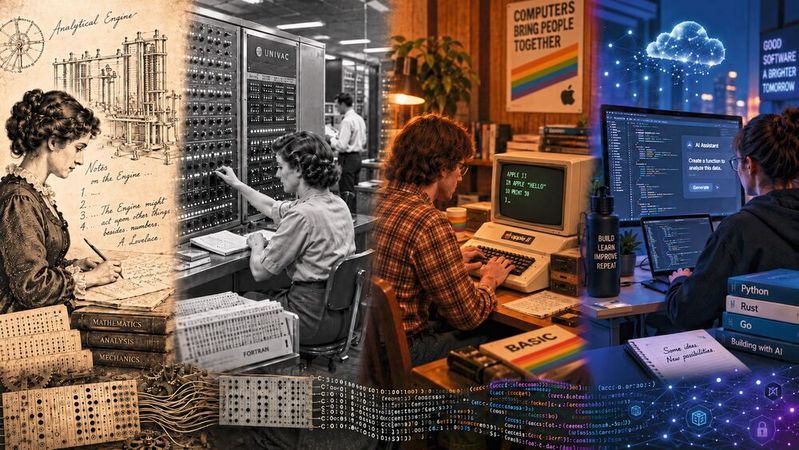
The Evolution of Coding: In the past, programs were written by hand and fed into the computer using punch cards and switches. Today, in the age of “vibe coding,” computers can largely program themselves.
(Image: Dall-E / AI-generated)
As early as 1843, Ada Lovelace described a procedure for calculating Bernoulli numbers for Charles Babbage’s Analytical Engine, which was never completed. This is generally considered the first computer program. Even though Lovelace was able to explain to a reader how such a program might be structured, one question remained largely unanswered due to the lack of a finished computer: How can we “talk” to the computer so that it understands how to carry out our instructions? And how can we do this in a way that remains as natural and comprehensible as possible for humans? When the first electronic general-purpose computers emerged about a century later, this idea could initially be implemented only to a limited extent.
Back When Programming Still Meant Modifying the Computer
When the ENIAC was completed in 1945, there was initially no program that could simply be loaded from memory. To perform new calculations, cables had to be reconnected and switches and function tables had to be adjusted. The six women who were among its first programmers—Kay McNulty, Betty Jennings, Betty Snyder, Marlyn Wescoff, Fran Bilas, and Ruth Lichterman—were initially provided with neither a programming language nor comprehensive training. They familiarized themselves with the machine using circuit diagrams and block diagrams and then translated their procedures into hundreds of plug connections and thousands of switches.
It was no coincidence that women played a central role in this early phase. “Computer” had previously been a job title: Hundreds of mostly female mathematical assistants calculated things like ballistic tables using mechanical calculators. Some of these “human computers” went on to become programmers of electronic computers. At first, software was viewed less as prestigious engineering work and more as a continuation of mathematical calculation work.
With the stored-program principle, instructions could finally be stored in memory themselves. At first, however, programming was done in machine code: sequences of numbers that corresponded directly to a computer’s architecture. One of the first responses to this came, once again, from a woman. Kathleen Hylda Valerie Britten, later Kathleen Booth, began working on early computers at Birkbeck College in 1946. In 1947, she developed a symbolic coding system for the ARC with Andrew Booth and was involved in the development of the assembler and Autocode for the Birkbeck computers. Her work is often described as one of the first—and in some cases, the very first—assembler languages; however, due to systems that emerged at the same time, the question of priority is not entirely clear. Instead of numerical operation codes, symbolic abbreviations and addresses could now be used: The programmer still had to understand the machine, but no longer had to think exclusively in terms of numbers.
FORTRAN, COBOL, and BASIC: Common Languages for Machines and Users
The next leap forward was to move away from the computer’s specific instruction set. One of the driving forces behind this was Grace Hopper. In 1952, she developed A-0, an early compiler system for the UNIVAC; MATH-MATIC and FLOW-MATIC followed later. The latter described business processes in a form more closely oriented toward English and had a significant influence on the COBOL language, which was developed starting in 1959. Hopper was not its sole inventor—COBOL was developed by the CODASYL committee—but her fundamental idea proved formative: People describe the problem in an understandable way, and the computer handles the translation.
At almost the same time, John Backus at IBM developed FORTRAN (“Formula Translation”) for scientific and technical calculations. When the language was released for the IBM 704 in 1957, its optimizing compiler was the key to its success. Many programmers doubted that automatically generated code could compete with hand-written assembly language. However, the FORTRAN team produced code whose efficiency was close to that of hand-optimized programs—thereby establishing the high-level language as a serious economic contender.
From then on, languages were developed for different users and ways of thinking. FORTRAN shaped science and technology, while COBOL shaped business and administrative software. John McCarthy’s LISP took a different path in 1958: programs and data could be treated as lists, and recursion and symbolic processing took center stage—an early root of functional programming.
Date: 08.12.2025
Naturally, we always handle your personal data responsibly. Any personal data we receive from you is processed in accordance with applicable data protection legislation. For detailed information please see our privacy policy.
Consent to the use of data for promotional purposes
I hereby consent to Vogel Communications Group GmbH & Co. KG, Max-Planck-Str. 7-9, 97082 Würzburg including any affiliated companies according to §§ 15 et seq. AktG (hereafter: Vogel Communications Group) using my e-mail address to send editorial newsletters. A list of all affiliated companies can be found here
Newsletter content may include all products and services of any companies mentioned above, including for example specialist journals and books, events and fairs as well as event-related products and services, print and digital media offers and services such as additional (editorial) newsletters, raffles, lead campaigns, market research both online and offline, specialist webportals and e-learning offers. In case my personal telephone number has also been collected, it may be used for offers of aforementioned products, for services of the companies mentioned above, and market research purposes.
Additionally, my consent also includes the processing of my email address and telephone number for data matching for marketing purposes with select advertising partners such as LinkedIn, Google, and Meta. For this, Vogel Communications Group may transmit said data in hashed form to the advertising partners who then use said data to determine whether I am also a member of the mentioned advertising partner portals. Vogel Communications Group uses this feature for the purposes of re-targeting (up-selling, cross-selling, and customer loyalty), generating so-called look-alike audiences for acquisition of new customers, and as basis for exclusion for on-going advertising campaigns. Further information can be found in section “data matching for marketing purposes”.
In case I access protected data on Internet portals of Vogel Communications Group including any affiliated companies according to §§ 15 et seq. AktG, I need to provide further data in order to register for the access to such content. In return for this free access to editorial content, my data may be used in accordance with this consent for the purposes stated here. This does not apply to data matching for marketing purposes.
Right of revocation
I understand that I can revoke my consent at will. My revocation does not change the lawfulness of data processing that was conducted based on my consent leading up to my revocation. One option to declare my revocation is to use the contact form found at https://contact.vogel.de. In case I no longer wish to receive certain newsletters, I have subscribed to, I can also click on the unsubscribe link included at the end of a newsletter. Further information regarding my right of revocation and the implementation of it as well as the consequences of my revocation can be found in the data protection declaration, section editorial newsletter.
In 1964, two very different approaches emerged. John Kemeny and Thomas Kurtz developed BASIC at Dartmouth College to make programming accessible to students and non-specialists. Combined with time-sharing, programming became more interactive; a decade later, BASIC was a perfect fit for the home computer revolution. On the Altair 8800, input in the basic version was still done via DIP switches, but even a contemporary article highlighted the advantages of assembler, FORTRAN, and BASIC over machine code. Bill Gates, Paul Allen, and Monte Davidoff ultimately turned Altair BASIC into an early commercially significant software product for microcomputers in 1975.
IBM’s PL/I took an almost opposite approach: Developed in the mid-1960s, the language was intended to handle scientific FORTRAN tasks as well as COBOL-style business processing, while also offering block structure, recursion, exceptions, and multitasking. The ambition was nearly universal—and correspondingly complex. Even then, a conflict emerged that remains relevant to this day: Should a language solve as many tasks as possible, or should it remain as simple as possible for a specific purpose?
From the "Tower of Babel" of Programming Languages to Structured Programming
In the 1960s and 1970s, the hierarchy of “low-level” to “high-level” languages finally evolved into a family tree. ALGOL 60 established a systematic block structure and influenced languages such as Pascal and C. Simula expanded on ALGOL’s ideas by introducing classes and objects and is considered the first language designed for object-oriented programming; Smalltalk made the object the centerpiece of an entire system in the 1970s. Prolog relied on logical rules, while SQL relied on declarative data queries: the programmer focuses more on describing the desired result rather than specifying every computational step.
That said, there were also developments that, in hindsight, turned out to be dead ends. One example is Forth. Charles “Chuck” Moore developed the stack-based language around 1970 based on his work on small computers and control systems. Instead of building increasingly complex high-level languages, Forth relied on a tiny language core, a stack, and the ability to define new “words” from existing ones. In 1971, a complete implementation ran on the National Radio Astronomy Observatory’s 11-meter radio telescope. This radical simplicity was particularly appealing on resource-constrained systems.
As programs grew in size, complexity became a critical problem. Edsger W. Dijkstra was one of the leading advocates of the idea that programming must become a methodical, transparent discipline. His 1968 paper, famous under the editorially assigned title “Go To Statement Considered Harmful,” was directed against uncontrolled jumps in program flow. The goal was broader than simply eliminating a single command: programs should consist of clear control structures whose behavior could be systematically understood.
Structured programming—using sequences, loops, decisions, and procedures—defined languages such as Pascal. Paradoxically, the next major advance then brought programming closer to the hardware again: a language needed to provide enough structure for large programs while remaining efficient enough to be used for writing operating systems.
C and C++: A Breakthrough for Object-Oriented Languages
That language was C. Dennis Ritchie developed it between 1969 and 1973 at Bell Labs, building on the BCPL and B line of languages and closely tied to Ken Thompson’s Unix. C offered data types, functions, and control structures, but also gave programmers a great deal of control through pointers and direct memory access. In 1973, most of Unix was rewritten in C. As a result, operating system software no longer had to be completely rewritten in assembly language for every processor architecture: C combined portability with remarkable hardware proximity.
This balance explains its tremendous longevity. C became the foundation for operating systems, compilers, drivers, and embedded software, and influenced countless successors. However, the claim that it is “dominant today” is only true to a limited extent: Across the entire software landscape, Python, JavaScript, and Java are of enormous importance, while C remains a defining force primarily in system and embedded software. The attached IEEE Spectrum ranking from 2024 even shows a decline for C, while C++ remains strong and Rust is gaining ground.
In the late 1970s, Bjarne Stroustrup wanted to address a weakness in C: large systems could be programmed efficiently, but could only be organized to a limited extent using higher-level abstractions. Stroustrup was familiar with Simula and appreciated its class concept, but was dissatisfied with its runtime efficiency. In 1979, he began working on “C with Classes” at Bell Labs; the name C++ was coined in 1983, and the first commercial version was released in 1985. His goal was to combine data abstraction and object-oriented programming with the efficiency of C.
Object-oriented programming was by no means new, but it became mainstream in the 1980s and, above all, in the 1990s. C++ brought it to system and application software, while Java, starting in 1995, made classes and objects the core of a deliberately portable platform. Instead of compiling directly for a processor, code was compiled for the Java Virtual Machine; garbage collection and standard libraries relieved developers of additional tasks. At the same time, Python, JavaScript, PHP, and Ruby emerged. With the rise of the web, development time, maintainability, libraries, and rapid deployment often became more important than maximum execution speed.
In the 2000s, therefore, what emerged was less a single new paradigm and more a blending of existing approaches. C#, Java, and later C++ adopted functional concepts; dynamic languages gained powerful runtimes and frameworks. Object-oriented, imperative, functional, and declarative elements could now coexist within the same language. At the same time, concurrency, distributed systems, and stronger type and safety checks took center stage.
Smartphones, the Cloud, and Storage Security: Requirements for Modern Programming Languages
The next wave came in the 2010s with smartphones and tablets. Mobile software had to run on hardware with limited power while also handling touch interfaces, sensors, wireless connections, and large operating system frameworks. Apple introduced Swift in 2014 as a modern alternative to Objective-C. The goal was to combine high performance with type safety and an accessible syntax; Swift has since become the preferred language for Apple platforms. On Android, Kotlin was officially supported in 2017, and in 2019, Google declared its development strategy increasingly “Kotlin-first.” Null safety, concise syntax, and coroutines demonstrate how modern languages aim to prevent common errors through their very design.
The shift is even more evident in Go and Rust. Go was developed at Google starting in 2007, drawing on the experiences of Robert Griesemer, Rob Pike, and Ken Thompson with large codebases, multicore processors, and distributed systems. The language emphasizes simplicity, fast compilation, standardized tools, garbage collection, and lightweight concurrency—and thus, above all, addresses the day-to-day challenges faced by large software teams.
Rust addresses a different vulnerability—and in doing so, takes us back to C. Graydon Hoare’s project was publicly unveiled at Mozilla in 2010 and was intended to combine high speed and hardware control with stronger memory safety. The ownership and borrowing model allows the compiler to check who owns memory and how references are used. The goal is to catch many classic error classes from C and C++ during compilation, without necessarily using a garbage collector.
As a result, the demands placed on programming languages have shifted once again. The early high-level languages freed people from numerical opcodes; FORTRAN made it possible to express mathematical tasks, COBOL made business processes expressible, BASIC made programming accessible, C made system software portable, and C++ made it easier to structure large programs. Modern languages also aim to prevent entire classes of errors and make parallelism and distributed systems manageable.
New languages do not simply replace the old ones. FORTRAN continues to be used in science and high-performance computing, COBOL in decades-old business and banking systems; even Forth, which was removed from the IEEE Spectrum Index in 2024, lives on in niche applications. At the same time, Python ranks near the top in current rankings, while C and C++ continue to operate beneath many modern software stacks.
Perhaps that is precisely the most important constant in nearly eight decades of programming history: there is no single “best” programming language. Each generation redraws the line between humans and machines. Assembler gave machine instructions names. High-level languages hid the specific processor. Object-oriented programming and modules helped organize increasingly complex programs. Mobile platforms tied the language and ecosystem more closely together, and today Rust shifts parts of error prevention into the type system. The history of programming is thus less a story of how people learned to use computers better—and more about how they got computers to take on more and more of the work of programming themselves. (sg)



:quality(80)/p7i.vogel.de/wcms/d9/43/d943b0ce33bdf921f37f14655bb0c376/cuscinetto-a-sfere-di-leonardo-da-vinci-in-una-mostra-su-leonardo-da-vinci-al-mulino-di-mora-bassa---morabassa-croppedv1.jpeg "Replica of Leonardo da Vinci's ball bearing: The inventor used wooden balls. Spacers prevent the balls from rubbing against each other. (Source: Capricornis crispus)")
:quality(80)/p7i.vogel.de/wcms/17/b8/17b8af0cb725e0e1d3e8d72458bab260/siemens-meet-at-the-machinev1.jpeg "“Meet at the Machine” is Siemens’ new initiative, which aims to bring together machine builders, software, and automation technologies to accelerate innovation in the machine tool industry and help manufacturers become productive more quickly. (Source: Siemens)")
:quality(80)/p7i.vogel.de/wcms/8e/7e/8e7e0cda4c68699bcc48283a38739769/0133316747v1.jpeg "A little-known hidden champion! When people think of laser cutting, the first thing that comes to mind is the power of the laser beam—and it is impressive to see the sparks flying. But Air Liquide—an exhibitor at Euroblech, by the way—wants to make it clear that the process gas is also key to success. (Image:AI-generated)")
:quality(80)/p7i.vogel.de/wcms/20/fa/20fa35e0af203c3464f7e7fdbb57a685/0133281172v1.jpeg "Since 2003, Etzinger AG has been developing and manufacturing high-quality coffee grinders, pepper mills, and grinding mechanisms for professional and home use. (Image:Etzinger)")
:quality(80)/p7i.vogel.de/wcms/b1/06/b106cf44923ce39565c3264982fd20eb/0133414574v1.jpeg "Robots Build Robots: At the new Ubtech factory, automated systems even handle parts of the material supply and logistics for the production of humanoid robots. (Image:Ubtech)")
:quality(80)/p7i.vogel.de/wcms/38/79/38799bfbbccd938b64c67068cfa68780/0133329362v1.jpeg "What exactly enables machines to act on their own? (Image:Shutterstock)")
:quality(80)/p7i.vogel.de/wcms/1b/9f/1b9fc9f113fc66212e2c0e17a3edaf9f/org-blobs-user-response-file-output-f317796f-57b7-483f-9403-5d9ac8a816f5-plugin-output-call-kdigtepb7be7us8xvbota0mh-1672x940v1.png "According to Barclays data, Europe leads the global trade in actuator components. With a 34 percent share, the region ranks ahead of China, which has a 26.3 percent share. (Source: Statista | CC BY-ND 4.0, AI-generated)")
:quality(80)/p7i.vogel.de/wcms/f5/4c/f54c9fc59ccb0604ab9219188469a45f/image1v1.jpeg "Christopher Savoia, Global Head of the UR+ Ecosystem at Universal Robots, presents the new SP7 Smart Panel on a UR17g-1300 robot during the unveiling of Gen 7—UR’s 7th-generation robot platform—at IMTS in Chicago on September 14, 2026. (Image:Image: Teradyne Robotics)")
:quality(80)/p7i.vogel.de/wcms/ca/46/ca462051dfb9a1fb37ca4053762af9df/org-blobs-user-response-file-output-908c701c-3b37-491e-bb5c-35fc3d336575-plugin-output-call-182851v1.png "Through extreme compression, high-energy lasers transform simple plastics into high-purity nanodiamonds. What was once used in planetary physics is now opening up entirely new possibilities for quantum sensors, novel catalysts, and extremely hard materials. (Illustrative image) (Source: VCG / AI-generated)")
:quality(80)/p7i.vogel.de/wcms/7c/7a/7c7a5eada63c7a36a365391c292f76d4/hot-fire-jarvisv1.jpeg "(Developed in record time: A “JARVIS-class” jet engine capable of up to 100 pounds of thrust. It was designed in a four-week sprint using generative AI and established CAD/CAE tools.MIT)")
:quality(80)/p7i.vogel.de/wcms/87/87/87870cf2b30aaef7b8a06212a4ef2c14/0133403885v1.jpeg "A digital twin and a real component demonstrate how closely simulation and manufacturing are converging. Stampack Xpress 2026.1 virtually models forming behavior and supports the validation of process and tool design. (Image:Stampack)")
:quality(80)/p7i.vogel.de/wcms/59/2a/592a7f2d0964e9e6846cae331f5daa3a/0133266065v1.jpeg "Perforated metal sheets are particularly well-suited for balcony railings, as they combine stability, privacy, and design versatility. (Image:Ripo Factory)")
:quality(80)/p7i.vogel.de/wcms/24/d5/24d546b8c00887feaef1cbc207b9e2af/0133433032v1.jpeg "Mahle CEO Arnd Franz was recently asked about his vision for the future of the commercial vehicle business—particularly regarding the industry's transition to electric vehicles... (Image:Kai R. Joachim / Mahle)")
:quality(80)/p7i.vogel.de/wcms/8b/c5/8bc5c0c40b6d706aca4e3f3ddcc99958/0133387335v1.jpeg "At InnoTrans, Stadler is unveiling for the first time its new four-axle EURO DuFour locomotive for freight service, which SBB Cargo has ordered. Compared to the existing fleet, it is expected to be significantly more energy-efficient in operation. (Image:Stadler)")
:quality(80)/p7i.vogel.de/wcms/49/97/49978469e969283ccb68531ebef1f412/klaus-zellmer-1v1.jpeg "Klaus Zellmer will become CEO of Volvo no later than October 2027. (Source: Volvo)")
:quality(80)/p7i.vogel.de/wcms/cf/e1/cfe1f3824102bd030f4fe5e4e13e1e0e/0133433007v1.jpeg "The situation in the German automotive manufacturing industry is not exactly rosy, especially when viewed in the context of global competition. Read here to find out what a recent analysis of the situation reveals ... (Image:AI-generated)")
:quality(80)/p7i.vogel.de/wcms/f3/d9/f3d91ebfd703e24d4065b0ae7898e46b/0133177388v1.jpeg "The Evolution of Coding: In the past, programs were written by hand and fed into the computer using punch cards and switches. Today, in the age of “vibe coding,” computers can largely program themselves. (Image:Dall-E / AI-generated)")
:quality(80)/p7i.vogel.de/wcms/00/cd/00cd7c51cf41652dbb295c14634cd34f/0133438409v1.jpeg "Flash memory from Spansion dating back to 2004, before the company merged with Cypress. Infineon is divesting its NOR flash and FRAM memory business. Winbond, which is acquiring the division for $1.12 billion, plans to continue operating it as a separate company under the Spansion name starting next year. (Image:Raimond Spekking / CC BY-SA 4.0 / Wikimedia Commons)")
:quality(80)/p7i.vogel.de/wcms/09/dc/09dcc37616c3a9d5d7a289c97a352a89/0133428369v1.jpeg "(Image:Gemini / AI-generated)")
:quality(80)/p7i.vogel.de/wcms/4c/53/4c534208d09a9b1ce597938715e7fc19/0133288763v1.jpeg "Logic Folding: In its latest Kirin 9050 Pro, Huawei uses hybrid bonding to distribute the computing units across two silicon layers in order to increase the effective transistor density without resorting to finer manufacturing processes. (Image:Huawei)")
:quality(80)/p7i.vogel.de/wcms/88/c0/88c0efef674e9a92a9438c4ca87232b4/0127890201v1.jpeg "A large number of different programming languages are used in the development of software for the automotive sector. But which language is best suited to meet the stringent requirements of cybersecurity? (Image:freely licensed)")
:quality(80)/p7i.vogel.de/wcms/77/0c/770c8f573b89b21e9815058b2466cb5a/0126977852v1.jpeg "The rise of AI assistants is particularly noticeable with scripting languages, where \"vibe coding\" is often employed. However, programming languages tailored for very specific tasks also seem to lose significance — or at least visibility — with the use of GenAI for code generation. (Image:freely licensed)")