GaN is revolutionizing the drive technology of humanoid robots, but the challenges go far beyond compact joints. A powerful nervous system consisting of Ethernet and quantum-resistant hardware security determines the success of the machines.
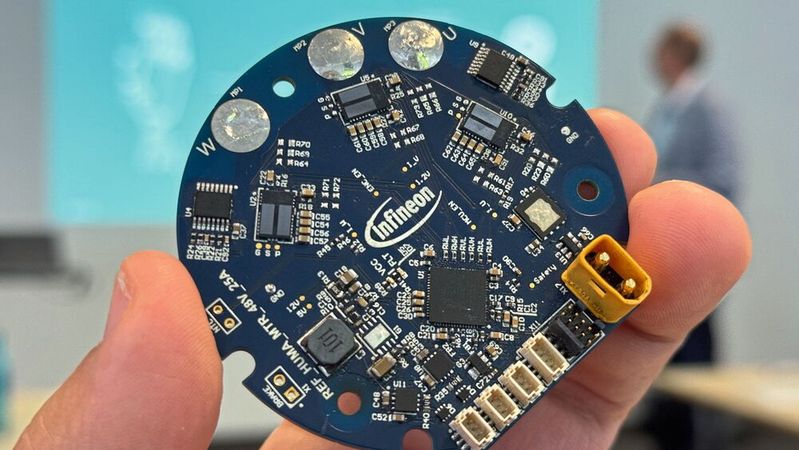
Integrated system solution: This compact circuit board serves as a highly integrated motor controller directly in the elbow joint of humanoid robots.
(Image: mc/VCG)
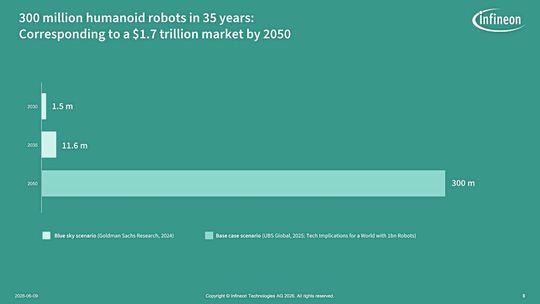
The robotics market is undergoing rapid expansion. Driven by an aging population and the widespread labor shortage, artificial intelligence is increasingly merging with the physical world. The industry refers to this as "Physical AI," or physical artificial intelligence. Machines are evolving from mere automatons to intelligent systems that perceive, understand, and interact with their surroundings.
Market growth: By 2050, the industry forecasts a demand for up to 300 million humanoid robots worldwide.
(Image: Infineon Technologies AG)
At the power electronics trade fair PCIM, semiconductor manufacturer Infineon addressed this technological challenge. Adam White, Head of Power & Sensor Systems at Infineon, sees his company playing a key role in this evolution: "We are shaping the industry from the power grid to the data center to Physical AI," White explains. Modern humanoid robots, perhaps the most complex mechanical systems of our time, often feature up to 70 motorized joints. Controlling these components presents developers with massive challenges.
Gallery
This is precisely where conventional semiconductors reach their limits. The electronics for motor control account for almost half of the entire semiconductor bill of materials in a robot. If these components are too heavy and bulky, a physical chain reaction occurs: heavier components require stronger motors, which in turn consume more power, drastically reducing the already limited battery life.
The GaN Advantage for Compact Joints
To break this cycle, semiconductor manufacturers like Infineon are increasingly relying on gallium nitride, or GaN. This innovative material enables significantly higher switching frequencies, which dramatically reduces the size of the required passive components and, consequently, the PCB footprint. Accordingly, Infineon showcased reference designs at the trade fair that achieve an extreme power density of 3.3 kilowatts per cubic inch.
"We know very well that, for example, in an elbow joint, the size is crucial because no one wants bulky and heavy motors," White explains this necessity. He adds: "Moreover, a bulky and heavy motor naturally requires a lot of energy."
The efficiency gains are also evident in thermal management. Nenad Belancic, Head of Application Management for Robotics at Infineon, emphasizes: "It's not just about size. It's also about the thermal performance you can achieve with GaN." The higher frequencies reduce the thermal power loss in the system. According to Belancic, this "not only relieves the boards but also the motor, as it cools there." Previously common, heavy cooling systems can thus be drastically reduced in size.
Dexterity: The Electronics of the Robotic Hand
Even more complex than an elbow is replicating the human hand. The so-called "dexterous hand" is considered one of the greatest challenges in robotics. To delicately grasp objects and operate tools, electronics and mechanics must work perfectly together in the smallest of spaces.
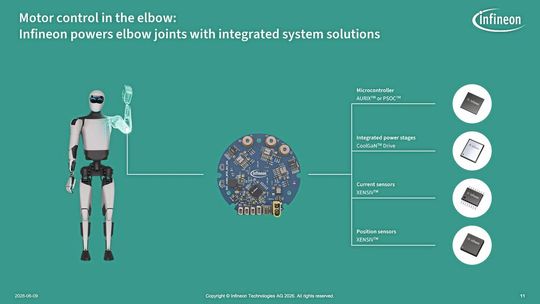
Compact power: A reference design for an elbow joint demonstrates the interplay of power switches, microcontrollers, and sensors in a confined space.
(Image: Infineon Technologies AG)
Infineon relies on highly integrated motor controllers from the Motix family, which enable exceptionally high component density. The drives are complemented by a phalanx of sensors. Radar systems, microphones, and specialized image processing chips help the robot with orientation, but for pure motion, internal sensors are crucial. Current and position sensors capture even the smallest movements of the finger joints in real time. "Dexterity for the hand will be the critical path," predicts Belancic, referencing specialized sensors that ensure safe and precise feedback.
System Architecture and Cost Drivers in Motor Control
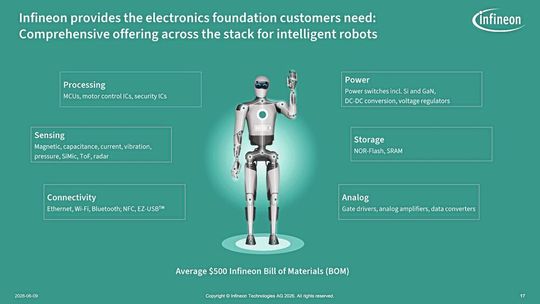
Depending on the safety requirements, conventional PSOC microcontrollers or high-security Aurix microcontrollers from the automotive sector control the joints. Economically, actuation remains the most expensive segment of the robot. Excluding the costly central processing units for machine learning (such as large GPUs), Infineon calculates its own semiconductor costs to average 500 US dollars per robot.
Value creation: Infineon estimates the addressable share of the semiconductor bill of materials (BOM) at an average of 500 USD per robot.
(Image: Infineon Technologies AG)
Belancic comments: "If you ask me, this number will certainly rise in the coming years because these robots' capabilities will increase." He identifies "actuation, data flow, and human-like behavior to support us humans" as key drivers for the growing demand for semiconductors.
Date: 08.12.2025
Naturally, we always handle your personal data responsibly. Any personal data we receive from you is processed in accordance with applicable data protection legislation. For detailed information please see our privacy policy.
Consent to the use of data for promotional purposes
I hereby consent to Vogel Communications Group GmbH & Co. KG, Max-Planck-Str. 7-9, 97082 Würzburg including any affiliated companies according to §§ 15 et seq. AktG (hereafter: Vogel Communications Group) using my e-mail address to send editorial newsletters. A list of all affiliated companies can be found here
Newsletter content may include all products and services of any companies mentioned above, including for example specialist journals and books, events and fairs as well as event-related products and services, print and digital media offers and services such as additional (editorial) newsletters, raffles, lead campaigns, market research both online and offline, specialist webportals and e-learning offers. In case my personal telephone number has also been collected, it may be used for offers of aforementioned products, for services of the companies mentioned above, and market research purposes.
Additionally, my consent also includes the processing of my email address and telephone number for data matching for marketing purposes with select advertising partners such as LinkedIn, Google, and Meta. For this, Vogel Communications Group may transmit said data in hashed form to the advertising partners who then use said data to determine whether I am also a member of the mentioned advertising partner portals. Vogel Communications Group uses this feature for the purposes of re-targeting (up-selling, cross-selling, and customer loyalty), generating so-called look-alike audiences for acquisition of new customers, and as basis for exclusion for on-going advertising campaigns. Further information can be found in section “data matching for marketing purposes”.
In case I access protected data on Internet portals of Vogel Communications Group including any affiliated companies according to §§ 15 et seq. AktG, I need to provide further data in order to register for the access to such content. In return for this free access to editorial content, my data may be used in accordance with this consent for the purposes stated here. This does not apply to data matching for marketing purposes.
Right of revocation
I understand that I can revoke my consent at will. My revocation does not change the lawfulness of data processing that was conducted based on my consent leading up to my revocation. One option to declare my revocation is to use the contact form found at https://contact.vogel.de. In case I no longer wish to receive certain newsletters, I have subscribed to, I can also click on the unsubscribe link included at the end of a newsletter. Further information regarding my right of revocation and the implementation of it as well as the consequences of my revocation can be found in the data protection declaration, section editorial newsletter.
Coexistence of Technologies: GaN Does Not Replace Silicon
Will gallium nitride completely replace conventional semiconductors like silicon in robotics? The experts clearly deny this. Instead, a parallel use will be established. Adam White sees the strengths of gallium nitride in areas where high switching frequencies necessitate miniaturization. However, he adds: "Silicon still offers significant advantages in terms of cost-performance ratio for a number of other joints that our customers are interested in."
Belancic also anticipates a long-term coexistence: "We will see both in the coming years." While integrated GaN modules offer clear advantages for joints from the shoulder downwards, he sees different requirements for heavily stressed components. "For the absolute high-performance joints, I believe the transition will be slower," says Belancic. In areas with extremely high torque, robust silicon solutions will retain their justification for the time being.
The Nervous System: Why Ethernet Resolves Data Bottlenecks
In addition to sheer driving force, a humanoid robot requires a gigantic nervous system to process the incoming masses of data. Cameras, microphones, and hundreds of sensors in the joints continuously generate information. "There is more and more data being generated," explains White. "You need the ability to transfer this information as quickly and effectively as possible, without latency."
While fieldbuses have traditionally dominated industrial plant networking, a technology known from IT is now moving to the center of the robotics chassis: Ethernet. The network protocol provides the necessary bandwidth to enable motors and sensors to communicate synchronously and without delay. "We believe Ethernet will become highly standardized in certain humanoids and in robotics within industrial architecture," White states confidently. Infineon is already supporting this development with concrete reference designs, including partnerships with the Nvidia platform Thor.
Hardware Security in the Age of Quantum Computers
However, the increasing networking and autonomy of Physical AI also entail immense risks. A robot that moves freely in factories or even in public spaces in the future represents a potentially devastating target for cyberattacks. Functional safety protects humans from the machine's malfunctions—but cybersecurity protects the machine from hackers.
"We want to ensure they are not taken over by external or malicious actors," warns White. The company is therefore integrating authentication chips and platform security solutions directly at the board level. A particular focus is already placed on post-quantum cryptography (PQC). Since future quantum computers could easily break today's encryptions, engineers are now implementing quantum-resistant hardware root of trust into the architecture of robots. "We don't just want to think about today, but also about tomorrow," White explains this forward-thinking step.
Accelerated Market Maturity through Global Partnerships
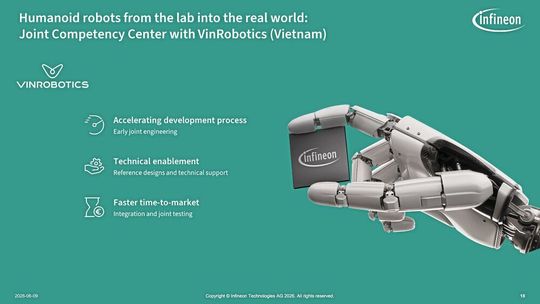
Strategic partnership: Together with Vinrobotics, Infineon is establishing a competence center in Vietnam to drastically shorten development cycles.
(Image: Infineon Technologies AG)
To accelerate the development of humanoid robots from initial design to mass production, semiconductor architects are increasingly relying on strategic collaborations. A recent example is a new partnership with the Vietnamese developer Vinrobotics. Both companies announced plans to establish a joint center of excellence in Hanoi. While the subsidiary of the Vingroup conglomerate contributes its expertise in mechanics and artificial intelligence, Infineon provides the complete electronic foundation, from sensors and power switches to cryptographic security chips. The choice of the Asian location is strategically motivated. The Southeast Asian region is rapidly developing into a massive hub for production, significantly driving the demand for automation solutions.
Virtual Training and the Evolution of Mechanics
Before these highly secure, connected, and intricate robots go into mass production, they must learn. This learning process is increasingly shifting to virtual spaces. Using digital twins, the systems complete millions of training cycles in simulation before taking their first physical step. Semiconductor manufacturers provide models of their hardware so developers can test the exact thermal and electrical behavior of the chips in advance on a computer.
The electronics industry thus provides all the tools for the age of Physical AI. The bottleneck is now increasingly shifting toward classic actuation. To fully exploit the efficiency advantages of the high switching frequencies of the new power electronics, new electromechanical concepts are required.
Belancic holds suppliers accountable: "This is not just about semiconductors. The motor industry must also address new motor technologies." Only when this bridge between electronics, software, and cutting-edge mechanics is achieved will nothing stand in the way of widespread use of humanoid robots.



:quality(80)/p7i.vogel.de/wcms/d1/ef/d1ef6b6f7d4543f7999980bacccaf22b/0133499261v1.jpeg "As the growing imbalance in trade relations with China continues to widen, the EU Chamber of Commerce foresees a day when trade with China will have to be seriously reevaluated ... (Image: AI-generated)")
:quality(80)/p7i.vogel.de/wcms/fe/1f/fe1fa5ee713f94deaba963dc24c3abc5/0133299273v1.jpeg "The Flexistar enables highly flexible production of laser-welded tubes thanks to its tool-free clamping system. (Image:Because Technology, LLC)")
:quality(80)/p7i.vogel.de/wcms/1b/5a/1b5ac72f83db4dbee3ff91e51bc398f4/0133496095v1.jpeg "BASF announces that it will take the next step toward producing the polyurethane precursor MDI in India ... (Image:BASF)")
:quality(80)/p7i.vogel.de/wcms/3f/cf/3fcfa390902944ffcf24e7fe973cc3ee/0133486258v1.jpeg "Do you need to create secure connections on structures using blind rivets, but space is tight? Then you should take a closer look at the Universalgrip from Gesipa ... (Image: Gesipa)")
:quality(80)/p7i.vogel.de/wcms/60/ef/60ef4f07e4829b2c2929befc0f353c58/0133511729v1.jpeg "Humanoid robots can match human performance in certain tasks. (Image:Gemini / AI-generated)")
:quality(80)/p7i.vogel.de/wcms/2e/99/2e99726b522e4b35b690e25eb6a42643/0133463991v1.jpeg "Robotics: In AMR applications, connection technology must reliably transmit power, signals, and data despite vibration and shock loads—in very confined spaces and in a way that allows for regular maintenance. (Image:Hyperever)")
:quality(80)/p7i.vogel.de/wcms/d0/18/d01801e3d5dbd7bc9d0b4f60408b630c/0133468429v1.jpeg "Quality requirements for film packaging are on the rise. At the same time, many companies are turning to recyclable film materials, which, however, have their own challenges. Fraunhofer researchers have therefore developed a fast system that detects problems in real time. (Image:Fraunhofer IKTS)")
:quality(80)/p7i.vogel.de/wcms/b1/06/b106cf44923ce39565c3264982fd20eb/0133414574v1.jpeg "Robots Build Robots: At the new Ubtech factory, automated systems even handle parts of the material supply and logistics for the production of humanoid robots. (Image:Ubtech)")
:quality(80)/p7i.vogel.de/wcms/c0/52/c052f405eb55fc3d08c4837e77206fc0/adobestock-2021845957--aucartstudio-stock-adobe-com-ki-generiertv1.jpeg "An innovation from China to combat extreme summer heat: A novel coating lowers temperatures. (Source: © AucArtStudio – stock.adobe.com_AI-generated)")
:quality(80)/p7i.vogel.de/wcms/66/a7/66a7b78159caeacce57136529688799f/0133503398v1.jpeg "Sunlight Makes Stone! These stone blocks weren't made the traditional way. Instead, they were additively manufactured from sand using a laser. In the future, however, the laser is set to be replaced by concentrated sunlight—if the startup Addisol is successful... (Image:Addisol / F. Fiedler)")
:quality(80)/p7i.vogel.de/wcms/72/b9/72b995c2c8d812c5e2115cbef31e035a/0133462727v1.jpeg "Eggl manufactures center hoods that are precisely tailored to each cooking island—whether standard size or custom shape. They are made entirely of stainless steel and are individually customized in terms of size and filter arrangement. (Image:SPI)")
:quality(80)/p7i.vogel.de/wcms/13/5d/135dfae6229ceaf5c55467a43e8f7257/adobestock-1879961393--ardi-stock-adobe-com-ki-generiertv1.jpeg "Annoying chatterboxes or awkward silences in response to questions—a moderator should specifically prepare for difficult situations in order to navigate them effectively. (Image:ardi - stock.adobe.com_AI-generated)")
:quality(80)/p7i.vogel.de/wcms/aa/a2/aaa2c6dd2daa24b485cddbf9297590c0/0133467318v1.jpeg "Battery Monitoring: Battery monitoring using electrochemical impedance spectroscopy offers several advantages. (Image:TI)")
:quality(80)/p7i.vogel.de/wcms/39/b2/39b21bf03be1683831862239a369987c/0133469638v1.jpeg "Data from autonomous vehicles and robots operating autonomously is in high demand, and Ruqi wants to capitalize on this. (Image:Ruqi Mobility)")
:quality(80)/p7i.vogel.de/wcms/8a/bb/8abbb6217220595edc1549ac9b84f307/0133429906v1.jpeg "The IAA in Hanover showcased the ambitions of Chinese commercial vehicle manufacturers in Europe. (Image:Wehner - VCG)")
:quality(80)/p7i.vogel.de/wcms/0c/53/0c5313ef91c14b6df0d0996efc33c8ad/jpg03568-bearbeitetv1.jpeg "The category winners of the 2027 German Car of the Year award. (Source: GCOTY)")
:quality(80)/p7i.vogel.de/wcms/ca/b4/cab46fd26d19d6a2febca032048200b6/0133471827v1.jpeg "Photonics SDK for C and Python: Computational operations are now abstracted as standard mathematical functions. (Image:Q.ANT)")
:quality(80)/p7i.vogel.de/wcms/92/b2/92b2ed5299cde450c0764f4f64468395/0133505895v1.jpeg "The \"Iris 100\" test system for high-precision volume production of microLEDs uses a spectrometer and a high-resolution camera. (Image:Teradyne)")
:quality(80)/p7i.vogel.de/wcms/f3/d8/f3d870d8f31a5a5110449c929ea3e641/0133470449v1.jpeg "The new Nexora sensor family from Teledyne e2v: These CMOS image sensors combine BSI technology with a global shutter and are available in 12- and 16-megapixel versions. (Image:Teledyne)")
:quality(80)/p7i.vogel.de/wcms/11/2e/112eabc5fb41e1a401f0e93e9326ef51/0133489329v1.jpeg "A sandbox limits the actions an AI agent can take, but it is not an impenetrable barrier. Only multiple independent layers of protection prevent an escape from immediately granting access to production systems. (Image:freely licensed)")
:fill(fff,0)/images.vogel.de/vogelonline/companyimg/76800/76895/65.jpg "FAULHABER_120mm.jpg ()")
:fill(fff,0)/p7i.vogel.de/companies/69/88/69882c428938e/tmts2026-ticec-banner-en-2000px.png "tmts2026-ticec-banner-en-2000px (https://www.tmts.tw/en)")
:fill(fff,0)/p7i.vogel.de/companies/69/de/69de1b7403b0d/simtos-logo.jpeg "simtos-logo (SIMTOS)")
:quality(80)/p7i.vogel.de/wcms/a2/bb/a2bb5134b8261cf6f8fbe60127fb0fdc/0131781745v1.jpeg "Strategy for artificial intelligence: Adam White, head of the Power & Sensor Systems division at Infineon, outlines the path from the power grid to Physical AI at the trade fair.(Image: mc/VCG)")
:quality(80)/p7i.vogel.de/wcms/72/e6/72e64c42ac05e03f24e1f1c7f829fb90/0131781712v1.jpeg "Integrated system solution: This compact circuit board serves as a highly integrated motor controller directly in the elbow joint of humanoid robots.(Image: mc/VCG)")
:quality(80)/p7i.vogel.de/wcms/84/b8/84b8127739aa2348eca3dfb607004696/0131781749v1.jpeg "View of the system architecture: Nenad Belancic, head of application management for robotics at Infineon, presents the electronic core components and the cost structure of the machines.(Image: mc/VCG)")
:quality(80)/p7i.vogel.de/wcms/cb/e2/cbe264cd5842f25f264e6fa75c0fefd8/0131628144v1v1.jpeg "Humanoid robotics places high demands on compact actuator designs: motor control, power electronics, sensors, and edge AI must work together efficiently in a confined space. (Image:Texas Instruments (edited))")
:quality(80)/p7i.vogel.de/wcms/0f/b2/0fb28656d39754b67a76b90b42243cda/0129655768v1.jpeg "Driven by GaN wafer production at 300 millimeters, Infineon's GaN products deliver outstanding performance with clear application benefits. (Image:Infineon Technologies AG)")
:quality(80)/p7i.vogel.de/wcms/cb/e2/cbe264cd5842f25f264e6fa75c0fefd8/0131628144v1v1.jpeg "Humanoid robotics places high demands on compact actuator designs: motor control, power electronics, sensors, and edge AI must work together efficiently in a confined space. (Image:Texas Instruments (edited))")