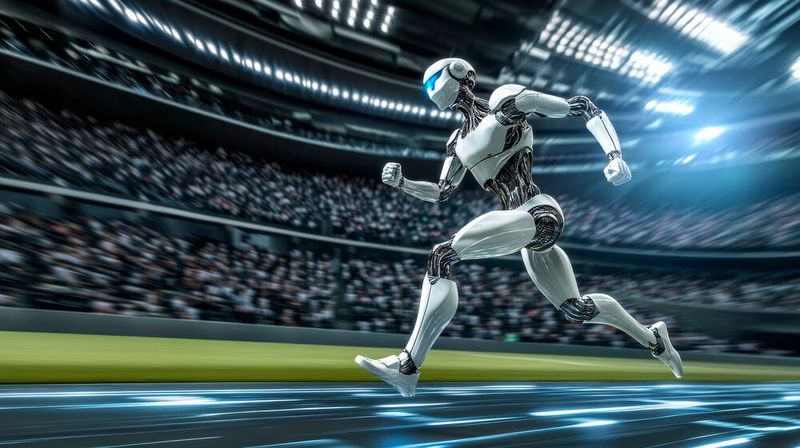
For three days, more than 500 humanoid robots from 16 countries recently competed in Beijing at the first World Games for Humanoid Robots – with impressive performances and also instructive mishaps.
From sprinting to basketball to synchronized dancing: Humanoid robots recently competed in 487 competitions across 26 "sports."
"6 minutes and 34 seconds!" This was the winning time with which "H1," a bipedal robot from the Chinese startup Unitree, won the gold medal in the 1500-meter race. A remote control was still in use, as with most other metal athletes. However, the runner-up "Tianjiao," competing for its manufacturer Beijing-X-Humanoid, already ran fully autonomously. No trainer was needed to run alongside it at the edge.
Autonomous runner wins the 100-meter sprint
In the 100-meter sprint as well, the gold medal went to one of the few athletes already equipped with sufficient artificial intelligence to run fully autonomously. "Tiangong Ultra," also from Beijing-X-Humanoid, did not achieve the best time over 100 meters—another biped was faster. However, since the humanoid with the absolute best time was still using a remote control, its time was evaluated differently. Similar to a sailing race, technical differences are balanced out at the Robot Olympics through multipliers and a type of points system.
Humanoid robots competed in nearly 500 competitions
The premiere of these "World Humanoid Robot Games" took place from August 15 to 17 in the "Beijing E-Town," an industrial district for high-tech start-ups on the outskirts of the Chinese capital. Domestic and international robots competed as fairly as possible for the honor of stepping onto the winners' podium at the end. They managed to do this independently as well.
There were a total of 487 competitions in 26 "sports," although not all of them fit into familiar Olympic categories. The range spanned from athletics, kickboxing, and soccer to more practical skills like sorting pharmaceutical products or serving tables in a restaurant. After all, the humanoids participated here as amateurs, while in everyday life, they usually dedicate themselves to more useful tasks.
From basketball to synchronized dancing
The robot "Photon" from Guanggu Dongzhi won the synchronized dancing competition with a powerful performance called "Soul of the Terracotta Warriors," which was particularly well-received by the judges. A noticeably agile team of humanoids named Hustrobocon, on the other hand, fought until the last second but ultimately had to settle for the silver medal in basketball. Judging by the applause, however, they were one of the audience's favorites.
The start-up Unitree from Hangzhou won a total of 11 medals, including four gold, making it the most successful team overall.
Chinese teams ultimately dominated the medal table. The start-up Unitree from Hangzhou won a total of 11 medals, including four gold, making it the most successful team overall. Right behind was X-Humanoid from Beijing with ten medals, including two gold.
Also multi-talented humanoids
Many of the humanoids did not participate in just a single competition but proved to be true multi-event talents. The H1 Unitree team, for example, competed in four running events (400 and 1500 meters, 100-meter hurdles, and the 4×100-meter relay). X-Humanoid's machines secured victories in the 100-meter sprint as well as on the material handling course, where factory work was simulated.
Other Chinese teams also excelled. The two Beijing start-ups Neotix Robotics and Booster Robotics, founded by graduates of Tsinghua University, won gold medals in robotic gymnastics, long jump, and soccer.
Just like in real world championships, there were also bizarre incidents and heartbreaking defeats here:
Some of the robots lost their orientation on the track. It looked as if they were exhausted, but it was likely more related to interference signals from opponents. One even collided with a human runner who was supposed to set the pace as a "pacer."
Still others stumbled over their own feet, and some of the robots wildly flailed their fists in the air during kickboxing until they fell over themselves without having hit any opponent beforehand.
An out-of-control humanoid had to be carried off the field by helpers like an injured track athlete.
These mishaps were, of course, a boon for the press, especially the foreign media, which was constantly looking for evidence that China still lags behind the USA or others in the field of AI or robotics.
Learning from mistakes
The developers themselves emphasized in interviews at the sidelines that every new mishap provides valuable feedback for the further development of their robots. They are still just at the very beginning. "No other industry has probably received so much attention so early on," one participant told a reporter from the Chinese portal Yicai, referring to the clumsy scenes. Every collision and every fall reveals weaknesses that need to be eliminated through improvements in mechanics and software, he said.
Max Polter, who participated in the competition with the robotic football team from the Leipzig University of Applied Sciences, expressed a similar sentiment. "We came here to play and win. But we are also interested in research," Polter told the news agency Reuters. "In this competition, you can try out many interesting, new, and exciting approaches."
Good prospects for the humanoids
All in all, however, the spectacle was quite impressive. It is astonishing what humanoid robots made in China have already learned in recent years. This is a promising sign for their use in the manufacturing and service industries.
Date: 08.12.2025
Naturally, we always handle your personal data responsibly. Any personal data we receive from you is processed in accordance with applicable data protection legislation. For detailed information please see our privacy policy.
Consent to the use of data for promotional purposes
I hereby consent to Vogel Communications Group GmbH & Co. KG, Max-Planck-Str. 7-9, 97082 Würzburg including any affiliated companies according to §§ 15 et seq. AktG (hereafter: Vogel Communications Group) using my e-mail address to send editorial newsletters. A list of all affiliated companies can be found here
Newsletter content may include all products and services of any companies mentioned above, including for example specialist journals and books, events and fairs as well as event-related products and services, print and digital media offers and services such as additional (editorial) newsletters, raffles, lead campaigns, market research both online and offline, specialist webportals and e-learning offers. In case my personal telephone number has also been collected, it may be used for offers of aforementioned products, for services of the companies mentioned above, and market research purposes.
Additionally, my consent also includes the processing of my email address and telephone number for data matching for marketing purposes with select advertising partners such as LinkedIn, Google, and Meta. For this, Vogel Communications Group may transmit said data in hashed form to the advertising partners who then use said data to determine whether I am also a member of the mentioned advertising partner portals. Vogel Communications Group uses this feature for the purposes of re-targeting (up-selling, cross-selling, and customer loyalty), generating so-called look-alike audiences for acquisition of new customers, and as basis for exclusion for on-going advertising campaigns. Further information can be found in section “data matching for marketing purposes”.
In case I access protected data on Internet portals of Vogel Communications Group including any affiliated companies according to §§ 15 et seq. AktG, I need to provide further data in order to register for the access to such content. In return for this free access to editorial content, my data may be used in accordance with this consent for the purposes stated here. This does not apply to data matching for marketing purposes.
Right of revocation
I understand that I can revoke my consent at will. My revocation does not change the lawfulness of data processing that was conducted based on my consent leading up to my revocation. One option to declare my revocation is to use the contact form found at https://contact.vogel.de. In case I no longer wish to receive certain newsletters, I have subscribed to, I can also click on the unsubscribe link included at the end of a newsletter. Further information regarding my right of revocation and the implementation of it as well as the consequences of my revocation can be found in the data protection declaration, section editorial newsletter.
There is particularly great potential in the hotel industry, said Huang Siyuan, a member of the BIGAI-Unitree team, to reporters. Where hotel guests, for example, sometimes complained about the varying cleanliness of their rooms, robots could perform cleaning tasks in the future with consistent thoroughness, Huang explained.
Beijing promotes the robotics industry
The robot Olympics, which are set to take place again next year, also served as a showcase for the city of Beijing, which actively promotes this industry. One of China's largest robotics industry hubs is to be established in the Beijing E-Town.
The effort is an example of the attempts by Chinese provincial governments to meet the Beijing central government's directive to use science and technology more than ever as a central growth driver for the gross domestic product. Robots and "embodied AI" are an example of the "new, high-quality productive forces" currently being vigorously promoted.
Global robotics market continues to grow
Anyone laughing at stumbling humanoids in the Beijing Olympics should better read the latest forecast from market research agency IDC: By 2029, it is predicted that the global robotics market could grow to a total value of 400 billion US dollars (around 340 billion euros). Nearly half of that is expected to be generated in China, according to IDC.
By 2029, the global robotics market could grow to a total value of 400 billion US dollars (around 340 billion euros).



:quality(80)/p7i.vogel.de/wcms/9f/5e/9f5ebdd436f99ade82edb3b60628c9f9/0132744768v1.jpeg "During welding, molten, glowing metal particles fly around. To ensure the welder is well protected, there are several things to consider. This includes protection from head to toe, covering the body, hands (image), and even feet. Arbeitsschutz-Express provides advice here ... (Image:Nitras)")
:quality(80)/p7i.vogel.de/wcms/80/92/8092cd36dac1d263ca6e705b8a7b0a69/0132724408v1.jpeg "New infrastructure projects in Kazakhstan aim to bring Europe and Asia closer together on the so-called Middle Corridor. (Image:Die Astana Times)")
:quality(80)/p7i.vogel.de/wcms/7d/1b/7d1b6a432c52f68600583b25f7d5c80d/0113143253v1.jpeg "In our China Market Insider, we regularly provide you with relevant information directly from China. (Image:© Eisenhans - stock.adobe.com)")
:quality(80)/p7i.vogel.de/wcms/09/42/09426afd0e023190089bd8c1c36c432f/0132473007v1.jpeg "Particularly in the area of solid carbide cutters, Pferd Tools has thousands of variants in its portfolio. (Image:Pferd Tools)")
:quality(80)/p7i.vogel.de/wcms/11/b0/11b041587fe5783597a78530b628ed7c/0132682714v1.jpeg "Symbolic image: New US rules could make market access more difficult for foreign providers of mobile robots and connected inverters. (Image:Dall-E / AI-generated)")
:quality(80)/p7i.vogel.de/wcms/f2/2d/f22d62adcc688c71e6bea844be9c2a9c/0132344529v1.jpeg "IO-Link is an important component for the Smart Factory. With high transmission speeds, additional data, simplified wiring, and easy integration, IO-Link offers crucial advantages for automation processes. (Image:Baumer)")
:quality(80)/p7i.vogel.de/wcms/2b/00/2b00bf86ad24c2db6c80b9edda1bb375/aufmacher-iotmaxx-gateways-cmykv1.jpeg "With the freely programmable Linux gateways from IoTmaxx, individual integration requirements can be implemented. They are now also available in customized switch cabinets from IoTmaxx. (Source: IoTmaxx GmbH)")
:quality(80)/p7i.vogel.de/wcms/6a/ab/6aab1e6c486540a1587dd92605efa931/0132684773v1.jpeg "Autonomous execution of workflows in the assembly of car doors at Audi. (Image:Mimic Robotics / Audi)")
:quality(80)/p7i.vogel.de/wcms/ca/90/ca90a13919cdade100d393bb3d2f4b3a/0132724138v1.jpeg "Improved cooling concept: Thanks to the cavity microstructure, known as vascular metamaterials, not only are volume and weight reduced, but the cooling capacity is also increased. (Image:Automoteam)")
:quality(80)/p7i.vogel.de/wcms/79/7d/797da27ccb047d5f70ba1d067db9aa81/newsimage425644v1.jpeg "Porous ceramic cubes from the 3D printer use energy-efficient evaporative cooling and noticeably reduce the temperature. (Source: Lunghammer - TU Graz)")
:quality(80)/p7i.vogel.de/wcms/ee/27/ee27620db6bb24e898d15a9452578774/titel-pumpev1.jpeg "Pressure fluctuations and flow forces directly influence the mechanical behavior of technical systems. Multiphysics analyses reveal critical interactions already in the early development stages. (Source: Merkle CAE Solutions)")
:quality(80)/p7i.vogel.de/wcms/47/a6/47a65bc9763ddfc99d52e7d9e48e8220/najwa-abdel-latif-shingle-matrix-fraunhofer-isev1.png "The project manager at Fraunhofer ISE, Najwa Abdel Latif, inspects the interconnected solar cells on the shingle matrix stringer at Fraunhofer ISE. (Source: Fraunhofer ISE / Sophia Bächle)")
:quality(80)/p7i.vogel.de/wcms/90/bb/90bb490f64a7eb60cf1805d9fdb541f0/353166-1-5v1.jpeg "A new electric car is almost always better for the climate than continuing to drive with a combustion engine. (Source: Volvo)")
:quality(80)/p7i.vogel.de/wcms/93/a5/93a52e2b9980dd2fe4823c8054d33c75/0132691285v1.jpeg "At the test bench, data from approximately 240 analog channels is measured. In total, including the channels captured via CAN, around 900 channels are recorded and monitored at the test bench. (Image: Liebherr)")
:quality(80)/p7i.vogel.de/wcms/0a/5c/0a5c469cb4bb53f28ff81c7689ebd868/0132728214v1.jpeg "Junghyun Kwon, Executive Vice President, Head of Autonomous Driving at Hyundai. (Image:Hyundai)")
:quality(80)/p7i.vogel.de/wcms/fd/f4/fdf477763e22c638539d9c204e6428f7/0132654523v1.jpeg "77 percent of EV batteries were manufactured in Asia, primarily in China, in 2025. This is an increase of 7 percent compared to 2024. (Image: AI-generated)")
:quality(80)/p7i.vogel.de/wcms/da/39/da39a38e5c07b0461d44b1a4660aa24f/0132715760v1.jpeg "Product innovation: Innodisk announces GMSL2 camera modules and adapter board series. (Image: Innodisk)")
:quality(80)/p7i.vogel.de/wcms/83/a9/83a9493ad202f37e188f3323c56aa2c6/0132672260v1.jpeg "After Moore's Law: Packaging is becoming the most important driver for semiconductor technology. (Image: ©Svitlana - stock.adobe.com)")
:quality(80)/p7i.vogel.de/wcms/1c/ba/1cba2c23c75d7e5d18f726598dc00708/0132680361v1.jpeg "Symbolic image: Data centers, chips, and circuit boards represent the real AI infrastructure—the fragile bubble represents the high expectations for its continued growth. (Image:Dall-E / AI-generated)")
:quality(80)/p7i.vogel.de/wcms/df/b6/dfb6fc4bd19a03eaff97541bd402c942/newsimage425602v1.png "In their work, researchers at Fraunhofer SIT first create deepfakes themselves to train the system. (Source: Fraunhofer SIT)")
:quality(80)/p7i.vogel.de/wcms/6c/7f/6c7fb5a967c52d6a5ab30d469a5d89ad/0127688784v1.jpeg "The Unitree Go2 can be ordered in its \"basic\" configuration starting at $1,600. (Image:Unitree)")
:quality(80)/p7i.vogel.de/wcms/3f/7f/3f7f9f45ebccd4751d41106866314aea/newsimage418028-2772x1559v1v1.jpeg "Live in the ice channel—detailed recordings in real time make the smallest mistakes and thus time losses in the luge run visible. (Image:Mittweida University of Applied Sciences)")