AI is putting strain on power grids worldwide, and more and more data centers need to generate their own energy. In an interview, Rolls-Royce data center expert Kevin McKinney explains how Rolls-Royce supports customers in this.
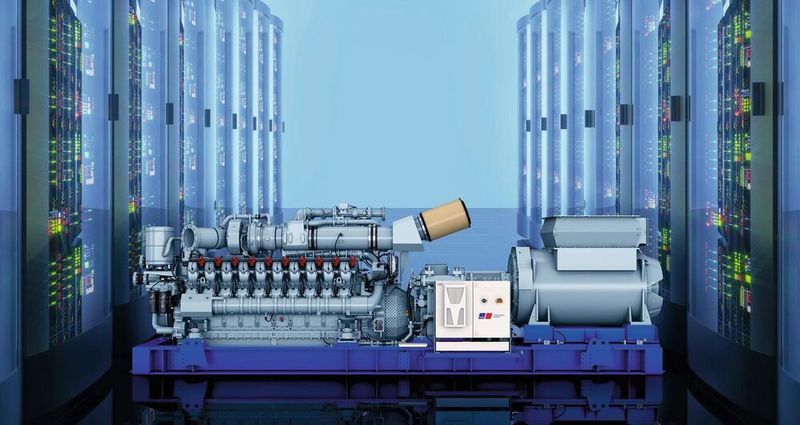
MTU gas generators of the 4000 series, which reach full load in 120 seconds, can already be used for power supply in data centers.
(Image: Rolls-Royce)
Rolls-Royce says it offers the Most Comprehensive Portfolio for Data Center Power Supply on the Market. What Does this Include— Briefly Explained?
McKinney: Rolls-Royce offers mtu emergency power solutions based on diesel and gas units, as well as dynamic uninterruptible power supply (UPS) systems, which are used worldwide to protect critical infrastructure. Mtu EnergetIQ, Rolls-Royce's energy management system, acts as the brain of the energy infrastructure, ensuring efficient and secure control of energy systems. With more than 10 gigawatts of installed capacity in mtu emergency power units, Rolls-Royce is one of the top three suppliers of emergency power systems for the world's booming data centers. We are the only major and experienced player in the data center energy systems sector offering diesel and gas units as well as dynamic high-performance UPS systems.
Recent Studies Show that the Energy Consumption of Data Centers Worldwide Will Double By 2030. At the Same Time, the Share of Renewable Energy in Power Grids is Growing in Many Countries—But these Are Often Inconsistent. For Data Center Operators, it is Becoming Increasingly Difficult to Obtain Sufficient And, Above All, Continuous Power. What Challenges Does this Development Pose for Data Center Operators?
McKinney: The major blackouts in 2025, such as in Portugal and Spain, have highlighted the vulnerability of the grids. Critical infrastructure like data centers must be protected against power outages and grid fluctuations, as these can lead to data loss and downtime.
Gallery
The limited capacity of power grids is becoming a bottleneck for data centers worldwide—especially in the US, Ireland, and key locations in Europe and Asia. New connections with the required capacity (often over 100 megawatts) are often unavailable, blocking investments, derailing site planning, and jeopardizing competitiveness in AI development.
At the same time, the rapidly growing energy demand driven by AI requires quick solutions, whereas grid expansion can take decades. While data centers can be constructed quickly, they often face challenges due to a lack of grid connections and insufficient power supply.
Is Self-Generation A Solution?
McKinney: Yes, self-generation is a solution, partly with renewable energy, but primarily with power generators that deliver continuously and reliably, such as gas engine power plants. They can be used to support the grid or as independent energy systems. Our mtu gas generators are already being used for continuous power supply at data centers. For example, SpaceDC operates its data center campus in Jakarta with Rolls-Royce technology. Mtu gas and diesel systems with exhaust aftertreatment technology ensure efficient and clean baseload and emergency power supply as well as cooling. Gas systems offer maximum efficiency because they can generate both electricity and heat or cooling. Mtu units also provide a lifespan of up to 84,000 operating hours until the time for overhaul (TBO).
Although investing in self-generation with gas engine power plants may initially seem like a cost risk, it offers long-term strategic advantages. Operators can open up new revenue streams with their own plants: for example, they can sell reserve capacities, waste heat, or processed CO2. Even after resolving grid bottlenecks, surpluses can be fed into the public grid, thereby reducing energy costs. This not only increases operational reliability but also strengthens grid stability and economic performance. Mtu gas generators are also available as container solutions, which are mobile and therefore can be used flexibly.
Can Gas Engines Also Be Used for the Emergency Power Supply of Data Centers?
McKinney: Yes, we already offer gas generators from our proven mtu Series 4000, which can reach full load in 120 seconds and are thus suitable for power supply in data centers. The brief supply gap is bridged by a UPS (batteries or kinetic energy storage systems). And for the 60-hertz market (e.g., North America), we will offer gas generators starting in 2026 that will achieve full power even faster—in 45 seconds—and with higher performance than their predecessors.
Why Are Classic Diesel Backup Generators Still the Number One Backup Solution?
McKinney: Diesel generators are still the perfect and most sought-after solution for critical facilities like data centers due to their excellent transient behavior—their ability to quickly respond to changing loads or speeds—and because they can take over full load extremely quickly. Within just ten seconds, they operate at full capacity and take over the entire power supply of a facility. The brief interval until the diesel engine reaches full power is bridged by batteries or kinetic energy storage systems. In emergencies, diesel generators can maintain power supply for several days. No other system can match their reliability and efficiency so quickly. Customers trust this technology and our expertise, which is why our revenue in this area increased by almost 50 percent last year.
Date: 08.12.2025
Naturally, we always handle your personal data responsibly. Any personal data we receive from you is processed in accordance with applicable data protection legislation. For detailed information please see our privacy policy.
Consent to the use of data for promotional purposes
I hereby consent to Vogel Communications Group GmbH & Co. KG, Max-Planck-Str. 7-9, 97082 Würzburg including any affiliated companies according to §§ 15 et seq. AktG (hereafter: Vogel Communications Group) using my e-mail address to send editorial newsletters. A list of all affiliated companies can be found here
Newsletter content may include all products and services of any companies mentioned above, including for example specialist journals and books, events and fairs as well as event-related products and services, print and digital media offers and services such as additional (editorial) newsletters, raffles, lead campaigns, market research both online and offline, specialist webportals and e-learning offers. In case my personal telephone number has also been collected, it may be used for offers of aforementioned products, for services of the companies mentioned above, and market research purposes.
Additionally, my consent also includes the processing of my email address and telephone number for data matching for marketing purposes with select advertising partners such as LinkedIn, Google, and Meta. For this, Vogel Communications Group may transmit said data in hashed form to the advertising partners who then use said data to determine whether I am also a member of the mentioned advertising partner portals. Vogel Communications Group uses this feature for the purposes of re-targeting (up-selling, cross-selling, and customer loyalty), generating so-called look-alike audiences for acquisition of new customers, and as basis for exclusion for on-going advertising campaigns. Further information can be found in section “data matching for marketing purposes”.
In case I access protected data on Internet portals of Vogel Communications Group including any affiliated companies according to §§ 15 et seq. AktG, I need to provide further data in order to register for the access to such content. In return for this free access to editorial content, my data may be used in accordance with this consent for the purposes stated here. This does not apply to data matching for marketing purposes.
Right of revocation
I understand that I can revoke my consent at will. My revocation does not change the lawfulness of data processing that was conducted based on my consent leading up to my revocation. One option to declare my revocation is to use the contact form found at https://contact.vogel.de. In case I no longer wish to receive certain newsletters, I have subscribed to, I can also click on the unsubscribe link included at the end of a newsletter. Further information regarding my right of revocation and the implementation of it as well as the consequences of my revocation can be found in the data protection declaration, section editorial newsletter.
What Advantages Do Dynamic UPS Systems Bring to Data Centers?
McKinney: Our mtu Kinetic PowerPacks can compensate for power and voltage fluctuations during normal operation, which can cause problems for advanced and sensitive IT equipment. Even if the primary power source completely fails, the stored kinetic energy is sufficient to bridge the time until the diesel engine reaches full operation. Compared to static UPS systems, these systems also offer the advantage of a smaller footprint and reduced overall complexity, as they do not require batteries or the associated HVAC infrastructure. This gives data centers more space for revenue-generating equipment (i.e., more servers).
Sustainability And CO2 Footprint Are Important Topics in the Data Center Market. Do Combustion Engines Have A Future in this Industry?
McKinney: Yes, definitely! At Rolls-Royce, we have made our mtu diesel engines future-ready in recent years: Without any performance limitations, it is already possible to reduce CO2, nitrogen oxide, and particulate emissions by over 90 percent.
Mtu emergency power generators are approved for sustainable fuels such as e-fuels and HVO (Hydrotreated Vegetable Oil). HVO can be used as a replacement for fossil diesel without further modifications. While it is already widely available on the market, its global availability still lags behind. As more operators adopt it and governments mandate environmental targets, we expect this to improve.
With our certified service, operators can perform test runs on their systems less frequently—every three months instead of monthly. This not only saves money but also reduces emissions. Our mtu exhaust aftertreatment systems also keep pollutants like nitrogen oxides and fine dust to an absolute minimum.
We have developed the first certified environmental product declarations for backup power generators as an engine manufacturer. This allows us to demonstrate the environmental footprint of our mtu systems, set new standards for environmental transparency, and support customers in reducing their CO2 footprint.
For gas engines, sustainable fuels such as biogas and biomethane are available and offer an environmentally friendly solution. Once green hydrogen becomes sufficiently available, mtu gas generators can operate with 100 percent hydrogen or with a hydrogen blend, significantly contributing to CO2 reduction. Since the summer of 2025, we have had the first mtu combined heat and power plants running on 100 percent hydrogen in operation.
We are also active in the development of carbon capture solutions, in which CO2 from gas power plants is recovered and processed, and we have commissioned a 10-megawatt gas power plant including a CO2 recovery system in the UK.
What Trends Do You See for the Energy Supply of Data Centers in the Next Ten Years?
McKinney: There is no doubt that efficiency and security will remain priorities in the energy supply of data centers. Solutions that are sustainable and those that provide opportunities for self-generation to enhance resilience and autonomy in energy supply will become increasingly important.
We assume that natural gas will increasingly be used for the energy supply of data centers in the future, especially in North America, where it is relatively inexpensive and readily available. We see it as a natural bridging technology for the emerging energy gap between supply and demand from the power grid.
In the medium to long term, we also see nuclear solutions like small modular reactors (SMRs) emerging, which provide reliable, long-term energy supply for data centers. These will also require backup power, ensuring continued demand for our diesel and gas systems even with the use of SMRs.
Overall, we do not see one single solution, no silver bullet. We assume that depending on the region, circumstances, and customer needs, there will be different technologies and solutions.
What’s Next for Rolls-Royce—Will there Be New Solutions?
McKinney: Yes, we will continue to innovate to keep pace with the constantly evolving data center market, as this is one of our key markets. Our strategic goal is to further expand the power generation business profitably. To this end, we are investing heavily in expanding our portfolio to meet the future needs of our customers.
In the field of diesel engines, we are currently developing the next generation of our proven Series 4000 engine, which will be available from 2028. The new engine will offer a performance increase of more than 20 percent with nearly the same footprint, providing us with the best power density in its class, which in turn benefits customers by requiring less space. The engines of the new platform are also exciting because they will consume less fuel and can be operated with sustainable fuels.
In the gas sector, the introduction of the 45-second fast-start solution with higher performance for the US market will represent a significant advancement for our customers. We also anticipate that our customers will come to appreciate the benefits of a combination of diesel and gas generators—to reduce emissions, improve efficiency, and expand more flexibly and quickly. Overall, we see ourselves well-positioned for future developments.
Looking to the future, we are excited about the prospects of Rolls-Royce's SMR nuclear power plant solution. The Rolls-Royce SMR offers a radically different approach to deploying proven nuclear technology and has already been selected for use in the UK (by Great British Nuclear—Energy) and in the Czech Republic (by European energy provider CEZ). The Rolls-Royce SMR is in the final stage of assessment by UK regulators and has recently entered the pre-application phase of the regulatory process in the US.



:quality(80)/p7i.vogel.de/wcms/17/b8/17b8af0cb725e0e1d3e8d72458bab260/siemens-meet-at-the-machinev1.jpeg "“Meet at the Machine” is Siemens’ new initiative, which aims to bring together machine builders, software, and automation technologies to accelerate innovation in the machine tool industry and help manufacturers become productive more quickly. (Source: Siemens)")
:quality(80)/p7i.vogel.de/wcms/8e/7e/8e7e0cda4c68699bcc48283a38739769/0133316747v1.jpeg "A little-known hidden champion! When people think of laser cutting, the first thing that comes to mind is the power of the laser beam—and it is impressive to see the sparks flying. But Air Liquide—an exhibitor at Euroblech, by the way—wants to make it clear that the process gas is also key to success. (Image:AI-generated)")
:quality(80)/p7i.vogel.de/wcms/20/fa/20fa35e0af203c3464f7e7fdbb57a685/0133281172v1.jpeg "Since 2003, Etzinger AG has been developing and manufacturing high-quality coffee grinders, pepper mills, and grinding mechanisms for professional and home use. (Image:Etzinger)")
:quality(80)/p7i.vogel.de/wcms/69/91/6991413943488b4a2f6fde9dcd88c5b0/0133256686v1.jpeg "The CMA-patented pendulum mount can compensate for radial tolerances of up to one millimeter. (Image:Schwiening)")
:quality(80)/p7i.vogel.de/wcms/38/79/38799bfbbccd938b64c67068cfa68780/0133329362v1.jpeg "What exactly enables machines to act on their own? (Image:Shutterstock)")
:quality(80)/p7i.vogel.de/wcms/1b/9f/1b9fc9f113fc66212e2c0e17a3edaf9f/org-blobs-user-response-file-output-f317796f-57b7-483f-9403-5d9ac8a816f5-plugin-output-call-kdigtepb7be7us8xvbota0mh-1672x940v1.png "According to Barclays data, Europe leads the global trade in actuator components. With a 34 percent share, the region ranks ahead of China, which has a 26.3 percent share. (Source: Statista | CC BY-ND 4.0, AI-generated)")
:quality(80)/p7i.vogel.de/wcms/f5/4c/f54c9fc59ccb0604ab9219188469a45f/image1v1.jpeg "Christopher Savoia, Global Head of the UR+ Ecosystem at Universal Robots, presents the new SP7 Smart Panel on a UR17g-1300 robot during the unveiling of Gen 7—UR’s 7th-generation robot platform—at IMTS in Chicago on September 14, 2026. (Image:Image: Teradyne Robotics)")
:quality(80)/p7i.vogel.de/wcms/bd/4e/bd4ef09ab0f84932ea76ca0330ffe789/0133329802v1.jpeg "The robotics boom and its consequences: According to a study, a significant portion of value creation occurs in the electronics industry. (Image:Fraunhofer IPA)")
:quality(80)/p7i.vogel.de/wcms/87/87/87870cf2b30aaef7b8a06212a4ef2c14/0133403885v1.jpeg "A digital twin and a real component demonstrate how closely simulation and manufacturing are converging. Stampack Xpress 2026.1 virtually models forming behavior and supports the validation of process and tool design. (Image:Stampack)")
:quality(80)/p7i.vogel.de/wcms/59/2a/592a7f2d0964e9e6846cae331f5daa3a/0133266065v1.jpeg "Perforated metal sheets are particularly well-suited for balcony railings, as they combine stability, privacy, and design versatility. (Image:Ripo Factory)")
:quality(80)/p7i.vogel.de/wcms/45/64/45642ff0fe0a6bec251b77739131d83b/abb-ferrari-hypersail-16-9-three-quarter-front-viewv1.jpeg "The Ferrari Hypersail is a 100-foot monohull wing-in-plane yacht powered entirely by renewable energy. (Source: ABB / Ferrari Hypersail)")
:quality(80)/p7i.vogel.de/wcms/3e/0e/3e0e3ea22e48410ceada53b02ffccb59/0133358454v1.jpeg "BYD top executive Stella Li plans to offer megawatt flash charging for commercial vehicles as well. (Image:VDA/IAA Transportation 2026)")
:quality(80)/p7i.vogel.de/wcms/e2/7d/e27de60472809cc58ac0d321066c9679/l1051833v1.jpeg "Geely has acquired a stake of just over 26 percent in Renault do Brasil. Geely models for the South American market are now also being produced at the Ayrton Senna plant in São José dos Pinhais. (Image:Renault)")
:quality(80)/p7i.vogel.de/wcms/1e/c1/1ec1495eb283200f4b7cb55de0c4dff7/20260917-110436643v1.jpeg "Ceremonial launch of Mercedes-Benz GLA production in Rastatt; among those in attendance was plant manager Marco Zwick (second from the right). (Source: Thomas Günnel – Automotive Industry)")
:quality(80)/p7i.vogel.de/wcms/76/f3/76f310eed0caebc79ff91195c29de08d/visual-siwa-treatment-optimizerv1.jpeg "A Mireo train from Siemens Mobility was used in the “Automated Train” project for a fully automated delivery and return trip on the open rail network. (Source: Siemens Mobility)")
:quality(80)/p7i.vogel.de/wcms/4c/53/4c534208d09a9b1ce597938715e7fc19/0133288763v1.jpeg "Logic Folding: In its latest Kirin 9050 Pro, Huawei uses hybrid bonding to distribute the computing units across two silicon layers in order to increase the effective transistor density without resorting to finer manufacturing processes. (Image:Huawei)")
:quality(80)/p7i.vogel.de/wcms/56/d1/56d131e0b5bd05ef47411e92ad740cb4/0133351029v1.jpeg "Researchers at DTU have developed a nanolaser in a semiconductor membrane. The structure concentrates charge carriers and the light field into a small area (shaded in blue). If data is transmitted on microchips using light instead of electrical signals, transmission speeds can be increased and energy losses reduced. (Image:Yi Yu, DTU)")
:quality(80)/p7i.vogel.de/wcms/5e/55/5e55101ddc6338f755fcf3244db1367f/0133331863v1.jpeg "For data center projects, it is becoming increasingly important to also obtain the consent of the affected community. (Image:Dall-E / AI-generated)")
:quality(80)/p7i.vogel.de/wcms/8d/f9/8df95d3f58408673986b3d643e6b63ba/0133252773v1.jpeg "TXC targets high-speed optical links in AI data centers with 312.5 MHz oscillators, among other solutions. As data rates increase, requirements for jitter and frequency stability become more demanding as well. (Bild: TXC)")
:fill(fff,0)/images.vogel.de/vogelonline/companyimg/76800/76895/65.jpg "FAULHABER_120mm.jpg ()")
:fill(fff,0)/p7i.vogel.de/companies/69/de/69de1b7403b0d/simtos-logo.jpeg "simtos-logo (SIMTOS)")
:quality(80)/p7i.vogel.de/wcms/15/00/1500914283ebd62e25179f63c8ee8ed3/0127135744v1.jpeg "Mtu-Kinetic PowerPacks can compensate for power and voltage fluctuations during normal operation. Even if the primary power source fails, the stored kinetic energy is sufficient to bridge the time until the diesel engine reaches full operation. Mtu-Kinetic PowerPacks consist of a constantly rotating kinetic energy storage unit, an mtu diesel engine, and a generator that also functions as an electric motor.(Image: Rolls-Royce)")
:quality(80)/p7i.vogel.de/wcms/53/52/535257acf490060e3545cd1b43f10a6d/0127135753v1.jpeg "Rolls-Royce SMR Ltd was established to develop a cost-effective power plant that generates electricity with a small modular reactor – an intelligent solution to meet our future energy needs.(Image: Rolls-Royce)")
:quality(80)/p7i.vogel.de/wcms/ba/2b/ba2b0cfb2233a28018579af609f4c9ae/0127136006v1.jpeg "Rolls-Royce data center expert Kevin McKinney, Vice President Powergen Sales Americas.(Image: Rolls-Royce)")
:quality(80):fill(efefef,0)/p7i.vogel.de/wcms/67/ad/67adf92d254d2/elatec-wp-smart-factory.png "Elatec WP Smart Factory")
:quality(80)/p7i.vogel.de/wcms/68/ec/68ec268edc51a26c4e6e2de7187e8e4f/0129456364v1.jpeg "The storage facilities are being built at three locations in Lithuania. (Image:Nidec Conversion)")
:quality(80)/p7i.vogel.de/wcms/0e/71/0e71cef13f6e8aedbfc7dcaa69f0728f/0132990439v1.jpeg "Rolls-Royce delivers 33 mtu Series 4000R engines to the Korea Railroad Corporation, which are integrated into new freight locomotives by the rail vehicle manufacturer Romansys. (Image:Rolls Royce)")