


:quality(80)/p7i.vogel.de/wcms/d9/43/d943b0ce33bdf921f37f14655bb0c376/cuscinetto-a-sfere-di-leonardo-da-vinci-in-una-mostra-su-leonardo-da-vinci-al-mulino-di-mora-bassa---morabassa-croppedv1.jpeg "Replica of Leonardo da Vinci's ball bearing: The inventor used wooden balls. Spacers prevent the balls from rubbing against each other. (Source: Capricornis crispus)")
:quality(80)/p7i.vogel.de/wcms/17/b8/17b8af0cb725e0e1d3e8d72458bab260/siemens-meet-at-the-machinev1.jpeg "“Meet at the Machine” is Siemens’ new initiative, which aims to bring together machine builders, software, and automation technologies to accelerate innovation in the machine tool industry and help manufacturers become productive more quickly. (Source: Siemens)")
:quality(80)/p7i.vogel.de/wcms/8e/7e/8e7e0cda4c68699bcc48283a38739769/0133316747v1.jpeg "A little-known hidden champion! When people think of laser cutting, the first thing that comes to mind is the power of the laser beam—and it is impressive to see the sparks flying. But Air Liquide—an exhibitor at Euroblech, by the way—wants to make it clear that the process gas is also key to success. (Image:AI-generated)")
:quality(80)/p7i.vogel.de/wcms/20/fa/20fa35e0af203c3464f7e7fdbb57a685/0133281172v1.jpeg "Since 2003, Etzinger AG has been developing and manufacturing high-quality coffee grinders, pepper mills, and grinding mechanisms for professional and home use. (Image:Etzinger)")
:quality(80)/p7i.vogel.de/wcms/b1/06/b106cf44923ce39565c3264982fd20eb/0133414574v1.jpeg "Robots Build Robots: At the new Ubtech factory, automated systems even handle parts of the material supply and logistics for the production of humanoid robots. (Image:Ubtech)")
:quality(80)/p7i.vogel.de/wcms/38/79/38799bfbbccd938b64c67068cfa68780/0133329362v1.jpeg "What exactly enables machines to act on their own? (Image:Shutterstock)")
:quality(80)/p7i.vogel.de/wcms/1b/9f/1b9fc9f113fc66212e2c0e17a3edaf9f/org-blobs-user-response-file-output-f317796f-57b7-483f-9403-5d9ac8a816f5-plugin-output-call-kdigtepb7be7us8xvbota0mh-1672x940v1.png "According to Barclays data, Europe leads the global trade in actuator components. With a 34 percent share, the region ranks ahead of China, which has a 26.3 percent share. (Source: Statista | CC BY-ND 4.0, AI-generated)")
:quality(80)/p7i.vogel.de/wcms/f5/4c/f54c9fc59ccb0604ab9219188469a45f/image1v1.jpeg "Christopher Savoia, Global Head of the UR+ Ecosystem at Universal Robots, presents the new SP7 Smart Panel on a UR17g-1300 robot during the unveiling of Gen 7—UR’s 7th-generation robot platform—at IMTS in Chicago on September 14, 2026. (Image:Image: Teradyne Robotics)")
:quality(80)/p7i.vogel.de/wcms/ca/46/ca462051dfb9a1fb37ca4053762af9df/org-blobs-user-response-file-output-908c701c-3b37-491e-bb5c-35fc3d336575-plugin-output-call-182851v1.png "Through extreme compression, high-energy lasers transform simple plastics into high-purity nanodiamonds. What was once used in planetary physics is now opening up entirely new possibilities for quantum sensors, novel catalysts, and extremely hard materials. (Illustrative image) (Source: VCG / AI-generated)")
:quality(80)/p7i.vogel.de/wcms/7c/7a/7c7a5eada63c7a36a365391c292f76d4/hot-fire-jarvisv1.jpeg "(Developed in record time: A “JARVIS-class” jet engine capable of up to 100 pounds of thrust. It was designed in a four-week sprint using generative AI and established CAD/CAE tools.MIT)")
:quality(80)/p7i.vogel.de/wcms/87/87/87870cf2b30aaef7b8a06212a4ef2c14/0133403885v1.jpeg "A digital twin and a real component demonstrate how closely simulation and manufacturing are converging. Stampack Xpress 2026.1 virtually models forming behavior and supports the validation of process and tool design. (Image:Stampack)")
:quality(80)/p7i.vogel.de/wcms/59/2a/592a7f2d0964e9e6846cae331f5daa3a/0133266065v1.jpeg "Perforated metal sheets are particularly well-suited for balcony railings, as they combine stability, privacy, and design versatility. (Image:Ripo Factory)")
:quality(80)/p7i.vogel.de/wcms/24/d5/24d546b8c00887feaef1cbc207b9e2af/0133433032v1.jpeg "Mahle CEO Arnd Franz was recently asked about his vision for the future of the commercial vehicle business—particularly regarding the industry's transition to electric vehicles... (Image:Kai R. Joachim / Mahle)")
:quality(80)/p7i.vogel.de/wcms/8b/c5/8bc5c0c40b6d706aca4e3f3ddcc99958/0133387335v1.jpeg "At InnoTrans, Stadler is unveiling for the first time its new four-axle EURO DuFour locomotive for freight service, which SBB Cargo has ordered. Compared to the existing fleet, it is expected to be significantly more energy-efficient in operation. (Image:Stadler)")
:quality(80)/p7i.vogel.de/wcms/49/97/49978469e969283ccb68531ebef1f412/klaus-zellmer-1v1.jpeg "Klaus Zellmer will become CEO of Volvo no later than October 2027. (Source: Volvo)")
:quality(80)/p7i.vogel.de/wcms/cf/e1/cfe1f3824102bd030f4fe5e4e13e1e0e/0133433007v1.jpeg "The situation in the German automotive manufacturing industry is not exactly rosy, especially when viewed in the context of global competition. Read here to find out what a recent analysis of the situation reveals ... (Image:AI-generated)")
:quality(80)/p7i.vogel.de/wcms/f3/d9/f3d91ebfd703e24d4065b0ae7898e46b/0133177388v1.jpeg "The Evolution of Coding: In the past, programs were written by hand and fed into the computer using punch cards and switches. Today, in the age of “vibe coding,” computers can largely program themselves. (Image:Dall-E / AI-generated)")
:quality(80)/p7i.vogel.de/wcms/00/cd/00cd7c51cf41652dbb295c14634cd34f/0133438409v1.jpeg "Flash memory from Spansion dating back to 2004, before the company merged with Cypress. Infineon is divesting its NOR flash and FRAM memory business. Winbond, which is acquiring the division for $1.12 billion, plans to continue operating it as a separate company under the Spansion name starting next year. (Image:Raimond Spekking / CC BY-SA 4.0 / Wikimedia Commons)")
:quality(80)/p7i.vogel.de/wcms/09/dc/09dcc37616c3a9d5d7a289c97a352a89/0133428369v1.jpeg "(Image:Gemini / AI-generated)")
:quality(80)/p7i.vogel.de/wcms/4c/53/4c534208d09a9b1ce597938715e7fc19/0133288763v1.jpeg "Logic Folding: In its latest Kirin 9050 Pro, Huawei uses hybrid bonding to distribute the computing units across two silicon layers in order to increase the effective transistor density without resorting to finer manufacturing processes. (Image:Huawei)")
Economic Sector Intelligence E-Mobility Fulfilled – China Focuses on Robotics and Artificial Intelligence
Related Vendor
:fill(fff,0)/images.vogel.de/vogelonline/companyimg/76800/76895/65.jpg "FAULHABER_120mm.jpg ()")
Electric mobility is now rolling on its own: China is focusing on autonomous driving, robotics, and artificial intelligence. The car is less a means of transportation and more a technology carrier and test application.
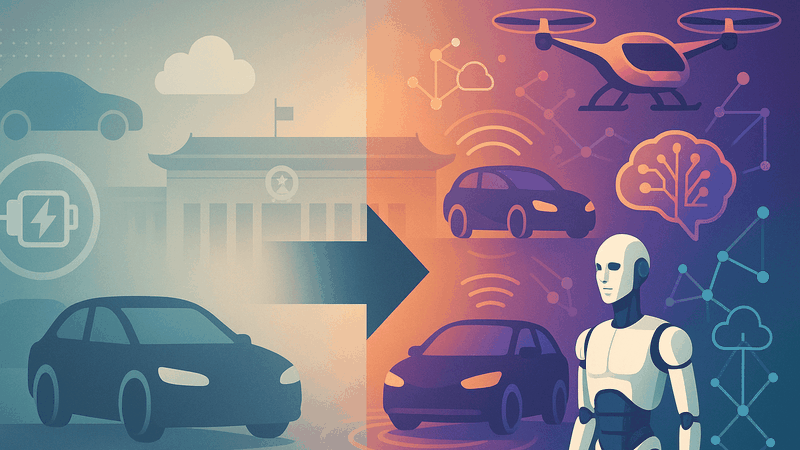
China's political leadership has just stamped the electric mobility initiative with "Mission accomplished." The task is completed. The government in Beijing is now focusing on new topics. In short: The focus is shifting to what comes next. Autonomous and connected driving, the integration of the automotive industry with robotics and artificial intelligence, as well as the new billion-dollar market for flying cars.
Sign in or register and read on
Please log in or register and read this article. To be able to read this article in full, you must be registered. Free registration gives you access to exclusive specialist information.
Already registered? Log in here
:quality(80)/p7i.vogel.de/wcms/3a/ed/3aed943c2c83093b13abcaf7a26112da/580727-xpeng-20p7-r5a9710-9202e9-original-1741189346-3600x2024v1v1.jpeg "\"Car manufacturing is not a good business model,\" says He Xiaopeng, founder and CEO of Chinese e-car manufacturer Xpeng. (Image:Xpeng)")
:quality(80)/p7i.vogel.de/wcms/d5/76/d5764e7ca6787e7a924fcc26c3de6793/l9-outdoor01-11358x6389v1v1.jpeg "According to the manufacturer, the new Li L9 is no longer a car, but embodies artificial intelligence. (Image:Li car)")