By 2030, electric drives could generate significantly more revenue. Additionally, charging times are decreasing. And: Europe must invest in cell production.
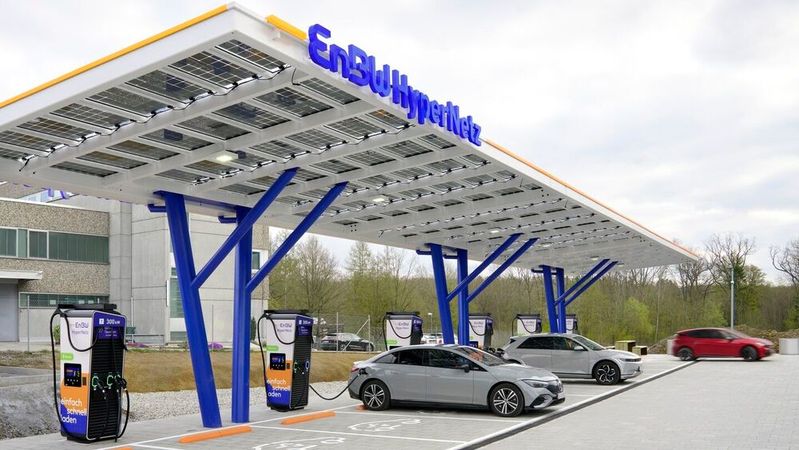
EnBW has the largest market share for DC charging in Germany at nearly 32 percent.
(Image: Endre Dulic)
By 2030, the global revenue from electric drive systems for electric cars could more than double—to over 630 billion euros annually (~$693 Billion). This would exceed the total revenue of the three largest European car manufacturers today. This is shown by the Powertrain Study 2025 by the consulting firm "Strategy&" of PwC.
According to the study, the share of pure BEV platforms among globally sold passenger cars will rise to around 40 percent by 2030 and to about 60 percent by 2035. Simultaneously, global battery demand is expected to nearly quintuple from today's 1.15 terawatt-hours to around five terawatt-hours in 2035, according to the consultants.
Electric cars are becoming more efficient, and charging is faster
According to the study, technological advancements are a major driver of the electric transition, with direct effects on range, charging speed, and cost-effectiveness. By 2030, charging capacities of up to 400 kilometers in ten minutes are expected to be widely available, reaching a level close to refueling with gasoline or diesel. At the same time, the average energy consumption of electric vehicles is expected to decrease significantly and could stabilize at around 14 kilowatt-hours per 100 kilometers, on average across platforms.
This is made possible by new cell chemistries, optimized battery architectures, and efficient drive systems. Costs are also decreasing according to the forecast: increased competition, economies of scale in production, and falling raw material prices are already noticeably driving down prices. According to the study, a further decline in cell prices by up to 15 percent within the next five years seems possible.
Same total costs as combustion models
In terms of total cost levels, purely electric vehicles are already on par with combustion engine models in many segments. "By 2030, they are likely to achieve economic parity in all segments—marking the breakthrough to becoming the dominant drive technology of the next mobility era," predict the study's authors.
The transformation, according to the study, is not proceeding uniformly. "While China continues to accelerate the ramp-up of BEVs, Europe and the U.S. particularly lack affordable and widespread fast-charging options in rural areas. Added to this are regulatory hurdles and inconsistent subsidy frameworks," explains Jörn Neuhausen, Senior Director and Head of E-Mobility at Strategy& Germany. Multi-energy platforms and plug-in hybrids, therefore, represent a flexible response to fragmented markets, according to Neuhausen. "In the long term, however, dedicated BEV platforms will prevail," he says.
Battery cells: Europe and the USA dependent on China
China's lead in electrification is evident in market penetration. In the first quarter of 2025, BEVs accounted for 26 percent of total passenger car sales in China. In Europe, it was 15 percent. In the U.S., only eight percent. The absolute sales figures also paint a clear picture: according to the study authors, around 6.7 million BEVs were sold in China in 2024—more than three times as many as in Europe, with two million, and more than five times as many as in the U.S., with 1.2 million.
China's dominance is particularly evident in battery cell production. Around 70 percent of global capacity is accounted for by companies headquartered in China. They are followed by companies from South Korea with 15 percent and Japan with five percent. European and U.S. manufacturers are thus heavily dependent on Asian suppliers. According to the consultants, battery cells are no longer just a technological issue but a strategic resource.
Date: 08.12.2025
Naturally, we always handle your personal data responsibly. Any personal data we receive from you is processed in accordance with applicable data protection legislation. For detailed information please see our privacy policy.
Consent to the use of data for promotional purposes
I hereby consent to Vogel Communications Group GmbH & Co. KG, Max-Planck-Str. 7-9, 97082 Würzburg including any affiliated companies according to §§ 15 et seq. AktG (hereafter: Vogel Communications Group) using my e-mail address to send editorial newsletters. A list of all affiliated companies can be found here
Newsletter content may include all products and services of any companies mentioned above, including for example specialist journals and books, events and fairs as well as event-related products and services, print and digital media offers and services such as additional (editorial) newsletters, raffles, lead campaigns, market research both online and offline, specialist webportals and e-learning offers. In case my personal telephone number has also been collected, it may be used for offers of aforementioned products, for services of the companies mentioned above, and market research purposes.
Additionally, my consent also includes the processing of my email address and telephone number for data matching for marketing purposes with select advertising partners such as LinkedIn, Google, and Meta. For this, Vogel Communications Group may transmit said data in hashed form to the advertising partners who then use said data to determine whether I am also a member of the mentioned advertising partner portals. Vogel Communications Group uses this feature for the purposes of re-targeting (up-selling, cross-selling, and customer loyalty), generating so-called look-alike audiences for acquisition of new customers, and as basis for exclusion for on-going advertising campaigns. Further information can be found in section “data matching for marketing purposes”.
In case I access protected data on Internet portals of Vogel Communications Group including any affiliated companies according to §§ 15 et seq. AktG, I need to provide further data in order to register for the access to such content. In return for this free access to editorial content, my data may be used in accordance with this consent for the purposes stated here. This does not apply to data matching for marketing purposes.
Right of revocation
I understand that I can revoke my consent at will. My revocation does not change the lawfulness of data processing that was conducted based on my consent leading up to my revocation. One option to declare my revocation is to use the contact form found at https://contact.vogel.de. In case I no longer wish to receive certain newsletters, I have subscribed to, I can also click on the unsubscribe link included at the end of a newsletter. Further information regarding my right of revocation and the implementation of it as well as the consequences of my revocation can be found in the data protection declaration, section editorial newsletter.
The conclusion of the study's authors: Europe must act now with consistent investments in its own cell production, research and development, and cross-location partnerships with industry, politics, and capital markets. Only then can companies secure a position in the value chain of the next mobility era.