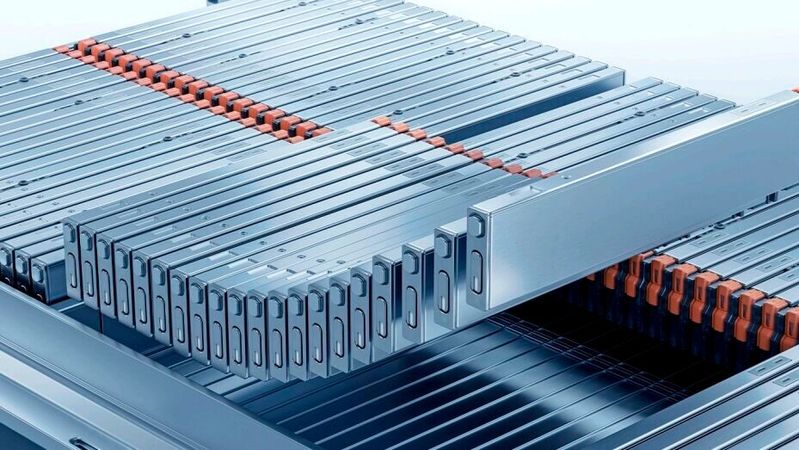
The market for battery cells is turning. There is overcapacity, according to a report by management consultants McKinsey. This has a positive effect on prices, but at the same time the train for cell production in Europe has finally left the station.
The prospects for European cell production have been poor for some time. The reasons for this are high production costs, technical difficulties in ramping up production and overcapacity on the market.
(Image: McKinsey)
The chances of European cell production have been poor for some time. Almost all major projects are on hold, have been abandoned or have slipped into insolvency. Automotive Cells Company (ACC) is no longer pursuing its plans for Kaiserslautern and Termoli in Italy. The joint venture between Stellantis, Mercedes-Benz and Total Energies is sticking with production in Douvrin, France. The Porsche investment Cellforce will not be implementing its ambitious plans for the production of high-performance cells with silicon anodes. The Chinese manufacturer Svolt is abandoning its two planned sites in Saarland and one in Brandenburg.
The insolvency of the Swedish company Northvolt is likely to have received the most media attention. The plans for Northvolt Drei, a cell factory in Heide, Germany, were caught up in the maelstrom of the Swedish parent company's insolvency. It remains to be seen whether the announced takeover by the US manufacturer Lyten will go ahead as planned.
900 GWh of Overcapacity
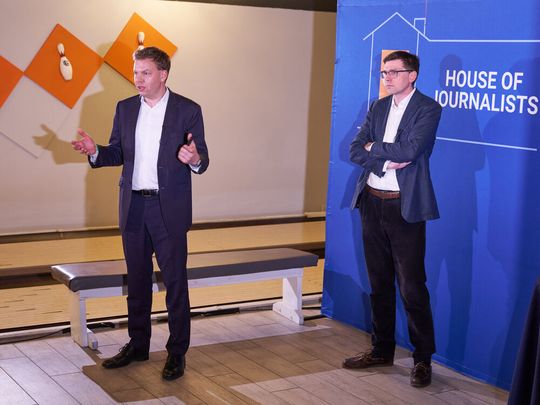
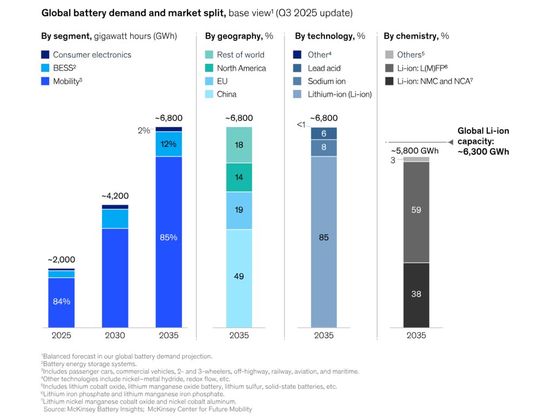
The reasons for the failure include excessively high production costs, technical difficulties in ramping up production and overcapacity on the market. "For the past year, we see around 900 gigawatt hours (GWh) of overcapacity in the global market," explains Raphael Rettig. He is a partner at the management consultancy McKinsey and heads the Battery Accelerator Team. Last year, demand for storage capacity totaled around 2,000 GWh. The cells are used in electromobility, battery storage systems and electrical devices. Despite overcapacity, the volume produced will continue to rise. The consultants expect annual growth of around 13 percent. Global demand will increase to 4,200 GWh by 2030 and to 6,800 GWh by 2035. In addition to electromobility, stationary buffer storage systems used by energy producers and data centers are driving this growth.
"For the past year, we see around 900 gigawatt hours (GWh) of overcapacity on the market globally," explains Raphael Rettig.
(Image: Steve Fecht)
Price Decline Slowed Down
Around 75 percent of battery cells currently come from Asian countries. Europe and the USA account for less than ten percent of production. The ramp-up of cell production and technical progress have led to a drop in prices. According to McKinsey, the weighted average per kWh for Li-ion battery packs was 108 US dollars last year. This is half the price that cell manufacturers were charging in 2018. At the same time, the energy density per cell has doubled in the past 15 years. The consultants assume that the price drop will not be as sharp in the future. "The price will fluctuate slightly, which can go both ways," emphasizes Rettig. In the long term, McKinsey expects a price of less than 60 dollars per kWh for Li-ion cells. "Overcapacity, lower material costs and the shift to LFP cells are the drivers," says Rettig.
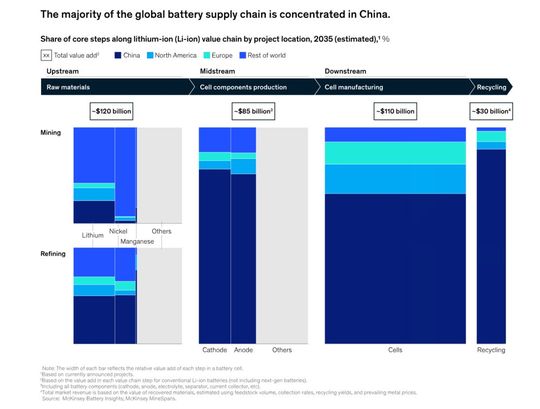
The huge share of the battery value chain is in Chinese hands.
(Image: Steven Fecht | Source: McKinsey)
LFP Wins
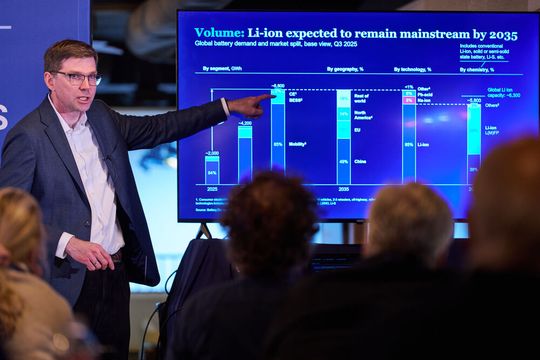
While nickel-manganese-cobalt (NMC) and nickel-cobalt-aluminum-oxide (NCA) have dominated cell chemistry to date, the cheaper lithium-ice phosphate (LFP) cell is catching up fast. "LFP is in high demand in smaller cars and stationary storage systems due to its lower costs," says Andreas Breiter, McKinsey consultant at the Center for Future Mobility in the USA. The consulting firm predicts a steep career for the LFP cell. Their estimate for 2035 is a market share of 59 percent for LFP compared to 38 percent for NMC/NCA. All three cell chemistries belong to Li-ion batteries, which are the dominant technology at 85 percent. It is interesting to note that the consultants give sodium-ion cells only an eight percent share of demand. "Yes, the raw materials are cheap, but salt as a charge carrier has a significantly lower energy density than lithium," says Breiter, "We will probably see this battery in the A-segment of cars and stationary storage systems."
Date: 08.12.2025
Naturally, we always handle your personal data responsibly. Any personal data we receive from you is processed in accordance with applicable data protection legislation. For detailed information please see our privacy policy.
Consent to the use of data for promotional purposes
I hereby consent to Vogel Communications Group GmbH & Co. KG, Max-Planck-Str. 7-9, 97082 Würzburg including any affiliated companies according to §§ 15 et seq. AktG (hereafter: Vogel Communications Group) using my e-mail address to send editorial newsletters. A list of all affiliated companies can be found here
Newsletter content may include all products and services of any companies mentioned above, including for example specialist journals and books, events and fairs as well as event-related products and services, print and digital media offers and services such as additional (editorial) newsletters, raffles, lead campaigns, market research both online and offline, specialist webportals and e-learning offers. In case my personal telephone number has also been collected, it may be used for offers of aforementioned products, for services of the companies mentioned above, and market research purposes.
Additionally, my consent also includes the processing of my email address and telephone number for data matching for marketing purposes with select advertising partners such as LinkedIn, Google, and Meta. For this, Vogel Communications Group may transmit said data in hashed form to the advertising partners who then use said data to determine whether I am also a member of the mentioned advertising partner portals. Vogel Communications Group uses this feature for the purposes of re-targeting (up-selling, cross-selling, and customer loyalty), generating so-called look-alike audiences for acquisition of new customers, and as basis for exclusion for on-going advertising campaigns. Further information can be found in section “data matching for marketing purposes”.
In case I access protected data on Internet portals of Vogel Communications Group including any affiliated companies according to §§ 15 et seq. AktG, I need to provide further data in order to register for the access to such content. In return for this free access to editorial content, my data may be used in accordance with this consent for the purposes stated here. This does not apply to data matching for marketing purposes.
Right of revocation
I understand that I can revoke my consent at will. My revocation does not change the lawfulness of data processing that was conducted based on my consent leading up to my revocation. One option to declare my revocation is to use the contact form found at https://contact.vogel.de. In case I no longer wish to receive certain newsletters, I have subscribed to, I can also click on the unsubscribe link included at the end of a newsletter. Further information regarding my right of revocation and the implementation of it as well as the consequences of my revocation can be found in the data protection declaration, section editorial newsletter.
Li-ion batteries are the dominant technology at 85 percent, as Andreas Breiter from McKinsey explains.
(Image: Steve Fecht)
China is not only ahead in terms of production, but also in terms of demand. Almost half of the cells produced in 2035 will be installed in China. The EU will account for 19 percent and North America 14 percent. The ramp-up of electromobility is slower than initially assumed. Due to the current political situation in the USA, development has almost come to a standstill. Expiring subsidies and the reaction of car manufacturers to political requirements are slowing down the drive turnaround. This will have an impact on the coming years. All the results and assessments of the management consultancy can be found in the report "Battery 2035: Building new advantages".
Battery demand by market and segment
(Image: Steven Fecht | Source: McKinsey)
Solid-State Battery as a Combined Product
The consulting firm expects the first solid-state batteries to be ready for series production by 2030 at the latest. Semi-solid state, i.e. no longer liquid electrolytes, are likely to be used before then. The consultants expect solid-state batteries to have an increased energy density of between 400 and 450 Wh per kg. However, the cycle stability of this technology is likely to be even lower than before. "We will probably see different cell chemistries in one battery," says Rettig. He can imagine that solid-state cells will be used for long-distance journeys because they store more energy and charge faster. For everyday use, existing Li-ion cells or LFP cells will be used in the battery pack.
Production in Europe Too Expensive
Both consultants are less optimistic about battery cell production in Europe. "According to our findings, China will play the dominant role in raw materials, their processing, cell production and recycling by 2035," Breiter is certain. According to McKinsey's calculations, an LFP cell could be produced in Europe in 2035 at prices of between 60 and 85 dollars per kWh. However, the import price from China, including transportation costs, would be around 55 dollars per kWh by then.
A joint venture with a Chinese manufacturer to produce in Europe is probably the only way to achieve commercial success. Stellantis has also considered this. Despite the rejection of the ACC project, they are building a battery factory for LFP cells together with CATL in Figueruelas near Zaragoza with an investment volume of 4.1 billion euros (~$4.83 Billion). Production in the 50:50 joint venture is due to start at the end of the year. Manufacturing close to production sites should bring advantages despite higher labor costs. (se)



:quality(80)/p7i.vogel.de/wcms/4b/7f/4b7feb398114331dff3d8b6c5e8dc06a/0133877511v1.jpeg "Brandt GmbH designs, manufactures, and services molds and tools for plastic injection molding, metal die casting, and the processing of LSR (liquid silicone rubber). (Image:Brandt)")
:quality(80)/p7i.vogel.de/wcms/db/23/db2332f08461bb166442018b9644b613/0133890143v1.jpeg "The International Monetary Fund (IMF) has revised some of its earlier forecasts for global economic growth upward. Germany, for example, is expected to grow more strongly in 2026 than previously thought. But the IMF has also taken a look at how things are shaping up in the rest of the world... (Image: AI-generated)")
:quality(80)/p7i.vogel.de/wcms/3b/53/3b53eec6903a838b98425d19f21d25ee/0132416085v1.jpeg "Complex progressive dies serve as the basis for stamped and formed parts—such as the copper outer conductors for sensor elements shown here. They are equipped with bending and embossing dies manufactured on the Kern Micro HD. (Image:Quittenbaum, LLC)")
:quality(80)/p7i.vogel.de/wcms/14/43/1443db59695f7eed2a338d16d03a6257/26-09-30-st-ber-ab-hunger-games-bild-1v1.jpeg "For “The Hunger Games: On Stage,” drive systems lift and move grandstand sections with a dynamic load of up to 26 metric tons—each section can accommodate up to 112 spectators. (Source: Troubadour at the Canary Wharf Theatre)")
:quality(80)/p7i.vogel.de/wcms/b7/95/b795d5fb82459f8a526e880f0698dffa/1-maxon-mind-covershot-landscapev1.jpeg "Claude Jaquemet demonstrates the Maxon Mind demo system. (Source: Maxon)")
:quality(80)/p7i.vogel.de/wcms/be/66/be661616d5250d4c3814a25688f3904b/0133917202v1.jpeg "Neuron AI combines 3D vision, touch, hearing, proprioception, and language—along with memory—into a Perception-Language-Action (PLA) model. Robots can grasp objects they cannot see. (Image:Neura)")
:quality(80)/p7i.vogel.de/wcms/c7/12/c712b688dba2262fa3906e3a4c1d2f7d/humanoide-robotikv1.jpeg "“Find a job that the humanoid can actually do, and understand your processes”—that’s the advice robotics expert Sebastian Prinz gives companies so they can benefit from the technology in the long term. (Source: Fraunhofer IEM / Janosch Gruschczyk)")
:quality(80)/p7i.vogel.de/wcms/05/bc/05bcc7390d30da9c23a829f7e96247e3/koch-glserdepalettierung-nahrungsmittelv1.jpeg "Opportunities for automation using robots can be found in all areas of manufacturing, such as in the palletizing of products. (Image:Koch Industrial Systems, LLC)")
:quality(80)/p7i.vogel.de/wcms/96/89/9689197f666e4aa9bc4a1f395c25d3ef/0133739635v1.jpeg "The 2026 Nobel Prize in Medicine laureates: Karl Deisseroth, Peter Hegemann, and Georg Nagel. (Image:Nobel Prize Outreach)")
:quality(80)/p7i.vogel.de/wcms/8a/c8/8ac8eb7fc2b70f4b72771548e2e2e520/epfl-motor-3v1.jpeg "FiberMotor has a diameter of 1 to 3 mm and consists of two concentric hollow fibers. Each fiber is wrapped in tightly insulated copper wire electrodes that are only slightly thicker than a human hair. (Source: EPFL)")
:quality(80)/p7i.vogel.de/wcms/a7/8a/a78a582a42a96aaaff38bd6b8f97a015/vishal-lal-mit-kernuhrv1.jpeg "It's ticking: Researchers have stabilized the first atomic clock. (Source: PTB)")
:quality(80)/p7i.vogel.de/wcms/36/f9/36f96a206fc408c9a632ce849de1f7fa/newsimage428299v1.jpeg "Polystyrene is used in protective packaging for televisions and electronic devices, in decorative moldings and baseboards for interior home construction, and even in Petri dishes. (Source: Hereon/Marcel Schwickerath)")
:quality(80)/p7i.vogel.de/wcms/c0/30/c030f79acad01285bcf98d3e634708e1/0133914206v1.jpeg "The Li 6 combines a platform developed specifically for electric vehicles with 800-V architecture and 5C fast-charging technology. The suspension and handling have been adapted to European roads and driving habits. (Image:LI Auto)")
:quality(80)/p7i.vogel.de/wcms/23/fa/23fa8e88a49a99e13e819c188c8a22de/0133950806v1.jpeg "In Shenyang, China, BMW has begun mass production of its Gen6 high-voltage batteries for the New Class. (Image:BMW)")
:quality(80)/p7i.vogel.de/wcms/64/bf/64bf3942deb5fa1fd3488d9f61bad2e9/0133911824v1.jpeg "The return of the \"Duck\" was certainly one of the most exciting topics at the 2026 Paris Motor Show. (Image:sp-x)")
:quality(80)/p7i.vogel.de/wcms/0e/0f/0e0fbf3c457f4b983ff9c2cc20de513c/708953-ef6f61c0616f461c9a42f6a0f403a3f8-c8ba35-original-1791536261v1.jpeg "In early October, Xpeng announced the successful production trial of its G9L model at Magna in Graz. (Image:Xpeng)")
:quality(80)/p7i.vogel.de/wcms/8a/d1/8ad1fd2d80399dd663a55b44b0953707/0133918510v1.jpeg "Multiple wireless standards on a single platform: Qualcomm's Dragonwing FWA Gen 6 Elite combines 5G Advanced, satellite communications, and Wi-Fi 8 with on-device AI processing for wireless broadband connectivity. (Image:Qualcomm)")
:quality(80)/p7i.vogel.de/wcms/8c/27/8c27323a09724f906aacf549d7cdaf3a/0133923995v1.jpeg "Keysight is working with research institutes to simplify the testing of next-generation semiconductor devices. (Image:Keysight)")
:quality(80)/p7i.vogel.de/wcms/78/92/7892504a95318acd1cd009ce614a33ab/0133939086v1.jpeg "Vishay's nine optical sensors combine an infrared emitter with a PIN photodiode. They enable bidirectional data transmission at speeds of up to 6 Mbit/s, for example in battery management systems for electric vehicles. (Image: Vishay)")
:quality(80)/p7i.vogel.de/wcms/50/81/50811ef8ab18d0626aa6d86dac2c46b4/0133922867v1.jpeg "Encapsulation materials are becoming increasingly important in electronics manufacturing. Particularly in highly integrated chip packages, the requirements for reliability, thermomechanical stability, and processability are rising. (Image:Sumitomo Bakelite)")
:quality(80)/p7i.vogel.de/wcms/5a/14/5a14b26a5d4495d3a192e90e5c216251/ai-catl-sodium-batteries-vs-lithium-revolution-1800x1012v1v1.jpeg "The supplier CATL is bringing its first sodium-ion batteries into series production. Although not in the automotive industry, this step is set to follow soon. (Image:CATL)")
:quality(80)/p7i.vogel.de/wcms/ac/4a/ac4ac41833e4d72d7e5fe55b12291134/0131065166v1.jpeg "Robin Zeng, Chairman and CEO of CATL, is driving forward the development of modern battery technologies. (Image:CATL)")