With battery cells from Europe, the domestic automotive industry would be independent of highly competitive Asian suppliers. What needs to happen for this — and is it still worth entering the market?
Morrow Batteries is one of the few cell manufacturers in Europe.
(Image: studio-dam/Morrow Batteries)
Plenty of energy! That is what Europe needs – both figuratively and technically – if battery cells for electric vehicles are to be produced here. For Europe to become self-sufficient in supplying these critical components by 2050, the annual European energy demand will rise from today's 3.5 terawatt-hours to around 250 terawatt-hours. However, this is only feasible "if a well-developed recycling infrastructure is in place by then." This forecast comes from a team led by Simon Lux, director of the Fraunhofer Facility for Battery Cell Research FFB, as of September.
Recycling. The European infrastructure for recycling used batteries is currently still "in an early stage of development," describe Lux and his team. Battery recycling rates and efficiency are crucial for independent procurement – and for the energy demand of cell production. The research team anticipates significant recycling capacities in Europe. According to their calculations, companies will recycle about 800 gigawatt-hours of battery capacity annually by 2050. This could reduce the energy required for battery production by 33 to 46 percent.
Slow Progress in Cell Production Expansion
However, for something to be recycled, it must first be created. In this case: battery cells. Chinese companies have now established, scaled, and optimized their production in their home country. A look at Germany: companies like ACC, Blackstone, CATL, Cellforce, Farasis, Svolt, and Northvolt have stopped projects, ceased operations, or become insolvent. Around 240 gigawatt-hours of production capacity for batteries are missing here, according to calculations by a team led by Tim Wicke. In Europe, the shortfall exceeds 700 GWh. Wicke is a research associate at the Fraunhofer Institute for Systems and Innovation Research ISI. Does Europe even stand a chance against the competition, which is now flooding markets with low-cost cells?
"Definitely yes!" says Michael Müller, Head of Climate Tech & Sustainability at the development service provider Capgemini Engineering. To close the gap and build competitive European champions, "we need to overcome the critical ramp-up phase on the one hand and simultaneously explore new paths with urgency that enable medium-term differentiation."
Although today's production volumes in Europe may not come close to reaching the projected values: "Nevertheless, there will be value creation in Europe at a significant volume. The question is whether this will be driven by European or established Asian — and specifically Chinese — companies," explains Müller.
Plan Versus Reality
Researchers at the Fraunhofer ISI also see opportunities for European battery cell production. According to an analysis by the institute, the announced production capacities in Europe will amount to more than two terawatt-hours per year by 2030. This would exceed the expected demand. However, "the past years have shown that the realization of all announced projects is highly unlikely."
The industry urgently needs to start working more closely together
Michael Müller, Capgemini Engineering
There are several reasons for this, including high energy prices, investment costs, and a lack of production know-how. "There are clear location disadvantages that we need to address structurally," confirms Michael Müller. However, according to the team led by Tim Wicke, the often-cited high labor costs do not seem to be a priority. Nearly 38 percent of the announced capacities are located in countries with low labor costs, 29 percent in regions with average wages, and 33 percent in countries with high wages. On the other hand, all announced production capacities in Europe are in countries where subsidy programs can be applied for.
Getting out of this predicament primarily requires substance. "The German industry must demonstrate that it can develop and produce innovative and competitive products in the necessary volume and quality. That is the main task to be solved," explains Müller. According to Wicke, the European Battery Regulation could play a favorable role. It requires, among other things, the disclosure of the CO2 footprint and sets requirements for battery recycling.
This does not change the costs for now. However, "Germany has always been a high-cost location and will remain so," says Müller. "This is, on the one hand, a disadvantage, but on the other hand, it shows that we have the substance to mobilize the best and most innovative minds. I am very optimistic that we will continue to be a strong R&D and production location in the future. The basic prerequisite is that we develop differentiation perspectives." Standards regarding the quality and origin of a battery can be a differentiating feature.
Date: 08.12.2025
Naturally, we always handle your personal data responsibly. Any personal data we receive from you is processed in accordance with applicable data protection legislation. For detailed information please see our privacy policy.
Consent to the use of data for promotional purposes
I hereby consent to Vogel Communications Group GmbH & Co. KG, Max-Planck-Str. 7-9, 97082 Würzburg including any affiliated companies according to §§ 15 et seq. AktG (hereafter: Vogel Communications Group) using my e-mail address to send editorial newsletters. A list of all affiliated companies can be found here
Newsletter content may include all products and services of any companies mentioned above, including for example specialist journals and books, events and fairs as well as event-related products and services, print and digital media offers and services such as additional (editorial) newsletters, raffles, lead campaigns, market research both online and offline, specialist webportals and e-learning offers. In case my personal telephone number has also been collected, it may be used for offers of aforementioned products, for services of the companies mentioned above, and market research purposes.
Additionally, my consent also includes the processing of my email address and telephone number for data matching for marketing purposes with select advertising partners such as LinkedIn, Google, and Meta. For this, Vogel Communications Group may transmit said data in hashed form to the advertising partners who then use said data to determine whether I am also a member of the mentioned advertising partner portals. Vogel Communications Group uses this feature for the purposes of re-targeting (up-selling, cross-selling, and customer loyalty), generating so-called look-alike audiences for acquisition of new customers, and as basis for exclusion for on-going advertising campaigns. Further information can be found in section “data matching for marketing purposes”.
In case I access protected data on Internet portals of Vogel Communications Group including any affiliated companies according to §§ 15 et seq. AktG, I need to provide further data in order to register for the access to such content. In return for this free access to editorial content, my data may be used in accordance with this consent for the purposes stated here. This does not apply to data matching for marketing purposes.
Right of revocation
I understand that I can revoke my consent at will. My revocation does not change the lawfulness of data processing that was conducted based on my consent leading up to my revocation. One option to declare my revocation is to use the contact form found at https://contact.vogel.de. In case I no longer wish to receive certain newsletters, I have subscribed to, I can also click on the unsubscribe link included at the end of a newsletter. Further information regarding my right of revocation and the implementation of it as well as the consequences of my revocation can be found in the data protection declaration, section editorial newsletter.
What Can Companies Do?
But where to start? What exactly can and must companies do to manufacture competitive battery cells and batteries in Germany? "I would highlight two points as examples. First, focus on innovation in product and process development. We see potential to reduce development time and the associated costs for new cell projects by 50 percent using data-driven and AI-supported processes," explains Müller. "We are in a continuous R&D race. Those who can achieve the above-mentioned KPIs will automatically become industry leaders." Second, it must be clear in the context of the production ramp-up what can be handled internally and what cannot.
For topics outside their own core competencies, Michael Müller recommends acquiring strong partners: "The core problem is that many European players cannot meet their output and timeline goals for projects. This causes enormous costs." Likely one reason why Volkswagen's battery division "PowerCo" is looking for external investors.
VW's Chief Technical Officer Thomas Schmall stated during the IAA Mobility: "Growth beyond 2030 will only be financeable with external capital." This was already clear at the launch of the cell subsidiary. Nevertheless, it is a clear statement – coming from a company like Volkswagen. Suppliers report similar sentiments; currently, no one dares to set up a functioning cell production facility alone and survive economically.
The fact that Powerco can still stick to its plans today is primarily due to a manageable set of requirements. "From the very beginning, we placed great importance on a stable ramp-up. For example, we only have one cell type – the unified cell – and a factory layout that keeps complexity under control," explains Powerco CEO Frank Blome. "We have a very experienced, international team. Additionally, the Volkswagen Group supports us with know-how and manpower. If we need 30 production planners or IT experts today, they'll be on board tomorrow. No other startup offers that. And we have relied on partnerships with experienced companies right from the start."
A European Path
If partnerships contribute to success, why has no alliance of strong industrial companies emerged so far to promote production "Made in Europe"? It is apparently not due to a lack of courage, because: "We observe a strong will in the industry and politics to shape a common European path," explains Michael Müller, and sees significantly closer collaboration as crucial; additionally, lower investment requirements and risks through cooperation in non-differentiating areas.
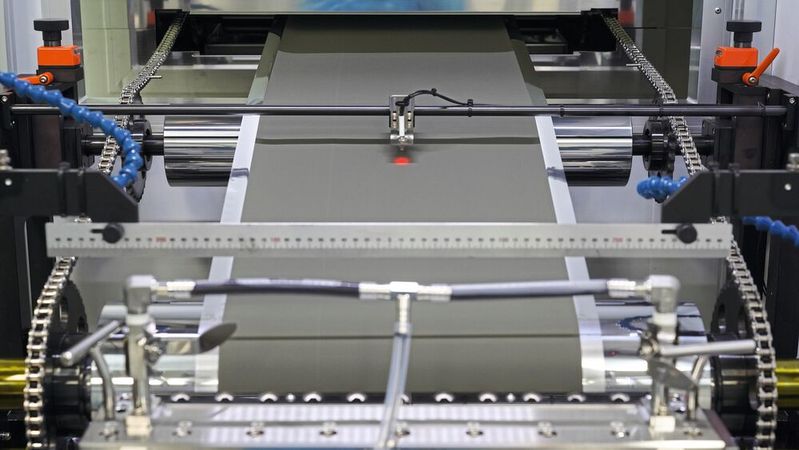
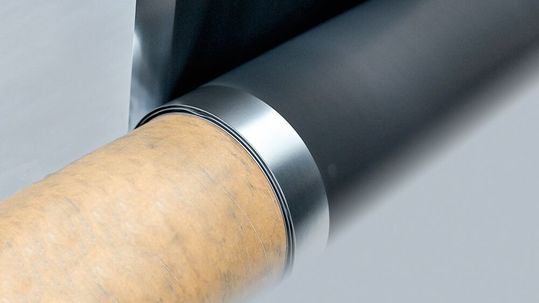
Powerco wants to dry-coat battery cells. The process saves energy, space, and money. Powerco successfully conducted the "Factory Acceptance Test" with equipment manufacturer Koenig & Bauer in May 2025.
(Image: Sebastian Dorbrietz)
In parallel, companies should, according to Müller, initiate joint development programs: for instance, in the digitalization of the entire product development and value chain. "The truth, however, is that we are not starting from scratch here, and we face different companies with varying goals, maturity levels, commitments, and technological strategies. We won't easily be able to bring this together." Therefore, companies should tackle the obvious synergies jointly in the short term, suggests Müller, "there are many points where we can start."
Predict Risks
Many points — for which a team at the Fraunhofer ISI has developed a risk assessment model. It can predict more realistic future capacities of battery cell production in Europe and assess the risk for battery production projects. The institute presented the model at the end of 2024.
The researchers combine an evaluation of individual announcements at the project level with a so-called Monte Carlo simulation, a method from stochastic analysis. The results show that likely only between 54 and 75 percent of the announced capacities in Europe will actually be realized. This would correspond to approximately 1.2 TWh to 1.7 TWh by the year 2030. Assumed construction delays and lower output in factories – due to production waste and lack of utilization – reduce the realistic production output to 0.8 to 1.1 TWh in 2030.
Master Common Cell Chemistries
Overtaking the competition, so to speak, and focusing now on solid-state batteries — the anticipated breakthrough technology — will not be a solution. "Solid-state batteries are a key technology for the future. But they are only one option in the broad portfolio of relevant cell chemistries," predicts Michael Müller.
"There are many approaches here that have medium-term relevance. The focus is on building the core competence of bringing innovative new cell chemistries with differentiating properties to the market at scale. Those who master this for conventional technologies will also be able to represent it very well for semi-solid and solid-state batteries."
Mastering the currently common cell chemistries is the right approach and necessary: "In the next three to five years, no major disruptions are to be expected on a broad scale. We will observe continuous optimization of the existing cell chemistries," explains Müller.
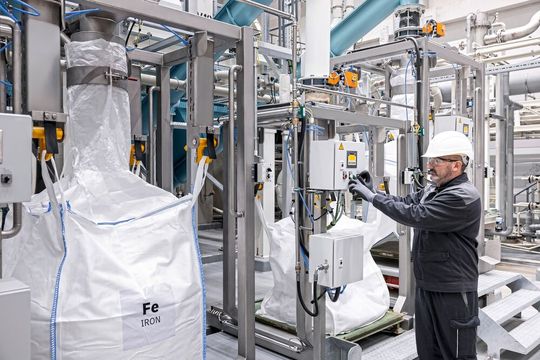
Mercedes-Benz recycles used batteries at the Kuppenheim site through a mechanical process — separating raw materials by type: plastics, copper, aluminum, and iron.
(Image: Mercedes-Benz)
This optimization can – and ideally should – take design into account to efficiently recycle the batteries at the end of their lifecycle. "The demand for recycled battery materials is high and will continue to rise," says Müller, confirming the analysis by Simon Lux and his team. "Especially in Germany, we have a strong network of research, innovative startups, and established companies. We now need to demonstrate that the pursued innovative approaches and processes lead to cost-competitive and high-quality battery materials."
At its core, Müller sees it as a scaling challenge: from the lab and pilot line to large industrial volumes. "Germany is on a good path to play a central role in this future industry," he assesses. Simplified approval procedures for building cell production facilities or recycling plants are, according to Müller, one approach to making Europe a more attractive location.
"It is up to us to find common ways to build a competitive battery industry. However, the industry urgently needs to start working more closely together, learn from its mistakes more quickly, make pragmatic decisions, and be open to new creative approaches," says Müller. "Most importantly: to have the willingness to work hard for our place in this industry."



:quality(80)/p7i.vogel.de/wcms/eb/2b/eb2bd1b8487afe577b37363cd02f16ff/0113143253v1.jpeg "In our China Market Insider, we regularly provide you with relevant information straight from China. (Image:© Eisenhans - stock.adobe.com)")
:quality(80)/p7i.vogel.de/wcms/dd/b8/ddb8edc98c49b384734ab2432b297eb5/adobestock-1913662309--irene-stock-adobe-com-ki-generiertv1.jpeg "Rotary joints are used in grippers and swivel mechanisms to allow assemblies to rotate or swivel smoothly relative to one another, even under very high loads (illustrative image). (Source: Irene - stock.adobe.com / KI-generiert)")
:quality(80)/p7i.vogel.de/wcms/d1/ef/d1ef6b6f7d4543f7999980bacccaf22b/0133499261v1.jpeg "As the growing imbalance in trade relations with China continues to widen, the EU Chamber of Commerce foresees a day when trade with China will have to be seriously reevaluated ... (Image: AI-generated)")
:quality(80)/p7i.vogel.de/wcms/fe/1f/fe1fa5ee713f94deaba963dc24c3abc5/0133299273v1.jpeg "The Flexistar enables highly flexible production of laser-welded tubes thanks to its tool-free clamping system. (Image:Because Technology, LLC)")
:quality(80)/p7i.vogel.de/wcms/60/ef/60ef4f07e4829b2c2929befc0f353c58/0133511729v1.jpeg "Humanoid robots can match human performance in certain tasks. (Image:Gemini / AI-generated)")
:quality(80)/p7i.vogel.de/wcms/2e/99/2e99726b522e4b35b690e25eb6a42643/0133463991v1.jpeg "Robotics: In AMR applications, connection technology must reliably transmit power, signals, and data despite vibration and shock loads—in very confined spaces and in a way that allows for regular maintenance. (Image:Hyperever)")
:quality(80)/p7i.vogel.de/wcms/d0/18/d01801e3d5dbd7bc9d0b4f60408b630c/0133468429v1.jpeg "Quality requirements for film packaging are on the rise. At the same time, many companies are turning to recyclable film materials, which, however, have their own challenges. Fraunhofer researchers have therefore developed a fast system that detects problems in real time. (Image:Fraunhofer IKTS)")
:quality(80)/p7i.vogel.de/wcms/b1/06/b106cf44923ce39565c3264982fd20eb/0133414574v1.jpeg "Robots Build Robots: At the new Ubtech factory, automated systems even handle parts of the material supply and logistics for the production of humanoid robots. (Image:Ubtech)")
:quality(80)/p7i.vogel.de/wcms/c0/52/c052f405eb55fc3d08c4837e77206fc0/adobestock-2021845957--aucartstudio-stock-adobe-com-ki-generiertv1.jpeg "An innovation from China to combat extreme summer heat: A novel coating lowers temperatures. (Source: © AucArtStudio – stock.adobe.com_AI-generated)")
:quality(80)/p7i.vogel.de/wcms/66/a7/66a7b78159caeacce57136529688799f/0133503398v1.jpeg "Sunlight Makes Stone! These stone blocks weren't made the traditional way. Instead, they were additively manufactured from sand using a laser. In the future, however, the laser is set to be replaced by concentrated sunlight—if the startup Addisol is successful... (Image:Addisol / F. Fiedler)")
:quality(80)/p7i.vogel.de/wcms/72/b9/72b995c2c8d812c5e2115cbef31e035a/0133462727v1.jpeg "Eggl manufactures center hoods that are precisely tailored to each cooking island—whether standard size or custom shape. They are made entirely of stainless steel and are individually customized in terms of size and filter arrangement. (Image:SPI)")
:quality(80)/p7i.vogel.de/wcms/13/5d/135dfae6229ceaf5c55467a43e8f7257/adobestock-1879961393--ardi-stock-adobe-com-ki-generiertv1.jpeg "Annoying chatterboxes or awkward silences in response to questions—a moderator should specifically prepare for difficult situations in order to navigate them effectively. (Image:ardi - stock.adobe.com_AI-generated)")
:quality(80)/p7i.vogel.de/wcms/aa/a2/aaa2c6dd2daa24b485cddbf9297590c0/0133467318v1.jpeg "Battery Monitoring: Battery monitoring using electrochemical impedance spectroscopy offers several advantages. (Image:TI)")
:quality(80)/p7i.vogel.de/wcms/39/b2/39b21bf03be1683831862239a369987c/0133469638v1.jpeg "Data from autonomous vehicles and robots operating autonomously is in high demand, and Ruqi wants to capitalize on this. (Image:Ruqi Mobility)")
:quality(80)/p7i.vogel.de/wcms/8a/bb/8abbb6217220595edc1549ac9b84f307/0133429906v1.jpeg "The IAA in Hanover showcased the ambitions of Chinese commercial vehicle manufacturers in Europe. (Image:Wehner - VCG)")
:quality(80)/p7i.vogel.de/wcms/0c/53/0c5313ef91c14b6df0d0996efc33c8ad/jpg03568-bearbeitetv1.jpeg "The category winners of the 2027 German Car of the Year award. (Source: GCOTY)")
:quality(80)/p7i.vogel.de/wcms/28/28/2828c5261714321afb0bab67bf771823/0133353387v1.jpeg "The 130-meter-long China Zorrilla draws its power from a battery system with a capacity of more than 40 MWh. Eight electric motors drive an equal number of water jets. (Image:Incat Australia Pty Ltd)")
:quality(80)/p7i.vogel.de/wcms/48/15/4815da27c45973ca629a99b375ac3aef/0133509585v1.jpeg "Ventuno Q RoadTest: Designed to help the Element14 community gain practical insights from real-world tests using the Ventuno Q. (Image:Farnell/Element14)")
:quality(80)/p7i.vogel.de/wcms/17/2b/172bd132f9febdfcbcedba292ad0504d/aufmacherv1.jpeg "Micro-Epsilon offers a wide range of IO-Link-compatible sensors. (Source: Micro-Epsilon Messtechnik GmbH & Co. KG)")
:quality(80)/p7i.vogel.de/wcms/ca/b4/cab46fd26d19d6a2febca032048200b6/0133471827v1.jpeg "Photonics SDK for C and Python: Computational operations are now abstracted as standard mathematical functions. (Image:Q.ANT)")
:fill(fff,0)/images.vogel.de/vogelonline/companyimg/76800/76895/65.jpg "FAULHABER_120mm.jpg ()")
:quality(80)/p7i.vogel.de/wcms/e5/e6/e5e67eccb62ee8a6cb251cddf8794500/0128016296v1.jpeg "Sascha Kleinert, CEO of Accumotive, opened the Battery Manufacturing Day: \"No battery will leave my plant that is not OK,\" he said in his presentation on Mercedes battery production in Kamenz. (Image:Eidens-Holl)")
:quality(80)/p7i.vogel.de/wcms/22/d0/22d03cd48e992435338b59464c428d41/0129739814v1.jpeg "More electric vehicles on the roads mean a higher demand for electricity - which should ideally be covered by renewable energies. (Image:BMW)")