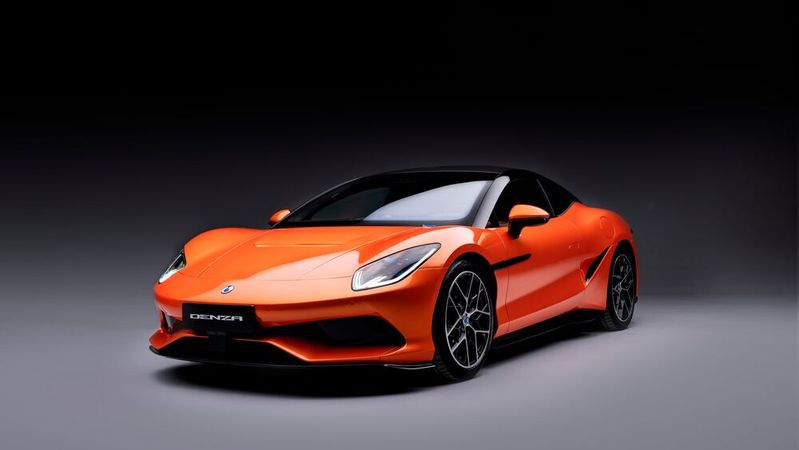
1,600 hp, 350 km/h (217 mph) top speed, and steer-by-wire technology: The Chinese Denza Z is aggressively challenging the established European sports car competition.
The Chinese Denza Z is targeting the established European sports car competition.
(Image: Denza)
Now even sports cars. From mass-market compact cars to affordable mainstream SUVs, BYD already builds almost everything with four wheels. Only an image model was missing until now. Something like the electric Denza Z. However, this does not sail under the BYD flag but is meant to attack the established European sports car elite as a product of the premium sub-brand Denza. And the American elite, in the form of the Corvette, as well.
But why is the world's largest electric car manufacturer suddenly building a sports car? Certainly not because flat coupes are particularly lucrative. The Denza Z is more of a statement and is being presented to the public for the first time. And that on the stage of all renowned sports car manufacturers in Goodwood, with plenty of fanfare and the largest booth at the auto show. The automotive world is meant to see: BYD can deliver not only volume but also emotions.
Originally launched in 2010 as a joint project with Mercedes-Benz, Denza now belongs entirely to BYD and takes on the role of the premium brand within the group. The Z sits at the top of the model range and is likely to be produced only in small quantities as a flagship project. However, production numbers are irrelevant in this case. The models Z Coupé and Roadster, capable of reaching speeds of up to 350 km/h, are primarily sporty image flagships designed to demonstrate that the Chinese can compete on equal footing with established manufacturers when it comes to design, driving dynamics, and technology.
Additional Competition for Porsche
That Porsche is the main target comes as no surprise. The image of the Swabian brand still extends far beyond the sports car scene. Ferrari and Lamborghini build exclusive dream cars, while Porsche combines driving dynamics with everyday usability and sells its vehicles in comparatively high volumes. Anyone looking to establish themselves in this segment must measure up to the Swabians—not with eccentric designs but with a look that will still work ten years from now.
And with contemporary technology that involves a lot of effort. The foundation is a 1000-volt architecture, a highly integrated drive unit, and carbon-ceramic brakes. Thanks to the high-voltage system and the new Blade battery, Denza promises extremely short charging times. In just nine minutes, the second-generation 76 kWh Blade battery can be charged from 10 to 97 percent. Even at extreme sub-zero temperatures, it reportedly takes only three minutes longer, according to the manufacturer.
The driving power is distributed to the wheels as needed by three electric motors, while two actuators in the rear-wheel steering support the steering response. The centerpiece, however, is the new steer-by-wire system. It completely eliminates a mechanical connection between the steering wheel and the front wheels. The steering wheel can even be folded away to create more space during automated driving.
Classic 2+2 Seater for the Joy of Driving
The Z was not designed as a robot car. On the contrary, instead of a futuristic lounge, Denza opts for a surprisingly classic sports car cockpit with deeply integrated carbon bucket seats, a slim instrument display, and a large central screen. The concept follows more of a European model rather than that of an uncompromising supercar. The Denza Z is designed as a 2+2-seater and is later planned to be offered as a spider. This positions BYD closer to the Porsche 911 or Gran Turismo than to a radical two-seater.
Steer-by-wire, chassis, drivetrain, and brakes work together on a unified software platform. Notably, BYD does not mention an external development partner for the chassis or steering. This aligns with their strategy of developing more key technologies in-house and consolidating them within their own group instead of purchasing from ZF or Bosch.
In other areas, however, Denza relies on European expertise. The design is overseen by Wolfgang Egger, who previously worked for brands such as Alfa Romeo, Audi, and Lamborghini. His creations include automotive legends like the Alfa 8C Competizione, as well as mass-market models like the Seat Ibiza or Audi A4 and A6. His role at BYD and Denza is likely to give the brands a distinctive identity.
Date: 08.12.2025
Naturally, we always handle your personal data responsibly. Any personal data we receive from you is processed in accordance with applicable data protection legislation. For detailed information please see our privacy policy.
Consent to the use of data for promotional purposes
I hereby consent to Vogel Communications Group GmbH & Co. KG, Max-Planck-Str. 7-9, 97082 Würzburg including any affiliated companies according to §§ 15 et seq. AktG (hereafter: Vogel Communications Group) using my e-mail address to send editorial newsletters. A list of all affiliated companies can be found here
Newsletter content may include all products and services of any companies mentioned above, including for example specialist journals and books, events and fairs as well as event-related products and services, print and digital media offers and services such as additional (editorial) newsletters, raffles, lead campaigns, market research both online and offline, specialist webportals and e-learning offers. In case my personal telephone number has also been collected, it may be used for offers of aforementioned products, for services of the companies mentioned above, and market research purposes.
Additionally, my consent also includes the processing of my email address and telephone number for data matching for marketing purposes with select advertising partners such as LinkedIn, Google, and Meta. For this, Vogel Communications Group may transmit said data in hashed form to the advertising partners who then use said data to determine whether I am also a member of the mentioned advertising partner portals. Vogel Communications Group uses this feature for the purposes of re-targeting (up-selling, cross-selling, and customer loyalty), generating so-called look-alike audiences for acquisition of new customers, and as basis for exclusion for on-going advertising campaigns. Further information can be found in section “data matching for marketing purposes”.
In case I access protected data on Internet portals of Vogel Communications Group including any affiliated companies according to §§ 15 et seq. AktG, I need to provide further data in order to register for the access to such content. In return for this free access to editorial content, my data may be used in accordance with this consent for the purposes stated here. This does not apply to data matching for marketing purposes.
Right of revocation
I understand that I can revoke my consent at will. My revocation does not change the lawfulness of data processing that was conducted based on my consent leading up to my revocation. One option to declare my revocation is to use the contact form found at https://contact.vogel.de. In case I no longer wish to receive certain newsletters, I have subscribed to, I can also click on the unsubscribe link included at the end of a newsletter. Further information regarding my right of revocation and the implementation of it as well as the consequences of my revocation can be found in the data protection declaration, section editorial newsletter.



:quality(80)/p7i.vogel.de/wcms/eb/2b/eb2bd1b8487afe577b37363cd02f16ff/0113143253v1.jpeg "In our China Market Insider, we regularly provide you with relevant information straight from China. (Image:© Eisenhans - stock.adobe.com)")
:quality(80)/p7i.vogel.de/wcms/dd/b8/ddb8edc98c49b384734ab2432b297eb5/adobestock-1913662309--irene-stock-adobe-com-ki-generiertv1.jpeg "Rotary joints are used in grippers and swivel mechanisms to allow assemblies to rotate or swivel smoothly relative to one another, even under very high loads (illustrative image). (Source: Irene - stock.adobe.com / KI-generiert)")
:quality(80)/p7i.vogel.de/wcms/d1/ef/d1ef6b6f7d4543f7999980bacccaf22b/0133499261v1.jpeg "As the growing imbalance in trade relations with China continues to widen, the EU Chamber of Commerce foresees a day when trade with China will have to be seriously reevaluated ... (Image: AI-generated)")
:quality(80)/p7i.vogel.de/wcms/fe/1f/fe1fa5ee713f94deaba963dc24c3abc5/0133299273v1.jpeg "The Flexistar enables highly flexible production of laser-welded tubes thanks to its tool-free clamping system. (Image:Because Technology, LLC)")
:quality(80)/p7i.vogel.de/wcms/60/ef/60ef4f07e4829b2c2929befc0f353c58/0133511729v1.jpeg "Humanoid robots can match human performance in certain tasks. (Image:Gemini / AI-generated)")
:quality(80)/p7i.vogel.de/wcms/2e/99/2e99726b522e4b35b690e25eb6a42643/0133463991v1.jpeg "Robotics: In AMR applications, connection technology must reliably transmit power, signals, and data despite vibration and shock loads—in very confined spaces and in a way that allows for regular maintenance. (Image:Hyperever)")
:quality(80)/p7i.vogel.de/wcms/d0/18/d01801e3d5dbd7bc9d0b4f60408b630c/0133468429v1.jpeg "Quality requirements for film packaging are on the rise. At the same time, many companies are turning to recyclable film materials, which, however, have their own challenges. Fraunhofer researchers have therefore developed a fast system that detects problems in real time. (Image:Fraunhofer IKTS)")
:quality(80)/p7i.vogel.de/wcms/b1/06/b106cf44923ce39565c3264982fd20eb/0133414574v1.jpeg "Robots Build Robots: At the new Ubtech factory, automated systems even handle parts of the material supply and logistics for the production of humanoid robots. (Image:Ubtech)")
:quality(80)/p7i.vogel.de/wcms/c0/52/c052f405eb55fc3d08c4837e77206fc0/adobestock-2021845957--aucartstudio-stock-adobe-com-ki-generiertv1.jpeg "An innovation from China to combat extreme summer heat: A novel coating lowers temperatures. (Source: © AucArtStudio – stock.adobe.com_AI-generated)")
:quality(80)/p7i.vogel.de/wcms/66/a7/66a7b78159caeacce57136529688799f/0133503398v1.jpeg "Sunlight Makes Stone! These stone blocks weren't made the traditional way. Instead, they were additively manufactured from sand using a laser. In the future, however, the laser is set to be replaced by concentrated sunlight—if the startup Addisol is successful... (Image:Addisol / F. Fiedler)")
:quality(80)/p7i.vogel.de/wcms/72/b9/72b995c2c8d812c5e2115cbef31e035a/0133462727v1.jpeg "Eggl manufactures center hoods that are precisely tailored to each cooking island—whether standard size or custom shape. They are made entirely of stainless steel and are individually customized in terms of size and filter arrangement. (Image:SPI)")
:quality(80)/p7i.vogel.de/wcms/13/5d/135dfae6229ceaf5c55467a43e8f7257/adobestock-1879961393--ardi-stock-adobe-com-ki-generiertv1.jpeg "Annoying chatterboxes or awkward silences in response to questions—a moderator should specifically prepare for difficult situations in order to navigate them effectively. (Image:ardi - stock.adobe.com_AI-generated)")
:quality(80)/p7i.vogel.de/wcms/aa/a2/aaa2c6dd2daa24b485cddbf9297590c0/0133467318v1.jpeg "Battery Monitoring: Battery monitoring using electrochemical impedance spectroscopy offers several advantages. (Image:TI)")
:quality(80)/p7i.vogel.de/wcms/39/b2/39b21bf03be1683831862239a369987c/0133469638v1.jpeg "Data from autonomous vehicles and robots operating autonomously is in high demand, and Ruqi wants to capitalize on this. (Image:Ruqi Mobility)")
:quality(80)/p7i.vogel.de/wcms/8a/bb/8abbb6217220595edc1549ac9b84f307/0133429906v1.jpeg "The IAA in Hanover showcased the ambitions of Chinese commercial vehicle manufacturers in Europe. (Image:Wehner - VCG)")
:quality(80)/p7i.vogel.de/wcms/0c/53/0c5313ef91c14b6df0d0996efc33c8ad/jpg03568-bearbeitetv1.jpeg "The category winners of the 2027 German Car of the Year award. (Source: GCOTY)")
:quality(80)/p7i.vogel.de/wcms/48/15/4815da27c45973ca629a99b375ac3aef/0133509585v1.jpeg "Ventuno Q RoadTest: Designed to help the Element14 community gain practical insights from real-world tests using the Ventuno Q. (Image:Farnell/Element14)")
:quality(80)/p7i.vogel.de/wcms/17/2b/172bd132f9febdfcbcedba292ad0504d/aufmacherv1.jpeg "Micro-Epsilon offers a wide range of IO-Link-compatible sensors. (Source: Micro-Epsilon Messtechnik GmbH & Co. KG)")
:quality(80)/p7i.vogel.de/wcms/ca/b4/cab46fd26d19d6a2febca032048200b6/0133471827v1.jpeg "Photonics SDK for C and Python: Computational operations are now abstracted as standard mathematical functions. (Image:Q.ANT)")
:quality(80)/p7i.vogel.de/wcms/92/b2/92b2ed5299cde450c0764f4f64468395/0133505895v1.jpeg "The \"Iris 100\" test system for high-precision volume production of microLEDs uses a spectrometer and a high-resolution camera. (Image:Teradyne)")
:quality(80)/p7i.vogel.de/wcms/6f/59/6f595e7d37c530d0a84a516bb9ac6391/0131541151v1.jpeg "The supplier Astemo is working on a completely new steering concept: a rotating knob replaces the steering wheel. (Image:Astemo)")
:quality(80)/p7i.vogel.de/wcms/df/6e/df6e1bccfcd0a1645ed1b73d97a98ef8/0132296214v1.jpeg "The design is the responsibility of Wolfgang Egger, who previously worked for Alfa Romeo, Audi, and Lamborghini.(Image: Denza)")
:quality(80)/p7i.vogel.de/wcms/8e/8f/8e8fd4b7dde820d79822a9d783f4ea3b/0132296208v1.jpeg "The foundation of the Denza Z consists of a 1000-volt architecture, a highly integrated drive unit, and carbon-ceramic brakes.(Image: Denza)")
:quality(80)/p7i.vogel.de/wcms/ce/d3/ced375d5ec49ec6b98367b52f213197a/0132296218v1.jpeg "The driving force is distributed by three electric motors to the wheels as needed, while two actuators of the rear-wheel steering support the steering behavior.(Image: Denza)")
:quality(80)/p7i.vogel.de/wcms/8e/6a/8e6abd22809da0c977beac67bea12b1a/0132296216v1.jpeg "Instead of a futuristic lounge, the Denza Z has a surprisingly classic sports car cockpit.(Image: Denza)")
:quality(80)/p7i.vogel.de/wcms/c0/b5/c0b5c793fad862e3220d289a22a0ec01/0131054939v1.jpeg "Auto China in Beijing showed which trends will shape the automotive industry in the coming years. (Picture:Wehner - VCG)")
:quality(80)/p7i.vogel.de/wcms/c9/2a/c92af18e41b077a518994a2ba60eb09f/0130037726v1.jpeg "The Renault subsidiary has presented a new brand strategy (Image:Alpine)")