Hardly any word has been heard as often this year in the Chinese automotive industry as solid-state battery. And hardly any word has caused so much confusion with so many different meanings. However, since July 1st, a new industrial standard has been in effect, precisely defining the concept.
In China, since July 2026, the GB/T 43568-2026 standard defines when an energy storage device may be referred to as a solid-state battery.
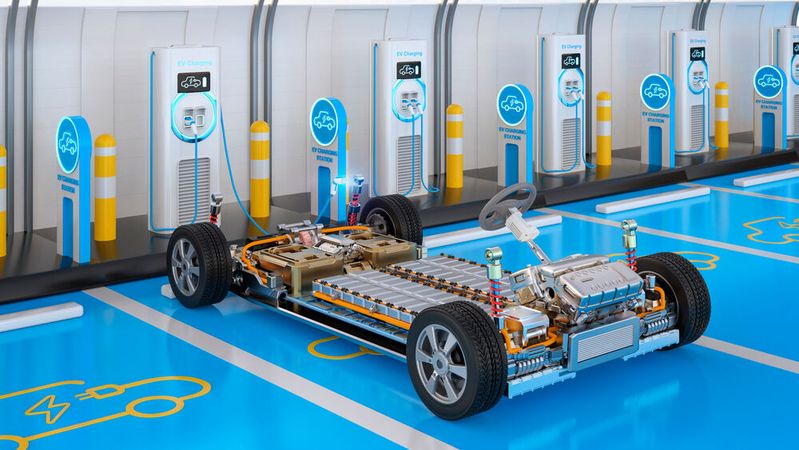
(Image: phonlamaiphoto - stock.adobe.com)
On July 1, 2026, the GB/T 43568-2026 standard came into effect, China’s first national standard for solid-state batteries in cars. For the first time, it defines with exact figures what can be called what. A battery with more than 20 percent liquid electrolyte is considered a liquid battery. Those with between five and 20 percent are classified as "hybrid solid-liquid batteries." Only those with less than five percent and that pass a test where the weight decreases by no more than 0.5 percent after six hours of vacuum drying at 120 degrees (248°F) are allowed to be referred to as true solid-state batteries.
Creating Facts Instead of Marketing Promises
This is stricter than the one percent previously allowed by an earlier standard of Chinese automotive engineers. For many manufacturers in China, this serves as a kind of reality check. The "solid-state batteries" installed in cars like the Nio ET9, the MG4, or models from GAC Hyptec and Chery in 2026 are, according to this new definition, all hybrid batteries with liquid electrolytes.
They achieve energy densities of 350 to 420 Wh/kg and can largely be produced on existing lithium production lines. This makes them relatively affordable—though not exactly what their prematurely promising name suggests. With the standard, the Ministry of Industry in Beijing sets a clear limit to the inflationary use of the term solid-state battery. Further regulations regarding performance, safety, and lifespan are expected to follow shortly.
With the new standard coming into effect, the ministry declared 2026 as the "first year of vehicle validation" for solid-state batteries in China. This is also a deliberately chosen blow against the marketing hype. Validation is important, but it is not yet mass production.
What Technical and Economic Challenges?
All major battery manufacturers in the People's Republic are heavily investing in the new technology. All have published roadmaps for the production of solid-state batteries for electric vehicles in the coming years. Currently, there are three parallel technological routes, named after the electrolyte used: solid-state batteries with sulfides, oxides, and polymers. For oxides and polymers, small-scale series production is already underway. Solid-state batteries with sulfides, which are considered the most promising in the long term, remain in pilot projects this year.
The reason for this lies in several technical hurdles that engineers and manufacturers still need to overcome. One of them is the contact between solid electrolyte and electrode. The connection is often unstable because the material expands during charging and discharging, creating microscopic gaps.
The lithium dendrites that then form can penetrate the solid electrolyte. This can have dangerous consequences, as demonstrated by the fire of a solid-state cell at Samsung SDI two years ago. Sulfide electrolytes are also very sensitive to moisture, making their production quite complex.
"As a precaution, vehicles with true solid-state batteries should probably not be sold in the next two years," said Ouyang Minggao, a member of the Chinese Academy of Sciences, at an industry conference in March.
In addition, the cost factor also plays a role. A true solid-state cell currently costs 1.6 to 2.2 Yuan per Wh in China, which corresponds to 20.8 to 28.6 Euro cents (approx. 22 to 30 US cents). This is three to five times as much as a common lithium iron phosphate cell, whose price has dropped to 0.39 to 0.5 Yuan, or approximately 5.1 to 6.5 cents (approx. 5.5 to 7 US cents), reports the Chinese automotive portal Gasgoo.
Anyone wanting a true solid-state battery in a typical 70 kWh electric vehicle for family use would currently have to pay more than 80,000 yuan extra for their car, roughly 10,000 euros (approx. $10,700). The lion's share of these costs is consumed by the lithium sulfide in the electrolyte. For most customers, this financial outlay would not be worthwhile. The currently widespread liquid batteries sufficiently meet their range needs.
Date: 08.12.2025
Naturally, we always handle your personal data responsibly. Any personal data we receive from you is processed in accordance with applicable data protection legislation. For detailed information please see our privacy policy.
Consent to the use of data for promotional purposes
I hereby consent to Vogel Communications Group GmbH & Co. KG, Max-Planck-Str. 7-9, 97082 Würzburg including any affiliated companies according to §§ 15 et seq. AktG (hereafter: Vogel Communications Group) using my e-mail address to send editorial newsletters. A list of all affiliated companies can be found here
Newsletter content may include all products and services of any companies mentioned above, including for example specialist journals and books, events and fairs as well as event-related products and services, print and digital media offers and services such as additional (editorial) newsletters, raffles, lead campaigns, market research both online and offline, specialist webportals and e-learning offers. In case my personal telephone number has also been collected, it may be used for offers of aforementioned products, for services of the companies mentioned above, and market research purposes.
Additionally, my consent also includes the processing of my email address and telephone number for data matching for marketing purposes with select advertising partners such as LinkedIn, Google, and Meta. For this, Vogel Communications Group may transmit said data in hashed form to the advertising partners who then use said data to determine whether I am also a member of the mentioned advertising partner portals. Vogel Communications Group uses this feature for the purposes of re-targeting (up-selling, cross-selling, and customer loyalty), generating so-called look-alike audiences for acquisition of new customers, and as basis for exclusion for on-going advertising campaigns. Further information can be found in section “data matching for marketing purposes”.
In case I access protected data on Internet portals of Vogel Communications Group including any affiliated companies according to §§ 15 et seq. AktG, I need to provide further data in order to register for the access to such content. In return for this free access to editorial content, my data may be used in accordance with this consent for the purposes stated here. This does not apply to data matching for marketing purposes.
Right of revocation
I understand that I can revoke my consent at will. My revocation does not change the lawfulness of data processing that was conducted based on my consent leading up to my revocation. One option to declare my revocation is to use the contact form found at https://contact.vogel.de. In case I no longer wish to receive certain newsletters, I have subscribed to, I can also click on the unsubscribe link included at the end of a newsletter. Further information regarding my right of revocation and the implementation of it as well as the consequences of my revocation can be found in the data protection declaration, section editorial newsletter.
Solid-state Batteries Likely Not Until 2030
Market observers, therefore, assume that the market for solid-state batteries will develop similarly to the market for lithium-ion batteries at the time. It took roughly from 1990 to 2020 for cell costs to drop to around one yuan per watt-hour. "Solid-state batteries will follow the same path, but it won’t take 30 years," said Pan Ruijun, a senior manager at the battery manufacturer Gotion, during a recent industry conference. He envisions real commercialization in large-scale production starting from 2030.
In addition, this year's statistics show that solid-state batteries are unlikely to immediately capture the mass market for passenger cars but will first find use in specific niches. For example, in air taxis and humanoid robots, where weight and safety are more important than price.
The manufacturer "Talent New Energy" already showcased series-ready solid-state cells for this sector at the drone fair in Shenzhen. From such niches, the new technology will gradually make its way into premium cars and later into more affordable vehicles.
At the same time, it cannot be denied that much progress has been made in the field of solid-state batteries since the beginning of this year. CATL has introduced a sulfide solid-state cell with more than 500 Wh/kg and is aiming for a small series production in 2027.
BYD launched a pilot line in Shenzhen and plans to start the first phase of a 20-gigawatt-hour line in Chongqing in the third quarter of 2026. Gotion High-Tech showcased its Jinshi cell with more than 400 Wh/kg and is planning small-scale production by the end of 2026.
EVE Energy launched the "Longquan No. 4" line, whose 60-Ah cells meet the requirements for automotive use. CALB has completed its "Wujie" system with around 430 Wh/kg, with vehicle installation planned for 2027. However, almost all of these projects are still in the pilot line, small-scale production, or testing phase.
While some manufacturers had already declared 2026 as the first year of mass production for solid-state batteries, in most cases, these were in fact the now precisely defined hybrid batteries. "True solid-state batteries will only come into limited commercial applications around 2030," emphasized Huang Xuejie, a researcher at the Institute of Physics of the Chinese Academy of Sciences. "2026 will be the first year of hybrid solid-liquid batteries."
With its new industrial standard for solid-state batteries, Beijing is now creating a solid foundation for this gradual commercialization.



:quality(80)/p7i.vogel.de/wcms/9e/23/9e23111e49d73012e9e3b7c69428ad5c/0134019347v1.jpeg "The Dominant VA45 high-helix tap from Bass, made of lead-free brass. The long chips, which result from the absence of lead, are clearly visible. (Image:Bass, Inc.)")
:quality(80)/p7i.vogel.de/wcms/1d/09/1d0999956ef87709b72ab1d0402ba207/csf-minis-gruppe-final-01-outputv1.jpeg "Since mid-2026, Harmonic Drive has been offering its CSF Mini gearheads in size 7 as well, in six variants designed for different installation scenarios. (Source: Harmonic Drive)")
:quality(80)/p7i.vogel.de/wcms/ab/08/ab08675922c3a7edea45128248b45b00/0133857009v1.jpeg "In the aerospace industry—one of the most demanding sectors of all—the Shanghai-based company TOPNC has already made a name for itself. (Image:TOPNC)")
:quality(80)/p7i.vogel.de/wcms/ff/48/ff48b1154746e79128935f28bd73ba0e/0113143253v1.jpeg "In our China Market Insider, we regularly provide you with relevant information straight from China. (Image:© Eisenhans - stock.adobe.com)")
:quality(80)/p7i.vogel.de/wcms/6e/bb/6ebb687f573be847aa611b413c6a33b1/0134094461v1.jpeg "From left: Sepp Hochreiter, founder of Nxai and AI researcher, and David Reger, founder and CEO of Neura Robotics, are excited about their collaboration on Physical AI. (Image:Neura)")
:quality(80)/p7i.vogel.de/wcms/89/01/890193a30c52ffd4811d18db82170952/0113143253v1.jpeg "In our China Market Insider, we regularly provide you with relevant information straight from China. (Image:© Eisenhans - stock.adobe.com)")
:quality(80)/p7i.vogel.de/wcms/6b/8a/6b8ac7cd85db2d1d1f6ab30957648711/schaeffler-news-taicanglighthouse6v1.jpeg "At the Lighthouse Factory, robots assemble linear and rotary actuators, among other components. (Source: Schaeffler)")
:quality(80)/p7i.vogel.de/wcms/4f/5a/4f5a2417df55dae5967e90b331e0bbc5/physical-ai-robotics-ariv1.jpeg "With new hardware and software solutions, the productive use of AI in industry is becoming increasingly prominent. (Source: Nvidia)")
:quality(80)/p7i.vogel.de/wcms/c3/68/c368b4f6821557ec497c64bc17fe9f8d/adobestock-2051843806--kaliel-stock-adobe-com-ki-generiertv1.jpeg "To truly harness the full potential of virtual product development, teams and management must radically change their mindset. (Source: © kaliel – stock.adobe.com_AI-generated)")
:quality(80)/p7i.vogel.de/wcms/a3/c1/a3c19e028b66a6fd7c373ab94981631d/paprika-gripperv1.jpeg "For the final, additively manufactured gripper base, SoftGripping chose PA 2200, a material based on polyamide 12 (PA12). It offers balanced mechanical properties and high load-bearing capacity, making it ideal for robust gripper solutions with integrated pneumatics. (Source: SoftGripping GmbH)")
:quality(80)/p7i.vogel.de/wcms/51/b8/51b8e08d2105fdd9952aff385f154192/graphic-2-adma1v1.png "The new surface hardening process enhances the performance of corrosion-resistant alloys by improving their tribological and mechanical surface properties, while preserving the properties of the base material. (Source: Bodycote)")
:quality(80)/p7i.vogel.de/wcms/96/ef/96effc239916cb7e0f396ab75627b8c0/image-space-testingv1.jpeg "Two scientists in front of a vacuum chamber used for testing: As technical instruments for spaceflight become more sensitive, the test facilities are becoming a critical system. (Source: Busch Group)")
:quality(80)/p7i.vogel.de/wcms/4c/61/4c61e3d5582715f2cadafc911480a20a/0132455124v1.jpeg "Mercedes-Benz has announced that it is moving away from its platform-based manufacturing strategy. Management expects a modular design concept to deliver greater benefits... (Image:Mercedes-Benz)")
:quality(80)/p7i.vogel.de/wcms/0d/14/0d14c9be5fc47bc256002ce3df435f21/keb-automation-drive-controller-marinev1.jpeg "Certified for ships, offshore applications, and more: the Combivert F6 Drive Controllers from KEB Automation. (Source: KEB Automation / Miss Irine)")
:quality(80)/p7i.vogel.de/wcms/ba/d3/bad3d62389a59fe3cdbac386a0dce64b/0134098250v1.jpeg "Following initial tests with its robotaxis in Europe, Pony.ai now plans to bring robot trucks to Europe as well. (Image:Pony.ai)")
:quality(80)/p7i.vogel.de/wcms/78/d1/78d124651f6149aa9f33913fc00ef98a/bertrandt-standort-tschechienv1.jpeg "Bertrandt has opened a new facility in the Czech Republic—near Škoda. (Source: Bertrandt)")
:quality(80)/p7i.vogel.de/wcms/27/47/27472d923d2d60f883a5682cb7987558/0134050215v1.jpeg "China's semiconductor industry: At the China International Industry Fair (CIIF) in Shanghai, the chip industry was given its own exhibition area for the first time in 2026. More than 300 companies showcased their technologies and solutions for industrial manufacturing at the “IC Ecosystem Show.” (Image:CIIF)")
:quality(80)/p7i.vogel.de/wcms/bc/20/bc2034a1ba033f00e539d91bcc70e403/bopla-bonext-1-rgbv1.jpeg "A translucent base allows for ambient lighting, either as a design feature or to visually indicate status. (Source: Bopla)")
:quality(80)/p7i.vogel.de/wcms/cd/23/cd239aa506b3ace30e62f44c83fa31ca/0134051508v1.jpeg "Figure 1: Schematic representation of the DAB (Dual Active Bridge) topology. (Image:Texas Instruments)")
:quality(80)/p7i.vogel.de/wcms/8b/35/8b35660420abba32fb891a4c5cc42fbd/0134018092v1.jpeg "Long-range UVC LED with lens and reflector: Close-up of a square LED with a transparent, dome-shaped lens on a dark base plate. The hermetically sealed housing ensures greater reliability and durability under demanding environmental conditions. (Image:FBH_Schurian)")
:fill(fff,0)/images.vogel.de/vogelonline/companyimg/76800/76895/65.jpg "FAULHABER_120mm.jpg ()")
:quality(80)/p7i.vogel.de/wcms/24/49/244902b72b5020c427bb50c6d3513811/0133725464v1.jpeg "Solid-state batteries: They promise a massive increase in the range of electric cars. Is there any truth to this promise, and what about mass production? (Image:Dall-E / AI-generated)")
:quality(80)/p7i.vogel.de/wcms/c0/30/c030f79acad01285bcf98d3e634708e1/0133914206v1.jpeg "The Li 6 combines a platform developed specifically for electric vehicles with 800-V architecture and 5C fast-charging technology. The suspension and handling have been adapted to European roads and driving habits. (Image:LI Auto)")