Battery TechnologyChina Brings the Next Battery Generation to Life
From
Henrik Bork | Translated by AI
4 min Reading Time
In China, the "next generation of batteries" is currently making the leap from development labs into industry. The manufacturer EVE Energy has opened a factory for the mass production of solid-state batteries in Chengdu, as reported by the automotive portal Gasgoo. The factory initially covers an area of 11,000 square meters (~118,400 Square Feet), with plans for continuous expansion.
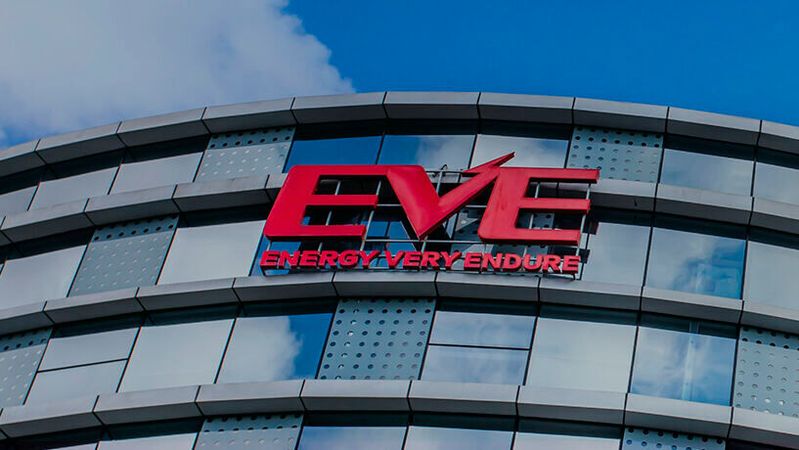
EVE Energy is one of the Chinese manufacturers heavily investing in solid-state batteries.
(Image: EVE Energy)
500,000 batteries per year will roll off the production line there once construction is fully completed in two phases. This is expected to happen by the end of next year, EVE Energy announced. Then, an annual capacity of 100 megawatts is set to be produced in Sichuan. In a manner typical for China, the company is pursuing a dual approach of incremental innovations that are very quickly accompanied by scaling in manufacturing. He himself calls it "scientifically based design and experimenting in large quantities," explained CEO Liu Jincheng at the factory's inauguration.
60-Ah Batteries in Series Production Starting at the End of the Year
This parallel advance and commercial production are reflected in the rapid "ramp-up" of battery models planned in Chengdu. From now on, the "Longquan No. 2" will be produced. With a capacity of 10 Ah, an energy density of 300 Wh/kg, and 700 Wh/L, this fully solid-state battery is intended, among other things, for use in air taxis and humanoid robots. EVE Energy recently entered into a collaboration with Vbot in the field of robotics, so there is no need to worry about demand.
From the end of this year, EVE Energy plans to produce solid-state batteries with 60 Ah in Chengdu, and by the end of next year, even those with 100 Ah in series production. The production line also serves as a test laboratory.
Soon Standard Ranges of 1,000 Kilometers (~621 Miles)?
Solid-state cells function like conventional lithium-ion cells with the familiar trio of anode, cathode, and electrolyte. However, instead of a liquid, they have a solid electrolyte layer. This makes them not only significantly more powerful, as ions feel more comfortable in this environment, but also virtually non-flammable, making them much safer for use in electromobility compared to the currently widespread liquid-electrolyte lithium-ion batteries.
Experts predict that the scaling of mass production, combined with rapidly falling prices for this new battery type, will give a significant boost to electrification in road traffic as well as emerging industries such as China's promoted "low-altitude economy" with air taxis and delivery drones.
This could mean that ranges of more than 1,000 kilometers per charge may soon become standard for electric cars, even as car batteries become lighter and more compact. Globally, not only battery manufacturers but also car manufacturers are engaged in a kind of global race in the research and development of solid-state batteries.
In China, where systematically government-supported battery research meets a dynamic environment shaped by the e-car and hybrid boom on the streets, a true explosion of data centers for AI applications, and rapidly growing supply chains in areas such as robotics or storage for renewable energy, a great deal is currently happening.
Automakers are almost all investing in the development of solid-state batteries, often also in manufacturers of solid-state batteries. Farasis Energy, which is supported by Mercedes-Benz among others, is currently building a pilot facility for the production of sulfide-based solid-state cells. The company's prototypes currently have target values of 400–500 Wh/kg. A 60-Ah sulfide solid-state cell is expected to be delivered in small series to strategic customers starting at the end of this year, Farasis hopes.
The same applies to EVE Energy's competitors. All major battery manufacturers in China are participating in the race. SVOLT and CATL have already announced new cell concepts, but these are still primarily focused on semi-solid systems. True solid-state cells with 100 percent solid electrolytes are still lacking there and are expected by insiders only next year.
When it comes to applications, automakers in China are already investing significant amounts of money in research and development. They are testing solid-state batteries in their vehicles and preparing to install them as standard in their electric cars and plug-in hybrids.
The Chinese electric brand GAC Aion has announced that starting next year, it plans to mass-produce the first models with fully solid-state batteries — no longer just the hybrid, semi-liquid type often referred to as "solid-state" in China. The first car to be sold with all-solid-state batteries and ranges of over 1,000 kilometers (~621 Miles) will be the GAC "Hyper," according to the automaker in Guangzhou.
Date: 08.12.2025
Naturally, we always handle your personal data responsibly. Any personal data we receive from you is processed in accordance with applicable data protection legislation. For detailed information please see our privacy policy.
Consent to the use of data for promotional purposes
I hereby consent to Vogel Communications Group GmbH & Co. KG, Max-Planck-Str. 7-9, 97082 Würzburg including any affiliated companies according to §§ 15 et seq. AktG (hereafter: Vogel Communications Group) using my e-mail address to send editorial newsletters. A list of all affiliated companies can be found here
Newsletter content may include all products and services of any companies mentioned above, including for example specialist journals and books, events and fairs as well as event-related products and services, print and digital media offers and services such as additional (editorial) newsletters, raffles, lead campaigns, market research both online and offline, specialist webportals and e-learning offers. In case my personal telephone number has also been collected, it may be used for offers of aforementioned products, for services of the companies mentioned above, and market research purposes.
Additionally, my consent also includes the processing of my email address and telephone number for data matching for marketing purposes with select advertising partners such as LinkedIn, Google, and Meta. For this, Vogel Communications Group may transmit said data in hashed form to the advertising partners who then use said data to determine whether I am also a member of the mentioned advertising partner portals. Vogel Communications Group uses this feature for the purposes of re-targeting (up-selling, cross-selling, and customer loyalty), generating so-called look-alike audiences for acquisition of new customers, and as basis for exclusion for on-going advertising campaigns. Further information can be found in section “data matching for marketing purposes”.
In case I access protected data on Internet portals of Vogel Communications Group including any affiliated companies according to §§ 15 et seq. AktG, I need to provide further data in order to register for the access to such content. In return for this free access to editorial content, my data may be used in accordance with this consent for the purposes stated here. This does not apply to data matching for marketing purposes.
Right of revocation
I understand that I can revoke my consent at will. My revocation does not change the lawfulness of data processing that was conducted based on my consent leading up to my revocation. One option to declare my revocation is to use the contact form found at https://contact.vogel.de. In case I no longer wish to receive certain newsletters, I have subscribed to, I can also click on the unsubscribe link included at the end of a newsletter. Further information regarding my right of revocation and the implementation of it as well as the consequences of my revocation can be found in the data protection declaration, section editorial newsletter.
Technical Hurdles
Despite all these advancements, some technical hurdles are still slowing down the introduction of the new technology. Manufacturing is complex and requires a level of precision otherwise known almost exclusively from the semiconductor industry.
Many solid-state materials tend to develop micro-cracks during temperature fluctuations, are sensitive to moisture, and require complex handling. The interfaces between the solid electrolyte and electrodes are particularly critical. A single poor contact can already lead to very high internal resistance and performance drops.
In addition, there are currently high material and production costs. However, this last problem is likely to disappear quickly, as experience shows, once mass production begins in more and more factories. (se)



:quality(80)/p7i.vogel.de/wcms/b5/67/b5676f3bfb36251ed31f9a0cccf650b6/0133167827v1.jpeg "Thanks to JumboFlex Generation 2, employees can effortlessly move wheelchairs weighing as much as 40 kilograms. (Image:Lard)")
:quality(80)/p7i.vogel.de/wcms/5e/c6/5ec615b7a51440f668259f2af9158cb9/0132654694v1.jpeg "Strategic Partnerships in Industry: As buyers and restructuring partners, Chinese investors are increasingly helping to preserve jobs in Germany. (Image: ©Anatolii Rymarchuk - stock.adobe.com)")
:quality(80)/p7i.vogel.de/wcms/eb/2b/eb2bd1b8487afe577b37363cd02f16ff/0113143253v1.jpeg "In our China Market Insider, we regularly provide you with relevant information straight from China. (Image:© Eisenhans - stock.adobe.com)")
:quality(80)/p7i.vogel.de/wcms/dd/b8/ddb8edc98c49b384734ab2432b297eb5/adobestock-1913662309--irene-stock-adobe-com-ki-generiertv1.jpeg "Rotary joints are used in grippers and swivel mechanisms to allow assemblies to rotate or swivel smoothly relative to one another, even under very high loads (illustrative image). (Source: Irene - stock.adobe.com / KI-generiert)")
:quality(80)/p7i.vogel.de/wcms/3a/9c/3a9c1fd546e1f041b86bb1d03cf39101/0133610524v1.jpeg "The Mason W-01 combines industrial-grade humanoid hardware, Physical AI-based perception, and autonomous task planning. (Image:Nova X Robotics)")
:quality(80)/p7i.vogel.de/wcms/d0/74/d074ae5d5d705b841b63107b20f9d8c2/699711-xpeng-iron-01-79661c-original-1788864313v1.png "(Source: XPeng Motors (Germany) GmbH)")
:quality(80)/p7i.vogel.de/wcms/60/ef/60ef4f07e4829b2c2929befc0f353c58/0133511729v1.jpeg "Humanoid robots can match human performance in certain tasks. (Image:Gemini / AI-generated)")
:quality(80)/p7i.vogel.de/wcms/2e/99/2e99726b522e4b35b690e25eb6a42643/0133463991v1.jpeg "Robotics: In AMR applications, connection technology must reliably transmit power, signals, and data despite vibration and shock loads—in very confined spaces and in a way that allows for regular maintenance. (Image:Hyperever)")
:quality(80)/p7i.vogel.de/wcms/3d/ff/3dff5e51c24b30c8dc37c1d024887157/0133602931v1.jpeg "Just a few years ago, SpaceX specialists were working on the world’s largest rocket—the Starship. Now, Elon Musk’s company has reached a milestone during a test flight: Earth’s orbit! But there was also a downside... (Image: SpaceX)")
:quality(80)/p7i.vogel.de/wcms/c0/52/c052f405eb55fc3d08c4837e77206fc0/adobestock-2021845957--aucartstudio-stock-adobe-com-ki-generiertv1.jpeg "An innovation from China to combat extreme summer heat: A novel coating lowers temperatures. (Source: © AucArtStudio – stock.adobe.com_AI-generated)")
:quality(80)/p7i.vogel.de/wcms/66/a7/66a7b78159caeacce57136529688799f/0133503398v1.jpeg "Sunlight Makes Stone! These stone blocks weren't made the traditional way. Instead, they were additively manufactured from sand using a laser. In the future, however, the laser is set to be replaced by concentrated sunlight—if the startup Addisol is successful... (Image:Addisol / F. Fiedler)")
:quality(80)/p7i.vogel.de/wcms/72/b9/72b995c2c8d812c5e2115cbef31e035a/0133462727v1.jpeg "Eggl manufactures center hoods that are precisely tailored to each cooking island—whether standard size or custom shape. They are made entirely of stainless steel and are individually customized in terms of size and filter arrangement. (Image:SPI)")
:quality(80)/p7i.vogel.de/wcms/42/95/4295a1b01f6fa1f696ffff89cd542737/0133563161v1.jpeg "At its plant in Zaragoza, Spain, Stellantis draws energy from a hybrid energy portfolio. Solar and wind power are expected to cover about 80 percent of the plant’s local electricity needs. (Image:Stellantis)")
:quality(80)/p7i.vogel.de/wcms/3e/2f/3e2f1ec6c4e1a24eac32957acebd0901/0133601693v1.jpeg "From the boule (bottom) to the wafer to the chip (on top of the boule). Transistors are used as switches in power electronics. (Image:Bosch)")
:quality(80)/p7i.vogel.de/wcms/8f/99/8f9956e7dce99d1b28c27fb1c30ea236/04-dsc-2230v1.jpeg "Bosch is cutting jobs in Nuremberg. (Source: Bosch)")
:quality(80)/p7i.vogel.de/wcms/aa/a2/aaa2c6dd2daa24b485cddbf9297590c0/0133467318v1.jpeg "Battery Monitoring: Battery monitoring using electrochemical impedance spectroscopy offers several advantages. (Image:TI)")
:quality(80)/p7i.vogel.de/wcms/22/f0/22f07d1635c733a29049fff5b1b8ccc8/0133601916v1.jpeg "AI models from various providers have been causing quite a stir lately because they’ve done things they weren’t supposed to—or so they say! Now, in light of recent incidents, the company “OpenAI” has decided against releasing a new AI model... (Image: AI-generated)")
:quality(80)/p7i.vogel.de/wcms/28/28/2828c5261714321afb0bab67bf771823/0133353387v1.jpeg "The 130-meter-long China Zorrilla draws its power from a battery system with a capacity of more than 40 MWh. Eight electric motors drive an equal number of water jets. (Image:Incat Australia Pty Ltd)")
:quality(80)/p7i.vogel.de/wcms/48/15/4815da27c45973ca629a99b375ac3aef/0133509585v1.jpeg "Ventuno Q RoadTest: Designed to help the Element14 community gain practical insights from real-world tests using the Ventuno Q. (Image:Farnell/Element14)")
:quality(80)/p7i.vogel.de/wcms/17/2b/172bd132f9febdfcbcedba292ad0504d/aufmacherv1.jpeg "Micro-Epsilon offers a wide range of IO-Link-compatible sensors. (Source: Micro-Epsilon Messtechnik GmbH & Co. KG)")
:quality(80)/p7i.vogel.de/wcms/9a/eb/9aebe89e1654dc14f3b44725a901b1a7/0132278483v1.jpeg "In China, since July 2026, the GB/T 43568-2026 standard defines when an energy storage device may be referred to as a solid-state battery. (Image:phonlamaiphoto - stock.adobe.com)")
:quality(80)/p7i.vogel.de/wcms/d6/c2/d6c29fed2099d2471cf31ea0e660f91e/0129501568v1.jpeg "BMW's sixth-generation cylindrical lithium-ion cells. (Image:BMW)")