


:quality(80)/p7i.vogel.de/wcms/37/9f/379f62914fcef347331e271270e3f755/ad1i8940-4368x2456v1.jpeg "(Source: SIMTOS)")
:quality(80)/p7i.vogel.de/wcms/a4/3c/a43c87e306c4b61c9afc01beec500296/-bcm8149-3936x2213v1.jpeg "(Source: TMBA)")
:quality(80)/p7i.vogel.de/wcms/10/11/1011a37522d84917f003e58d93b5aa58/0129426354v1.jpeg "Producing hydrogen where the raw material is available in vast quantities: In the sea! Researchers at Bremerhaven University of Applied Sciences now want to get this off the ground. They believe that offshore hydrogen production is more favorable than on land ... (Picture: ©Shawn Hempel - stock.adobe.com)")
:quality(80)/p7i.vogel.de/wcms/68/4b/684b0fdf046c2ce50f85f2962e4a5c4e/0128861342v1.jpeg "Consistent pricing is a prerequisite for success in the retrofit business. (Picture: ©bakhtiarzein - stock.adobe.com)")
:quality(80)/p7i.vogel.de/wcms/ec/78/ec78a17c244d3aed1f27b95af980c490/0129438580v1.jpeg "According to the Microsoft study, 29 percent of employees use AI agents without the approval of their IT department or superiors. (Picture: ©immimagery - stock.adobe.com)")
:quality(80)/p7i.vogel.de/wcms/8a/1e/8a1e6f65e2a0233007e1308a0bc42891/org-blobs-user-response-file-output-3964257d-ad39-4188-854f-cb9f073d1d06-plugin-output-call-xpdfkdgybtu3axwxtgikmroc-1536x864v1.png "(Source: AI-generated)")
:quality(80)/p7i.vogel.de/wcms/f8/f1/f8f13c6a36ecc58af66cdcd16733b262/pexels-googledeepmind-17485706-1920x1079v1.jpeg "(Source: Google DeepMind)")
:quality(80)/p7i.vogel.de/wcms/c5/c2/c5c2fbe38a551a5ac9e8201aa3044e95/0129369094v1.jpeg "The big tech companies are outbidding each other with triple-digit billion investments in AI development. (Picture: ©Shuo - stock.adobe.com)")
:quality(80)/p7i.vogel.de/wcms/a7/34/a73475e9638e032c32288f53006abab7/newsimage417867-2665x1500v1v1.jpeg "Combination of a model from a scanning electron microscope image (left) with a section of the underlying crystal structure of a studied MXene with precisely controlled surface terminations. (Image:B. Schröder/HZDR)")
:quality(80)/p7i.vogel.de/wcms/d2/1a/d21a9b3e1333f306ffd6421e84f9e3d0/semiconductor-20image-20courtesy-20of-20gelest-3000x1688v1.jpeg "In a new collaboration, IBM will test the performance of Gelest precursor materials for dry resist EUV lithography, generating results that aim to guide Gelest on materials research and speed innovation toward smaller devices. (Source: Gelest)")
:quality(80)/p7i.vogel.de/wcms/f5/c6/f5c6cefa374d48138dc702821d41c7c6/greenspeed-visual-home-1500x843v1v1.jpeg "The EU Green Speed project is laying the foundations for cleaner and more competitive production of lithium-ion batteries in Europe. (Image:greenSPEED Consortium / VIRTUAL VEHICLE)")
:quality(80)/p7i.vogel.de/wcms/ba/d0/bad011e604599660b5b2cdd50eb44755/stefanie-arnold-152236-4500x2530v1v1.jpeg "Materials researcher Stefanie Arnold wants to make energy storage more environmentally friendly with the help of hollow carbon spheres. (Image:Saarland University)")
:quality(80)/p7i.vogel.de/wcms/e7/01/e701127d385ceffd0f86b3294f2a3c6d/0129354681v1.jpeg "Parking towers can be a space-saving solution, as the Munich-based company VePa Vertical Parking shows. The start-up has implemented an automated paternoster parking system in Munich's Werksviertel district. (Image:SEW-Eurodrive)")
:quality(80)/p7i.vogel.de/wcms/04/5c/045cb66bca1a642c56fc405ab96213dd/0129353500v1.jpeg "CATL's new sodium-ion battery is to be used in future car models of various Changan brands. They underwent rigorous testing in Yakeshi. (Image:Changan)")
:quality(80)/p7i.vogel.de/wcms/ce/ce/cecefd66fe6478ab996f9e975779b9e0/0129426378v1.jpeg "Electrifying losses! Ford, like so many other car companies, has miscalculated its electric car strategy. Now the US car manufacturer has to accept losses in the 2-digit billion range and is therefore setting a new course ... (Image:Ford)")
:quality(80)/p7i.vogel.de/wcms/89/e2/89e2226e826f23fb666222b66c737531/0129393966v1.jpeg "Chinese car manufacturers and suppliers want to produce small batches of brake-by-wire systems this year. (Image:Chery)")
:quality(80)/p7i.vogel.de/wcms/72/e8/72e82e7be7eb9c7f3fe6e7bd6442b95d/0129427931v1.jpeg "Strategic: EPC licenses eGaN technology to Renesas (Image:freely licensed)")
:quality(80)/p7i.vogel.de/wcms/7b/73/7b736ec0a4a0f7298b65edadc633bb97/0129365186v1.jpeg "Old form factor, new technologies: Ahmed Shihab, Chief Product Officer at Western Digital, shows the physical drive, which is designed to hold up to 140 TB, at Innovation Day. (Image:Western Digital)")
:quality(80)/p7i.vogel.de/wcms/de/30/de30109024cc88d5a9f546a881542789/0129416855v1.jpeg "Starting signal for sub-2nm innovation made in Europe: The Belgian research institute Imec has announced the launch of the European NanoIC pilot line with a clean room expansion of 2000 square meters. (Image:imec)")
:quality(80)/p7i.vogel.de/wcms/02/50/02507ce2e6225bb6816c8805bd98da71/0129407664v1.jpeg "Thanks to a new type of sensor, hydrogen can also be reliably detected in humid environments. (Image:freely licensed)")
:fill(fff,0)/images.vogel.de/vogelonline/companyimg/76800/76895/65.jpg "FAULHABER_120mm.jpg ()")
:fill(fff,0)/p7i.vogel.de/companies/67/eb/67eba621ef6ea/logo2.png "logo2 (Wuxi InfiMotion)")

:quality(80):fill(efefef,0)/p7i.vogel.de/wcms/67/ae/67ae0b9ac31f8/elatec-wp-universal-reader.png "Elatec WP Universal Reader")
Date: 08.12.2025
Naturally, we always handle your personal data responsibly. Any personal data we receive from you is processed in accordance with applicable data protection legislation. For detailed information please see our privacy policy.
Consent to the use of data for promotional purposes
I hereby consent to Vogel Communications Group GmbH & Co. KG, Max-Planck-Str. 7-9, 97082 Würzburg including any affiliated companies according to §§ 15 et seq. AktG (hereafter: Vogel Communications Group) using my e-mail address to send editorial newsletters. A list of all affiliated companies can be found here
Newsletter content may include all products and services of any companies mentioned above, including for example specialist journals and books, events and fairs as well as event-related products and services, print and digital media offers and services such as additional (editorial) newsletters, raffles, lead campaigns, market research both online and offline, specialist webportals and e-learning offers. In case my personal telephone number has also been collected, it may be used for offers of aforementioned products, for services of the companies mentioned above, and market research purposes.
Additionally, my consent also includes the processing of my email address and telephone number for data matching for marketing purposes with select advertising partners such as LinkedIn, Google, and Meta. For this, Vogel Communications Group may transmit said data in hashed form to the advertising partners who then use said data to determine whether I am also a member of the mentioned advertising partner portals. Vogel Communications Group uses this feature for the purposes of re-targeting (up-selling, cross-selling, and customer loyalty), generating so-called look-alike audiences for acquisition of new customers, and as basis for exclusion for on-going advertising campaigns. Further information can be found in section “data matching for marketing purposes”.
In case I access protected data on Internet portals of Vogel Communications Group including any affiliated companies according to §§ 15 et seq. AktG, I need to provide further data in order to register for the access to such content. In return for this free access to editorial content, my data may be used in accordance with this consent for the purposes stated here. This does not apply to data matching for marketing purposes.
Right of revocation
I understand that I can revoke my consent at will. My revocation does not change the lawfulness of data processing that was conducted based on my consent leading up to my revocation. One option to declare my revocation is to use the contact form found at https://contact.vogel.de. In case I no longer wish to receive certain newsletters, I have subscribed to, I can also click on the unsubscribe link included at the end of a newsletter. Further information regarding my right of revocation and the implementation of it as well as the consequences of my revocation can be found in the data protection declaration, section editorial newsletter.
:quality(80)/p7i.vogel.de/wcms/6f/a4/6fa443ed1e0db0d4683188545438cc70/0127127874v1.jpeg "EVE Energy is one of the Chinese manufacturers heavily investing in solid-state batteries. (Image:EVE Energy)")
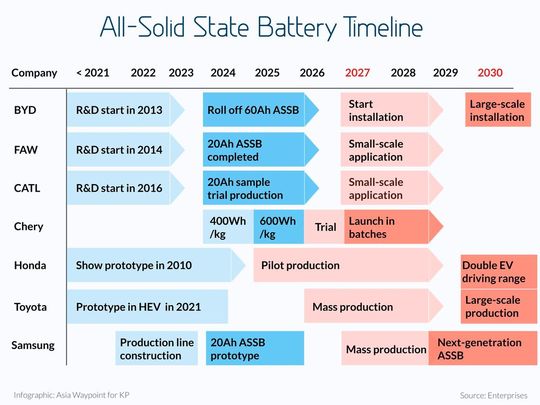
:quality(80)/p7i.vogel.de/wcms/3f/44/3f44b82f5e0b1fbb5e8d5cb8897730f6/0122913680v1.jpeg "Japan and China are in a hot neck-and-neck race to see who will be the first to commercialize solid-state batteries. It seems that Japan is one step ahead, as Honda presented its demonstration production line for solid-state cells in Sakura last year. (Image:Honda)")