The sales halt for certain CoolGaN products in China is just a snapshot of a larger patent dispute between Infineon and Innoscience. An overview of proceedings, markets, and the significance for GaN power semiconductors.
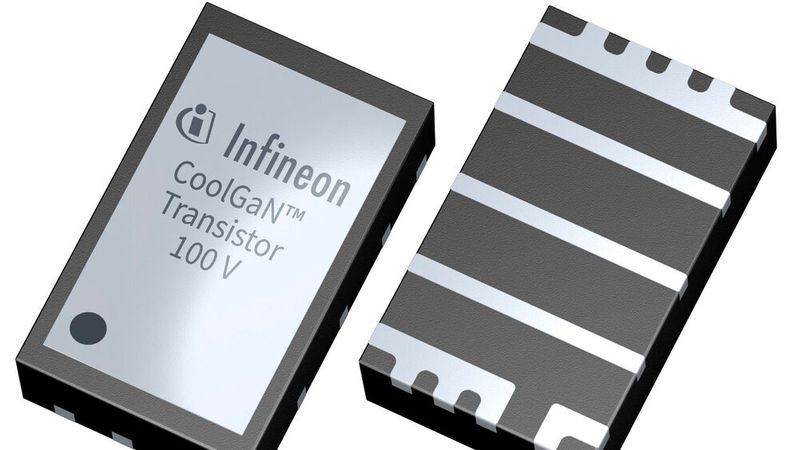
Infineon's CoolGaN 100 V transistor family offers high switching performance and power capacity in a compact package.
(Image: Infineon)
It's a familiar sight at major trade shows: sometimes an exhibit is covered with a cloth, other times something has to be removed. This is usually due to patent disputes and complaints from competitors. This time, Infineon has been affected in China.
On the opening day of "electronica China" in Shanghai in early July 2026, Infineon had to remove part of its display again, reported the Chinese financial portal Shidai Caijing. Representatives of the Chinese chip manufacturer Innoscience had discovered several GaN components at the booth of their Munich-based (Germany) competitor that had previously been subjected to a sales ban by a Chinese court.
Following this objection, the trade fair organizer removed the disputed exhibits from Infineon's booth, Innoscience stated on its official WeChat account on July 2, 2026. It is reportedly the first time that a sales ban in China's relatively young gallium nitride industry has been enforced so publicly, and that on an international leading trade fair, according to Chinese comments.
The two companies are already battling in court in Germany and the USA, with several rulings having favored Infineon. Recently, however, Innoscience launched a "counteroffensive" in its hometown Suzhou, near Shanghai, as the financial portal described it. On May 27, the Intermediate People's Court of Suzhou ruled in the first instance that Infineon had infringed two of Innoscience's invention patents, according to Shidai Caijing—as previously reported.
The court ordered an immediate halt to the sale, offering, and import of the affected products in China, awarded Innoscience ten million yuan (approximately 1.2 million euros / $1.3 million) in damages, and issued an injunction. Since Innoscience is headquartered in Suzhou, this was essentially a home-court victory.
Not Without my Lawyer
Infineon fought back. The company attempted to have the two patents declared invalid and appealed to the Supreme People's Court. Both attempts failed, according to Shidai Caijing. The Chinese Patent Office CNIPA fully upheld the validity of both patents in November 2025, and a subsequent objection by Infineon was dismissed by the Beijing Intellectual Property Court.
On June 12, the Intellectual Property Tribunal of the Supreme People's Court upheld the ruling and rejected all objections, Innoscience stated in a press release. This made the ban enforceable in China. The two patents, which Innoscience asserted in Suzhou at the end of 2024, are considered fundamental for 650-volt GaN devices on a silicon basis. They pertain to their design and manufacturing, according to Chinese media reports. Ten products from Infineon's CoolGaN-G3 series are affected.
Where Profits Await
The background to the dispute lies in one of the most lucrative areas of power electronics. GaN switches faster and with lower losses than conventional silicon, paving the way for data centers to adopt 800-volt power supplies, as demanded by the significantly increased power consumption of AI servers. According to market researcher Yole Group, Innoscience and Infineon were among the world's five largest GaN manufacturers in 2023 and 2024, as reported by the South China Morning Post. Market researcher Trendforce data showed that Innoscience led the global GaN power device market in 2024 with 29.9 percent, while Infineon ranked fourth with 10.3 percent. According to Infineon's financial report, China and Hong Kong accounted for 38 percent of the company's revenue in the 2025 fiscal year.
Both companies are suppliers to Nvidia. Innoscience is working with Nvidia on GaN power supply solutions for its 800-volt architecture, according to the South China Morning Post in Hong Kong. Other industry reports suggest that both corporations, Innoscience and Infineon, are on Nvidia's list of approved suppliers for this transition.
Date: 08.12.2025
Naturally, we always handle your personal data responsibly. Any personal data we receive from you is processed in accordance with applicable data protection legislation. For detailed information please see our privacy policy.
Consent to the use of data for promotional purposes
I hereby consent to Vogel Communications Group GmbH & Co. KG, Max-Planck-Str. 7-9, 97082 Würzburg including any affiliated companies according to §§ 15 et seq. AktG (hereafter: Vogel Communications Group) using my e-mail address to send editorial newsletters. A list of all affiliated companies can be found here
Newsletter content may include all products and services of any companies mentioned above, including for example specialist journals and books, events and fairs as well as event-related products and services, print and digital media offers and services such as additional (editorial) newsletters, raffles, lead campaigns, market research both online and offline, specialist webportals and e-learning offers. In case my personal telephone number has also been collected, it may be used for offers of aforementioned products, for services of the companies mentioned above, and market research purposes.
Additionally, my consent also includes the processing of my email address and telephone number for data matching for marketing purposes with select advertising partners such as LinkedIn, Google, and Meta. For this, Vogel Communications Group may transmit said data in hashed form to the advertising partners who then use said data to determine whether I am also a member of the mentioned advertising partner portals. Vogel Communications Group uses this feature for the purposes of re-targeting (up-selling, cross-selling, and customer loyalty), generating so-called look-alike audiences for acquisition of new customers, and as basis for exclusion for on-going advertising campaigns. Further information can be found in section “data matching for marketing purposes”.
In case I access protected data on Internet portals of Vogel Communications Group including any affiliated companies according to §§ 15 et seq. AktG, I need to provide further data in order to register for the access to such content. In return for this free access to editorial content, my data may be used in accordance with this consent for the purposes stated here. This does not apply to data matching for marketing purposes.
Right of revocation
I understand that I can revoke my consent at will. My revocation does not change the lawfulness of data processing that was conducted based on my consent leading up to my revocation. One option to declare my revocation is to use the contact form found at https://contact.vogel.de. In case I no longer wish to receive certain newsletters, I have subscribed to, I can also click on the unsubscribe link included at the end of a newsletter. Further information regarding my right of revocation and the implementation of it as well as the consequences of my revocation can be found in the data protection declaration, section editorial newsletter.
A Verdict With Impact?
How significant the sales ban in China is remains a matter of differing opinions. The ruling has a "very limited effect" on the GaN business, as it only concerns a small part of the portfolio, an Infineon spokesperson told the South China Morning Post. The company strongly disagrees with the decision and will "exhaust all legal means to defend its innovation leadership in GaN technology."
In contrast, the patent consultancy PRIP Research expects a "significant impact" on Infineon's business, particularly for Infineon's high-margin high-voltage products for industrial and server applications, as well as modules for the automotive sector. The ruling caused short-term stock price jumps among Chinese chip manufacturers. Innoscience's Hong Kong-listed shares rose by 16.6 percent on the following Monday. Shanghai-based compound semiconductor manufacturers Silan Microelectronics and Sanan Optoelectronics hit their daily limit of ten percent, while China Resources Microelectronics shares increased by more than 13 percent.
The dispute is a "system-level confrontation" over dominance in third-generation semiconductors, the South China Morning Post quoted Zhang Guobin, the founder of the Chinese chip portal eetrend.com. With the explosive growth in demand for efficient power components for AI data centers, electric vehicles, and renewable energy, competition in the GaN market will further intensify, Zhang said.
A Dispute in Multiple Instances
Infineon was the first to take its Chinese competitor to court, Shidai Caijing reported. In the US, the Munich-based company sued the Chinese firm in March 2024 before a federal court in California. Later, they petitioned the trade authority ITC for an import ban. In May 2026, the ITC ruled that an already discontinued legacy product from Innoscience infringed an Infineon patent and imposed an import ban for it.
The current GaN products were unaffected by this, Innoscience emphasized at the time. In Germany, Infineon filed a lawsuit in June 2024 before the Munich I Regional Court and won in the first instance in August 2025. On June 18, 2026, the same court found Innoscience guilty in two more cases of infringing a patent and a utility model. "Today's ruling demonstrates the value of our GaN portfolio and underscores our commitment to vigorously defend our intellectual property," stated Johannes Schoiswohl, Head of Infineon's GaN Division, in a press release.
The final word has not yet been spoken. Infineon denied that there had been a "final victory" for Innoscience in China, as claimed by its rival. The decision by the Supreme People's Court only concerned the preliminary injunction; the main proceedings are still ongoing, the company told the industry service ip Fray. Additional cases involving other patents are pending. Meanwhile, the market over which both companies are fiercely battling is only just beginning to expand with the growth of AI data centers in China and the US.



:quality(80)/p7i.vogel.de/wcms/1d/09/1d0999956ef87709b72ab1d0402ba207/csf-minis-gruppe-final-01-outputv1.jpeg "Since mid-2026, Harmonic Drive has been offering its CSF Mini gearheads in size 7 as well, in six variants designed for different installation scenarios. (Source: Harmonic Drive)")
:quality(80)/p7i.vogel.de/wcms/ab/08/ab08675922c3a7edea45128248b45b00/0133857009v1.jpeg "In the aerospace industry—one of the most demanding sectors of all—the Shanghai-based company TOPNC has already made a name for itself. (Image:TOPNC)")
:quality(80)/p7i.vogel.de/wcms/ff/48/ff48b1154746e79128935f28bd73ba0e/0113143253v1.jpeg "In our China Market Insider, we regularly provide you with relevant information straight from China. (Image:© Eisenhans - stock.adobe.com)")
:quality(80)/p7i.vogel.de/wcms/b4/6e/b46ec48324b602f1a1b43836293d8968/0133970817v1.jpeg "New Weapons! Chancellor Friedrich Merz and French President Emmanuel Macron, in particular, are calling on the European Commission to take tougher action against unfair trade practices by certain countries. Read here to find out what that might look like... (Image: AI-generated)")
:quality(80)/p7i.vogel.de/wcms/ca/24/ca24d741a2fd714fa14d2a3e9db1c904/image1v1.jpeg "With 117,500 units sold, transportation and logistics will remain the leading application area for service robotics in 2025 as well. (Image:Innok Robotics)")
:quality(80)/p7i.vogel.de/wcms/b7/95/b795d5fb82459f8a526e880f0698dffa/1-maxon-mind-covershot-landscapev1.jpeg "Claude Jaquemet demonstrates the Maxon Mind demo system. (Source: Maxon)")
:quality(80)/p7i.vogel.de/wcms/be/66/be661616d5250d4c3814a25688f3904b/0133917202v1.jpeg "Neuron AI combines 3D vision, touch, hearing, proprioception, and language—along with memory—into a Perception-Language-Action (PLA) model. Robots can grasp objects they cannot see. (Image:Neura)")
:quality(80)/p7i.vogel.de/wcms/c7/12/c712b688dba2262fa3906e3a4c1d2f7d/humanoide-robotikv1.jpeg "“Find a job that the humanoid can actually do, and understand your processes”—that’s the advice robotics expert Sebastian Prinz gives companies so they can benefit from the technology in the long term. (Source: Fraunhofer IEM / Janosch Gruschczyk)")
:quality(80)/p7i.vogel.de/wcms/51/b8/51b8e08d2105fdd9952aff385f154192/graphic-2-adma1v1.png "The new surface hardening process enhances the performance of corrosion-resistant alloys by improving their tribological and mechanical surface properties, while preserving the properties of the base material. (Source: Bodycote)")
:quality(80)/p7i.vogel.de/wcms/96/ef/96effc239916cb7e0f396ab75627b8c0/image-space-testingv1.jpeg "Two scientists in front of a vacuum chamber used for testing: As technical instruments for spaceflight become more sensitive, the test facilities are becoming a critical system. (Source: Busch Group)")
:quality(80)/p7i.vogel.de/wcms/5a/12/5a1294a38a634f839f542c0055024d7a/jie-yin-feather-star-header-1500v1.jpeg "Underwater Acrobatics: The new soft robot mimics brittle stars—using minimal propulsion technology. (Source: North Carolina State University)")
:quality(80)/p7i.vogel.de/wcms/96/89/9689197f666e4aa9bc4a1f395c25d3ef/0133739635v1.jpeg "The 2026 Nobel Prize in Medicine laureates: Karl Deisseroth, Peter Hegemann, and Georg Nagel. (Image:Nobel Prize Outreach)")
:quality(80)/p7i.vogel.de/wcms/74/c2/74c23330dd9ae0a52a04081387700910/0133983556v1.jpeg "(Image:Stadler Rail AG)")
:quality(80)/p7i.vogel.de/wcms/9d/2b/9d2bfaec0c4526db4dba63f74ae63872/screenshot-2026-10-19-113605v1.png "The brake pedal on the Maextro V800 luxury van is broken. This has implications for regulations in China. (Screenshot from the website) (Image:Maextro/HIMA)")
:quality(80)/p7i.vogel.de/wcms/8e/1a/8e1a9142a2d17625be9fdf52b0510a3d/0133969475v1.jpeg "Hot Battery! Just recently, a massive number of Volkswagen and its subsidiaries' vehicles had to be recalled worldwide due to problems. Now, another defect is making another recall necessary... (Image:Volkswagen)")
:quality(80)/p7i.vogel.de/wcms/59/81/598132f927d96d9d61eac5da2ebcb027/0133969500v1.jpeg "Tesla has now put the new Roadster through its paces; it runs on cold-gas engines (picture). A version called the Rocket Roadster can even fly. At the same time, Porsche has unveiled its vision of the future for the first time: the Mission S supercar. Read more about all of this here... (Image: Tesla)")
:quality(80)/p7i.vogel.de/wcms/b3/bf/b3bf55a31510b319bb473f73aa205477/0133987448v1.jpeg "In court, Qualcomm achieved a partial victory in its legal dispute with Arm, but was awarded only a symbolic $2 in damages—for now. (Image:Dall-E / AI-generated)")
:quality(80)/p7i.vogel.de/wcms/9c/fc/9cfce46a9d31453834442ef2373c821d/0133913848v1.jpeg "Illustration: In direct-to-chip cooling, a heat sink absorbs heat directly from the processor. In immersion cooling, on the other hand, the electronic components are completely submerged in an electrically insulating coolant. (Image:Dall-E / AI-generated)")
:quality(80)/p7i.vogel.de/wcms/cd/49/cd49c2b5951c484c72f87e7c148145a2/0133989644v1.jpeg "Infineon is increasingly relying on 200-mm wafers for the production of SiC power semiconductors. An expanded supply agreement with Wolfspeed is intended to ensure a steady supply of the larger substrates. (Image:Infineon Technologies)")
:quality(80)/p7i.vogel.de/wcms/76/c6/76c6e27898decc7f638189b2eb2404ed/0133998131v1.jpeg "After China began taking a closer look last year at what kind of know-how is allowed to leave the country, it is now tightening controls even further... (Image: AI-generated)")
:fill(fff,0)/p7i.vogel.de/companies/69/88/69882c428938e/tmts2026-ticec-banner-en-2000px.png "tmts2026-ticec-banner-en-2000px (https://www.tmts.tw/en)")
:fill(fff,0)/p7i.vogel.de/companies/69/de/69de1b7403b0d/simtos-logo.jpeg "simtos-logo (SIMTOS)")
:quality(80)/p7i.vogel.de/wcms/ed/78/ed786ed6b280ff6c692908f01f715e3d/0113143253v1.jpeg "In our China Market Insider, we regularly provide you with relevant information straight from China. (Image:© Eisenhans - stock.adobe.com)")
:quality(80)/p7i.vogel.de/wcms/1f/47/1f47da6ee12c38a745eb478a04157a65/0133726100v1.jpeg "The schematic diagram shows the structure of a 3D NAND memory device with memory cells stacked on top of one another and vertical connections for high storage density. (Image:Dall-E / AI-generated)")