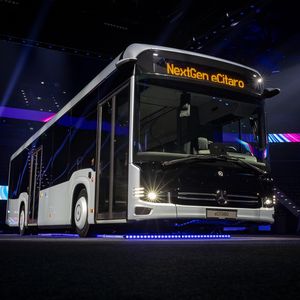
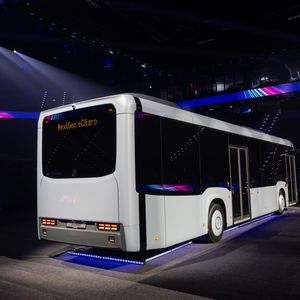
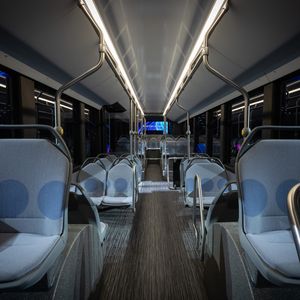
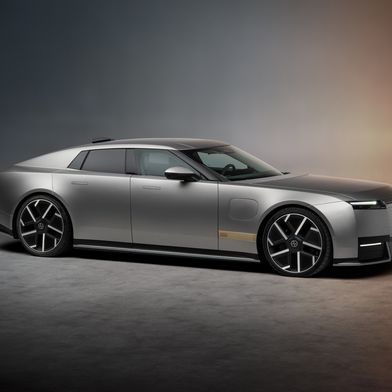
Daimler Buses has unveiled a prototype of the upcoming E-Citaro. The bus is based on a new electric architecture and is scheduled to hit the market in 2028.
Mercedes-Benz has unveiled a prototype of the new E-Citaro.
(Source: Daimler Truck)
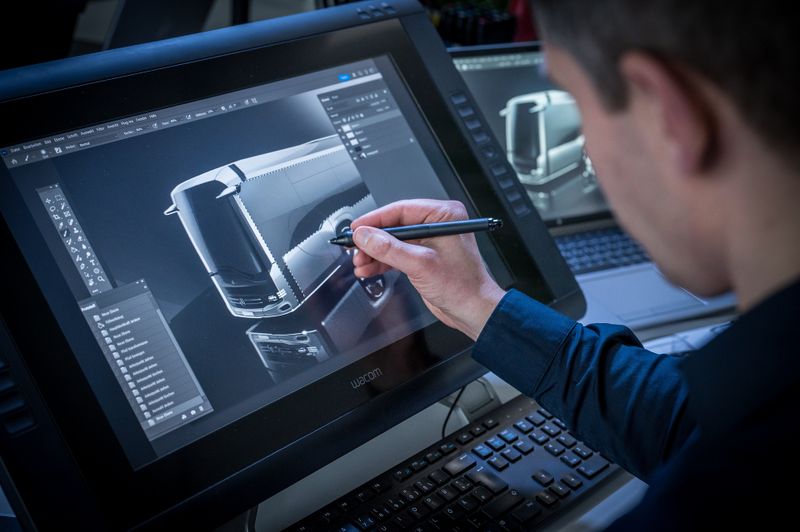
Daimler Buses has unveiled a near-production prototype of the next generation of the E-Citaro city bus. The vehicle, developed from the ground up, is designed for electric propulsion. According to the manufacturer, this architecture reduces the curb weight of the articulated bus by approximately 750 kilograms (about 1,653 pounds). The vehicle platform covers lengths ranging from a 10-meter (32.8-foot) single-section bus to an 18-meter (59.1-foot) articulated bus. A new electronics platform enables over-the-air updates.
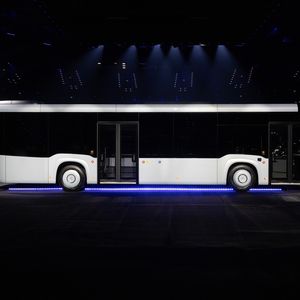
The body-in-white, roof, and underbody have been redesigned. A modular design featuring standardized front and rear modules allows for seven variants: three lengths as low-floor city buses—10.63 (34.9 feet), 12.13 (39.8 feet), and 18.13 meters (59.5 feet), and four lengths in the low-entry version at 10.63 (34.9 feet); 12.34 (40.5 feet); 13.08 (42.9 feet); and 14.68 meters (48.2 feet). The variants cover both city route and intercity buses.
The new, multi-layered sandwich roof is now only 42 millimeters thick (1.65 inches), down from 70 millimeters (2.76 inches). This reduces the overall height and cuts the weight by up to 100 kilograms (220 pounds) for the single-section bus and 150 kilograms (331 pounds) for the articulated bus. With eight compact battery packs, the new generation of city buses weighs around 13,050 kilograms (28,770 pounds). Current E-Citaros, equipped with five NMC battery packs, weigh around 13,800 kilograms (30,424 pounds). A continuously straight sidewall enables a high degree of standardization of the roof and underbody across all vehicle variants.
LFP Cell Chemistry and Modular Battery System
The battery chemistry in the new E-Citaro is new. Instead of nickel-manganese-cobalt cells, Mercedes-Benz will use lithium iron phosphate (LFP) cells in the future. The system is based on a standardized battery pack with a capacity of approximately 50 kilowatt-hours. Depending on the vehicle length and operating profile, solo buses can accommodate six to twelve packs, while articulated buses can accommodate eight to 14 packs—distributed between the underbody and the roof.
This is made possible by the new battery-electric platform concept with combinable charging interfaces. Options include CCS 2, a pantograph, or a charging rail. The charging power is up to 450 kilowatts. There are two drive systems available. In the low-floor version, the “AxTrax 2 LF” electric portal axle from supplier ZF provides propulsion, with wheel-mounted electric motors and up to 360 kilowatts of system power. In today’s buses, the figure is around 280 kilowatts.
The new E-Citaro is equipped with only one drive axle—and is correspondingly lighter. The “Modular Multi Torque Interface” controls the regenerative braking and braking behavior for each wheel individually and in real time—for greater efficiency and driving stability, as well as reduced brake wear. In the low-entry version, a central motor works in combination with the manufacturer’s own “RO 440” rear axle. This allows the bus to reach speeds of up to 100 km/h (62 mph), making it suitable for intercity service.
More Space, Waste Heat Recovery, and a New Cockpit
The elimination of the traditional engine compartment creates space for a passenger compartment with a low floor throughout, all the way to the rear. A fully integrated thermal management system combines heating, ventilation, and air conditioning and utilizes waste heat from the powertrain and auxiliary systems.
The driver's cockpit was designed, in part, based on feedback from drivers. They were able to test control concepts virtually in workshops. Two 12-inch displays consolidate driving data and control functions. Customizable driver and depot profiles, along with an expandable software platform, make it possible to retrofit functions. The instrument panel and steering wheel offer a wide range of adjustability.
A number of driver-assistance systems and a crash-resistant vehicle structure are designed to protect against accidents and their consequences. These systems include an active braking assistant with pedestrian detection, a radar-based turn-assist system, a close-range assist system for starting off, and an assistant that detects signs of fatigue or distraction. For the first time, ESP is available for the articulated bus. The official world premiere of the new E-Citaro is scheduled for October 2027 at Busworld Europe in Brussels. The bus will hit the market in 2028.
Date: 08.12.2025
Naturally, we always handle your personal data responsibly. Any personal data we receive from you is processed in accordance with applicable data protection legislation. For detailed information please see our privacy policy.
Consent to the use of data for promotional purposes
I hereby consent to Vogel Communications Group GmbH & Co. KG, Max-Planck-Str. 7-9, 97082 Würzburg including any affiliated companies according to §§ 15 et seq. AktG (hereafter: Vogel Communications Group) using my e-mail address to send editorial newsletters. A list of all affiliated companies can be found here
Newsletter content may include all products and services of any companies mentioned above, including for example specialist journals and books, events and fairs as well as event-related products and services, print and digital media offers and services such as additional (editorial) newsletters, raffles, lead campaigns, market research both online and offline, specialist webportals and e-learning offers. In case my personal telephone number has also been collected, it may be used for offers of aforementioned products, for services of the companies mentioned above, and market research purposes.
Additionally, my consent also includes the processing of my email address and telephone number for data matching for marketing purposes with select advertising partners such as LinkedIn, Google, and Meta. For this, Vogel Communications Group may transmit said data in hashed form to the advertising partners who then use said data to determine whether I am also a member of the mentioned advertising partner portals. Vogel Communications Group uses this feature for the purposes of re-targeting (up-selling, cross-selling, and customer loyalty), generating so-called look-alike audiences for acquisition of new customers, and as basis for exclusion for on-going advertising campaigns. Further information can be found in section “data matching for marketing purposes”.
In case I access protected data on Internet portals of Vogel Communications Group including any affiliated companies according to §§ 15 et seq. AktG, I need to provide further data in order to register for the access to such content. In return for this free access to editorial content, my data may be used in accordance with this consent for the purposes stated here. This does not apply to data matching for marketing purposes.
Right of revocation
I understand that I can revoke my consent at will. My revocation does not change the lawfulness of data processing that was conducted based on my consent leading up to my revocation. One option to declare my revocation is to use the contact form found at https://contact.vogel.de. In case I no longer wish to receive certain newsletters, I have subscribed to, I can also click on the unsubscribe link included at the end of a newsletter. Further information regarding my right of revocation and the implementation of it as well as the consequences of my revocation can be found in the data protection declaration, section editorial newsletter.
Development and Production in Europe
According to Daimler Buses, the new E-Citaro is being developed primarily in Mannheim. The bus is to be built in Germany, France, and the Czech Republic—just like the current E-Citaro. Starting in 2030, Daimler Buses plans to offer only electric city buses in its new vehicle business in Europe.