With the announcement of a new 2CV, Citroën has electrified more than just 2CV nostalgics. The hype surrounding this electric car with its distinctive shape is enormous. We’ve already taken a detailed look at this modern-day 2CV at the brand’s own design studio in Paris.
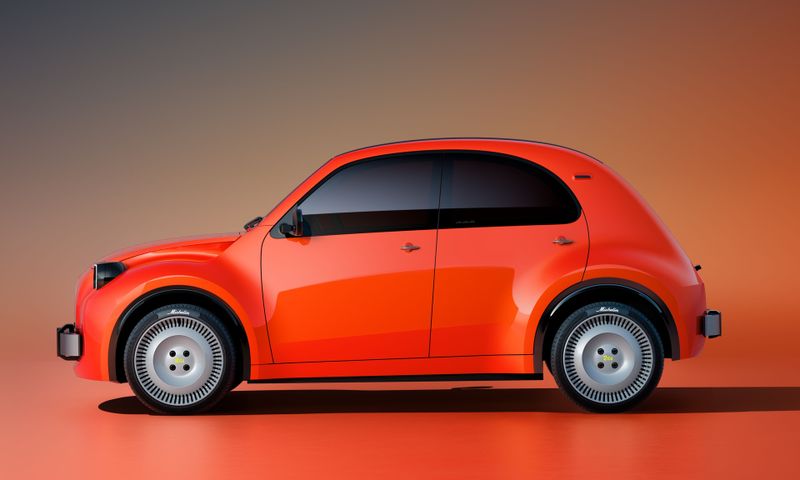
The proportions are just right: However, the new 2CV is seven centimeters shorter than the original 2CV, at 3.76 meters.
(Image: Citroën)
First impressions are often decisive. And with the new 2CV, it’s entirely positive: This is exactly what a 2CV should look like these days—that was the first thought that came to mind when the design team pulled the covers off the bright-yellow show car, which wasn’t yet ready to drive. The characteristic curves, the distinctive features, the many small details reminiscent of its predecessors, which were built until 1990: it all fits.
What immediately stands out: The reborn 2CV is a tad smaller than the original. Instead of the previous 3.83 meters (12 feet 7 inches), the new 2CV is 3.76 meters (12 feet 4 inches) long. The proportions have remained largely the same. And the designers have managed to bring the body in line with current tastes by giving it slightly sleeker lines. The 2CV stays true to itself, but in a contemporary form.
Many Quotes from the Original "Duck"
You don’t have to look far to find nods to the past. The rotating door handles, the trunk handle, and the manually operated convertible top—all of these immediately bring back memories of the original without being overly imitative. The round, freestanding headlights with modern LED internals on the curved fenders, the visibly mounted windshield wipers, and the mechanically hinged vents positioned beneath the steeply raked windshield all fit right into the picture. Or the hood, adapted from the historic “TPV” (“Toute Petite Voiture” or “very small car”) project, with its characteristic ribbing.
But that’s not all when it comes to references and nods to the past: Narrow turn signals are located on the C-pillars, the 19-inch steel wheels pay homage to the historic 2CV just as effectively as the black tailgate—which extends all the way down to the bumper—featuring a large brand logo and three horizontal trim elements. A must-have for the development team was the retractable roof, which, when open, sits like a round rear spoiler above the rear window and transforms the new 2CV—just like its predecessor—into a quasi-convertible.
When it comes to the interior, too, the designers have clearly taken great pleasure in drawing inspiration from the combustion-engine predecessor of the future all-electric 2CV. The moment you step inside, that unmistakable 2CV feeling—one not experienced in many years—comes flooding back. Anyone who climbs onto the 3D-printed front bench seat beneath the rounded door pillar takes a trip back in time—but also lands straight in the future. Specifically, in a very colorful, practical interior with fun little touches. The interior design is kept simple, spatially reduced to the essentials, and thus creates a very airy, spacious feel. Will the front bench seat with its continuous seating surface make it into future series production? That remains to be seen. It’s definitely fun and—when stationary—cozy.
The 2CV Concept features a square, 8-inch touchscreen for infotainment and settings, and there’s still room between the dashboard and the windshield for a mini-display showing a magnified speedometer, charge level and temperature gauges, and a navigation map. In the footwell is a removable storage basket; above it sits the “Radioën,” which can also be removed if needed and is designed to create the right atmosphere with a suitable playlist while driving or spending time outdoors.
The controls are mounted on a cylinder flanged to the steering column; the gear selector lever is reminiscent of the “crutch stick” shifter in the old 2CV. And, of course, the horn isn’t located in the center of the slightly oval steering wheel, but rather in the turn signal lever. Citroën promises that the horn’s sound matches that of the historic model. And so does the artificial sound of the electric drive—we’ll have to wait and see. A little joke in the footwell: The brake pedal is decorated with a turtle on the front. The accelerator pedal features a rabbit. According to the explanation from Paris, this is “a tongue-in-cheek allusion to the freedom to drive slowly or quickly.” Small storage compartments are designed for transporting eggs—a tongue-in-cheek reference to a key requirement in the original 2CV’s specifications.
Its successor will be all-electric—that much is clear. It is set to be one of the first models in the new M1E vehicle class within the next two years. Key requirements: a length of up to 4.20 meters (13 feet 9 inches), and compliance with passenger car safety standards and crash test standards for the M1 class. In return—and as a reward for mandatory production in Europe—there will be no mandatory updates for software and driver-assistance systems for ten years, among other measures, to reduce development costs. The goal: full-featured yet affordable electric cars from EU countries at prices around 15,000 euros (about $16,800).
Date: 08.12.2025
Naturally, we always handle your personal data responsibly. Any personal data we receive from you is processed in accordance with applicable data protection legislation. For detailed information please see our privacy policy.
Consent to the use of data for promotional purposes
I hereby consent to Vogel Communications Group GmbH & Co. KG, Max-Planck-Str. 7-9, 97082 Würzburg including any affiliated companies according to §§ 15 et seq. AktG (hereafter: Vogel Communications Group) using my e-mail address to send editorial newsletters. A list of all affiliated companies can be found here
Newsletter content may include all products and services of any companies mentioned above, including for example specialist journals and books, events and fairs as well as event-related products and services, print and digital media offers and services such as additional (editorial) newsletters, raffles, lead campaigns, market research both online and offline, specialist webportals and e-learning offers. In case my personal telephone number has also been collected, it may be used for offers of aforementioned products, for services of the companies mentioned above, and market research purposes.
Additionally, my consent also includes the processing of my email address and telephone number for data matching for marketing purposes with select advertising partners such as LinkedIn, Google, and Meta. For this, Vogel Communications Group may transmit said data in hashed form to the advertising partners who then use said data to determine whether I am also a member of the mentioned advertising partner portals. Vogel Communications Group uses this feature for the purposes of re-targeting (up-selling, cross-selling, and customer loyalty), generating so-called look-alike audiences for acquisition of new customers, and as basis for exclusion for on-going advertising campaigns. Further information can be found in section “data matching for marketing purposes”.
In case I access protected data on Internet portals of Vogel Communications Group including any affiliated companies according to §§ 15 et seq. AktG, I need to provide further data in order to register for the access to such content. In return for this free access to editorial content, my data may be used in accordance with this consent for the purposes stated here. This does not apply to data matching for marketing purposes.
Right of revocation
I understand that I can revoke my consent at will. My revocation does not change the lawfulness of data processing that was conducted based on my consent leading up to my revocation. One option to declare my revocation is to use the contact form found at https://contact.vogel.de. In case I no longer wish to receive certain newsletters, I have subscribed to, I can also click on the unsubscribe link included at the end of a newsletter. Further information regarding my right of revocation and the implementation of it as well as the consequences of my revocation can be found in the data protection declaration, section editorial newsletter.
Citroën is also aiming for this entry-level price with its retro-chic model. Technical details are practically nonexistent so far. Aside from the overall length and the fact that the “target weight” is supposed to be around one metric ton, nothing else has been revealed. What is clear, however, is that the new 2CV isn’t aiming for top performance in terms of battery, range, and driving dynamics. With this target weight, the 2CV will be roughly on par with the current Dacia Spring. That model is powered by a 60-kW (80-hp) motor and a 27.5-kWh battery and, according to the WLTP standard, has a range of around 250 kilometers (155 miles). One could imagine similar specs for the 2CV 2.0 as well, though—thanks to its lower development costs—it would be priced about 3,000 euros ($3,420) less than the Dacia model, which is offered “under 18,000 euros (about $20,520) ” without subsidies.
After getting our first look at the “Duck” prototypes—Citroën is also bringing back a van called the Fourgonnette—one thing quickly becomes clear: The French have hit the nail on the head with this new little car. It’s the perfect vehicle for these highly complex and complicated times: It’s retro, but not over the top; it’s also fun, clever, practical—and affordable. You don’t have to be a prophet to predict, after its debut at the Paris Auto Show (October 12–18), that it will initially become one of the stars of the 2026 show.



:quality(80)/p7i.vogel.de/wcms/db/23/db2332f08461bb166442018b9644b613/0133890143v1.jpeg "The International Monetary Fund (IMF) has revised some of its earlier forecasts for global economic growth upward. Germany, for example, is expected to grow more strongly in 2026 than previously thought. But the IMF has also taken a look at how things are shaping up in the rest of the world... (Image: AI-generated)")
:quality(80)/p7i.vogel.de/wcms/3b/53/3b53eec6903a838b98425d19f21d25ee/0132416085v1.jpeg "Complex progressive dies serve as the basis for stamped and formed parts—such as the copper outer conductors for sensor elements shown here. They are equipped with bending and embossing dies manufactured on the Kern Micro HD. (Image:Quittenbaum, LLC)")
:quality(80)/p7i.vogel.de/wcms/14/43/1443db59695f7eed2a338d16d03a6257/26-09-30-st-ber-ab-hunger-games-bild-1v1.jpeg "For “The Hunger Games: On Stage,” drive systems lift and move grandstand sections with a dynamic load of up to 26 metric tons—each section can accommodate up to 112 spectators. (Source: Troubadour at the Canary Wharf Theatre)")
:quality(80)/p7i.vogel.de/wcms/5f/96/5f9606264f35f5979529286a887bbccf/0133859498v1.jpeg "Trumpf Expands Its Portfolio for 2D Laser Cutting (Image:TRUMPF GMBH + CO. KG)")
:quality(80)/p7i.vogel.de/wcms/05/bc/05bcc7390d30da9c23a829f7e96247e3/koch-glserdepalettierung-nahrungsmittelv1.jpeg "Opportunities for automation using robots can be found in all areas of manufacturing, such as in the palletizing of products. (Image:Koch Industrial Systems, LLC)")
:quality(80)/p7i.vogel.de/wcms/a8/0d/a80d9eb978dd47dbd8f390181a039bfc/adobestock-2081783940--design-store-stock-adobe-com-ki-generiertv1.jpeg "We’re showcasing five of the latest innovations for virtual commissioning—from AI copilots and smart browser tools to deep PLC integration. (Source: © Design Store – stock.adobe.com_AI-generated)")
:quality(80)/p7i.vogel.de/wcms/87/88/8788e0b7fd98cca21a9c370ed0f0aa18/0133859688v1.jpeg "The software newly developed at Fraunhofer IWU helps employees reliably
identify parts that do not meet quality requirements. (Image:Fraunhofer IWU)")
:quality(80)/p7i.vogel.de/wcms/4b/7c/4b7c11f510878f154012d04c18a7c3cc/0133798118v1.jpeg "RobCo Becomes a Unicorn: The Munich-based robotics company has reached a valuation of more than one billion U.S. dollars and is driving the next generation of autonomous industrial robotics with Alfie. (Image:RobCo)")
:quality(80)/p7i.vogel.de/wcms/8a/c8/8ac8eb7fc2b70f4b72771548e2e2e520/epfl-motor-3v1.jpeg "FiberMotor has a diameter of 1 to 3 mm and consists of two concentric hollow fibers. Each fiber is wrapped in tightly insulated copper wire electrodes that are only slightly thicker than a human hair. (Source: EPFL)")
:quality(80)/p7i.vogel.de/wcms/a7/8a/a78a582a42a96aaaff38bd6b8f97a015/vishal-lal-mit-kernuhrv1.jpeg "It's ticking: Researchers have stabilized the first atomic clock. (Source: PTB)")
:quality(80)/p7i.vogel.de/wcms/36/f9/36f96a206fc408c9a632ce849de1f7fa/newsimage428299v1.jpeg "Polystyrene is used in protective packaging for televisions and electronic devices, in decorative moldings and baseboards for interior home construction, and even in Petri dishes. (Source: Hereon/Marcel Schwickerath)")
:quality(80)/p7i.vogel.de/wcms/90/30/90300137452b00d22f95113eff065ac3/fliehkraftkupplungen-und-bremsen-montage-centrifugal-clutches-and-brakes-assembly-1v1.jpeg "Installation: Centrifugal clutches should always be precisely matched to the machine. (Source: Amsbeck Machine Technology)")
:quality(80)/p7i.vogel.de/wcms/c0/3f/c03f30533805b91651a79fa308960759/0133801213v1.jpeg "The downward spiral in sales that Audi is currently experiencing shows no signs of stopping, as the analysis of the third quarter of 2026 shows ... (Image:Audi)")
:quality(80)/p7i.vogel.de/wcms/59/9c/599cd4bee03f350ca6e514957122878d/3-entev1.jpeg "The proportions are just right: However, the new 2CV is seven centimeters shorter than the original 2CV, at 3.76 meters. (Image:Citroën)")
:quality(80)/p7i.vogel.de/wcms/5d/ee/5dee32902927f6caa3d2f47a48c39860/renault-e-space-conceptv1.jpeg "The “Renault E-Space Concept” offers a glimpse of future models at the Paris Motor Show. (Image:Renault)")
:quality(80)/p7i.vogel.de/wcms/a6/c1/a6c172d92327528ff2036d70ead65036/db2026au00899-largev1.jpeg "The new ID Tiguan will replace the existing ID 4 and ID 5 models. (Image:Volkswagen AG)")
:quality(80)/p7i.vogel.de/wcms/22/18/2218229508f08c6d6ddcb1b49edeafbf/0133889260v1.jpeg "Figure 1: A portable health sensor platform. (Image:ADI)")
:quality(80)/p7i.vogel.de/wcms/47/90/479021ce10c621080b54df868977552f/0133858815v1.jpeg "Power electronics for humanoid robots: GaN transistors are expected to make motor drives in joints such as the shoulders, hips, and knees more compact and efficient. Nexperia is continuing to expand its GaN portfolio for this purpose. (Image:AI-generated)")
:quality(80)/p7i.vogel.de/wcms/02/51/0251848caae753abf68f7813f6fe543f/harting-in-elginv1.jpeg "Harting Americas is headquartered in Elgin, Illinois (photo), and has branches in Mexico, Canada, and Brazil. (Source: Harting)")
:quality(80)/p7i.vogel.de/wcms/b6/6d/b66d11215bcdb8e107ca626e6cfd3643/tungart7-future-9045696-1920x1079v1.jpeg "Transparent and controllable AI architectures can support crisis management by making data sources, reasoning processes and uncertainties visible to human decision-makers. (Source: Tung Lam on Pixabay)")
:fill(fff,0)/p7i.vogel.de/companies/69/88/69882c428938e/tmts2026-ticec-banner-en-2000px.png "tmts2026-ticec-banner-en-2000px (https://www.tmts.tw/en)")
:quality(80)/p7i.vogel.de/wcms/f7/9e/f79eb21ac246cb5ae9f4413400c8f8f7/0129006331v1.jpeg "The range of electric cars has grown significantly compared to 2024. At the same time, prices have dropped sharply. (Image:Hyundai)")
:quality(80)/p7i.vogel.de/wcms/53/7a/537ae93f38ebc50d59f984c5fa4f5253/1-entev1.jpeg "Brand-new, yet quintessentially 2CV: The new 2CV is set to hit the road in two years at the latest.(Source: Citroën)")
:quality(80)/p7i.vogel.de/wcms/25/e6/25e6c6d09bf71e14a8bb9bbec1a3c5d9/2-entev1.jpeg "The front features the heavily arched hood and round headlights familiar from the previous model.(Source: Citroën)")
:quality(80)/p7i.vogel.de/wcms/0b/63/0b6306c8d8aa6e51bf045a2269013a90/4-entev1.jpeg "Retractable roof, black tailgate with a large double-angle design: The new 2CV makes bold use of design references.(Source: Citroën)")
:quality(80)/p7i.vogel.de/wcms/84/17/8417c86223b21b9d22f4a884d367e565/5-entev1.jpeg "The ventilation vents below the windshield can be opened and closed mechanically.(Source: Citroën)")
:quality(80)/p7i.vogel.de/wcms/3c/e1/3ce13cf499573490d536bb5741f6fb7f/1-entev1.jpeg "Brand-new, yet quintessentially 2CV: The new 2CV is set to hit the road in two years at the latest. (Image:Citroën)")
:quality(80)/p7i.vogel.de/wcms/5d/ee/5dee32902927f6caa3d2f47a48c39860/renault-e-space-conceptv1.jpeg "The “Renault E-Space Concept” offers a glimpse of future models at the Paris Motor Show. (Image:Renault)")
:quality(80)/p7i.vogel.de/wcms/2e/58/2e58c664e733dd182666606f850c5da4/0133400664v1.jpeg "The IM6 is sort of the crossover version of the IM5. (Image:MG Motor)")
:quality(80)/p7i.vogel.de/wcms/c2/57/c257d627beec10e94252cde72830adf6/0130472803v1.jpeg "With the Twingo E-Tech, Renault is now launching a purely electrically powered new edition of the Twingo small car (Image:Renault)")