Battery TechnologyCATL: Charge Vans Almost as Fast as Refueling
By
Henrik Bork
Henrik Bork | Translated by AI
5 min Reading Time
CATL has launched a battery that charges light commercial vehicles almost as quickly as a diesel can be refueled. In six minutes and 48 seconds, the new battery reaches 80 percent of its capacity, with a full charge taking eight minutes and 56 seconds, according to the Chinese automotive portal Gasgoo.
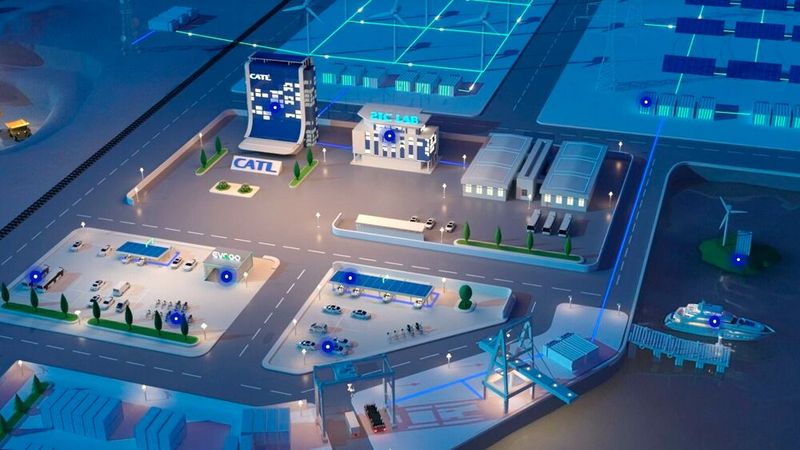
CATL has promised a battery that can charge light commercial vehicles almost as quickly as a diesel can be refueled.
(Image: CATL)
It is the first traction battery for commercial vehicles to enable fast charging in the "8C" category. The C stands for the charging rate. 8C theoretically means that a cell can be fully charged in an eighth of an hour. CATL has introduced the product under its commercial vehicle brand Tianxing, known in English as "Tectrans." The fast-charging version of the "Tianxing II" for light commercial vehicles is being marketed by the battery manufacturer primarily for its high charging rate, according to the automotive portal. CATL itself speaks of a new era of "parity between electric and fuel" in the logistics industry.
Looking at the previous products of the Tianxing or Tectrans brand, the new 8C battery is a logical progression. In July 2024, CATL launched this series with two batteries of the so-called L-series for the logistics market. One of these was capable of 4C fast charging at the time. At the beginning of this year, the second generation was introduced. According to CATL, its cold-weather variant was the first mass-produced sodium-ion battery for light commercial vehicles. At its market launch, it was stated that it retains 90 percent of its capacity even at minus 40 degrees Celsius (-40°F).
Commercial Vehicle Market of Great Interest
With the new battery, CATL signals its strong interest in a market that has only recently begun to gain significant momentum. The market for traction batteries in passenger cars is considered largely mature in China. Growth in new registrations of electric passenger vehicles has slowed. In contrast, electrification in commercial vehicles is just starting to take off and is growing very rapidly.
In 2025, 871,000 electric commercial vehicles were sold in China, a 63.7 percent increase compared to the previous year, as the industry portal Xinnengyuan Shangye Pinglun highlighted. The share of EVs among all newly sold commercial vehicles rose from around 2.7 percent in 2020 to 26.9 percent last year.
This segment is particularly attractive to battery manufacturers because delivery vehicles require more battery capacity. An electric passenger car carries a battery of 40 to 80 kWh, while a heavy electric truck for regional freight transport or mining reaches 400 to 600 kWh, and the industry is already working on packages of 750 kWh and more than 1 MWh. A single heavy electric truck thus generates as much battery demand as ten to fifteen passenger cars.
The share of electric commercial vehicles will exceed the 36 percent threshold in 2026, and sales will amount to more than 1.1 million vehicles, predicts Huang Hongliang, who heads domestic sales for commercial vehicle batteries at EVE Energy.
With an average capacity of 300 kWh per vehicle, this segment alone would result in an annual battery demand of more than 300 GWh. That is more than half of all batteries installed in new electric vehicles in China in 2023.
What the electrification of the commercial vehicle fleet in China means can be observed every morning at sunrise. In every city across the People's Republic, tens of thousands of delivery vans fan out to restock store shelves with new goods. For fleet operators, every minute of downtime equals a loss of income. Long charging breaks for batteries are something no one in this business can afford.
According to CATL, users of electric delivery vehicles have so far been plagued by four issues. The vehicles charge slowly, their batteries age quickly, they lose performance in winter, and charging stations often fail to provide the required power. In addition to charging speed, CATL is promoting the durability of its new battery. It is said to last up to ten years or one million kilometers (approx. 620,000 miles), as long as the vehicle itself. For fleet operators, this reduces amortization costs and increases the resale value of used vehicles.
Date: 08.12.2025
Naturally, we always handle your personal data responsibly. Any personal data we receive from you is processed in accordance with applicable data protection legislation. For detailed information please see our privacy policy.
Consent to the use of data for promotional purposes
I hereby consent to Vogel Communications Group GmbH & Co. KG, Max-Planck-Str. 7-9, 97082 Würzburg including any affiliated companies according to §§ 15 et seq. AktG (hereafter: Vogel Communications Group) using my e-mail address to send editorial newsletters. A list of all affiliated companies can be found here
Newsletter content may include all products and services of any companies mentioned above, including for example specialist journals and books, events and fairs as well as event-related products and services, print and digital media offers and services such as additional (editorial) newsletters, raffles, lead campaigns, market research both online and offline, specialist webportals and e-learning offers. In case my personal telephone number has also been collected, it may be used for offers of aforementioned products, for services of the companies mentioned above, and market research purposes.
Additionally, my consent also includes the processing of my email address and telephone number for data matching for marketing purposes with select advertising partners such as LinkedIn, Google, and Meta. For this, Vogel Communications Group may transmit said data in hashed form to the advertising partners who then use said data to determine whether I am also a member of the mentioned advertising partner portals. Vogel Communications Group uses this feature for the purposes of re-targeting (up-selling, cross-selling, and customer loyalty), generating so-called look-alike audiences for acquisition of new customers, and as basis for exclusion for on-going advertising campaigns. Further information can be found in section “data matching for marketing purposes”.
In case I access protected data on Internet portals of Vogel Communications Group including any affiliated companies according to §§ 15 et seq. AktG, I need to provide further data in order to register for the access to such content. In return for this free access to editorial content, my data may be used in accordance with this consent for the purposes stated here. This does not apply to data matching for marketing purposes.
Right of revocation
I understand that I can revoke my consent at will. My revocation does not change the lawfulness of data processing that was conducted based on my consent leading up to my revocation. One option to declare my revocation is to use the contact form found at https://contact.vogel.de. In case I no longer wish to receive certain newsletters, I have subscribed to, I can also click on the unsubscribe link included at the end of a newsletter. Further information regarding my right of revocation and the implementation of it as well as the consequences of my revocation can be found in the data protection declaration, section editorial newsletter.
This is technically possible because the internal resistance of the cell is only half as high as the industry average, which reduces battery heating during fast charging. Additionally, the company has reshaped the interface of graphite particles at the atomic level to slow the loss of active lithium and reduce aging, as reported by Chinese specialized publications.
The third selling point pertains to the cold. At a cell temperature of –20°C (-4°F), the battery only takes about two and a half minutes longer to charge than under normal conditions, according to CATL. In northern China, where severe frost is common, slow charging in winter has been one of the biggest hurdles for switching to electric drive so far.
Strong Competition in the Commercial Vehicle Battery Market
BYD and EVE Energy are also making strong moves into the commercial vehicle battery market. The competition among battery manufacturers is noticeably shifting from the passenger car to the commercial vehicle segment. EVE Energy, one of the largest battery manufacturers in the country by supply volume, introduced its "AI battery" in May. As the first mass-produced cell, it features a highly precise miniature pressure sensor that detects pressure changes and fine electrochemical processes inside the battery.
Together with an AI chip on board and a cloud-based platform, this is intended to create a "360-degree condition network" that not only monitors the battery but also the ambient temperature, altitude, the road ahead, and map data. Here, too, the goal is clearly to position e-mobility as a realistic alternative for fleet operators.
Focus on Cost-Effectiveness
Subsidies from the government are no longer the decisive factor. This phase is over in China. Whether a fleet operator switches to electric drive increasingly depends on the cost-effectiveness of the vehicles, referred to in the industry as "operating economics."
Faster charging, longer durability, and reliable performance in the cold are not technical gimmicks. They improve the calculations a logistics entrepreneur makes before replacing a diesel vehicle with an electric one.
To ensure the new battery reaches as many users as possible, CATL has also introduced a combined charging and swapping station called Choco, which serves both cars and commercial vehicles. Its cables are specifically tailored to the connectors of vans and light trucks so that drivers don't have to maneuver after parking.
The company plans to set up 4,000 such stations in about 190 Chinese cities this year. Whether the charging times in harsh fleet operations will actually match the laboratory values claimed by the manufacturer remains to be seen. What is certain, however, is the current focus of the strategies of major battery companies. Electric commercial vehicles promise the fastest growth in a battery market that has significantly cooled following a phase of ultra-rapid expansion in passenger cars.



:quality(80)/p7i.vogel.de/wcms/eb/2b/eb2bd1b8487afe577b37363cd02f16ff/0113143253v1.jpeg "In our China Market Insider, we regularly provide you with relevant information straight from China. (Image:© Eisenhans - stock.adobe.com)")
:quality(80)/p7i.vogel.de/wcms/d1/ef/d1ef6b6f7d4543f7999980bacccaf22b/0133499261v1.jpeg "As the growing imbalance in trade relations with China continues to widen, the EU Chamber of Commerce foresees a day when trade with China will have to be seriously reevaluated ... (Image: AI-generated)")
:quality(80)/p7i.vogel.de/wcms/fe/1f/fe1fa5ee713f94deaba963dc24c3abc5/0133299273v1.jpeg "The Flexistar enables highly flexible production of laser-welded tubes thanks to its tool-free clamping system. (Image:Because Technology, LLC)")
:quality(80)/p7i.vogel.de/wcms/1b/5a/1b5ac72f83db4dbee3ff91e51bc398f4/0133496095v1.jpeg "BASF announces that it will take the next step toward producing the polyurethane precursor MDI in India ... (Image:BASF)")
:quality(80)/p7i.vogel.de/wcms/60/ef/60ef4f07e4829b2c2929befc0f353c58/0133511729v1.jpeg "Humanoid robots can match human performance in certain tasks. (Image:Gemini / AI-generated)")
:quality(80)/p7i.vogel.de/wcms/2e/99/2e99726b522e4b35b690e25eb6a42643/0133463991v1.jpeg "Robotics: In AMR applications, connection technology must reliably transmit power, signals, and data despite vibration and shock loads—in very confined spaces and in a way that allows for regular maintenance. (Image:Hyperever)")
:quality(80)/p7i.vogel.de/wcms/d0/18/d01801e3d5dbd7bc9d0b4f60408b630c/0133468429v1.jpeg "Quality requirements for film packaging are on the rise. At the same time, many companies are turning to recyclable film materials, which, however, have their own challenges. Fraunhofer researchers have therefore developed a fast system that detects problems in real time. (Image:Fraunhofer IKTS)")
:quality(80)/p7i.vogel.de/wcms/b1/06/b106cf44923ce39565c3264982fd20eb/0133414574v1.jpeg "Robots Build Robots: At the new Ubtech factory, automated systems even handle parts of the material supply and logistics for the production of humanoid robots. (Image:Ubtech)")
:quality(80)/p7i.vogel.de/wcms/c0/52/c052f405eb55fc3d08c4837e77206fc0/adobestock-2021845957--aucartstudio-stock-adobe-com-ki-generiertv1.jpeg "An innovation from China to combat extreme summer heat: A novel coating lowers temperatures. (Source: © AucArtStudio – stock.adobe.com_AI-generated)")
:quality(80)/p7i.vogel.de/wcms/66/a7/66a7b78159caeacce57136529688799f/0133503398v1.jpeg "Sunlight Makes Stone! These stone blocks weren't made the traditional way. Instead, they were additively manufactured from sand using a laser. In the future, however, the laser is set to be replaced by concentrated sunlight—if the startup Addisol is successful... (Image:Addisol / F. Fiedler)")
:quality(80)/p7i.vogel.de/wcms/72/b9/72b995c2c8d812c5e2115cbef31e035a/0133462727v1.jpeg "Eggl manufactures center hoods that are precisely tailored to each cooking island—whether standard size or custom shape. They are made entirely of stainless steel and are individually customized in terms of size and filter arrangement. (Image:SPI)")
:quality(80)/p7i.vogel.de/wcms/13/5d/135dfae6229ceaf5c55467a43e8f7257/adobestock-1879961393--ardi-stock-adobe-com-ki-generiertv1.jpeg "Annoying chatterboxes or awkward silences in response to questions—a moderator should specifically prepare for difficult situations in order to navigate them effectively. (Image:ardi - stock.adobe.com_AI-generated)")
:quality(80)/p7i.vogel.de/wcms/aa/a2/aaa2c6dd2daa24b485cddbf9297590c0/0133467318v1.jpeg "Battery Monitoring: Battery monitoring using electrochemical impedance spectroscopy offers several advantages. (Image:TI)")
:quality(80)/p7i.vogel.de/wcms/39/b2/39b21bf03be1683831862239a369987c/0133469638v1.jpeg "Data from autonomous vehicles and robots operating autonomously is in high demand, and Ruqi wants to capitalize on this. (Image:Ruqi Mobility)")
:quality(80)/p7i.vogel.de/wcms/8a/bb/8abbb6217220595edc1549ac9b84f307/0133429906v1.jpeg "The IAA in Hanover showcased the ambitions of Chinese commercial vehicle manufacturers in Europe. (Image:Wehner - VCG)")
:quality(80)/p7i.vogel.de/wcms/0c/53/0c5313ef91c14b6df0d0996efc33c8ad/jpg03568-bearbeitetv1.jpeg "The category winners of the 2027 German Car of the Year award. (Source: GCOTY)")
:quality(80)/p7i.vogel.de/wcms/48/15/4815da27c45973ca629a99b375ac3aef/0133509585v1.jpeg "Ventuno Q RoadTest: Designed to help the Element14 community gain practical insights from real-world tests using the Ventuno Q. (Image:Farnell/Element14)")
:quality(80)/p7i.vogel.de/wcms/17/2b/172bd132f9febdfcbcedba292ad0504d/aufmacherv1.jpeg "Micro-Epsilon offers a wide range of IO-Link-compatible sensors. (Source: Micro-Epsilon Messtechnik GmbH & Co. KG)")
:quality(80)/p7i.vogel.de/wcms/ca/b4/cab46fd26d19d6a2febca032048200b6/0133471827v1.jpeg "Photonics SDK for C and Python: Computational operations are now abstracted as standard mathematical functions. (Image:Q.ANT)")
:quality(80)/p7i.vogel.de/wcms/92/b2/92b2ed5299cde450c0764f4f64468395/0133505895v1.jpeg "The \"Iris 100\" test system for high-precision volume production of microLEDs uses a spectrometer and a high-resolution camera. (Image:Teradyne)")
:quality(80)/p7i.vogel.de/wcms/08/41/08411f15eb953e1f9f734d792e99f3e9/0131722999v1.jpeg "Is the lithium-air battery the next \"big\" thing? CATL, at least, is investing in its research efforts in this regard. (Image: freely licensed on Pixabay)")
:quality(80)/p7i.vogel.de/wcms/ac/4a/ac4ac41833e4d72d7e5fe55b12291134/0131065166v1.jpeg "Robin Zeng, Chairman and CEO of CATL, is driving forward the development of modern battery technologies. (Image:CATL)")
:quality(80)/p7i.vogel.de/wcms/3d/6f/3d6f237bda1ed959f4926789b8dcac11/0132622329v1.jpeg "The battery manufacturer CATL has announced a cell that can charge so quickly that the driver can remain standing next to the van after plugging in the cable. (Image:Volkswagen Commercial Vehicles)")
:quality(80)/p7i.vogel.de/wcms/b6/bb/b6bbb8b6cfc885e28518d42d31efaaa4/org-blobs-user-response-file-output-e3944719-21bc-489b-908d-2e20572fbcf0-file-1782765707127-jpgv1.jpeg "In China, several companies are working on sodium-ion batteries for heavy trucks. (Image: )")